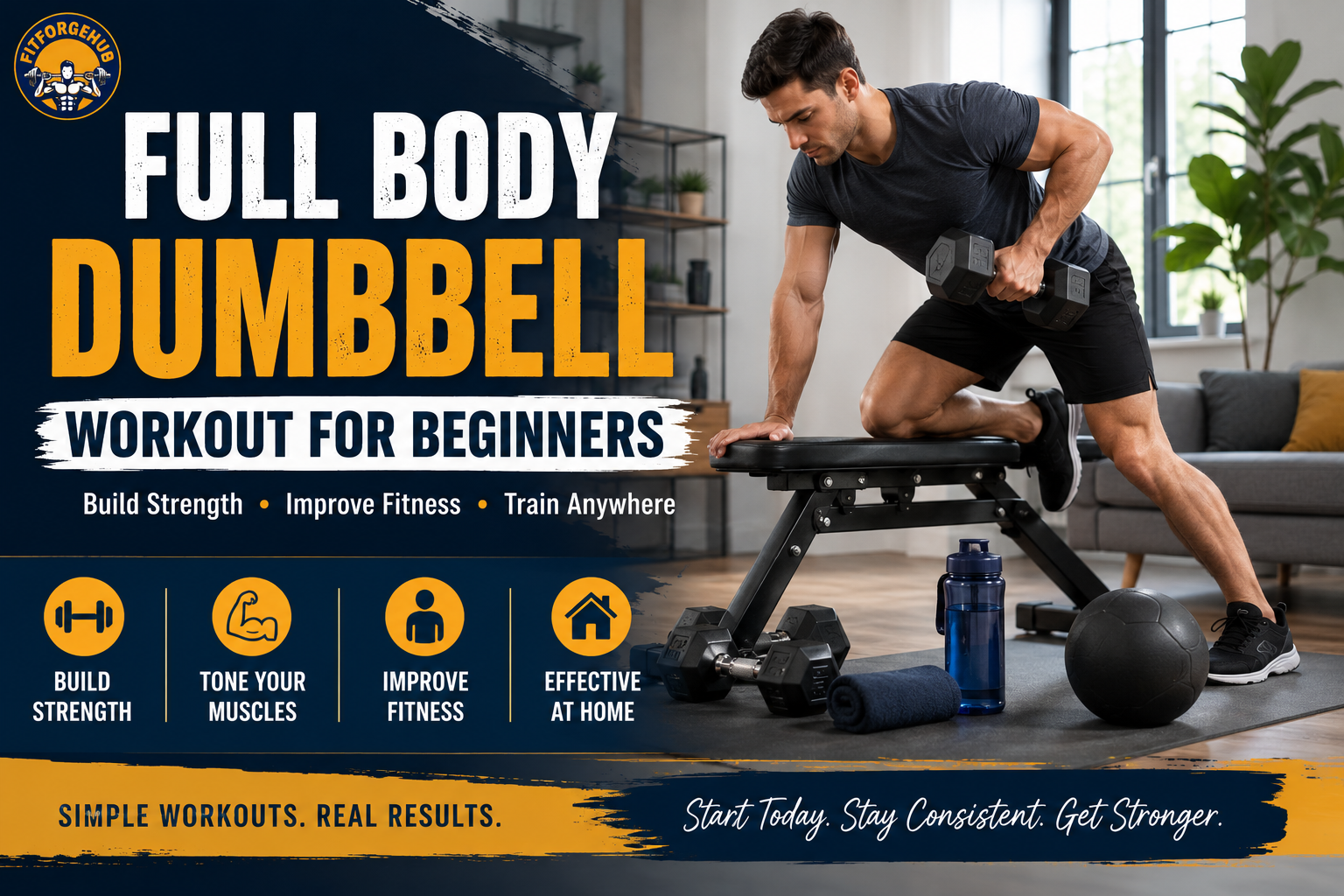
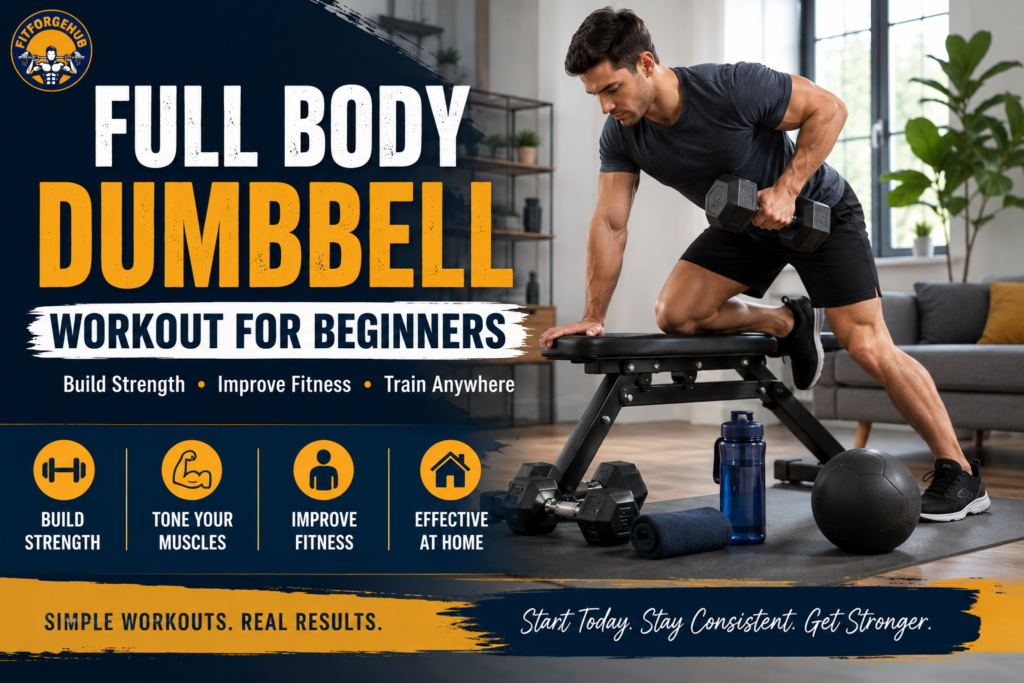
A full body dumbbell workout for beginners is a simple and effective way to build strength, improve fitness, and train your major muscle groups at home. Dumbbells are versatile, easy to use, and can make home workouts more challenging as you become stronger.
You don’t need a large home gym or complicated training program to get started. With a pair of dumbbells and a little space, beginners can perform exercises for the legs, chest, back, shoulders, arms, and core.
If you’re completely new to exercising at home, start with our How to Start Working Out at Home for Beginners guide to build a strong foundation.
In this guide, you’ll find a complete beginner-friendly dumbbell workout, including exercises, sets, reps, rest periods, warm-up tips, progression strategies, common mistakes, and a simple weekly schedule.
Table of Contents
- What Is a Full Body Dumbbell Workout?
- Can Beginners Do Full Body Dumbbell Workouts?
- What Equipment Do You Need?
- How Often Should Beginners Do Dumbbell Workouts?
- Beginner Full Body Dumbbell Workout
- 1. Dumbbell Goblet Squat
- 2. Dumbbell Romanian Deadlift
- 3. Dumbbell Floor Press
- 4. One-Arm Dumbbell Row
- 5. Dumbbell Shoulder Press
- 6. Dumbbell Reverse Lunge
- 7. Dumbbell Biceps Curl
- 8. Dumbbell Overhead Triceps Extension
- 9. Dumbbell Calf Raise
- 10. Dumbbell Suitcase Hold
- How to Warm Up Before a Dumbbell Workout
- How to Choose the Right Dumbbell Weight
- How to Progress With Dumbbells
- Beginner Weekly Dumbbell Workout Schedule
- Common Dumbbell Workout Mistakes
- Tips for Better Results
- Frequently Asked Questions
- Final Thoughts
- About the Author
What Is a Full Body Dumbbell Workout?
A full body dumbbell workout is a training session that uses dumbbells to exercise multiple major muscle groups during the same workout.
Instead of training only your chest or arms, a full body routine can include movements for:
- Legs
- Glutes
- Chest
- Back
- Shoulders
- Biceps
- Triceps
- Core
This type of workout can be especially convenient for beginners because you can train your entire body without spending several days focusing on individual muscle groups.
Can Beginners Do Full Body Dumbbell Workouts?
Yes. Dumbbells can be an excellent starting point for resistance training because the weight can be adjusted to match your current ability.
Beginners should prioritize:
- Learning proper exercise technique
- Starting with manageable weights
- Performing controlled repetitions
- Getting adequate rest
- Gradually increasing the challenge
You don’t need to lift heavy weights immediately. The goal is to build a foundation and become stronger over time.
Beginners who want a structured routine can also follow our 3-Day Workout Plan for Beginners at Home.
What Equipment Do You Need?
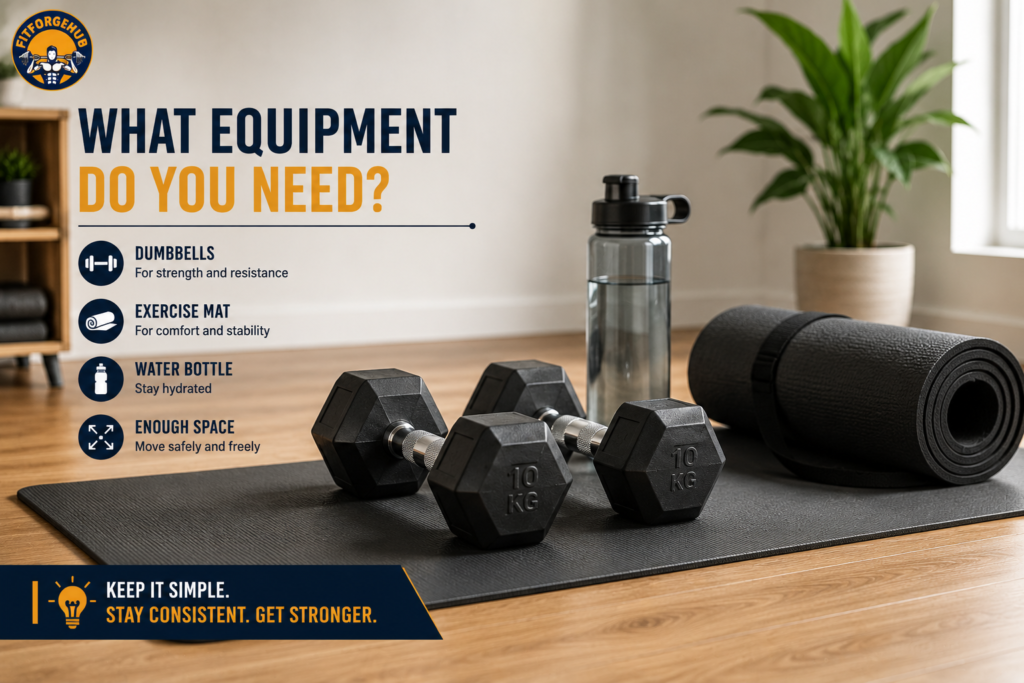
The basic equipment for this workout is simple.
Essential Equipment
- A pair of dumbbells
- Exercise mat
- Water bottle
- Enough open space to move safely
Optional Equipment
- Adjustable dumbbells
- Workout bench
- Resistance bands
- Stable support for certain exercises
Adjustable dumbbells can be useful if you want to increase resistance gradually without buying multiple pairs of weights.
Beginner Full Body Dumbbell Workout
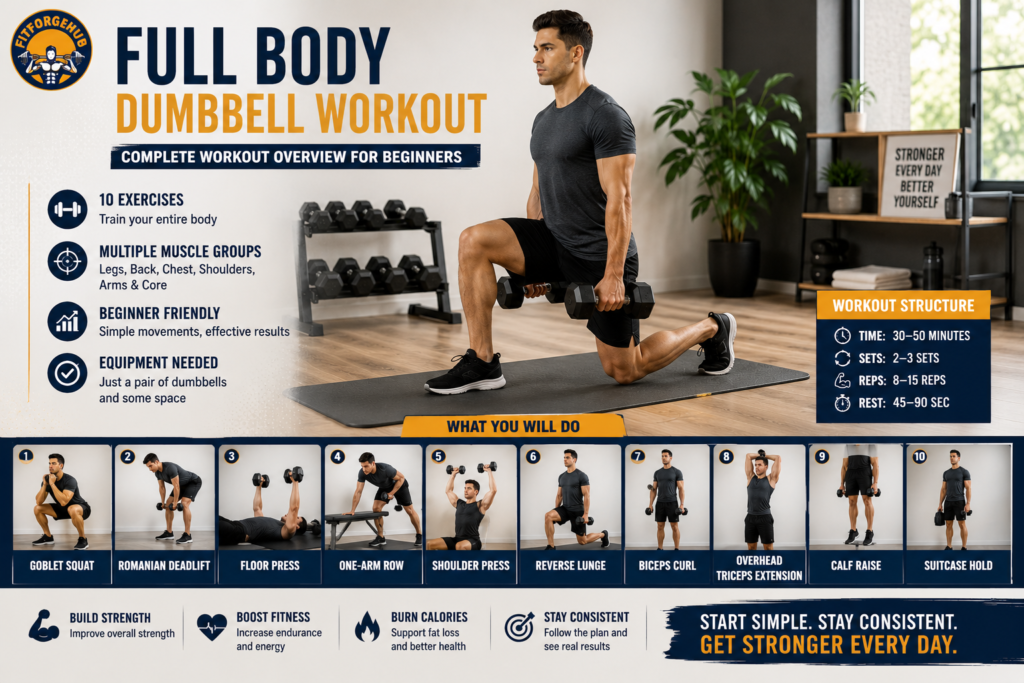
Here is a simple full body dumbbell routine designed for beginners.
| Exercise | Sets | Reps | Rest |
| Dumbbell Goblet Squat | 3 | 8–12 | 60–90 sec |
| Dumbbell Romanian Deadlift | 3 | 8–12 | 60–90 sec |
| Dumbbell Floor Press | 3 | 8–12 | 60–90 sec |
| One-Arm Dumbbell Row | 3 | 8–12/side | 60–90 sec |
| Dumbbell Shoulder Press | 2 | 8–12 | 60–90 sec |
| Dumbbell Reverse Lunge | 2 | 8–10/leg | 60–90 sec |
| Dumbbell Biceps Curl | 2 | 10–15 | 60 sec |
| Dumbbell Overhead Triceps Extension | 2 | 10–15 | 60 sec |
| Dumbbell Calf Raise | 2 | 12–20 | 45–60 sec |
| Dumbbell Suitcase Hold | 2 | 20–40 sec/side | 45–60 sec |
If you’re completely new to resistance training, start with fewer sets and focus on learning the movements correctly.
1. Dumbbell Goblet Squat
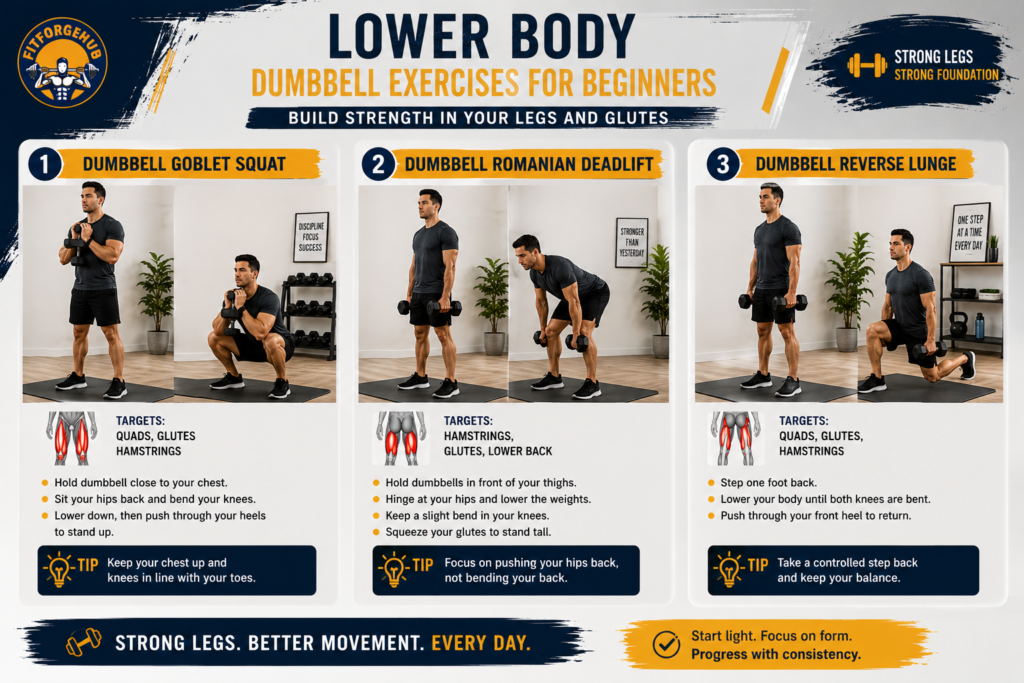
The dumbbell goblet squat is a beginner-friendly lower-body exercise that trains the quadriceps, glutes, and other muscles involved in the squat movement.
How to Perform a Dumbbell Goblet Squat
- Hold one dumbbell vertically close to your chest.
- Stand with your feet around shoulder-width apart.
- Brace your core.
- Push your hips back and bend your knees.
- Lower your body under control.
- Keep the dumbbell close to your chest.
- Push through your feet to return to standing.
Beginner target: 3 sets of 8–12 repetitions.
Form Tip
Keep the movement controlled and use a range of motion that allows you to maintain good technique.
2. Dumbbell Romanian Deadlift
The dumbbell Romanian deadlift focuses on the muscles at the back of your body, including the hamstrings and glutes.
How to Perform a Dumbbell Romanian Deadlift
- Stand with a dumbbell in each hand.
- Keep your feet approximately hip-width apart.
- Keep your chest comfortable and your core engaged.
- Push your hips backward.
- Lower the dumbbells along the front of your legs.
- Stop when you feel a controlled stretch in your hamstrings.
- Drive your hips forward to return to standing.
Beginner target: 3 sets of 8–12 repetitions.
Form Tip
Think about moving your hips backward rather than simply bending forward at your waist.
3. Dumbbell Floor Press
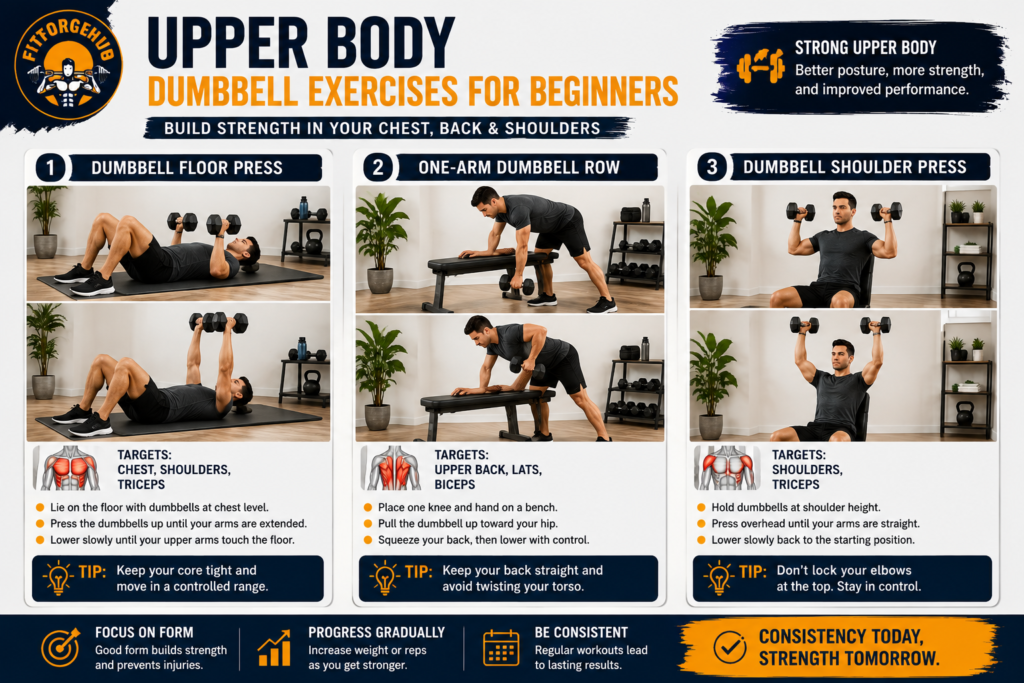
The dumbbell floor press trains the chest, shoulders, and triceps while requiring only a small amount of space.
How to Perform a Dumbbell Floor Press
- Sit on the floor with a dumbbell in each hand.
- Carefully lie back.
- Position the dumbbells around chest level.
- Keep your feet planted.
- Press the dumbbells upward.
- Lower them slowly until your upper arms gently contact the floor.
- Press them back up.
Beginner target: 3 sets of 8–12 repetitions.
Why Use the Floor?
The floor provides a stable surface and limits the range of motion compared with some bench press variations, which can make this movement practical for a home workout.
4. One-Arm Dumbbell Row
The one-arm dumbbell row is an effective exercise for training the upper back and also involves the biceps.
How to Perform a One-Arm Dumbbell Row
- Hold a dumbbell in one hand.
- Support yourself with your other hand on a stable surface.
- Position your torso comfortably.
- Pull the dumbbell toward your hip.
- Pause briefly.
- Lower the dumbbell under control.
- Complete your repetitions and switch sides.
Beginner target: 3 sets of 8–12 repetitions per side.
Form Tip
Avoid twisting your torso or using momentum to move the dumbbell.
5. Dumbbell Shoulder Press
The dumbbell shoulder press primarily trains the shoulders while also involving the triceps.
How to Perform a Dumbbell Shoulder Press
- Hold a dumbbell in each hand.
- Bring the dumbbells to approximately shoulder height.
- Brace your core.
- Press the dumbbells upward.
- Lower them slowly to the starting position.
Beginner target: 2 sets of 8–12 repetitions.
Use a weight that allows you to control both the upward and downward portions of the movement.
6. Dumbbell Reverse Lunge
The dumbbell reverse lunge adds resistance to a single-leg movement and trains the lower body.
How to Perform a Dumbbell Reverse Lunge
- Stand upright while holding dumbbells at your sides.
- Step one foot backward.
- Lower your body under control.
- Push through your front foot.
- Return to the starting position.
- Repeat on the other side.
Beginner target: 2 sets of 8–10 repetitions per leg.
If balance is difficult, start without weights until you become comfortable with the movement.
7. Dumbbell Biceps Curl
Dumbbell curls are a simple isolation exercise for the biceps.
How to Perform Dumbbell Curls
- Stand upright with a dumbbell in each hand.
- Keep your elbows close to your body.
- Curl the dumbbells upward.
- Pause briefly.
- Lower the weights slowly.
Beginner target: 2 sets of 10–15 repetitions.
Common Mistake
Avoid swinging your upper body to move the weights. Use a weight that you can control.
8. Dumbbell Overhead Triceps Extension
This exercise targets the triceps at the back of the upper arm.
How to Perform the Exercise
- Hold one dumbbell with both hands.
- Raise it above your head.
- Keep your elbows pointing generally forward.
- Lower the dumbbell behind your head in a controlled manner.
- Extend your arms to return to the starting position.
Beginner target: 2 sets of 10–15 repetitions.
Use a light weight initially so you can learn the movement comfortably.
9. Dumbbell Calf Raise
Dumbbell calf raises are an easy way to add resistance to your calf training.
How to Perform Dumbbell Calf Raises
- Stand upright while holding dumbbells.
- Keep your feet stable.
- Raise your heels from the floor.
- Pause briefly at the top.
- Lower your heels slowly.
Beginner target: 2 sets of 12–20 repetitions.
Hold onto a stable surface if you need additional balance.
10. Dumbbell Suitcase Hold
The suitcase hold is a simple loaded carry variation that challenges your grip and core stability.
How to Perform a Dumbbell Suitcase Hold
- Stand upright with a dumbbell in one hand.
- Keep your shoulders level.
- Brace your core.
- Stand tall without leaning toward the weight.
- Hold for the desired time.
- Switch sides.
Beginner target: 2 sets of 20–40 seconds per side.
Start with a manageable weight and focus on maintaining an upright position.
How to Warm Up Before a Dumbbell Workout
A short warm-up can help you prepare for your workout.
Spend approximately 5–10 minutes performing easy movements such as:
- Walking in place
- Arm circles
- Hip rotations
- Bodyweight squats
- Light lunges
- Shoulder movements
The warm-up should prepare you for exercise without making you tired before the main workout.
How to Choose the Right Dumbbell Weight
Choosing the correct dumbbell weight is more important than simply choosing the heaviest weight you can lift.
A suitable beginner weight should allow you to:
- Maintain good form
- Perform the planned repetitions
- Control the weight during both directions of the movement
- Finish the set without excessive swinging or momentum
If you cannot perform the exercise with controlled technique, the weight may be too heavy.
If you can easily perform many more repetitions than planned while maintaining excellent form, the weight may eventually need to be increased.
The appropriate weight will also differ between exercises. You may be able to use heavier dumbbells for squats than for shoulder exercises.
How to Progress With Dumbbells
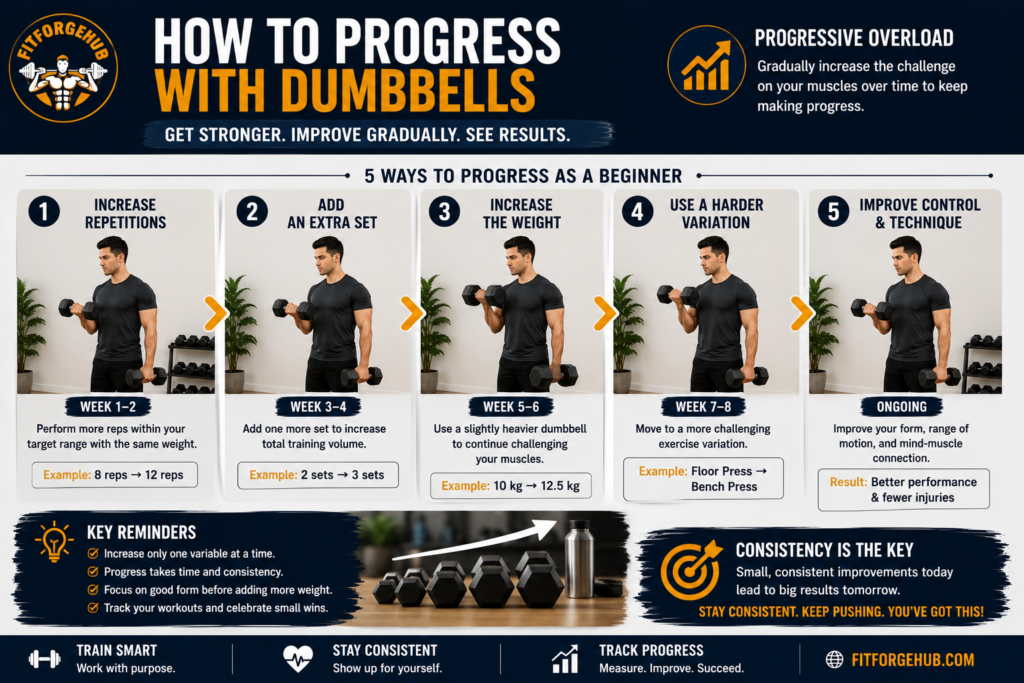
Progressive overload is an important principle for getting stronger.
You can make your workouts gradually more challenging by:
- Increasing repetitions
- Adding a set
- Increasing dumbbell weight
- Using a more challenging exercise variation
- Improving control and technique
- Increasing your training consistency
For example, if your program calls for 8–12 repetitions and you can comfortably perform 12 controlled repetitions for every set, you may be ready to increase the resistance slightly.
Don’t increase the weight if doing so causes your technique to break down.
Resistance Training Recommendations
American College of Sports Medicine
Beginner Weekly Dumbbell Workout Schedule
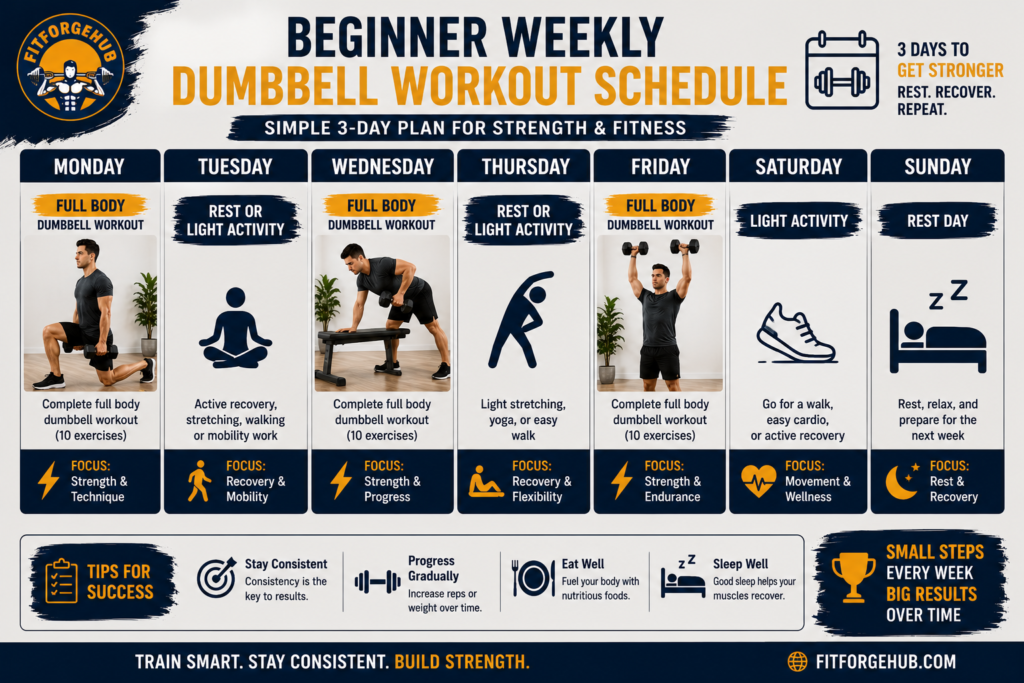
Beginners don’t necessarily need to perform this workout every day.
A simple three-day schedule can look like this:
| Day | Training |
| Monday | Full Body Dumbbell Workout |
| Tuesday | Rest or Light Activity |
| Wednesday | Full Body Dumbbell Workout |
| Thursday | Rest |
| Friday | Full Body Dumbbell Workout |
| Saturday | Walking or Optional Light Activity |
| Sunday | Rest |
This schedule provides recovery days between strength sessions.
If you’re new to exercise, you can begin with two sessions per week and gradually work toward three if that fits your schedule and recovery.
Common Dumbbell Workout Mistakes
1. Using Too Much Weight
Lifting heavier weights isn’t automatically better.
If the weight causes you to swing, rush repetitions, or lose control, reduce the resistance.
2. Ignoring Technique
Learn the movement first. Increase resistance only when you can perform the exercise with appropriate control.
3. Skipping Warm-Up
Going directly from sitting to heavy exercise isn’t ideal. Spend a few minutes preparing your body for the workout.
4. Training Hard Every Day
More training isn’t always better. Recovery is an important part of a sustainable strength program.
5. Never Tracking Progress
Write down your exercises, weights, repetitions, and sets.
Tracking your workouts makes it easier to see whether you’re improving.
6. Comparing Yourself to Advanced Lifters
Beginners should focus on their own progress.
Your first goal should be to develop good movement patterns and consistency.
Tips for Better Results
Focus on Consistency
A moderate workout performed consistently is generally more useful than an extremely difficult workout that you only perform occasionally.
Prioritize Good Form
Don’t sacrifice technique just to lift heavier weights.
Get Enough Recovery
Allow your body adequate time to recover between challenging workouts.
Eat a Balanced Diet
Include adequate protein, carbohydrates, healthy fats, fruits, vegetables, and fluids according to your individual needs.
Sleep Well
Quality sleep supports recovery and overall health.
Adding mobility work to your routine may also help improve movement quality. Read our Beginner’s Guide to Better Flexibility and Mobility for simple exercises.
Track Your Workouts
Keep a simple record of:
- Exercise
- Weight
- Sets
- Repetitions
- Workout date
Over time, you’ll be able to see your progress more clearly.
Frequently Asked Questions
Is a full body dumbbell workout good for beginners?
Yes. A full body dumbbell workout can be a practical way for beginners to train multiple major muscle groups in one session while keeping the program relatively simple.
How many days a week should beginners do dumbbell workouts?
Three full-body strength workouts per week can be a practical starting point for many beginners. Some people may prefer two sessions initially and gradually increase training frequency.
Can I build muscle with dumbbells at home?
Yes. Dumbbells can provide progressive resistance that can support strength and muscle development when combined with appropriate training, nutrition, and recovery.
How heavy should dumbbells be for beginners?
There is no single weight that is appropriate for every beginner. Choose a weight that allows you to perform the planned repetitions with good technique and control.
Can I do a full body dumbbell workout every day?
You don’t need to perform a challenging full-body strength workout every day. Rest and recovery days can help you maintain a sustainable training routine.
How long should a full body dumbbell workout take?
A beginner session may take approximately 30–50 minutes depending on the number of exercises, sets, repetitions, and rest periods.
Are adjustable dumbbells worth it for home workouts?
Adjustable dumbbells can be convenient because they allow you to change resistance without purchasing many separate pairs. Whether they’re worth it depends on your budget, available space, and training goals.
What should I do if I feel pain during an exercise?
Stop the exercise if you experience significant or unusual pain. Don’t attempt to push through concerning symptoms. If you’re unsure about an injury or whether a particular exercise is appropriate for you, consult a qualified healthcare professional.
Final Thoughts
A full body dumbbell workout for beginners can be an effective and convenient way to start strength training at home.
You don’t need a complicated program or a large collection of equipment. Start with manageable dumbbell weights, learn the basic movements, and focus on performing each repetition with control.
The workout in this guide trains the major muscle groups through exercises such as goblet squats, Romanian deadlifts, floor presses, rows, shoulder presses, lunges, curls, triceps extensions, calf raises, and suitcase holds.
Start with a manageable schedule, track your progress, and gradually increase the challenge as your fitness improves.
If you’re new to home fitness, you can also read our [How to Start Working Out at Home for Beginners] and [3-Day Workout Plan for Beginners at Home] guides for additional beginner-friendly routines.
Important: If you have an injury, medical condition, or concerns about starting a new exercise program, consult a qualified healthcare professional before exercising. Stop exercising if you experience significant pain, dizziness, chest pain, or other concerning symptoms.
About the Author
FitForgeHub Fitness Team
The FitForgeHub Fitness Team creates practical, beginner-friendly fitness content covering home workouts, strength training, muscle building, workout plans, and healthy lifestyle habits.
Our goal is to make fitness easier to understand by providing simple exercise guides, training tips, and practical information that beginners can use to develop consistent fitness habits.
FitForgeHub focuses on helpful, easy-to-follow content designed to help readers make informed decisions about their fitness routines.
Website: FitForgeHub.com
Disclaimer: The information published on FitForgeHub is intended for general educational purposes and is not medical advice. Fitness needs and exercise requirements vary between individuals. If you have a medical condition, injury, or concerns about exercise, consult a qualified healthcare professional before starting a new workout program.
4 thoughts on “Full Body Dumbbell Workout for Beginners: Complete Home Guide”