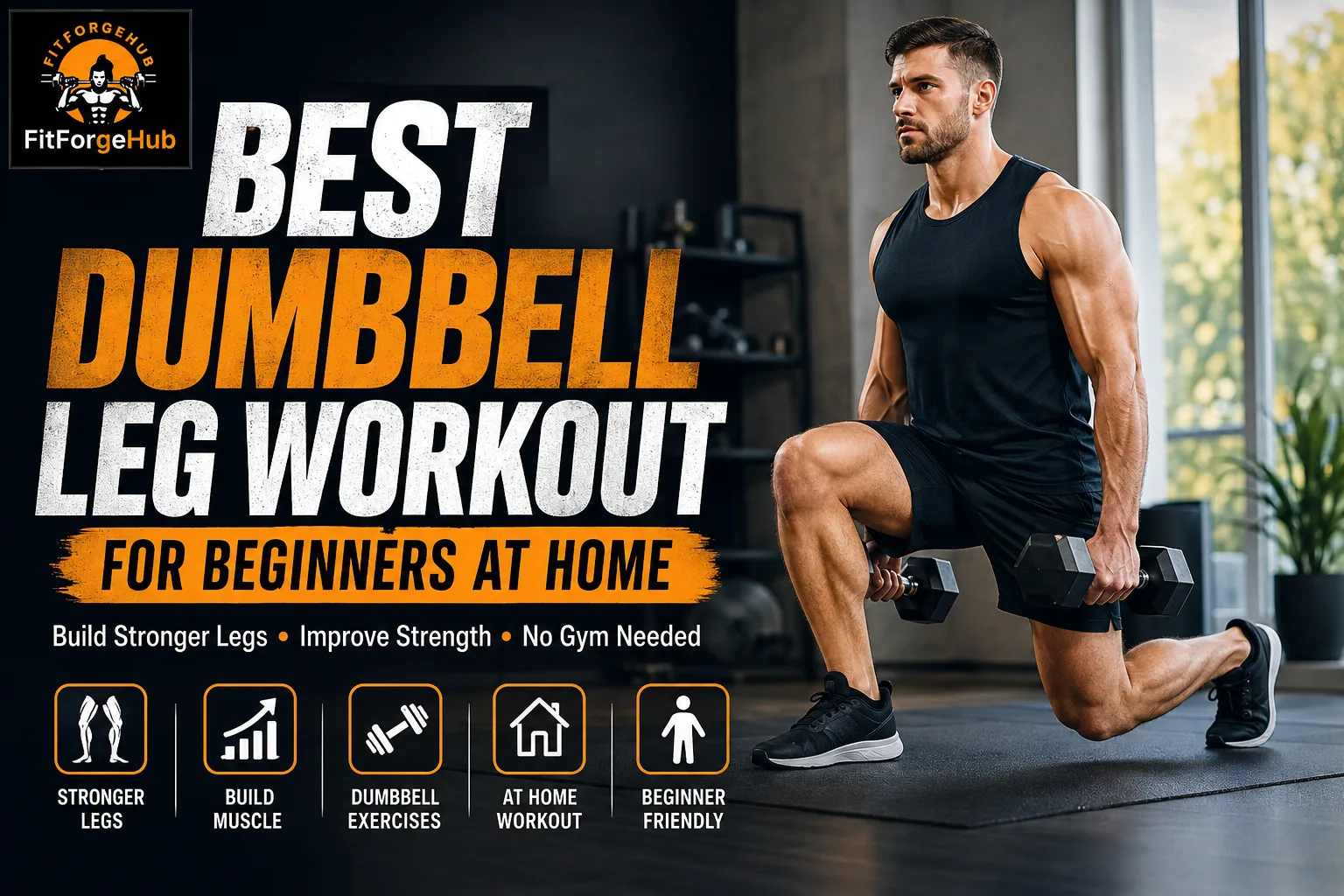
Building stronger legs doesn’t require a gym membership or expensive equipment. With a pair of dumbbells and enough space to exercise safely, beginners can perform a variety of effective leg exercises at home.
A dumbbell leg workout at home can train the major muscles of your lower body, including your quadriceps, hamstrings, glutes, and calves. The key is to choose exercises that match your fitness level, use proper form, and gradually increase the challenge as you become stronger.
In this guide, you’ll learn the best dumbbell leg exercises for beginners, how many sets and reps to perform, how to warm up, how to choose the right dumbbell weight, common mistakes to avoid, and how to create a simple leg workout you can do at home.
Quick Answer: Beginners can start with 4–6 dumbbell leg exercises, performing around 2–3 sets of 8–15 controlled repetitions per exercise. Start with a manageable weight and focus on technique before increasing resistance.
Table of Contents
- Can You Build Your Legs With Dumbbells at Home?
- What Muscles Does a Dumbbell Leg Workout Train?
- What Equipment Do You Need?
- Best Dumbbell Leg Workout for Beginners
- 1. Dumbbell Goblet Squat
- 2. Dumbbell Romanian Deadlift
- 3. Dumbbell Reverse Lunge
- 4. Dumbbell Bulgarian Split Squat
- 5. Dumbbell Sumo Squat
- 6. Dumbbell Calf Raise
- How to Warm Up Before a Leg Workout
- How Heavy Should Your Dumbbells Be?
- How Many Sets and Reps Should Beginners Do?
- How Often Should You Train Your Legs?
- How to Progress Your Dumbbell Leg Workout
- Common Dumbbell Leg Workout Mistakes
- Beginner Dumbbell Leg Workout Routine
- How to Combine Leg Training With Your Full-Body Routine
- Nutrition and Recovery for Stronger Legs
- Frequently Asked Questions
- Final Thoughts
- About the Author
Can You Build Your Legs With Dumbbells at Home?
Yes, dumbbells can be an effective tool for building lower-body strength at home.
You can use dumbbells to make common movements such as squats, lunges, and hip-hinge exercises more challenging.
A well-designed dumbbell leg workout can train:
- Quadriceps
- Hamstrings
- Glutes
- Calves
- Core and stabilizing muscles
You don’t need to perform every possible leg exercise in one workout.
For beginners, a few fundamental movements performed consistently can provide a strong starting point.
If you’re following the FitForgeHub beginner dumbbell series, you can combine this workout with our Full Body Dumbbell Workout for Beginners.
Suggested URL:
/full-body-dumbbell-workout-for-beginners/
What Muscles Does a Dumbbell Leg Workout Train?
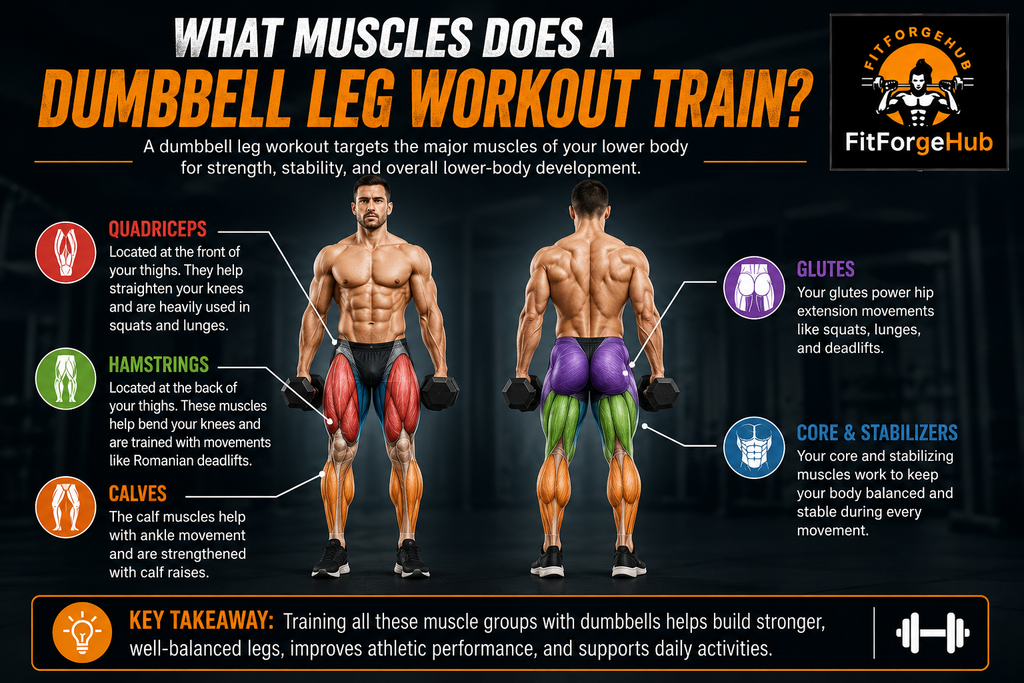
Your lower body contains several major muscle groups.
Understanding what you’re training can help you choose exercises more effectively.
Quadriceps
The quadriceps are located at the front of your thighs.
Squats and lunges are common exercises that challenge these muscles.
Hamstrings
The hamstrings are located on the back of your thighs.
Hip-hinge movements such as Romanian deadlifts are particularly useful for training the posterior chain.
Glutes
The gluteal muscles are involved in movements such as squats, lunges, and hip hinges.
They also play an important role in hip extension and lower-body strength.
Calves
The calf muscles help with movements involving the ankle and foot.
Calf raises are a simple way to directly train them.
Core
Your core muscles also work during many standing dumbbell exercises because they help stabilize your torso.
What Equipment Do You Need?
You don’t need a complete home gym for this workout.
Basic Equipment
- Pair of dumbbells
- Exercise mat
- Stable floor
- Enough open space
Optional Equipment
- Adjustable dumbbells
- Stable workout bench or chair
- Step platform
A bench or chair can be useful for certain variations, but the basic workout can be performed without specialized equipment.
Safety first: If you use a chair or another elevated surface, make sure it is stable and doesn’t slide.
Best Dumbbell Leg Workout for Beginners
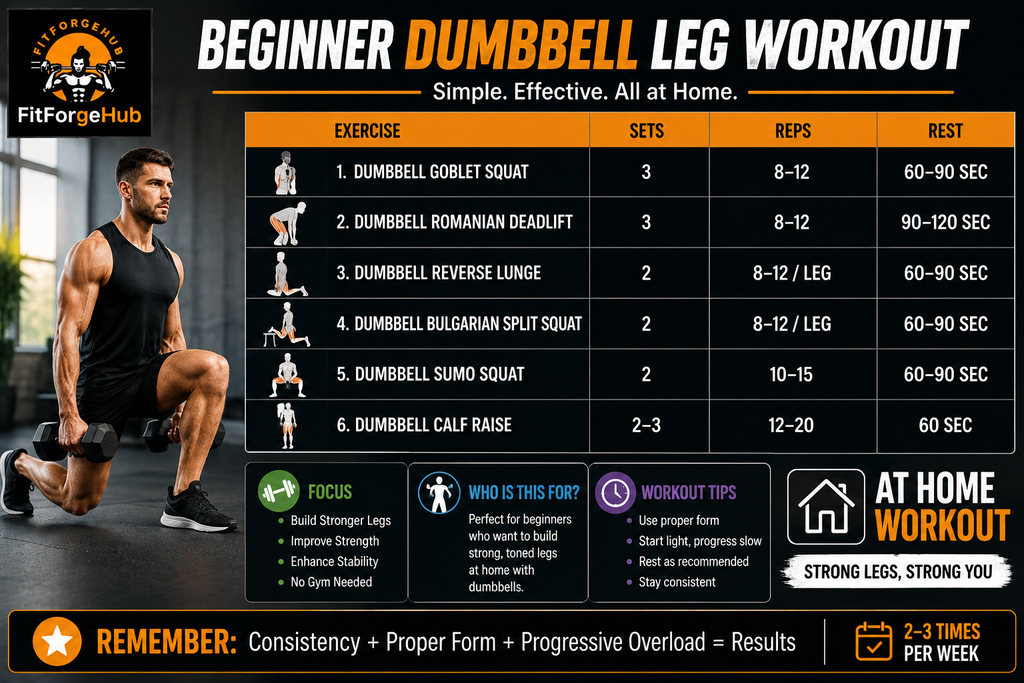
Here’s a practical beginner-friendly routine.
| Exercise | Sets | Reps | Rest |
| Dumbbell Goblet Squat | 3 | 8–12 | 60–90 sec |
| Dumbbell Romanian Deadlift | 3 | 8–12 | 90–120 sec |
| Dumbbell Reverse Lunge | 2 | 8–12/leg | 60–90 sec |
| Dumbbell Bulgarian Split Squat | 2 | 8–12/leg | 60–90 sec |
| Dumbbell Sumo Squat | 2 | 10–15 | 60–90 sec |
| Dumbbell Calf Raise | 2–3 | 12–20 | 60 sec |
Beginner Modification
If you’re completely new to strength training, start with just:
- Goblet squat
- Romanian deadlift
- Reverse lunge
- Calf raise
Once you become comfortable with these movements, you can add the other exercises.
1. Dumbbell Goblet Squat
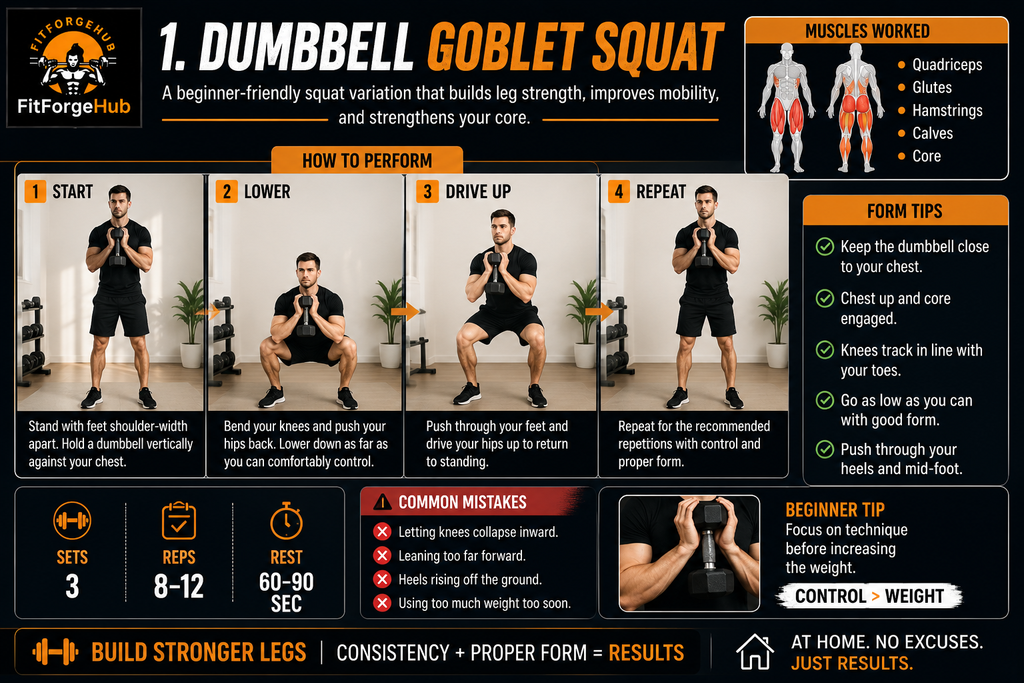
The dumbbell goblet squat is one of the easiest dumbbell squat variations for beginners to learn.
You hold one dumbbell close to your chest while performing the squat.
How to Perform a Goblet Squat
- Stand with your feet around shoulder-width apart.
- Hold one dumbbell vertically against your chest.
- Keep your chest comfortably upright.
- Brace your core.
- Bend your knees and push your hips back.
- Lower yourself as far as you can comfortably control.
- Push through your feet to return to standing.
- Repeat.
Beginner target: 3 sets of 8–12 reps.
Form Tip
Keep the dumbbell close to your body rather than holding it far away.
Your depth should be based on what you can perform comfortably while maintaining good technique.
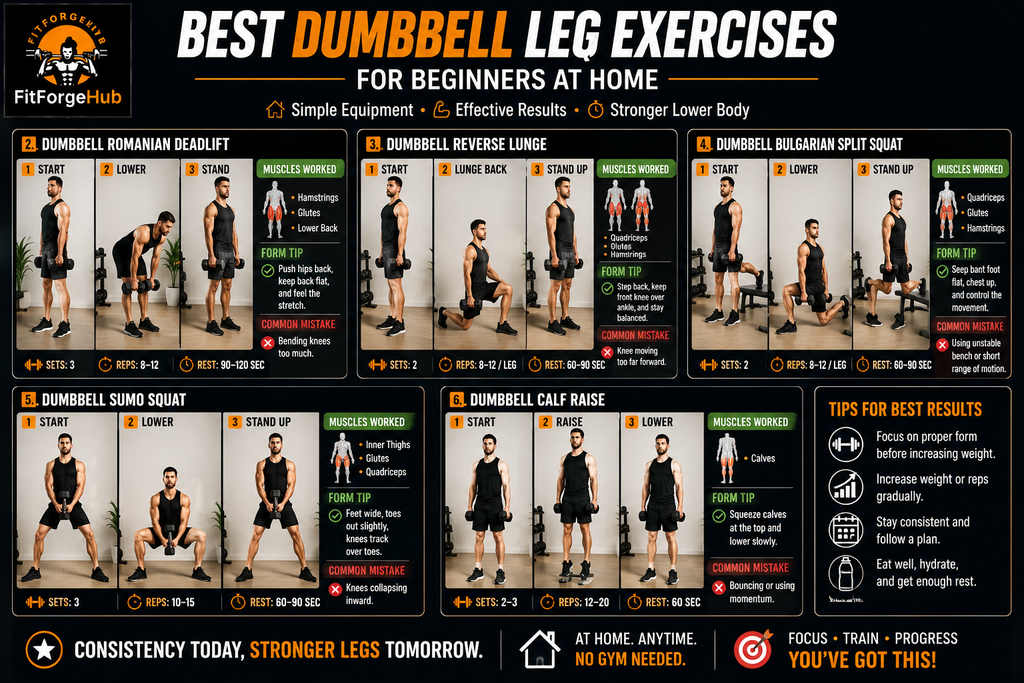
2. Dumbbell Romanian Deadlift
The dumbbell Romanian deadlift is an important hip-hinge movement that primarily trains the hamstrings and glutes while also challenging your back and core to stabilize the body.
How to Perform a Romanian Deadlift
- Stand with your feet approximately hip-width apart.
- Hold a dumbbell in each hand.
- Keep your knees slightly bent.
- Push your hips backward.
- Lower the dumbbells along your legs.
- Keep your back in a comfortable neutral position.
- Stop when you feel an appropriate stretch in your hamstrings.
- Drive your hips forward to return to standing.
Beginner target: 3 sets of 8–12 reps.
Common Mistake
Don’t turn the movement into a squat.
The primary movement should come from your hips moving backward and forward.
If you’re learning the movement for the first time, practice with very light weights.
3. Dumbbell Reverse Lunge
Reverse lunges are a useful unilateral exercise that can train your legs one side at a time.
How to Perform a Reverse Lunge
- Stand upright while holding dumbbells at your sides.
- Step one foot backward.
- Lower your body under control.
- Keep your front foot stable.
- Push through the front foot to return to standing.
- Repeat on the other side.
Beginner target: 2 sets of 8–12 reps per leg.
Beginner Tip
If you’re struggling with balance, practice the movement without dumbbells first.
Once your technique improves, add light dumbbells.
4. Dumbbell Bulgarian Split Squat
The Bulgarian split squat is a more challenging single-leg exercise that can strongly challenge the legs and glutes.
Because balance can be difficult for beginners, don’t rush into heavy weights.
How to Perform It
- Stand a short distance in front of a stable elevated surface.
- Place one foot behind you.
- Hold dumbbells at your sides if appropriate.
- Bend your front leg and lower your body.
- Keep your front foot stable.
- Push through your front foot to return upward.
- Complete your repetitions and switch sides.
Beginner target: 2 sets of 8–12 reps per leg.
Beginner Modification
Practice with bodyweight first.
Once you can perform the movement comfortably, introduce light dumbbells.
Safety: Use only a stable surface that can safely support your foot. If you aren’t confident about the setup, perform a regular split squat instead.
5. Dumbbell Sumo Squat
The dumbbell sumo squat uses a wider stance than a traditional squat.
It can be a useful variation to include in a lower-body routine.
How to Perform It
- Stand with your feet wider than shoulder-width.
- Point your toes slightly outward.
- Hold one dumbbell with both hands.
- Keep your chest comfortably upright.
- Bend your knees and lower your hips.
- Push through your feet to return to standing.
Beginner target: 2 sets of 10–15 reps.
Form Tip
Don’t force your knees outward excessively.
Let your knees track naturally in the same general direction as your toes.
6. Dumbbell Calf Raise
Calf raises are a simple way to directly train the muscles in the lower leg.
How to Perform a Dumbbell Calf Raise
- Stand upright with a dumbbell in each hand.
- Keep your feet stable.
- Slowly raise your heels.
- Pause briefly at the top.
- Lower your heels under control.
- Repeat.
Beginner target: 2–3 sets of 12–20 reps.
Beginner Tip
Perform the movement slowly instead of bouncing up and down.
How to Warm Up Before a Leg Workout
A short warm-up can prepare your body for exercise.
Spend around 5–10 minutes performing light movements such as:
- Walking
- Bodyweight squats
- Hip hinges
- Alternating lunges
- Leg swings
- Ankle movements
Start your first weighted exercise with a lighter set before using your normal working weight.
Your warm-up should prepare you for the session rather than make you tired before the workout begins.
How Heavy Should Your Dumbbells Be?
There is no single dumbbell weight that works for every beginner.
The right weight depends on:
- Your current strength
- Training experience
- Exercise
- Technique
- Fitness goal
Choose a weight that allows you to complete your target repetitions with good form.
For example, if your target is 8–12 reps and you can only perform 4–5 controlled repetitions, the weight is probably too heavy.
If you can easily perform far more repetitions than your target without the exercise becoming challenging, you may eventually need more resistance.
The Rule to Remember
Choose a weight you can control—not the heaviest weight you can move.
How Many Sets and Reps Should Beginners Do?
For many beginner leg exercises, 2–3 sets of 8–15 repetitions is a practical starting point.
Some exercises, such as calf raises, can comfortably use a higher repetition range.
| Exercise | Sets | Reps |
| Goblet Squat | 3 | 8–12 |
| Romanian Deadlift | 3 | 8–12 |
| Reverse Lunge | 2 | 8–12/leg |
| Bulgarian Split Squat | 2 | 8–12/leg |
| Sumo Squat | 2 | 10–15 |
| Calf Raise | 2–3 | 12–20 |
You don’t need to complete all six exercises during your first workout.
Start with a manageable routine and increase your training volume gradually.
How Often Should You Train Your Legs?
Beginners generally don’t need to perform intense leg workouts every day.
A full-body routine performed 2–3 times per week can provide regular lower-body training while allowing time for recovery.
For example:
| Day | Workout |
| Monday | Full Body |
| Tuesday | Rest / Light Activity |
| Wednesday | Full Body |
| Thursday | Rest |
| Friday | Full Body |
| Saturday | Light Activity |
| Sunday | Rest |
The CDC recommends that adults include muscle-strengthening activities on at least 2 days per week as part of their overall physical activity routine.
CDC — Adult Physical Activity Guidelines
Your personal schedule should depend on your overall training plan, fitness level, recovery, and goals.
How to Progress Your Dumbbell Leg Workout
If you want to become stronger, you need to gradually increase the challenge.
This is often referred to as progressive overload.
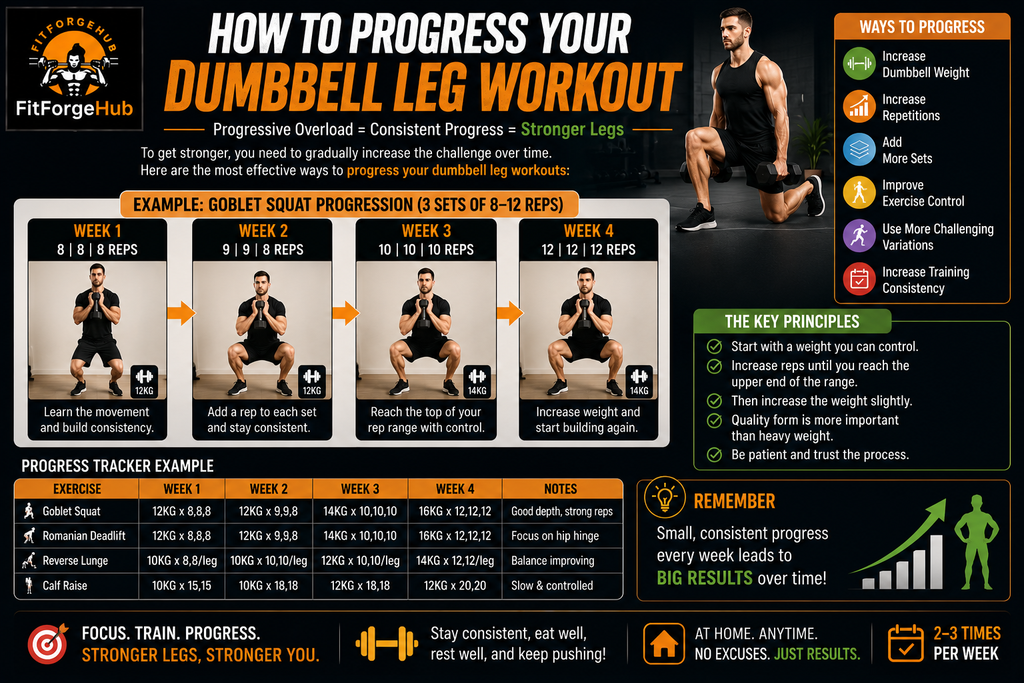
You can progress by:
- Increasing repetitions
- Increasing dumbbell weight
- Adding a set
- Improving exercise control
- Using a more challenging variation
- Increasing training consistency
Example: Goblet Squat
Your target is:
3 × 8–12 reps
You might progress like this:
Week 1: 8, 8, 8
Week 2: 9, 9, 8
Week 3: 10, 10, 10
Week 4: 12, 12, 12
Once you can comfortably perform the upper end of your repetition range with good technique, you can consider increasing the resistance slightly.
Then build your repetitions again.
This gives you a simple way to measure progress without changing your entire workout every week.
The American College of Sports Medicine emphasizes consistency and progressive resistance as important parts of an effective resistance-training program
ACSM — Resistance Training Guidelines
Common Dumbbell Leg Workout Mistakes
1. Using Too Much Weight
Heavy dumbbells can make it difficult to maintain proper technique.
Start with a manageable weight.
2. Rushing Through Repetitions
Fast repetitions can make it harder to maintain control.
Use a steady tempo and focus on the movement.
3. Letting Your Technique Break Down
When your form becomes noticeably worse, stop the set or reduce the weight.
More repetitions aren’t automatically better.
4. Ignoring the Hamstrings
Don’t only perform squats.
Include a hip-hinge movement such as the Romanian deadlift to train the posterior chain.
5. Avoiding Single-Leg Exercises
Lunges and split squats can help you train each leg individually.
You don’t need to use heavy weights to benefit from them.
6. Training Legs Every Day
Your muscles need time to recover after challenging workouts.
Give your body adequate recovery between hard leg sessions.
7. Neglecting Calves
If you want a more complete lower-body routine, include direct calf work.
Beginner Dumbbell Leg Workout Routine
If you’re completely new to strength training, start with this simple routine:
| Exercise | Sets | Reps | Rest |
| Dumbbell Goblet Squat | 3 | 8–12 | 60–90 sec |
| Dumbbell Romanian Deadlift | 3 | 8–12 | 90–120 sec |
| Dumbbell Reverse Lunge | 2 | 8–12/leg | 60–90 sec |
| Dumbbell Calf Raise | 2 | 12–20 | 60 sec |
Optional
After several weeks of consistent training, you can add:
- Bulgarian split squats
- Sumo squats
You don’t need to make your workout extremely long to make progress.
How to Combine Leg Training With Your Full-Body Routine
Because this article is part of the FitForgeHub Beginner Dumbbell Workout Series, you can combine the different workouts into a larger training plan.
Day 8
Full Body Dumbbell Workout for Beginners
/full-body-dumbbell-workout-for-beginners/
Day 9
Best Dumbbell Chest Workout at Home
/best-dumbbell-chest-workout-at-home/
Day 10
Best Dumbbell Back Workout at Home
/best-dumbbell-back-workout-at-home/
Day 11
Best Dumbbell Leg Workout for Beginners
Current article.
Day 12
Best Dumbbell Shoulder Workout at Home
Future article.
Day 13
Dumbbell Workout for Skinny Beginners
Future article.
Day 14
Complete Dumbbell Workout Guide for Beginners
Future pillar article.
Once Article #14 is published, it should become the main pillar page linking to the individual chest, back, leg, and shoulder articles.
Nutrition and Recovery for Stronger Legs
Training is only one part of improving your strength and building muscle.
Your body also needs adequate nutrition and recovery.
Focus on:
- Adequate protein
- Balanced meals
- Carbohydrates for training energy
- Healthy fats
- Fruits and vegetables
- Adequate fluids
- Consistent sleep
- Recovery between challenging workouts
Protein-rich foods can include:
- Eggs
- Chicken
- Fish
- Milk
- Greek yogurt
- Beans
- Lentils
- Other protein-rich foods
You don’t need expensive supplements to start building a solid fitness foundation.
If your overall goal is muscle building, read our:
Best Beginner Muscle Building Workout at Home
Suggested URL:
/best-beginner-muscle-building-workout-at-home/
Frequently Asked Questions
Can I build my legs with dumbbells at home?
Yes. Dumbbells can provide effective resistance for squats, lunges, Romanian deadlifts, calf raises, and other lower-body exercises.
What is the best dumbbell leg exercise for beginners?
The dumbbell goblet squat is a practical starting point because it is relatively simple to learn and requires only one dumbbell.
Can I build my legs without a gym?
Yes. A combination of dumbbell and bodyweight exercises can provide an effective home-based lower-body workout.
How many leg exercises should beginners do?
Start with approximately 3–5 exercises. You can gradually increase the number of exercises as your fitness and experience improve.
How many sets should I do for legs?
Beginners can start with approximately 2–3 sets per exercise and adjust the amount based on their overall training program and recovery.
How many reps should I do for a dumbbell leg workout?
For many beginner exercises, 8–15 controlled repetitions per set is a practical starting range. Calf raises can be performed for somewhat higher repetitions.
How often should beginners train legs?
Many beginners can include lower-body training 2–3 times per week as part of a full-body routine, depending on their overall program and recovery.
Are dumbbell squats enough for building legs?
Squats are an excellent foundational movement, but a balanced leg routine can also include hip-hinge exercises, single-leg movements, and calf training.
Can I build bigger legs with light dumbbells?
You can make progress with lighter dumbbells by using appropriate repetitions, controlled technique, and progressive overload. However, the resistance eventually needs to provide enough challenge for continued progress.
Should I train legs if I’m sore?
Mild muscle soreness doesn’t necessarily mean you must stop all activity, but you should avoid training through significant pain. Consider reducing intensity or allowing additional recovery if your muscles are very sore.
What should I do if a leg exercise causes pain?
Stop the exercise if you experience significant or unusual pain. Don’t try to push through it. If you have an injury or persistent symptoms, consult a qualified healthcare professional.
Final Thoughts
A dumbbell leg workout at home can be an effective way for beginners to develop lower-body strength without joining a gym.
You can build a practical routine around:
- Dumbbell goblet squats
- Romanian deadlifts
- Reverse lunges
- Bulgarian split squats
- Sumo squats
- Calf raises
You don’t need to perform every exercise in one session.
Start with a manageable routine, learn proper technique, and gradually increase the challenge as your strength improves.
The most important factors are consistency, good form, progressive overload, nutrition, and recovery.
For the next article in the FitForgeHub series, check out:
Best Dumbbell Shoulder Workout at Home
You can also read:
- Full Body Dumbbell Workout for Beginners
- Best Dumbbell Chest Workout at Home
- Best Dumbbell Back Workout at Home
Important: This article is for general educational purposes and isn’t a substitute for individualized medical or fitness advice. If you have an injury, medical condition, or concerns about starting a new exercise program, consult a qualified healthcare professional before beginning a new workout routine.
About the Author
FitForgeHub Fitness Team
The FitForgeHub Fitness Team creates practical, beginner-friendly fitness content covering home workouts, dumbbell training, strength training, muscle building, workout plans, exercise techniques, and healthy lifestyle habits.
Our goal is to make fitness easier to understand by providing clear and practical workout guides that beginners can follow at home.
FitForgeHub focuses on useful fitness information designed to help readers build strength, improve consistency, and develop sustainable exercise habits.
Website: FitForgeHub.com
Disclaimer
The information published on FitForgeHub is intended for general educational purposes and is not medical advice. Exercise needs and fitness goals vary between individuals. If you have a medical condition, injury, or concerns about exercise, speak with a qualified healthcare professional before starting a new exercise program.