
Building muscle doesn’t always require a gym membership or expensive workout equipment. Beginners can start building strength and muscle at home by following a consistent workout routine, using bodyweight exercises, and gradually adding resistance as they become stronger.
Beginner-friendly muscle-building. If you’re looking for a beginner muscle-building workout at home, this guide will give you a simple routine that targets your major muscle groups and can be performed with minimal equipment.
Whether your goal is to build muscle, get stronger, or simply become more fit, the key is to start at a manageable level and gradually increase the challenge over time.
If you’re wondering how to start working out at home as a beginner, this guide will show you exactly where to start…”
how to start working out at home as a beginner
→ How to Start Working Out at Home for Beginners: A Simple Step-by-Step Guide
Table of Contents
- Can Beginners Build Muscle at Home?
- What Do You Need for a Home Muscle-Building Workout?
- How Often Should Beginners Train to Build Muscle?
- Beginner Muscle Building Workout at Home
- 1. Bodyweight Squats
- 2. Push-Ups
- 3. Reverse Lunges
- 4. Glute Bridges
- 5. Dumbbell Rows
- 6. Dumbbell Shoulder Press
- 7. Plank
- How to Progress Your Home Workout
- Beginner Weekly Workout Schedule
- Common Muscle-Building Mistakes
- Nutrition Tips for Building Muscle
- Frequently Asked Questions
- Final Thoughts
- About the Author
Can Beginners Build Muscle at Home?
Yes, beginners can make meaningful strength and muscle-building progress with home workouts.
The most important factor is progressive overload. This means gradually making your workouts more challenging as your body adapts.
The most important factor is progressive overload, which means gradually making your workouts more challenging as your body adapts. Learn more about strength-training principles from ACE Fitness
You can increase the challenge by:
- Adding repetitions
- Adding sets
- Using dumbbells or resistance bands
- Choosing a more difficult exercise variation
- Increasing resistance
- Improving your exercise technique
- Gradually increasing training volume
You don’t need to start with advanced exercises. In fact, beginners often benefit from mastering basic movements before progressing to more difficult variations.
If you don’t have access to dumbbells or other equipment, you can also learn more about building muscle at home without weights.
→ How to Build Muscle at Home Without Weights: A Beginner’s Guide
What Do You Need for a Home Muscle-Building Workout?
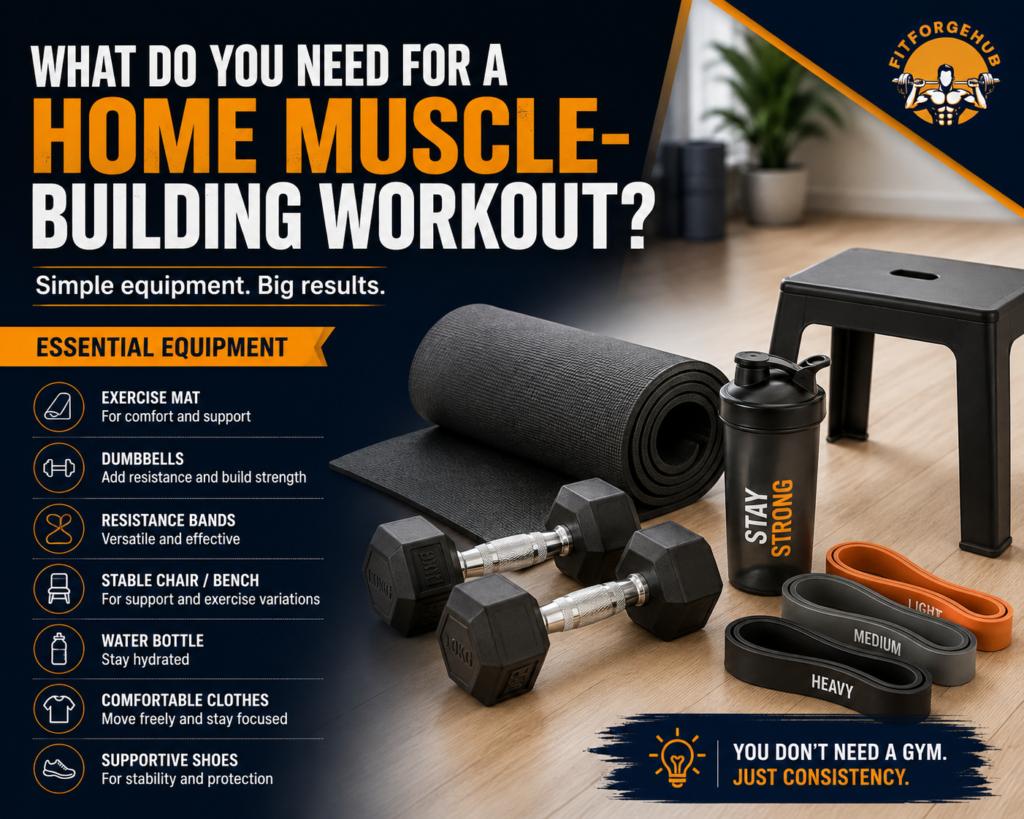
You can begin with bodyweight exercises, but having a few basic pieces of equipment can give you more options.
Useful home workout equipment includes:
- Exercise mat
- Pair of adjustable or fixed dumbbells
- Resistance bands
- Stable chair or bench
- Water bottle
- Comfortable workout clothes
- Supportive training shoes
If you don’t have dumbbells, you can start with bodyweight exercises and add resistance later.
Always make sure any chair, table, or other surface used for exercise is stable and appropriate for the movement.
If you prefer training with little or no equipment, check out our best home workout plan for beginners with no equipment.
Anchor: best home workout plan for beginners with no equipment
→ Best Home Workout Plan for Beginners (No Equipment)
How Often Should Beginners Train to Build Muscle?
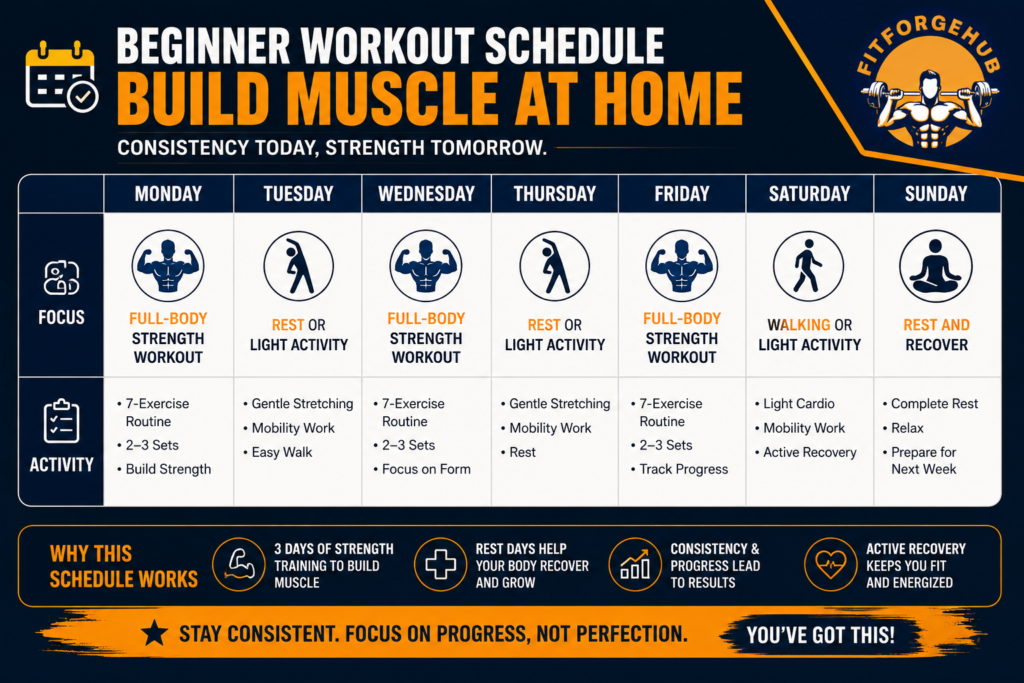
For many beginners, three full-body strength workouts per week are a practical starting point.
For example:
| Day | Workout |
| Monday | Full-Body Strength Workout |
| Tuesday | Rest or Light Activity |
| Wednesday | Full-Body Strength Workout |
| Thursday | Rest |
| Friday | Full-Body Strength Workout |
| Saturday | Walking or Light Activity |
| Sunday | Rest |
You don’t need to train the same muscles intensely every day. Recovery is an important part of a training routine.
If you’re new to exercise, start with a manageable amount of training and increase gradually.
Beginner Muscle Building Workout at Home
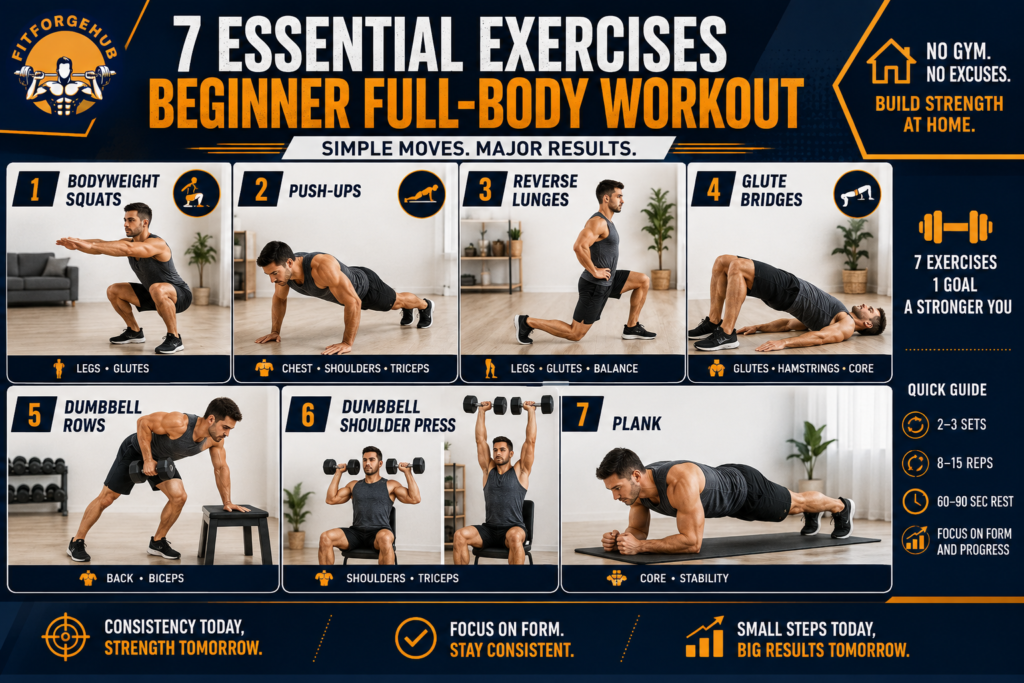
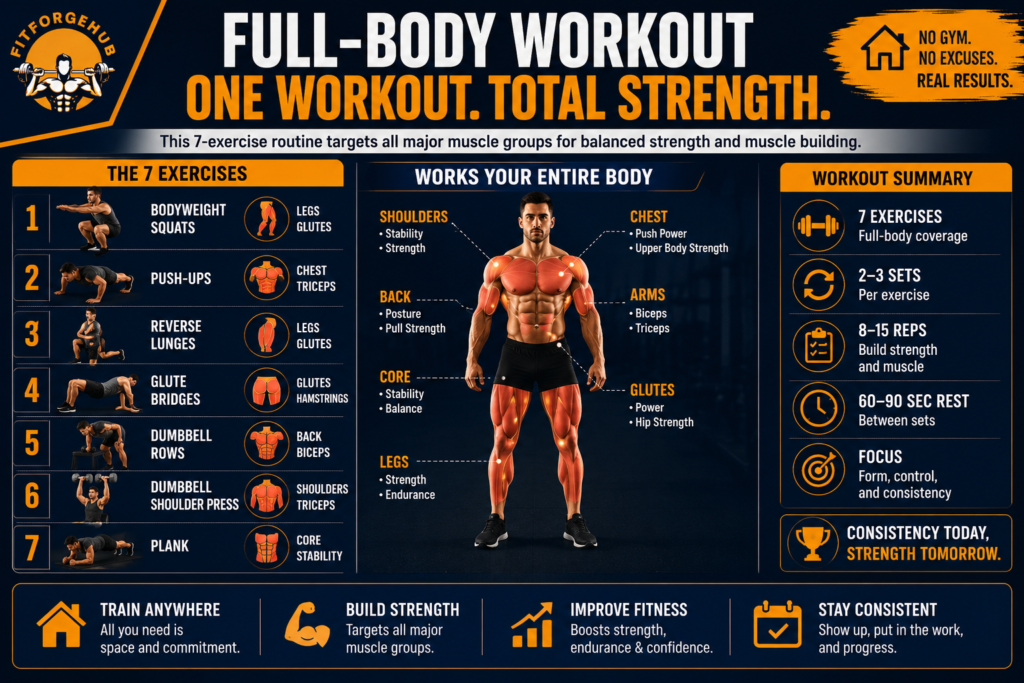
The following workout targets several major muscle groups, including the legs, chest, back, shoulders, glutes, and core.
Beginner Workout Summary
| Exercise | Sets | Reps | Rest |
| Bodyweight Squats | 3 | 8–15 | 60–90 sec |
| Push-Ups | 3 | 6–12 | 60–90 sec |
| Reverse Lunges | 2 | 8–10/leg | 60–90 sec |
| Glute Bridges | 3 | 10–15 | 60 sec |
| Dumbbell Rows | 3 | 8–12/side | 60–90 sec |
| Dumbbell Shoulder Press | 2 | 8–12 | 60–90 sec |
| Plank | 2 | 20–40 sec | 45–60 sec |
If you’re completely new to strength training, start with fewer sets and focus on learning proper technique.
Warm-Up Before Your Workout
Before starting your strength workout, spend around 5–10 minutes preparing your body for exercise.
A simple warm-up can include:
- Easy walking in place
- Arm circles
- Bodyweight squats
- Hip rotations
- Shoulder movements
- Light dynamic movements
The goal is to gradually increase activity and prepare for the movements you’re about to perform.
Avoid turning your warm-up into another exhausting workout.
1. Bodyweight Squats
Bodyweight squats are one of the simplest exercises for developing lower-body strength.
They primarily train the quadriceps and glutes while also involving other muscles around the hips and legs.
How to Perform Bodyweight Squats
- Stand with your feet approximately shoulder-width apart.
- Keep your chest comfortably upright.
- Brace your core.
- Push your hips back and bend your knees.
- Lower yourself under control.
- Push through your feet to return to standing.
Beginner target: 3 sets of 8–15 repetitions.
Beginner Tip
Don’t worry about reaching a specific depth if you cannot maintain good control. Work within a comfortable range and gradually improve your movement.
2. Push-Ups
Push-ups are a bodyweight exercise that primarily trains the chest, shoulders, and triceps while requiring your core to stabilize your body.
How to Perform Push-Ups
- Place your hands slightly wider than shoulder width.
- Extend your legs behind you.
- Keep your body in a controlled straight line.
- Bend your elbows and lower your body.
- Push through your hands to return to the starting position.
Beginner target: 3 sets of 6–12 repetitions.
Too Difficult?
Try an easier variation such as:
- Incline push-ups
- Knee push-ups
- Wall push-ups
As you become stronger, gradually progress toward regular push-ups.
3. Reverse Lunges
Reverse lunges train the lower body while also challenging balance and coordination.
How to Perform Reverse Lunges
- Stand upright.
- Step one foot backward.
- Lower your body under control.
- Push through the front foot.
- Return to the starting position.
- Repeat on the other side.
Beginner target: 2 sets of 8–10 repetitions per leg.
Use a stable support if you need help maintaining balance.
4. Glute Bridges
Glute bridges are a simple exercise that targets the glutes and involves the muscles around the hips and core.
How to Perform Glute Bridges
- Lie on your back.
- Bend your knees.
- Place your feet flat on the floor.
- Brace your core.
- Lift your hips.
- Pause briefly at the top.
- Lower your hips slowly.
Beginner target: 3 sets of 10–15 repetitions.
Focus on controlled movement rather than lifting your hips as quickly as possible.
5. Dumbbell Rows
Dumbbell rows are useful for adding resistance to your back workout.
If you don’t have dumbbells, start with bodyweight exercises and add resistance when equipment becomes available.
How to Perform a Dumbbell Row
- Hold a dumbbell in one hand.
- Place your other hand on a stable surface for support.
- Keep your back in a comfortable neutral position.
- Pull the dumbbell toward your torso.
- Lower it slowly.
- Complete your repetitions and switch sides.
Beginner target: 3 sets of 8–12 repetitions per side.
Avoid using momentum to swing the weight.
6. Dumbbell Shoulder Press
The dumbbell shoulder press is a simple resistance exercise for the shoulders and triceps.
How to Perform a Dumbbell Shoulder Press
- Hold a dumbbell in each hand.
- Start with the weights around shoulder level.
- Brace your core.
- Press the dumbbells upward.
- Lower them under control.
Beginner target: 2 sets of 8–12 repetitions.
Choose a weight that allows you to maintain good form throughout the set.
7. Plank
The plank is an isometric exercise that develops core endurance.
How to Perform a Plank
- Place your forearms on the floor.
- Extend your legs behind you.
- Keep your body controlled and stable.
- Brace your core.
- Hold the position while maintaining good technique.
Beginner target: 2 sets of 20–40 seconds.
If a full plank is too difficult, you can perform a modified version with your knees on the floor.
How to Progress Your Home Workout
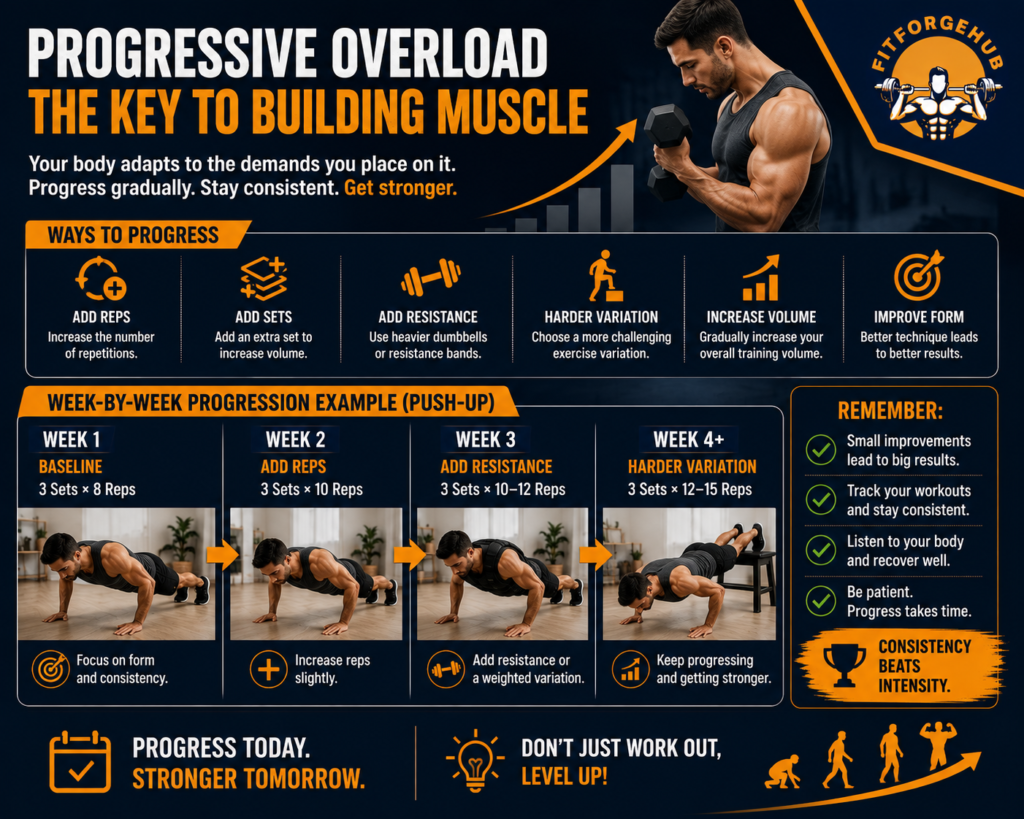
Doing the same number of repetitions with the same resistance forever will eventually make your workout less challenging.
Instead, gradually increase the difficulty.
Week-by-Week Example
| Week | Goal |
| Week 1 | Learn technique and establish consistency |
| Week 2 | Add a few repetitions where appropriate |
| Week 3 | Increase resistance or add a set |
| Week 4 | Use a slightly more challenging variation |
You don’t have to increase everything at once.
For example, if you can comfortably perform 8 push-ups, your next goal might be 10 or 12 controlled repetitions. Once that becomes manageable, you can consider a more challenging variation.
Beginner Weekly Workout Schedule
Here’s a simple schedule you can follow:
Monday — Full Body
Perform the complete workout listed above.
Tuesday — Recovery
Take a rest day or do light activity such as walking.
Wednesday — Full Body
Repeat the workout and focus on improving technique.
Thursday — Recovery
Rest or perform comfortable light activity.
Friday — Full Body
Complete the workout again and track your repetitions.
Saturday — Optional Activity
Take a walk, perform light mobility work, or simply rest.
Sunday — Rest
Give your body time to recover before beginning the next week.
Common Muscle-Building Mistakes
1. Starting With Too Much Weight
Using heavy weights before learning proper technique can make exercises unnecessarily difficult.
Start with a manageable resistance.
2. Doing Too Many Exercises
Beginners don’t need 20 different exercises in one workout.
A simple routine that trains the major muscle groups can be more practical and easier to maintain.
3. Ignoring Recovery
Muscle-building training creates a stimulus, but recovery is an important part of adaptation.
Make sure your weekly routine includes rest and recovery.
4. Changing Your Workout Constantly
If you change exercises every few days, it becomes difficult to track whether you’re getting stronger.
Stay with a basic program long enough to measure progress.
5. Poor Exercise Technique
Don’t sacrifice form just to complete more repetitions.
Controlled, technically sound repetitions should be the priority.
6. Expecting Fast Results
Muscle building is a gradual process.
Your results depend on factors such as training consistency, nutrition, sleep, recovery, genetics, and your starting point.
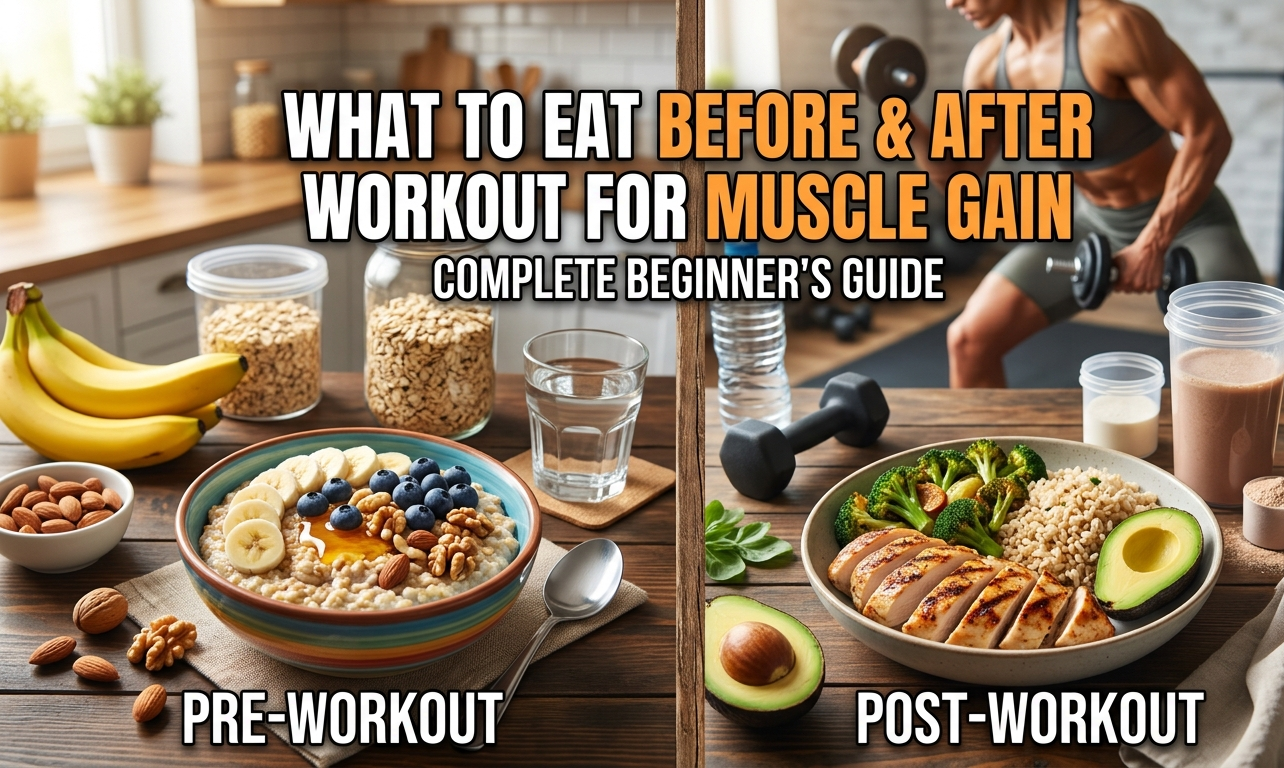
Nutrition Tips for Building Muscle
Exercise is only one part of building muscle.
Your body also needs adequate nutrition and recovery.
Focus on a balanced diet that includes:
- Protein-rich foods
- Fruits and vegetables
- Whole grains and other carbohydrate sources
- Healthy fats
- Adequate fluids
Good protein sources can include eggs, poultry, fish, dairy products, beans, lentils, and other protein-rich foods.
If your goal is to gain muscle, make sure your overall food intake supports your training and body-composition goals.
You don’t need to rely on expensive supplements to start a muscle-building routine.
How Much Protein Do Beginners Need?
Protein requirements vary depending on body size, training, total diet, and individual goals.
Instead of focusing only on supplements, prioritize a balanced diet and regular protein-rich meals.
If you’re unsure about your individual nutrition requirements, especially if you have a medical condition or specific dietary needs, consider speaking with a registered dietitian or qualified healthcare professional.
Protein requirements vary depending on body size, training, total diet, and individual goals. For additional sports-nutrition information, see the International Society of Sports Nutrition
Frequently Asked Questions
Can I build muscle at home without a gym?
Yes. Beginners can build strength and make muscle-building progress at home using bodyweight exercises and, when appropriate, equipment such as dumbbells and resistance bands.
How many days a week should I work out to build muscle?
Three full-body strength workouts per week can be a practical starting point for many beginners. Your ideal training frequency depends on your fitness level, recovery, schedule, and goals.
Can I build muscle with bodyweight exercises?
Yes. Bodyweight exercises can provide a useful training stimulus, especially for beginners. As you become stronger, you may need more challenging variations or additional resistance to continue progressing.
Do I need dumbbells to build muscle at home?
No. You can begin with bodyweight exercises. However, dumbbells and resistance bands can provide additional resistance and make progressive training easier.
How long should a muscle-building workout take?
A beginner home workout can often be completed in approximately 30–45 minutes, including warm-up and rest periods. The exact duration depends on your exercise selection, sets, repetitions, and rest periods.
Should I work out every day to build muscle?
No. You don’t need to perform hard strength workouts every day. Rest and recovery are important parts of a sustainable training program.
How quickly can I see results?
Results vary from person to person. Beginners may notice improvements in strength and exercise performance before seeing major physical changes. Consistent training, nutrition, sleep, and recovery all matter.
What should I do if an exercise causes pain?
Stop the exercise if you experience significant or unusual pain. Don’t try to push through concerning symptoms. If you’re unsure about an injury or whether an exercise is appropriate for you, consult a qualified healthcare professional.
Final Thoughts
A beginner muscle building workout at home doesn’t need to be complicated.
Start with basic movements such as squats, push-ups, lunges, glute bridges, rows, shoulder presses, and planks. Focus on proper technique, train consistently, and gradually increase the challenge as your strength improves.
A three-day full-body routine can be a simple starting point for beginners. Over time, you can add resistance bands, dumbbells, or more challenging exercise variations to continue progressing.
Remember that muscle building is not just about exercise. Training, nutrition, sleep, and recovery all work together.
If you’re ready for your next workout, check out our [Full Body Home Workout for Beginners] and [3-Day Workout Plan for Beginners] for more beginner-friendly routines.
About the Author
FitForgeHub Fitness Team
The FitForgeHub Fitness Team creates practical, beginner-friendly fitness content covering home workouts, strength training, muscle building, workout plans, and healthy lifestyle habits.
Our goal is to make fitness easier to understand by providing simple workout guides, exercise explanations, and practical training information that beginners can follow.
FitForgeHub focuses on helpful, easy-to-understand fitness content designed to help readers build consistent and sustainable exercise habits.
Website: FitForgeHub.com
Disclaimer: The information published on FitForgeHub is intended for general educational purposes and is not medical advice. Fitness needs vary from person to person. If you have an injury, medical condition, or concerns about starting a new exercise program, consult a qualified healthcare professional before exercising.
One thought on “Best Beginner Muscle Building Workout at Home: A Simple Guide”