
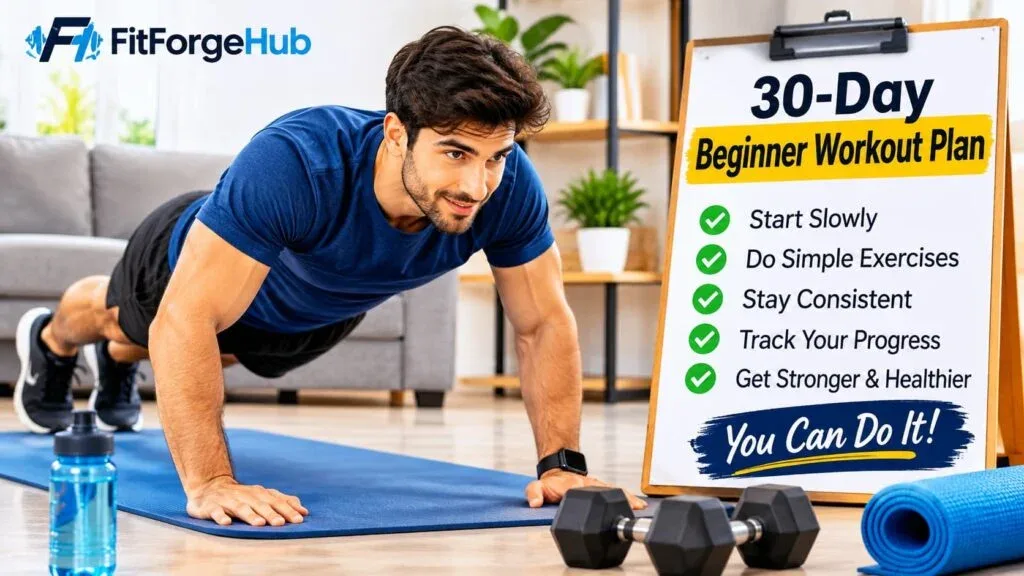
Starting a fitness routine can feel confusing when you don’t know which exercises to choose or how often to train. You might wonder whether you need a gym membership, expensive equipment, or a different workout every day. The good news is that you can begin with a few simple movements and gradually build a routine that fits your life. This 30-day beginner workout plan combines strength exercises, walking, mobility, and recovery to help you get comfortable with regular activity.
Over the next month, you’ll learn basic exercises, follow a realistic schedule, and discover how to make workouts easier or more challenging. Most sessions take around 15 to 35 minutes, and you can complete them at home with minimal equipment. This 30-day beginner workout plan is designed to help you develop consistent habits without exhausting daily workouts. If you’re completely new to exercise, our guide to starting workouts at home offers additional advice to help you prepare.
What Is a 30-Day Beginner Workout Plan?
A 30-day beginner workout plan is a structured exercise routine designed to help people gradually become more active over one month. Instead of jumping into demanding workouts, it introduces manageable strength exercises, cardiovascular activity, mobility work, and rest days.
This program is intended for adults who are new to structured exercise or returning after a period of inactivity. You can adjust the difficulty based on your current abilities. The goal is to develop consistency and confidence rather than achieve a dramatic physical transformation in 30 days.

Why Should Beginners Follow a 30-Day Workout Plan?
Following a schedule removes some of the guesswork from exercise. You know what to do each day, which can make it easier to establish a routine. A 30-day beginner workout plan provides a practical way to balance strength training, walking, mobility, and recovery.
Regular physical activity can support cardiovascular health, muscular strength, sleep, and general well-being. The Centers for Disease Control and Prevention recommends that adults work toward at least 150 minutes of moderate intensity aerobic activity each week and muscle strengthening activities on at least two days.
You don’t need to reach those targets immediately. This plan is a starting point that helps you gradually build your activity level.
When Is the Best Time to Start Working Out?
The best time to start is when you can realistically make room for regular exercise. Morning workouts may suit someone with a busy evening schedule, while another person might prefer exercising after work.
Choose a time when you feel reasonably energetic and can focus on your movements. Consistency matters more than finding a supposedly perfect hour of the day. You can follow this 30-day beginner workout plan at a time that fits your daily schedule.
If you have a medical condition, an injury, or concerns about starting exercise, seek personalized advice from a qualified healthcare professional before beginning.
What Equipment Do You Need?
You can complete most of this plan without buying anything. A few basic items can make your workouts more comfortable. The 30-day beginner workout plan is designed to remain accessible even if you don’t have a home gym.
- Comfortable exercise shoes
- A sturdy chair or countertop for support
- Enough floor space to move safely
- An exercise mat if preferred
- Optional light dumbbells or resistance bands
- Water and a notebook for tracking progress
If you eventually want to introduce weights, our complete dumbbell workout guide for beginners explains how to get started with simple resistance exercises.
How Does the 30-Day Workout Schedule Work?
The program is divided into four weekly stages, followed by two final days. Strength training helps you practice basic movement patterns, walking builds activity tolerance, and recovery days give your body time to adapt.
This 30-day beginner workout plan gradually introduces new challenges while allowing enough time for rest and recovery between strength sessions.
Complete 30-Day Workout Calendar
| Day | Activity |
|---|---|
| 1 | Full Body Workout A |
| 2 | Easy Walking |
| 3 | Mobility and Stretching |
| 4 | Full Body Workout B |
| 5 | Easy Walking |
| 6 | Optional Light Activity |
| 7 | Rest |
| 8 | Full Body Workout A |
| 9 | Walking and Core |
| 10 | Mobility |
| 11 | Full Body Workout B |
| 12 | Easy Walking |
| 13 | Optional Light Activity |
| 14 | Rest |
| 15 | Full Body Workout A |
| 16 | Walking and Core |
| 17 | Mobility |
| 18 | Full Body Workout B |
| 19 | Easy Walking |
| 20 | Full Body Workout A |
| 21 | Rest |
| 22 | Full Body Workout B |
| 23 | Walking and Core |
| 24 | Mobility |
| 25 | Full Body Workout A |
| 26 | Easy Walking |
| 27 | Full Body Workout B |
| 28 | Rest |
| 29 | Easy Full Body Workout |
| 30 | Progress Review and Recovery |
This schedule is flexible. If you need additional recovery, take a rest day and resume when you’re ready.
What Are the Best Strength Exercises for Beginners?
Beginner strength training should focus on learning controlled movements before increasing resistance. The following routines work several major muscle groups without requiring complicated equipment. Both workouts form the strength training foundation of this 30-day beginner workout plan.
The American College of Sports Medicine (ACSM) emphasizes that consistent resistance training involving all major muscle groups can improve strength and physical function. Its updated guidance also recognizes that bodyweight exercises and home-based training can be effective options for healthy adults.
Before starting either workout, spend 5 to 10 minutes warming up. Begin with easy walking or marching in place, followed by gentle shoulder circles, arm movements, and comfortable hip movements. Start your exercises slowly and avoid forcing any movement. After finishing, take a few minutes to walk gently and allow your breathing to return to normal.
Full Body Workout A
| Exercise | Sets | Repetitions |
|---|---|---|
| Chair Squats | 2 | 8 to 12 |
| Wall Push Ups | 2 | 6 to 10 |
| Glute Bridges | 2 | 10 to 12 |
| Standing Calf Raises | 2 | 12 to 15 |
| Bird Dogs | 2 | 6 per side |
How to Perform Workout A
Chair Squats: Stand in front of a sturdy chair with your feet comfortably apart. Lower your hips slowly toward the seat, lightly touch it, and stand back up. Use your hands for assistance if needed.
Wall Push Ups: Place your hands against a wall at approximately shoulder height. Bend your elbows and bring your chest toward the wall, then push away while keeping your body aligned.
Glute Bridges: Lie on your back with your knees bent and feet flat. Lift your hips gently by pressing through your feet, then lower with control.
Standing Calf Raises: Hold a stable surface for balance. Rise onto your toes and slowly lower your heels.
Bird Dogs: Begin on your hands and knees. Extend one arm and the opposite leg without twisting your torso, then switch sides.
Full Body Workout B
| Exercise | Sets | Repetitions |
|---|---|---|
| Supported Reverse Lunges | 2 | 6 to 8 per leg |
| Prone W Raises | 2 | 8 to 12 |
| Standing Hip Hinges | 2 | 10 to 12 |
| Wall Push Ups | 2 | 8 to 12 |
| Dead Bugs | 2 | 6 to 8 per side |
How to Perform Workout B
Supported Reverse Lunges: Hold a sturdy chair or countertop. Step backward and bend your knees within a comfortable range. Return to standing and alternate legs. Substitute chair squats if lunges are too challenging.
Prone W Raises: Lie face down with your forehead comfortably supported. Bend your elbows to form a W shape with your arms. Gently lift your hands and elbows a short distance while drawing your shoulder blades together, then lower with control. Keep the movement small and pain-free.
Standing Hip Hinges: Stand with slightly bent knees. Push your hips backward while maintaining a comfortable, neutral back position, then return upright.
Wall Push Ups: Repeat the controlled pushing movement used in Workout A.
Dead Bugs: Lie on your back with your knees bent and arms raised. Slowly extend one arm and the opposite leg, keeping your torso stable. Return and alternate sides.
Rest for approximately 60 to 90 seconds between sets, or longer when necessary. If you want more exercise options, explore our full body dumbbell workout for beginners.
Week 1: Days 1 to 7
Learning the Basics
Your first week is about becoming familiar with movement. Keep your effort comfortable and concentrate on learning exercise technique. During the first week of this 30-day beginner workout plan, developing a manageable routine matters more than workout intensity.
Day 1: Complete Workout A. Start with one set per exercise if two sets feel overwhelming.
Day 2: Walk for 15 to 20 minutes at a comfortable pace. You can divide the walk into shorter sessions.
Day 3: Spend 10 to 15 minutes on gentle mobility exercises such as shoulder circles, ankle movements, and comfortable hip stretches.
Day 4: Complete Workout B. Use support for balance and move slowly.
Day 5: Enjoy another easy walk for approximately 15 to 20 minutes.
Day 6: Choose an optional light activity, such as walking or gentle stretching. Rest instead if you need recovery.
Day 7: Take a rest day and consider which exercises felt comfortable.
Week 2: Days 8 to 14
Building Workout Consistency
During the second week, you’ll repeat familiar exercises. There’s no need to increase difficulty until you can complete your current routine with controlled technique. This stage of the 30-day beginner workout plan helps you become more comfortable with the movements you’ve already learned.
Day 8: Repeat Workout A. Try both sets if you previously completed only one.
Day 9: Walk for around 20 minutes, then perform one comfortable set of bird dogs or dead bugs.
Day 10: Complete 10 to 15 minutes of gentle mobility work.
Day 11: Repeat Workout B and focus on stable movement.
Day 12: Walk for approximately 20 to 25 minutes, adjusting the duration to your ability.
Day 13: Choose light recreational activity or take additional rest.
Day 14: Rest and review how consistently you’ve followed the program.
Week 3: Days 15 to 21
Improving Strength and Endurance
By now, some exercises may feel more familiar. If your form is steady, you can add one or two repetitions to selected movements. At this stage of the 30-day beginner workout plan, small improvements are more useful than sudden increases in workout difficulty.
Day 15: Complete Workout A and consider a small repetition increase.
Day 16: Walk for 20 to 25 minutes and add gentle core exercises.
Day 17: Spend 10 to 15 minutes improving comfortable mobility.
Day 18: Complete Workout B while focusing on controlled Prone W Raises and hip hinges.
Day 19: Take an easy walk of approximately 25 minutes.
Day 20: Repeat Workout A. Maintain your current difficulty if you still find the movements challenging.
Day 21: Take a full rest day.
If you want to understand how strength develops over time, read our article on how long it takes to build muscle.
Week 4: Days 22 to 28
Building Confidence With Exercise
The fourth week is an opportunity to practice what you’ve learned. Rather than pushing yourself to exhaustion, focus on completing manageable workouts consistently. By the final week of this 30-day beginner workout plan, you may find familiar exercises easier to perform with control.
Day 22: Complete Workout B and notice any improvement in coordination.
Day 23: Walk for 25 to 30 minutes, followed by gentle core exercises if comfortable.
Day 24: Complete 10 to 15 minutes of mobility exercises.
Day 25: Repeat Workout A. If wall push ups have become easy, try a sturdy countertop for a slightly harder variation.
Day 26: Enjoy a comfortable walk of up to 30 minutes.
Day 27: Complete Workout B using manageable resistance and good technique.
Day 28: Rest and allow your body to recover.
What Should You Do on Days 29 and 30?
Day 29: Easy Full Body Workout
Select three or four exercises from Workouts A and B. Complete one or two comfortable sets of each. Avoid testing your maximum strength or exercising to exhaustion.
Day 30: Review Your Progress
Use your final day to reflect on how your routine has changed. You might notice that walking feels easier, your balance has improved, or you’re more comfortable performing basic exercises.
Finishing this 30-day beginner workout plan gives you an opportunity to identify the activities you enjoy and decide how to continue exercising.
Write down what worked well, what felt difficult, and which activities you would like to continue next month.
How Can Beginners Make Workouts Easier or Harder?
Exercise should be challenging enough to encourage gradual improvement without compromising technique. You can adjust this 30-day beginner workout plan based on your strength, energy, and recovery needs.
When an Exercise Feels Too Difficult
Reduce the number of repetitions, perform one set instead of two, or choose a supported variation. For example, use wall push ups instead of floor push ups and chair squats instead of unsupported lunges.
When an Exercise Becomes Easier
Increase repetitions slightly or try a more challenging variation. Avoid increasing resistance, repetitions, and workout duration all at once.
For additional guidance, the Move Your Way initiative from the U.S. Department of Health and Human Services provides practical resources for gradually increasing physical activity.
Can a 30-Day Workout Plan Help With Weight Loss?
This routine can support weight management by increasing your activity level, but it does not guarantee weight loss. Changes in body weight depend on several factors, including eating habits, activity levels, sleep, and individual circumstances.
Following a 30-day beginner workout plan can help you become more physically active, but lasting weight management usually involves habits that continue beyond one month.
Focus on building sustainable habits rather than expecting rapid results. Strength training can also support muscular fitness while you’re working toward your broader health goals.
What Should Beginners Eat During the Program?
You don’t need an expensive diet or special supplements to begin exercising. Try to eat balanced meals that include protein, fruits or vegetables, carbohydrates, and sources of healthy fats.
For example, breakfast might include eggs and toast, lunch could feature chicken or beans with rice and vegetables, and dinner might include fish, potatoes, and a salad. Adjust food choices according to your preferences and dietary needs.
Good nutrition can help support your activity throughout the 30-day beginner workout plan. Aim for meals that are satisfying and practical rather than following unnecessarily restrictive food rules.
Drink water throughout the day and pay attention to thirst, especially during exercise or hot weather.
Our guide to eating before and after workouts provides more practical meal ideas.
What Are the Most Common Beginner Workout Mistakes?
Starting With Too Much Exercise
Doing intense workouts every day can lead to excessive soreness and make it harder to maintain a routine. Increase activity gradually.
Skipping Recovery
Recovery gives your body time to adapt. Keep your rest days and take additional recovery when necessary.
Using Poor Exercise Technique
Focus on controlled repetitions and maintain proper form rather than rushing through exercises. Stop immediately if you experience sharp pain, dizziness, chest pain, or unusual shortness of breath. Allow yourself to recover, and seek medical advice if symptoms persist or feel concerning.
Expecting Immediate Results
Fitness improvements vary between individuals. Pay attention to consistency, strength, endurance, and confidence rather than appearance alone.
Giving Up After Missing a Workout
Missing one or two sessions doesn’t erase your progress. Resume with a manageable workout instead of trying to make up everything at once.
A successful 30-day beginner workout plan should help you develop habits you can maintain, not make you feel discouraged after an imperfect week.
Frequently Asked Questions
Is This Workout Plan Suitable for Complete Beginners?
Yes. The plan includes basic exercises and easier variations. You can reduce the number of sets or shorten sessions according to your fitness level.
Can I Complete This Plan Without a Gym?
Yes. Most exercises require only body weight, floor space, and a sturdy support surface. Light weights or resistance bands are optional.
How Many Minutes Should Beginners Exercise Each Day?
Most sessions in this plan take approximately 15 to 35 minutes. Beginners can start with shorter sessions and increase activity gradually.
Should Beginners Work Out Every Day?
No. Strength workouts are separated by lighter activities and recovery periods. You don’t need intense exercise every day to establish a fitness routine.
Can You Build Muscle in 30 Days?
Beginners can begin developing strength and muscle with consistent resistance training, but visible changes vary. A month is better treated as the beginning of a longer training journey.
What Happens if I Miss a Workout?
Continue with the next manageable session. Avoid doubling up on demanding workouts simply to catch up.
What Should I Do After Finishing the Plan?
You can repeat the program with slightly more challenging variations or move to a structured strength routine. Our beginner gym workout plan is another option if you decide to train at a gym. If you’re planning to move from home workouts to gym training, read our First Month Gym Guide for Beginners for practical advice on getting started.
Final Thoughts
Getting started with exercise doesn’t have to be complicated. A simple routine that fits your schedule is often more useful than an ambitious program you struggle to maintain. This 30-day beginner workout plan gives you a starting point for building confidence with regular physical activity.
Some days will feel easier than others, and that’s normal. Adjust your workouts when needed, allow time for recovery, and focus on learning the movements. Completing this 30-day beginner workout plan is a starting point for developing healthier habits that can continue beyond your first month.
Health note: This article provides general fitness education and is not a substitute for personalized medical advice. If you have an injury, medical condition, or unusual symptoms during exercise, consult an appropriate healthcare professional.
About the Author
Riaz Ahmed
Riaz Ahmed holds a Master’s degree in Health and Physical Education and is the founder of FitForgeHub, where he shares practical fitness and workout information.
Through FitForgeHub, Riaz writes practical fitness guides covering beginner workouts, strength training, home exercise routines, and healthy fitness habits. His goal is to make fitness information easier to understand and help readers build realistic, sustainable workout routines.
Learn more: About Riaz Ahmed and FitForgeHub
Disclaimer: This content is provided for general fitness education and is not a substitute for personalized medical advice.