Starting a fitness routine can be difficult because you do not know what exercises to perform or how often you should train. A simple beginner’s home workout plan can help you by creating a simple schedule to follow, and not worrying about going to the gym or buying expensive equipment. This four-week home workout plan uses simple bodyweight exercises to help beginners learn basic movement patterns, build strength, and develop a consistent exercise habit.
You’ll train three days per week with recovery days in between. The plan starts with manageable sessions and gradually becomes more challenging over four weeks. This guide is for general fitness education and isn’t a substitute for individualized medical advice. If you have an injury, medical condition, chest pain, unexplained dizziness, or concerns about starting exercise, consider speaking with an appropriate healthcare professional.
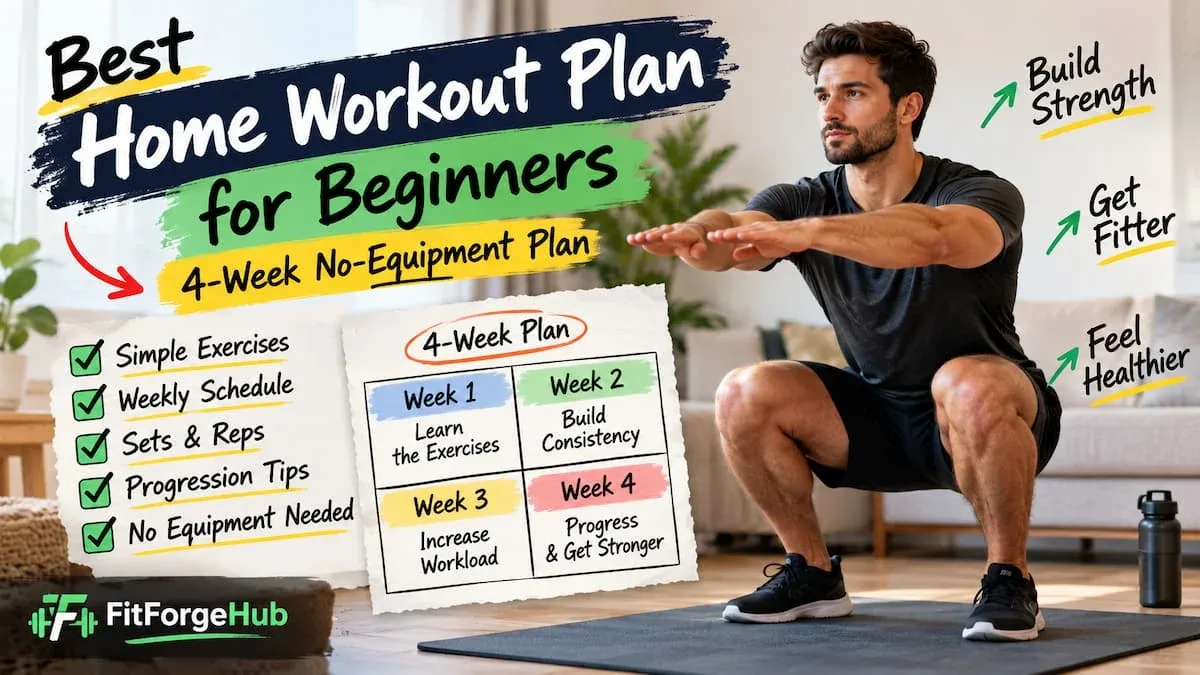
Quick Overview of the 4 Week Plan
The goal of this home workout plan for beginners is simple: start with manageable workouts and gradually make them more challenging as your body adapts.
| Week | Main Goal | Training Approach |
|---|---|---|
| Week 1 | Learn the exercises | 3 easy full-body sessions |
| Week 2 | Build consistency | Gradually add repetitions |
| Week 3 | Increase workload | Add sets where appropriate |
| Week 4 | Progress exercises | Try harder variations when ready |

A simple weekly schedule looks like this:
Monday: Full-body workout
Tuesday: Rest or easy walking
Wednesday: Full-body workout
Thursday: Rest or gentle mobility
Friday: Full-body workout
Saturday: Optional easy walking
Sunday: Rest
This three-day strength schedule also leaves room for other physical activity during the week. According to the CDC physical activity guidelines, adults should aim for at least 150 minutes of moderate-intensity aerobic activity each week and muscle-strengthening activity on at least two days.
Who Is This Home Workout Plan for Beginners For?
This home workout plan for beginners is designed for people who are new to structured exercise and want a straightforward routine they can perform at home.
It may be suitable if you:
- Are new to regular exercise
- Want to train at home
- Don’t currently own workout equipment
- Prefer a simple three-day schedule
- Want to develop basic strength and movement skills
- Need a routine that can gradually become more challenging
You don’t need to perform every exercise perfectly during your first workout. During Week 1, your main priorities are learning the movements, finding comfortable exercise variations, and becoming familiar with the routine.
What Equipment Do You Need?
One advantage of this home workout plan for beginners is that you don’t need dumbbells, barbells, or workout machines.
You mainly need enough floor space to move safely.
An exercise mat is optional. A sturdy wall, chair, or stable elevated surface can also be useful when you need an easier exercise variation.
Wear comfortable clothing that allows you to move freely and keep water nearby.
Start With a 5 Minute Warm-Up
Before starting the main workout, spend approximately five minutes gradually preparing your body for exercise.
March in Place — 60 Seconds
Begin at a comfortable pace and gradually increase your movement.
Arm Circles — 30 Seconds Each Direction
Perform controlled circles without forcing your shoulders through an uncomfortable range of motion.
Hip Hinges — 10 Repetitions
Push your hips backward while maintaining a comfortable and controlled torso position.
Easy Bodyweight Squats — 8–10 Repetitions
Use a comfortable depth and focus on smooth movement.
Wall Push-Ups — 8 Repetitions
Perform several controlled repetitions to prepare your upper body.
Your warm-up shouldn’t leave you exhausted. Its purpose is simply to prepare you for the main session.
Bodyweight training can count as muscle-strengthening activity when the exercises challenge your muscles. The CDC’s muscle-strengthening guidance includes bodyweight movements such as push-ups as examples of strengthening exercise.
7 Exercises for Your Home Workout Plan for Beginners
The following exercises form the main workout. Perform this routine on Monday, Wednesday, and Friday while using the progression guidelines later in this guide.

1. Bodyweight Squat
Beginner target: 2–3 sets of 8–15 repetitions
Stand with your feet in a comfortable position. Push your hips back and bend your knees as you lower yourself under control. Descend only as far as you can comfortably manage before standing back up.
Make it easier: Place a sturdy chair behind you and squat toward the seat.
Make it harder: Take approximately three seconds to lower yourself during each repetition.
Common mistake: Don’t force yourself into a deeper squat if doing so causes you to lose control.
2. Wall or Incline Push-Up
Beginner target: 2–3 sets of 6–12 repetitions
Place your hands against a wall or stable elevated surface. Keep your body controlled as you bend your elbows and bring your chest toward the surface. Push back to the starting position.
Make it easier: Perform the exercise against a wall.
Make it harder: Move your hands to a lower stable surface.
As your upper-body strength improves, you may eventually progress toward floor push-ups.
3. Reverse Lunge
Beginner target: 2 sets of 6–10 repetitions per leg
Stand upright and step one foot backward. Lower yourself under control and then return to the starting position.
You can lightly hold a wall or stable surface if you need help with balance.
Alternative: If reverse lunges are currently uncomfortable, use controlled chair squats while gradually improving your balance and lower-body strength.
If you want to spend more time strengthening your lower body without buying equipment, try our Home Leg Workout Without Equipment for additional beginner-friendly leg exercises.
4. Glute Bridge
Beginner target: 2–3 sets of 10–15 repetitions
Lie on your back with your knees bent and feet on the floor.
Lift your hips under control, briefly squeeze your glutes near the top, and then slowly return to the starting position.
Avoid excessively arching your lower back simply to lift your hips higher.
5. Bird Dog
Beginner target: 2 sets of 6–10 repetitions per side
Begin on your hands and knees.
Slowly extend one arm and the opposite leg while trying to keep your torso stable. Return them to the starting position and repeat on the opposite side.
Prioritize control instead of trying to lift your arm or leg as high as possible.
6. Standing Calf Raise
Beginner target: 2 sets of 12–20 repetitions
Stand upright and slowly rise onto the balls of your feet.
Pause briefly before lowering your heels under control.
You can lightly hold a wall or stable object if you need additional balance.
7. Plank
Beginner target: 2 sets of 15–30 seconds
Maintain a controlled body position while continuing to breathe normally.
End your set when you can no longer maintain a comfortable position.
Easier option: Perform an elevated plank using a stable surface.
These seven exercises allow the home workout plan for beginners to train multiple major muscle groups without requiring traditional gym equipment.
How Long Should You Rest Between Sets?
For this home workout plan for beginners, approximately 60–90 seconds of rest between sets is a reasonable starting point for many people.
However, you don’t need to follow a stopwatch perfectly.
If you’re still breathing heavily or don’t feel ready to perform another controlled set, take a little more recovery time.
The goal is not to rush through the workout. Focus on performing controlled repetitions with reasonable technique.
4-Week Home Workout Plan for Beginners
Now let’s turn the exercises into a progressive four-week program.
Week 1 — Learn the Movements
During your first week, focus on becoming familiar with each exercise.
Perform approximately 2 sets of each movement and stay near the lower end of the recommended repetition ranges.
An example session could look like:
Bodyweight Squat: 2 × 8
Wall Push-Up: 2 × 6
Reverse Lunge: 2 × 6 per leg
Glute Bridge: 2 × 10
Bird Dog: 2 × 6 per side
Calf Raise: 2 × 12
Plank: 2 × 15 seconds
You don’t need to deliberately train until you can’t perform another repetition.
The main objective of Week 1 is completing your three scheduled sessions while learning the exercises.
Week 2 — Add Repetitions
During Week 2 of the home workout plan for beginners, keep the same basic exercises but try gradually increasing your repetitions where appropriate.
For example, if you completed:
2 × 8 bodyweight squats
during Week 1, you might progress toward:
2 × 10–12 bodyweight squats
during Week 2.
You don’t need to increase every exercise during every session.
Progress where you can while keeping your repetitions controlled.
Week 3 — Increase Your Workload
By Week 3, the exercises should feel more familiar.
If you’re recovering well and maintaining good control, consider adding a third set to some of the main exercises.
For example:
Bodyweight Squat: 3 × 10–15
Incline Push-Up: 3 × 8–12
Glute Bridge: 3 × 12–15
You can keep exercises such as Bird Dogs or Lunges at two sets if adding another set feels excessive.
The purpose is gradual progression, not making every workout as difficult as possible.
Week 4 — Progress Selected Exercises
During the final week of this home workout plan for beginners, consider making selected exercises slightly more challenging rather than endlessly adding repetitions.
For example:
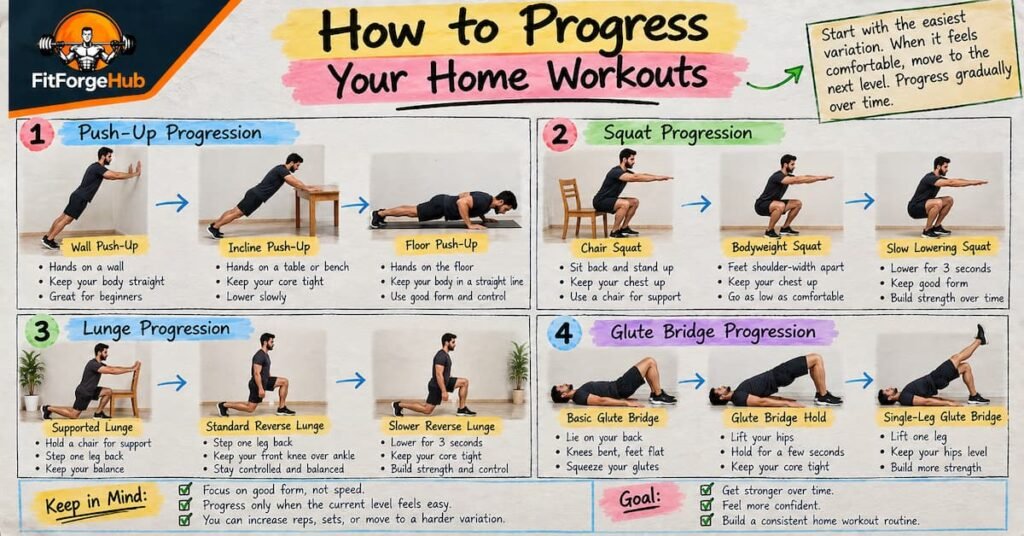
Wall Push-Up → Incline Push-Up
Chair-Assisted Squat → Regular Bodyweight Squat
15-Second Plank → 20–30-Second Plank
Regular Squat → Slow 3-Second Lowering Squat
Only move to a harder variation when you can perform the current version with reasonable control.
How Do You Know When to Progress?
Progress should be based on your actual performance rather than the calendar alone.
Suppose your target for incline push-ups is 6–12 repetitions.
During your first session, you might complete:
Set 1: 8 reps
Set 2: 7 reps
After several workouts, you may eventually reach:
Set 1: 12 reps
Set 2: 12 reps
If those repetitions feel controlled, you can consider making the exercise slightly more challenging, such as using a lower stable surface.
This progression method helps your home workout plan for beginners continue providing a useful challenge.
What If the Workout Is Too Difficult?
There’s nothing wrong with adjusting the routine to your current ability.
During your first week, you can perform only one or two sets of each exercise if necessary.
You can also choose easier variations.
Push-ups too difficult?
Start with wall push-ups.
Squats too difficult?
Use a sturdy chair as a depth target.
Planks too difficult?
Perform an elevated plank or reduce the duration.
Lunges too difficult?
Use a stable support for balance or temporarily perform additional squats.
An easier variation gives you an exercise you can practice consistently and progress over time.

What If the Workout Becomes Too Easy?
As you become stronger, your original routine may stop feeling challenging.
You don’t necessarily need to purchase equipment immediately.
Try progressing one training variable at a time:
- Add repetitions within the recommended range.
- Add another set where appropriate.
- Slow down the lowering portion of an exercise.
- Increase your controlled range of motion.
- Progress to a more challenging exercise variation.
Once bodyweight exercises become too easy, you can add resistance and follow a Full Body Dumbbell Workout for Beginners to continue building strength at home.
How Hard Should Beginners Train?
A home workout plan for beginners doesn’t need to leave you completely exhausted after every session.
For many sets, aim to finish while feeling that you could still perform a few additional controlled repetitions.
This approach allows you to practice the exercises while gradually adapting to regular training.
As you gain experience, you’ll become better at judging how challenging your sets should be.
What Should You Do on Rest Days?
Rest days are deliberately included in the program.
That doesn’t mean you must remain completely inactive.
Easy activities can include:
- Walking
- Gentle mobility exercises
- Light stretching
- Normal daily activities
However, you don’t need to add another difficult workout between every scheduled strength session.
Recovery is part of a sustainable training routine.
Track Your Home Workouts
Keeping a basic workout log can make this home workout plan for beginners more useful because you’ll be able to see whether your performance is improving.
Your log doesn’t need to be complicated.
| Exercise | Week 1 | Week 2 | Week 3 | Week 4 |
|---|---|---|---|---|
| Squat | 2×8 | 2×12 | 3×12 | 3×15 |
| Wall/Incline Push-Up | 2×6 | 2×9 | 3×9 | Harder variation |
| Glute Bridge | 2×10 | 2×15 | 3×12 | 3×15 |
| Plank | 2×15 sec | 2×20 sec | 2×25 sec | 2×30 sec |
These numbers are only examples.
Record the sets, repetitions, and variations you actually complete.
If your repetitions gradually increase or you’re able to perform a more challenging variation, you have a clear sign of progress.
Common Beginner Workout Mistakes
Doing Too Much in Week One
Starting a new routine can be motivating, but adding extra workouts immediately isn’t always necessary.
Begin with the planned schedule and allow yourself time to adapt.
Changing Exercises Every Workout
You don’t need a completely different routine every day.
Repeating basic exercises gives you an opportunity to practice technique and compare your performance from one session to another.
Progressing Too Quickly
Adding more repetitions, sets, and harder exercises simultaneously can make it difficult to manage your training.
Progress gradually and pay attention to how you’re recovering.
Ignoring Exercise Control
Don’t sacrifice controlled movement simply to achieve a larger repetition number.
Quality repetitions are more useful than rushing through your sets.
Expecting a Complete Transformation in Four Weeks
A 4-week home workout plan for beginners can help you establish consistency and improve your ability to perform the exercises, but fitness is a long-term process.
Think of these four weeks as the beginning of your training rather than the finish line.
What Should You Do After Week 4?
Once you’ve completed all four weeks, review your workout log.
If the exercises are still challenging, you can repeat the program while gradually improving your repetitions and movement quality.
If the bodyweight exercises have become relatively easy, progress to harder variations.
If you’re ready to begin resistance training, our Complete Dumbbell Workout Guide for Beginners can help you make the transition from bodyweight exercises to structured dumbbell training.
This creates a logical next step instead of repeating exactly the same beginner workout indefinitely.
Frequently Asked Questions
Is This Home Workout Plan for Beginners Suitable Without Equipment?
Yes. This home workout plan for beginners primarily uses bodyweight exercises. A wall, sturdy chair, or stable elevated surface can help with modifications, but traditional gym equipment isn’t required.
How Many Days a Week Should a Beginner Work Out?
This program uses three full-body sessions each week.
Monday, Wednesday, and Friday is one simple option because it provides a recovery day between the main workouts.
Your exact days can change depending on your schedule
How Long Should a Beginner Home Workout Take?
Workout duration depends on the number of sets you perform and how much rest you need.
Don’t reduce your rest periods simply to finish the session as quickly as possible. Give yourself enough time to perform the next set with reasonable control.
Can I Do This Workout Every Day?
The program is designed around three main strength-training days rather than performing the same full-body routine every day.
Use the days between sessions for recovery or easy activity.
What Happens If I Miss a Workout?
Missing one session doesn’t mean the entire program has failed.
Continue with your schedule while maintaining reasonable recovery between your main strength sessions.
Avoid performing several workouts back-to-back simply to catch up.
When Should I Start Using Dumbbells?
There is no specific week when everyone needs to add weights.
Consider adding resistance when bodyweight variations are becoming too easy or when you want more options for progressing your training.
Final Thoughts
A successful home workout plan for beginners doesn’t require hundreds of different exercises
A few basic movements that you’ll be able to perform with consistency and correct form will give you the best chance at long term success.
Throughout these 4 weeks, you should be focusing on 3 main areas of development.
If you’re ready for a more structured three-day training split, the Beginner Push Pull Legs Workout at Home is another option for your next training phase.
Learning the movements, developing consistency, and progressing at a steady but reasonable pace.
You’ll be tracking your workouts and taking small steps forward with your fitness, instead of taking big leaps that could potentially lead to injury.
Once you finish this home workout plan for beginners, you can either continue to develop your bodyweight skills or move onto the next stage of your fitness journey which would be resistance training with dumbbells or bands.