
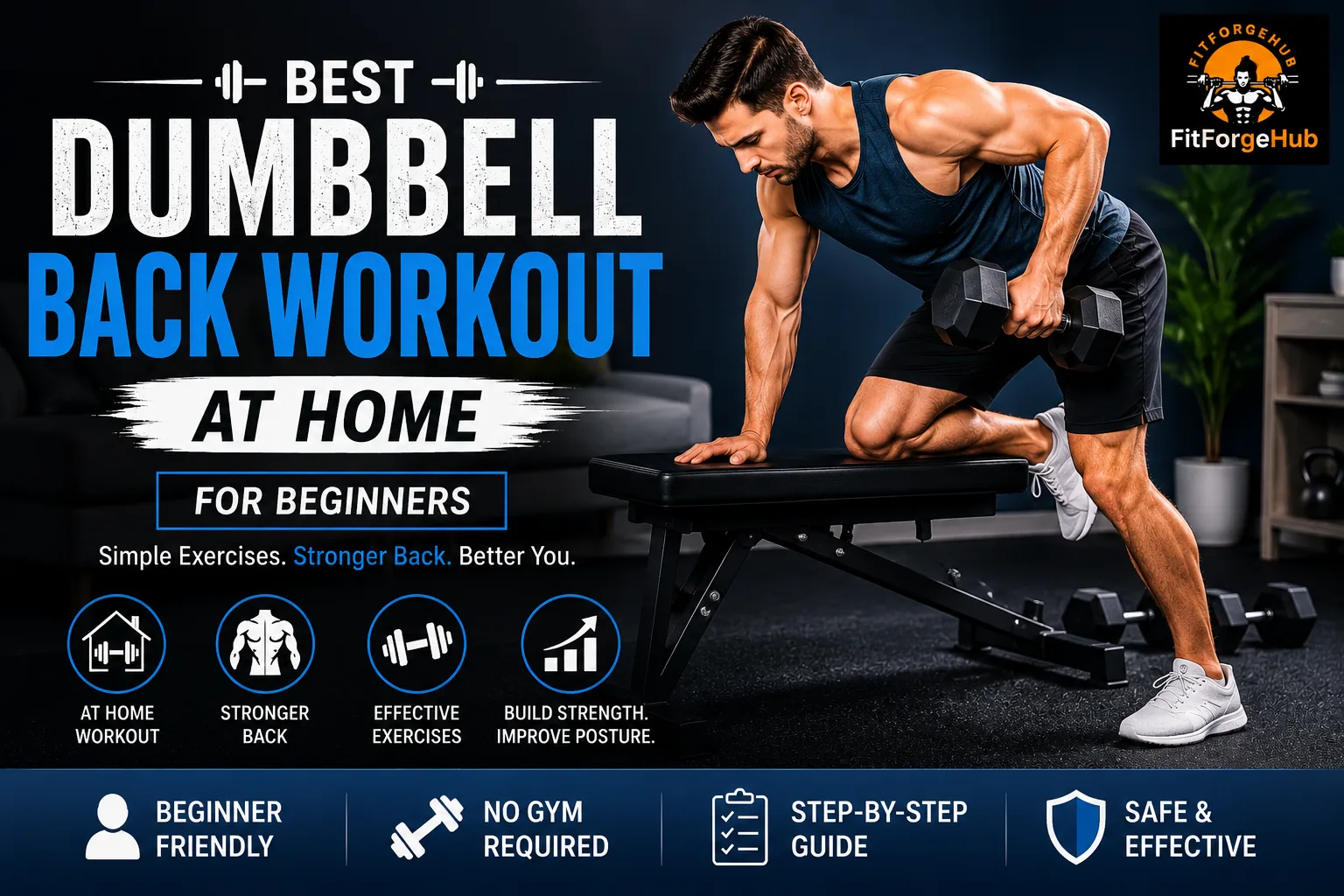
Building a stronger back doesn’t require a gym membership or a complicated home gym. With a pair of dumbbells and enough space to exercise safely, you can train several important back muscles at home.
A dumbbell back workout at home can help beginners strengthen the upper back, lats, rear shoulders, and supporting muscles while improving overall upper-body strength. The key is to use an appropriate weight, maintain good technique, and gradually make your workouts more challenging.
In this guide, you’ll learn the best dumbbell back exercises for beginners, how many sets and reps to perform, how to warm up, how to choose the right dumbbell weight, common mistakes to avoid, and how to build a simple back workout you can do at home.
Quick Answer: Beginners can start with 4–5 dumbbell back exercises, performing about 2–3 sets of 8–15 controlled repetitions per exercise. Focus on technique first, then gradually increase repetitions or resistance as you become stronger.
Table of Contents
- Can You Build Your Back With Dumbbells at Home?
- What Muscles Does a Dumbbell Back Workout Train?
- What Equipment Do You Need?
- Best Dumbbell Back Workout at Home
- 1. One-Arm Dumbbell Row
- 2. Bent-Over Dumbbell Row
- 3. Dumbbell Reverse Fly
- 4. Dumbbell Romanian Deadlift
- 5. Dumbbell Pullover
- 6. Dumbbell Shrugs
- How to Warm Up Before a Back Workout
- How Heavy Should Your Dumbbells Be?
- How Many Sets and Reps Should Beginners Do?
- How Often Should You Train Your Back?
- How to Progress Your Dumbbell Back Workout
- Common Dumbbell Back Workout Mistakes
- Beginner Dumbbell Back Workout Routine
- Frequently Asked Questions
- Final Thoughts
- About the Author
Can You Build Your Back With Dumbbells at Home?
Yes, you can train and strengthen your back at home with dumbbells.
Dumbbells allow you to perform pulling, rowing, hinging, and upper-back movements without needing a cable machine or large gym setup.
Some of the most useful dumbbell back exercises include:
- One-arm dumbbell rows
- Bent-over dumbbell rows
- Reverse flys
- Dumbbell Romanian deadlifts
- Dumbbell pullovers
- Dumbbell shrugs
Different exercises emphasize different muscles and movement patterns.
For beginners, you don’t need to perform all of them in one workout. A few well-selected exercises performed consistently can be enough to build a solid foundation.
If you’re following our beginner dumbbell series, start by reading our Full Body Dumbbell Workout for Beginners.
Suggested URL:
/full-body-dumbbell-workout-for-beginners/
What Muscles Does a Dumbbell Back Workout Train?
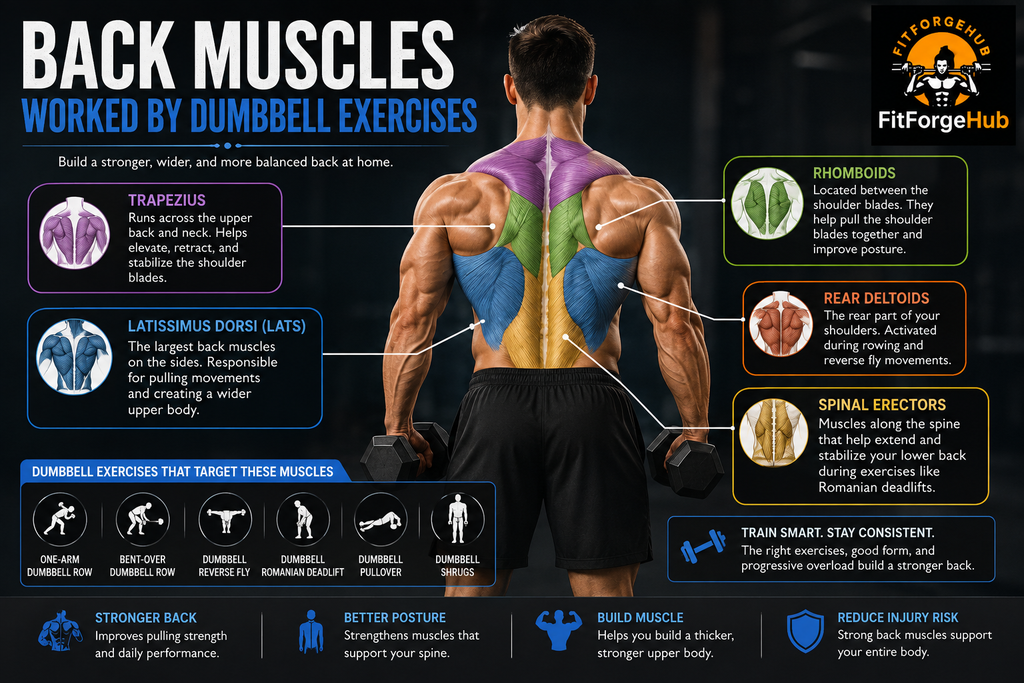
Your back isn’t one single muscle. It contains several muscles that work together during pulling and lifting movements.
A dumbbell back workout can involve:
Latissimus Dorsi
Often called the lats, these large muscles on the sides of your back contribute to pulling movements and help create a wider-looking upper body.
Trapezius
The trapezius muscles extend across the upper back and neck area and help with shoulder and upper-back movements.
Rhomboids
The rhomboids sit between the shoulder blades and contribute to pulling the shoulder blades together.
Rear Deltoids
Although they’re part of the shoulders, the rear deltoids work during several upper-back exercises, particularly reverse fly variations.
Spinal Erectors
These muscles run along your spine and help stabilize and extend your torso during movements such as Romanian deadlifts.
Training these muscles together can help you develop a more balanced upper body.
What Equipment Do You Need?
You don’t need a full home gym.
Basic Equipment
- Pair of dumbbells
- Exercise mat
- Clear floor space
- Water bottle
Optional Equipment
- Adjustable dumbbells
- Workout bench
- Resistance bands
Many exercises in this guide can be performed without a bench.
If you’re building your home gym gradually, adjustable dumbbells can be particularly useful because you can increase or decrease resistance as your strength changes.
Best Dumbbell Back Workout at Home
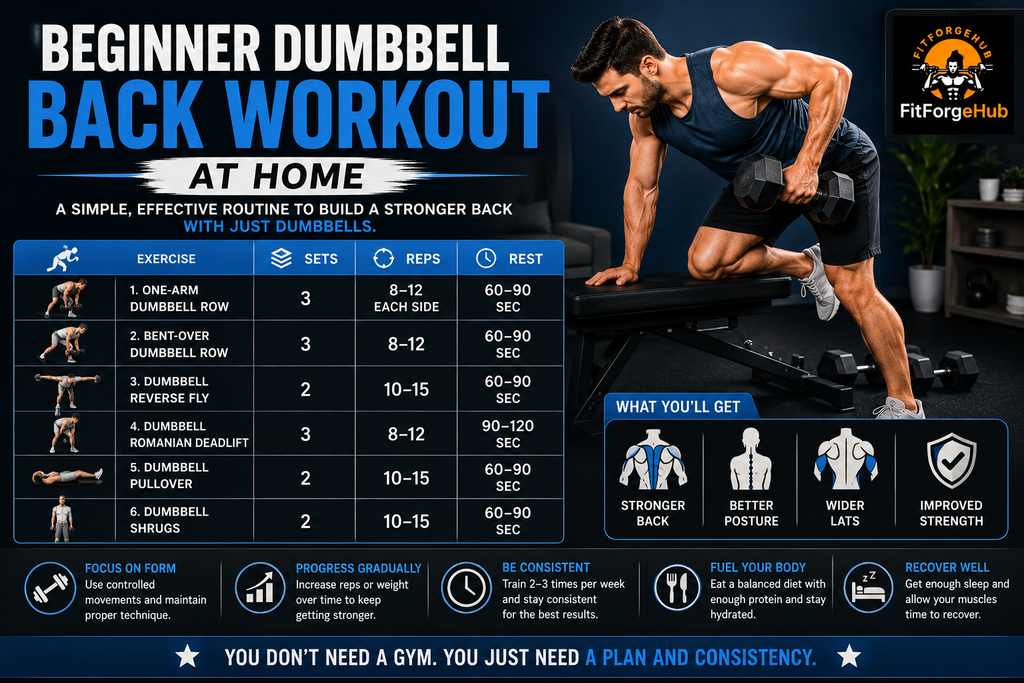
A simple dumbbell back workout routine with beginner-friendly exercises, sets, reps, and rest periods.Here’s a beginner-friendly routine you can use at home.
| Exercise | Sets | Reps | Rest |
| One-Arm Dumbbell Row | 3 | 8–12/side | 60–90 sec |
| Bent-Over Dumbbell Row | 3 | 8–12 | 60–90 sec |
| Dumbbell Reverse Fly | 2 | 10–15 | 60–90 sec |
| Dumbbell Romanian Deadlift | 3 | 8–12 | 90–120 sec |
| Dumbbell Pullover | 2 | 10–15 | 60–90 sec |
| Dumbbell Shrugs | 2 | 10–15 | 60–90 sec |
Beginner Modification
If you’re new to resistance training, start with:
- One-arm dumbbell row
- Bent-over dumbbell row
- Romanian deadlift
- Reverse fly
You can add the other exercises as you become more comfortable.
Quality is more important than quantity.
1. One-Arm Dumbbell Row
The one-arm dumbbell row is one of the most practical dumbbell exercises for training your back at home.
It primarily involves the upper back and lats while also requiring your core to stabilize your body.
How to Perform a One-Arm Dumbbell Row
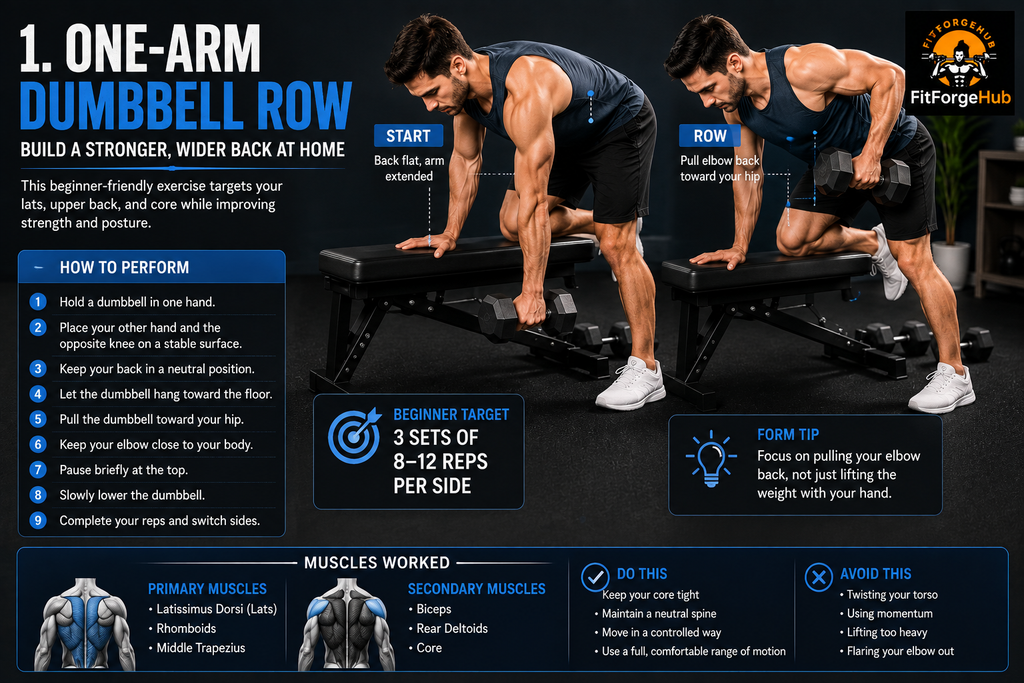
- Hold a dumbbell in one hand.
- Place your other hand on a stable surface if needed.
- Keep your back in a neutral position.
- Let the dumbbell hang toward the floor.
- Pull the dumbbell toward your hip.
- Keep your elbow relatively close to your body.
- Pause briefly at the top.
- Slowly lower the dumbbell.
- Complete your repetitions and switch sides.
Beginner target: 3 sets of 8–12 repetitions per side.
Form Tip
Think about pulling your elbow backward rather than simply lifting the dumbbell with your hand.
Avoid twisting your torso to move the weight.
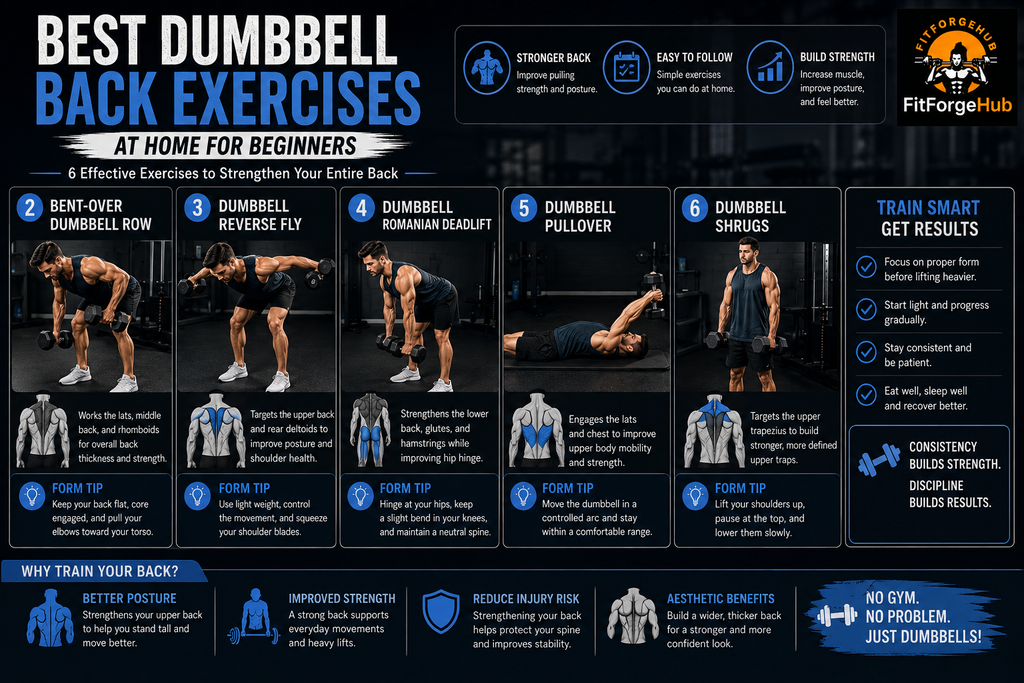
2. Bent-Over Dumbbell Row
The bent-over dumbbell row allows you to train both sides of your upper body at the same time.
How to Perform It
- Stand with your feet approximately hip-width apart.
- Hold a dumbbell in each hand.
- Slightly bend your knees.
- Push your hips backward.
- Keep your spine in a comfortable neutral position.
- Let your arms hang toward the floor.
- Pull the dumbbells toward your torso.
- Lower them slowly.
- Repeat.
Beginner target: 3 sets of 8–12 reps.
Common Mistake
Don’t turn the movement into a full-body swing.
If you need to jerk your torso to move the dumbbells, reduce the weight.
3. Dumbbell Reverse Fly
The dumbbell reverse fly targets the upper back and rear shoulder area.
Because the movement uses relatively small muscles and a long lever, you generally don’t need heavy dumbbells.
How to Perform a Reverse Fly
- Hold a light dumbbell in each hand.
- Hinge forward at your hips.
- Keep your back in a comfortable neutral position.
- Let the dumbbells hang beneath your shoulders.
- Raise your arms outward.
- Stop when your arms are approximately in line with your torso.
- Slowly lower the weights.
Beginner target: 2 sets of 10–15 reps.
Beginner Tip
Use light weights and focus on controlled movement.
Heavy dumbbells often cause people to use momentum rather than the muscles they are trying to train.
4. Dumbbell Romanian Deadlift
The dumbbell Romanian deadlift is primarily a hip-hinge exercise that trains the hamstrings and glutes while also challenging the muscles responsible for stabilizing your back.
It can be a useful addition to a full-body or posterior-chain workout.
How to Perform It
- Stand with your feet about hip-width apart.
- Hold dumbbells in front of your thighs.
- Keep your knees slightly bent.
- Push your hips backward.
- Lower the dumbbells along the front of your legs.
- Keep your back in a comfortable neutral position.
- Stop when you feel an appropriate stretch in the back of your legs.
- Push through your feet and bring your hips forward.
- Return to the starting position.
Beginner target: 3 sets of 8–12 reps.
Important Form Tip
The movement should come primarily from your hips, not from rounding your back.
If you’re unfamiliar with the hip-hinge movement, practice with very light weights first.
5. Dumbbell Pullover
The dumbbell pullover can involve the chest and muscles around the upper body, making it a useful accessory exercise in some home workouts.
How to Perform It
- Lie on a stable floor surface.
- Hold one dumbbell securely with both hands.
- Position the dumbbell above your chest.
- Slowly move it backward over your head.
- Move only through a comfortable range of motion.
- Bring the dumbbell back above your chest.
Beginner target: 2 sets of 10–15 reps.
Safety Tip
Use a light weight when learning this exercise.
Don’t force your shoulders into a range that feels painful or uncomfortable.
You can also include this exercise in your chest routine from Article #9: Best Dumbbell Chest Workout at Home.
Suggested URL:
/best-dumbbell-chest-workout-at-home/
6. Dumbbell Shrugs
Dumbbell shrugs primarily train the upper trapezius muscles.
They’re simple to perform and require very little equipment.
How to Perform Dumbbell Shrugs
- Stand upright with a dumbbell in each hand.
- Keep your arms relaxed beside your body.
- Lift your shoulders upward.
- Pause briefly.
- Lower your shoulders in a controlled manner.
- Repeat.
Beginner target: 2 sets of 10–15 reps.
Avoid This
Don’t roll your shoulders in large circles.
Focus on a controlled upward and downward movement.
How to Warm Up Before a Back Workout
Spend approximately 5–10 minutes warming up before your workout.
A simple warm-up can include:
- Light walking
- Arm circles
- Shoulder rotations
- Bodyweight hip hinges
- Light rows
- Gentle dynamic movements
Start your first exercise with a lighter weight before moving to your normal working resistance.
A warm-up should prepare you for the workout rather than exhaust you before the first set.
How Heavy Should Your Dumbbells Be?
There’s no single dumbbell weight that’s appropriate for every beginner.
The right resistance depends on:
- Your current strength
- Exercise selection
- Training experience
- Technique
- Fitness goal
Choose a weight that allows you to complete the planned repetitions with good control.
For example, if your target is 8–12 repetitions and you can only perform four controlled repetitions, the weight may be too heavy.
If you can perform 25 repetitions without the exercise becoming challenging, you may eventually need more resistance.
The Goal
Your final few repetitions should feel challenging while your technique remains controlled.
Don’t sacrifice form just to lift heavier dumbbells.
How Many Sets and Reps Should Beginners Do?
For many beginner back exercises, 2–3 sets of 8–15 repetitions is a practical starting range.
However, different exercises can use different repetition targets.
| Exercise | Sets | Reps |
| One-Arm Row | 3 | 8–12 |
| Bent-Over Row | 3 | 8–12 |
| Reverse Fly | 2 | 10–15 |
| Romanian Deadlift | 3 | 8–12 |
| Pullover | 2 | 10–15 |
| Shrugs | 2 | 10–15 |
You don’t need to perform every exercise in every workout.
Start with a manageable amount of training volume and increase gradually.
For additional evidence-based guidance on building an effective resistance training program, see the American College of Sports Medicine’s resistance training recommendations.
For general resistance-training guidance, you can also refer to the American College of Sports Medicine (ACSM) resources.
How Often Should You Train Your Back?
Beginners generally don’t need to train their back every day.
A full-body program performed 2–3 times per week can train the back regularly while giving you recovery days.
For example:
| Day | Workout |
| Monday | Full Body |
| Tuesday | Rest / Light Activity |
| Wednesday | Full Body |
| Thursday | Rest |
| Friday | Full Body |
| Saturday | Light Activity |
| Sunday | Rest |
The CDC recommends that adults include muscle-strengthening activity on at least 2 days per week as part of their overall physical activity routine.
Your ideal schedule can vary depending on your workout program, experience, recovery, and goals.
How to Progress Your Dumbbell Back Workout
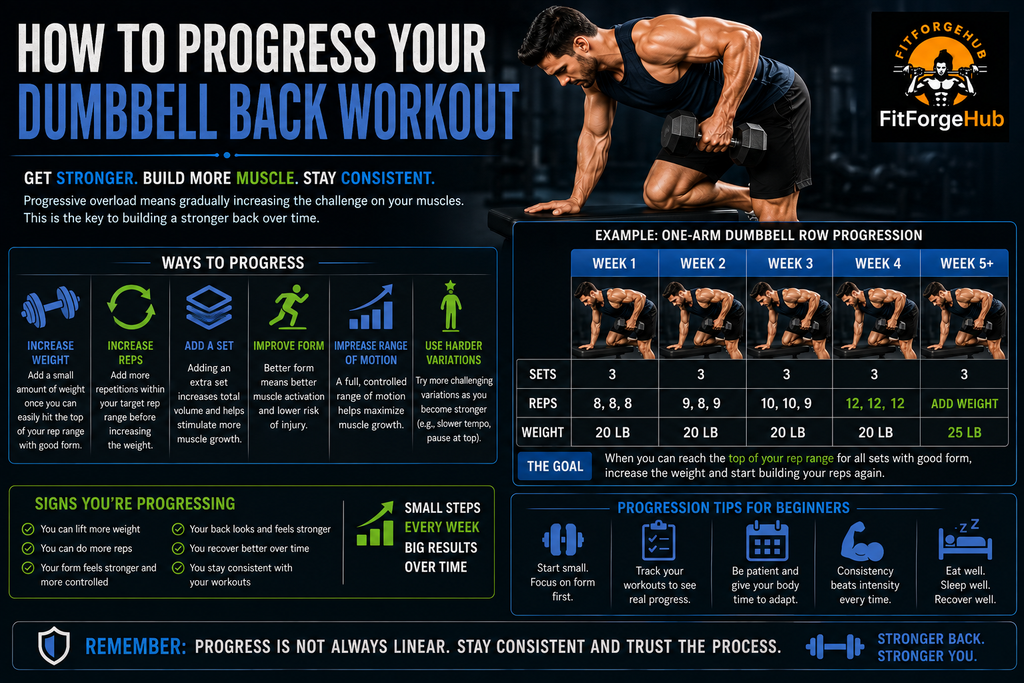
Learn how to gradually increase reps, weight, sets, and exercise difficulty to keep making progress with your dumbbell back workout.Getting stronger requires gradually increasing the challenge placed on your muscles.
This is commonly called progressive overload.
You can progress by:
- Increasing repetitions
- Increasing dumbbell weight
- Adding a set
- Improving technique
- Increasing range of motion where appropriate
- Using a more challenging variation
Example: One-Arm Row
Suppose your target is:
3 sets × 8–12 reps
You might start with:
Week 1: 8, 8, 8
Week 2: 9, 8, 9
Week 3: 10, 10, 9
Week 4: 12, 12, 12
Once you can consistently reach the upper end of your target range with good form, consider a small increase in resistance.
Then build your repetitions again.
This approach is simple and makes your progress easier to track.
Common Dumbbell Back Workout Mistakes
1. Using Too Much Weight
Heavy dumbbells can make it difficult to maintain proper technique.
Start lighter and progress gradually.
2. Using Momentum
Swinging the dumbbell may make the exercise look easier, but it can reduce your control.
Keep the movement deliberate.
3. Rounding Your Back
This is especially important during bent-over rows and Romanian deadlifts.
Maintain a comfortable, controlled spinal position.
4. Moving Only Your Hands
During rowing exercises, think about moving your elbows toward your torso rather than simply pulling with your hands.
5. Training Back Every Day
More training isn’t automatically better.
Allow your muscles enough recovery between challenging sessions.
6. Doing Too Many Exercises
You don’t need a dozen back exercises.
Start with a few effective movements and focus on getting stronger over time.
7. Ignoring Other Muscle Groups
A strong back is only one part of a balanced fitness program.
Make sure your weekly routine also includes your:
- Chest
- Shoulders
- Arms
- Legs
- Core
For chest training, see our previous guide:
Best Dumbbell Chest Workout at Home
Beginner Dumbbell Back Workout Routine
If you’re completely new to training, try this shorter workout:
| Exercise | Sets | Reps | Rest |
| One-Arm Dumbbell Row | 3 | 8–12/side | 60–90 sec |
| Bent-Over Dumbbell Row | 3 | 8–12 | 60–90 sec |
| Reverse Fly | 2 | 10–15 | 60–90 sec |
| Romanian Deadlift | 3 | 8–12 | 90–120 sec |
Optional Finisher
Dumbbell Shrugs — 2 × 10–15
You don’t have to add the finisher if your workout already feels challenging.
How to Fit This Workout Into Your Dumbbell Program
Since this article is part of the FitForgeHub Week 2 Dumbbell Cluster, you can combine your articles into a complete program.
Day 8
Full Body Dumbbell Workout for Beginners
/full-body-dumbbell-workout-for-beginners/
Day 9
Best Dumbbell Chest Workout at Home
/best-dumbbell-chest-workout-at-home/
Day 10
Best Dumbbell Back Workout at Home
Current article.
Future Day 11
Best Dumbbell Leg Workout for Beginners
Future Day 12
Best Dumbbell Shoulder Workout at Home
Future Day 14
Complete Dumbbell Workout Guide for Beginners
This structure creates a strong topical cluster around beginner dumbbell workouts.
Nutrition and Recovery for Back Muscle Growth
Exercise is only one part of building muscle and improving strength.
Your recovery and nutrition also matter.
Focus on:
- Adequate protein
- A balanced diet
- Enough calories for your goal
- Proper hydration
- Quality sleep
- Consistent training
- Recovery between challenging sessions
Good nutrition doesn’t have to be complicated.
Include protein-rich foods such as:
- Eggs
- Chicken
- Fish
- Milk
- Greek yogurt
- Beans
- Lentils
- Other protein-rich foods
If your overall goal is muscle gain, also read our:
Best Beginner Muscle Building Workout at Home
Suggested URL:
/best-beginner-muscle-building-workout-at-home/
Frequently Asked Questions
Can I build my back with dumbbells at home?
Yes. Dumbbells can provide effective resistance for several back exercises, including rows, reverse flys, shrugs, and other movements.
What is the best dumbbell back exercise for beginners?
The one-arm dumbbell row is a practical choice because it is relatively simple to learn and can be performed with minimal equipment.
Can I work out my back without a bench?
Yes. Many dumbbell back exercises, including rows, Romanian deadlifts, reverse flys, and shrugs, can be performed without a bench.
How many back exercises should beginners do?
Starting with 3–5 exercises is usually more practical than trying to perform every possible back exercise.
How many sets should I do for back?
Beginners can start with approximately 2–3 sets per exercise and adjust their training volume as they become more experienced.
How many reps should I do for a dumbbell back workout?
A practical starting range for many exercises is 8–15 controlled repetitions per set.
How often should I train my back?
Many beginners can train their back 2–3 times per week as part of a full-body routine, depending on their overall program and recovery.
Are dumbbell rows enough for back development?
Dumbbell rows are an excellent foundational exercise, but a balanced program can include different movement patterns to train different areas of the back.
Can I build a wider back with dumbbells?
Consistent resistance training can help develop the muscles of your back. Exercises such as rows can train the lats and upper back, while overall muscle development also depends on training, nutrition, recovery, and individual factors.
What should I do if a back exercise causes pain?
Stop the exercise if you experience significant or unusual pain. Don’t try to push through pain. If you have an injury or ongoing symptoms, consult an appropriate healthcare professional.
Final Thoughts
You don’t need a commercial gym to start building a stronger back.
A pair of dumbbells can provide enough resistance for a variety of effective home exercises, including:
- One-arm dumbbell rows
- Bent-over dumbbell rows
- Reverse flys
- Romanian deadlifts
- Dumbbell pullovers
- Dumbbell shrugs
If you’re a beginner, start with a manageable number of exercises and focus on proper technique.
Don’t worry about lifting the heaviest dumbbells in the room.
Instead, focus on consistent workouts, controlled repetitions, gradual progression, proper recovery, and good nutrition.
As you become stronger, gradually increase your repetitions or resistance.
For the next step in your FitForgeHub dumbbell series, check out:
Best Dumbbell Leg Workout for Beginners
Future Article #11 — add the URL after publishing.
You can also read:
- Full Body Dumbbell Workout for Beginners
- Best Dumbbell Chest Workout at Home
- Best Beginner Muscle Building Workout at Home
Important: This article is for general educational purposes and isn’t a substitute for individualized medical or fitness advice. If you have an injury, medical condition, or concerns about starting a new exercise program, consult a qualified healthcare professional before beginning a new workout routine.
About the Author
FitForgeHub Fitness Team
The FitForgeHub Fitness Team creates practical, beginner-friendly fitness content covering home workouts, dumbbell training, strength training, muscle building, workout plans, exercise techniques, and healthy lifestyle habits.
Our goal is to make fitness easier to understand by providing clear, practical workout guides that beginners can follow at home.
FitForgeHub focuses on useful fitness information designed to help readers build strength, improve consistency, and develop sustainable exercise habits.
Website: FitForgeHub.com
Disclaimer
The information published on FitForgeHub is intended for general educational purposes and is not medical advice. Exercise needs and fitness goals vary between individuals. If you have a medical condition, injury, or concerns about exercise, speak with a qualified healthcare professional before starting a new exercise program.
One thought on “Best Dumbbell Back Workout at Home: Beginner-Friendly Guide”