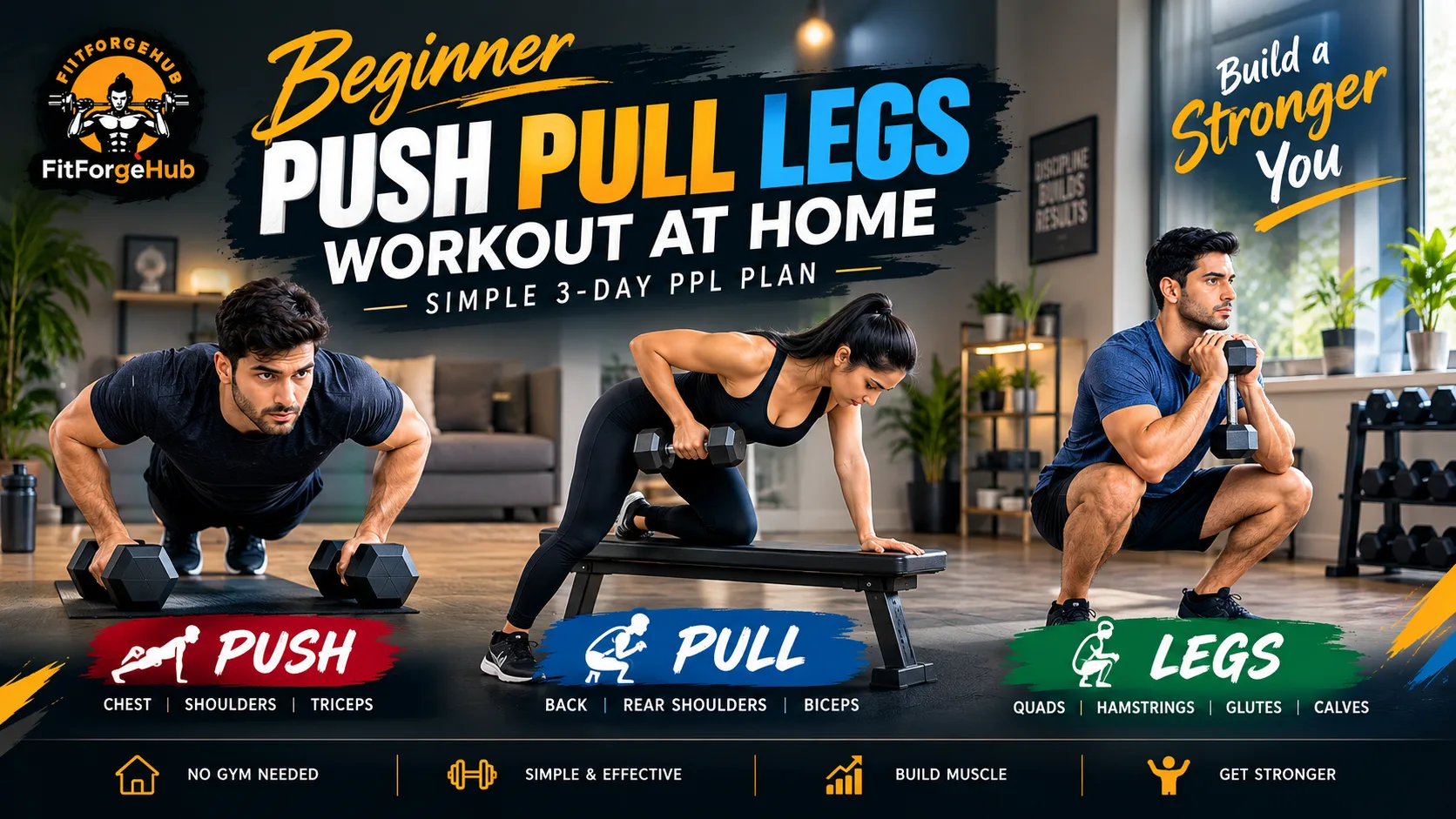
Starting a workout routine can feel confusing when you see hundreds of different exercises online.
You may wonder:
Should I train my chest today? What about my back? How many exercises do I need? How many days should I work out?
A Push Pull Legs (PPL) workout can make things much simpler.
This beginner push pull legs workout at home divides your training into three simple sessions:
- Push: Chest, shoulders, and triceps
- Pull: Back and biceps
- Legs: Quads, hamstrings, glutes, and calves
You can perform this routine with dumbbells and basic home equipment. If you don’t have weights, several exercises can be modified using bodyweight movements.
The goal isn’t to finish as many exercises as possible. The goal is to train consistently, use good form, gradually make the workouts harder, and recover properly.
Important: This article provides general fitness education and is not a substitute for individualized medical advice.
Table of Contents
- What Is a Beginner Push Pull Legs Workout at Home?
- Is PPL Good for Beginners?
- Beginner 3-Day PPL Workout at Home
- Day 1: Push Workout
- Day 2: Pull Workout
- Day 3: Legs Workout
- How Many Sets and Reps Should Beginners Do?
- How Much Rest Should You Take?
- How to Progress With a PPL Workout
- Can You Build Muscle With PPL at Home?
- PPL Workout Without Equipment
- Common Beginner Mistakes
- How to Schedule Your 3-Day PPL Workout
- Nutrition and Recovery
- Frequently Asked Questions
- Final Thoughts
- About the Author
What Is a Beginner Push Pull Legs Workout at Home?
A beginner push pull legs workout at home divides your training into push, pull, and leg sessions.
Push Pull Legs, commonly called PPL, is a workout structure that organizes exercises according to the primary movement or muscle groups being trained.
Push Day
Push exercises generally train:
- Chest
- Shoulders
- Triceps
Pull Day
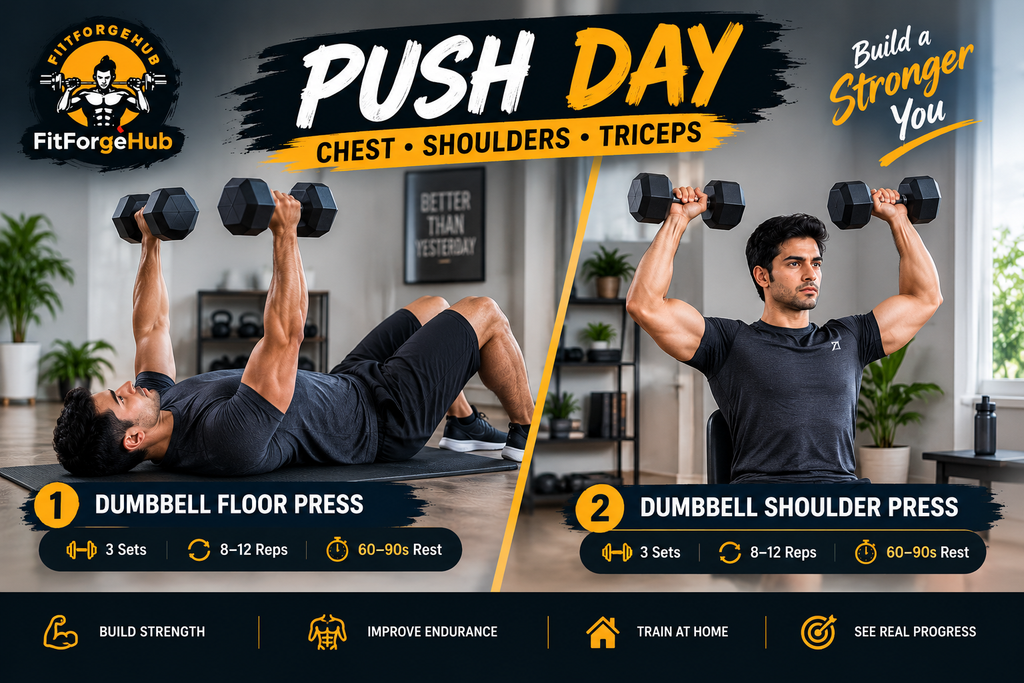
Pull exercises generally train:
- Back
- Rear shoulders
- Biceps
Leg Day
Leg exercises train:
- Quadriceps
- Hamstrings
- Glutes
- Calves
This structure makes it easier to organize your weekly training without trying to train every muscle in one long workout.
For beginners, a three-day version can be especially practical because it provides training days separated by recovery days.
Is Push Pull Legs Good for Beginners?
Yes, a simplified PPL routine can work well for beginners, especially when the program is kept manageable.
The biggest mistake beginners make is assuming that a good workout needs to be extremely long or complicated.
It doesn’t.
A beginner can make progress by focusing on:
- Consistent workouts
- Good exercise technique
- Appropriate resistance
- Enough recovery
- Gradual progression
- Adequate nutrition
The American College of Sports Medicine’s 2026 resistance-training guidance emphasizes consistency and notes that resistance training can be adapted to different goals and settings.
Beginner 3-Day Push Pull Legs Workout at Home
Here is a simple weekly structure:
| Day | Workout |
|---|---|
| Monday | Push |
| Tuesday | Rest |
| Wednesday | Pull |
| Thursday | Rest |
| Friday | Legs |
| Saturday | Rest |
| Sunday | Rest |
You can also move these days around based on your schedule.
The important thing is to give your body enough recovery between challenging sessions.
Day 1: Beginner Push Workout
Before starting this beginner push pull legs workout at home, choose weights that allow you to maintain good form.
1. Dumbbell Floor Press
Sets: 3
Reps: 8–12
Rest: 60–90 seconds
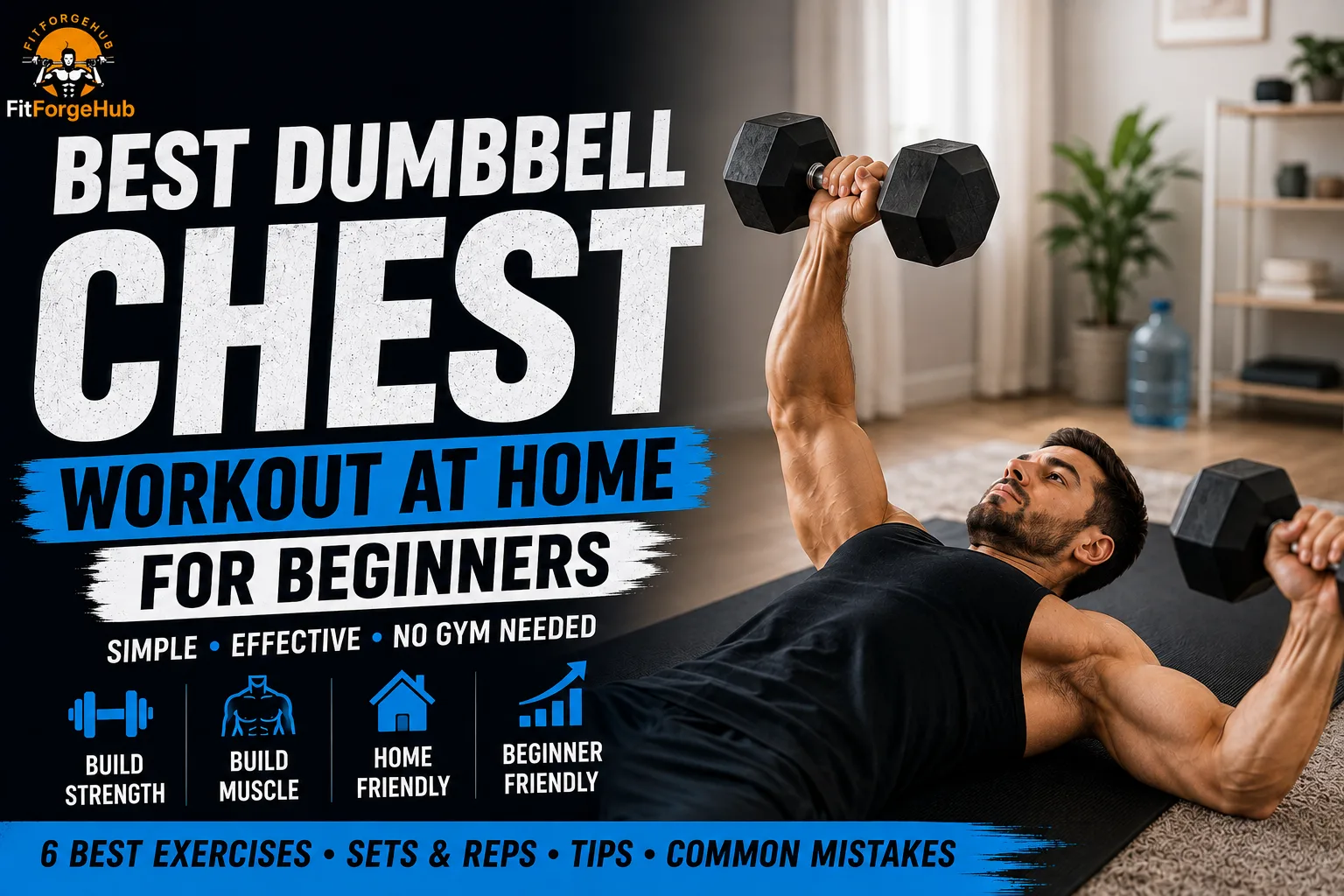
The dumbbell floor press is a useful home alternative when you don’t have a workout bench.
It primarily trains the chest while also involving the triceps and shoulders.
Focus on controlled repetitions rather than rushing through the movement.
2. Dumbbell Shoulder Press
Sets: 3
Reps: 8–12
Rest: 60–90 seconds
Sit or stand with a stable posture and press the dumbbells overhead.
Keep your core controlled and avoid using excessive momentum.
3. Dumbbell Lateral Raise
Sets: 2
Reps: 10–15
Rest: 45–60 seconds
Use lighter dumbbells and control the movement.
The goal is not to swing heavy weights.
4. Push-Ups
Sets: 2
Reps: 6–15
Choose a variation that matches your current ability.
Beginners can use:
- Wall push-ups
- Incline push-ups
- Knee push-ups
- Standard push-ups
5. Dumbbell Overhead Triceps Extension
Sets: 2
Reps: 10–15
Rest: 45–60 seconds
Keep the movement controlled and avoid using more weight than you can handle safely.
Push Workout Summary
Total exercises: 5
Approximate working sets: 12
If you’re completely new to resistance training, you can start with fewer sets and gradually build up.
Day 2: Beginner Pull Workout
After a rest day, move to your pull session.
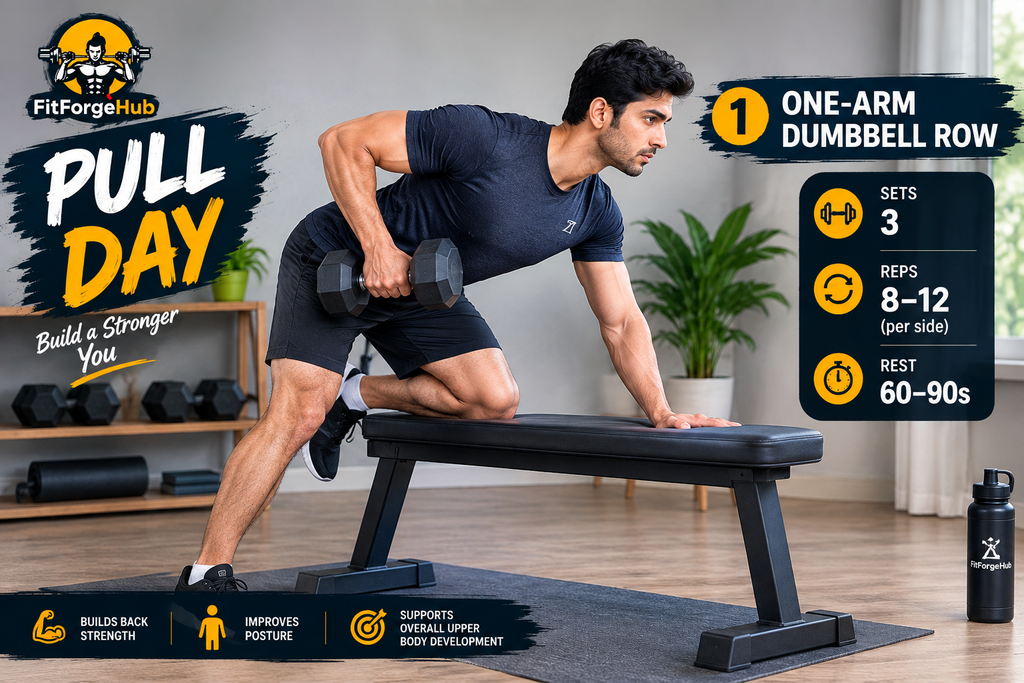
1. One-Arm Dumbbell Row
Sets: 3
Reps: 8–12 per side
This is one of the most useful dumbbell exercises for training the back at home.
Keep your back stable and pull the dumbbell toward your hip.
2. Dumbbell Bent-Over Row
Sets: 3
Reps: 8–12
Use a controlled movement and avoid excessively rounding your lower back.
3. Dumbbell Rear Delt Fly
Sets: 2
Reps: 10–15
Use light resistance and focus on controlled movement.
4. Dumbbell Curl
Sets: 2
Reps: 10–15
Keep your elbows relatively stable while curling.
5. Hammer Curl
Sets: 2
Reps: 10–15
Hammer curls use a neutral grip and can be an easy addition to a beginner pull workout.
Pull Workout Summary
Total exercises: 5
Approximate working sets: 12
If you already have a home dumbbell routine, you can also compare this session with our [Best Dumbbell Back Workout at Home] and [Complete Dumbbell Workout Guide for Beginners].
Day 3: Beginner Legs Workout
The final session trains the lower body.
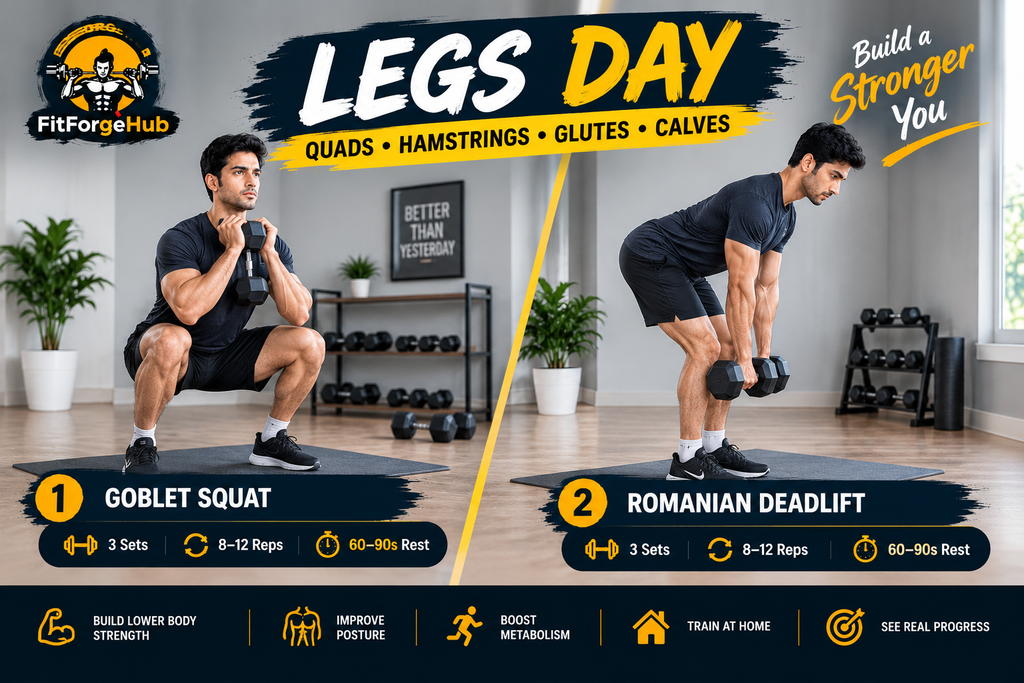
1. Goblet Squat
Sets: 3
Reps: 8–12
Hold one dumbbell close to your chest and squat while maintaining control.
2. Dumbbell Romanian Deadlift
Sets: 3
Reps: 8–12
This exercise emphasizes the posterior chain, including the hamstrings and glutes.
Keep the dumbbells close to your legs and focus on controlled hip movement.
3. Reverse Lunge
Sets: 2
Reps: 8–12 per leg
Reverse lunges can be easier for some beginners to control than forward lunges.
4. Bulgarian Split Squat
Sets: 2
Reps: 8–12 per leg
Start with bodyweight if you’re new to the movement.
5. Standing Calf Raise
Sets: 3
Reps: 12–20
Pause briefly at the top and lower your heels under control.
Legs Workout Summary
Total exercises: 5
Approximate working sets: 13
For more exercise ideas, see our [Best Dumbbell Leg Workout for Beginners at Home].
How Many Sets and Reps Should Beginners Do?
You don’t need to perform dozens of sets to make progress.
For this beginner PPL program, most exercises use:
8–12 reps for major movements.
For smaller movements such as lateral raises, curls, and calf raises:
10–20 reps can work well.
The CDC notes that muscle-strengthening activities can be performed for sets of roughly 8–12 repetitions, with one set providing benefit and two or three sets offering additional benefit.
CDC: What Counts as Physical Activity
Your actual training volume should also depend on your experience, recovery, exercise selection, and goals.
How Much Rest Should You Take?
Rest is part of the workout.
A simple starting point is:
- Big exercises: 60–120 seconds
- Smaller exercises: 45–90 seconds
If you need more time to perform your next set with good technique, take it.
Don’t sacrifice form simply because a timer says your rest period has ended.
How to Progress With a PPL Workout
This is one of the most important parts of building muscle.
Your body needs a reason to adapt.
You can gradually increase training difficulty by:
- Adding a small amount of weight
- Performing more repetitions
- Improving exercise technique
- Increasing your range of motion
- Adding a set when appropriate
- Using a more challenging variation
For example:
Week 1: 10 lb × 8 reps
Week 2: 10 lb × 10 reps
Week 3: 10 lb × 12 reps
Week 4: Slightly heavier weight × 8 reps
You don’t need to increase everything every workout.
Small, consistent improvements are enough.
ACSM’s 2026 guidance emphasizes consistency and individualized resistance-training plans rather than a one-size-fits-all program.
ACSM Resistance Training Guidance
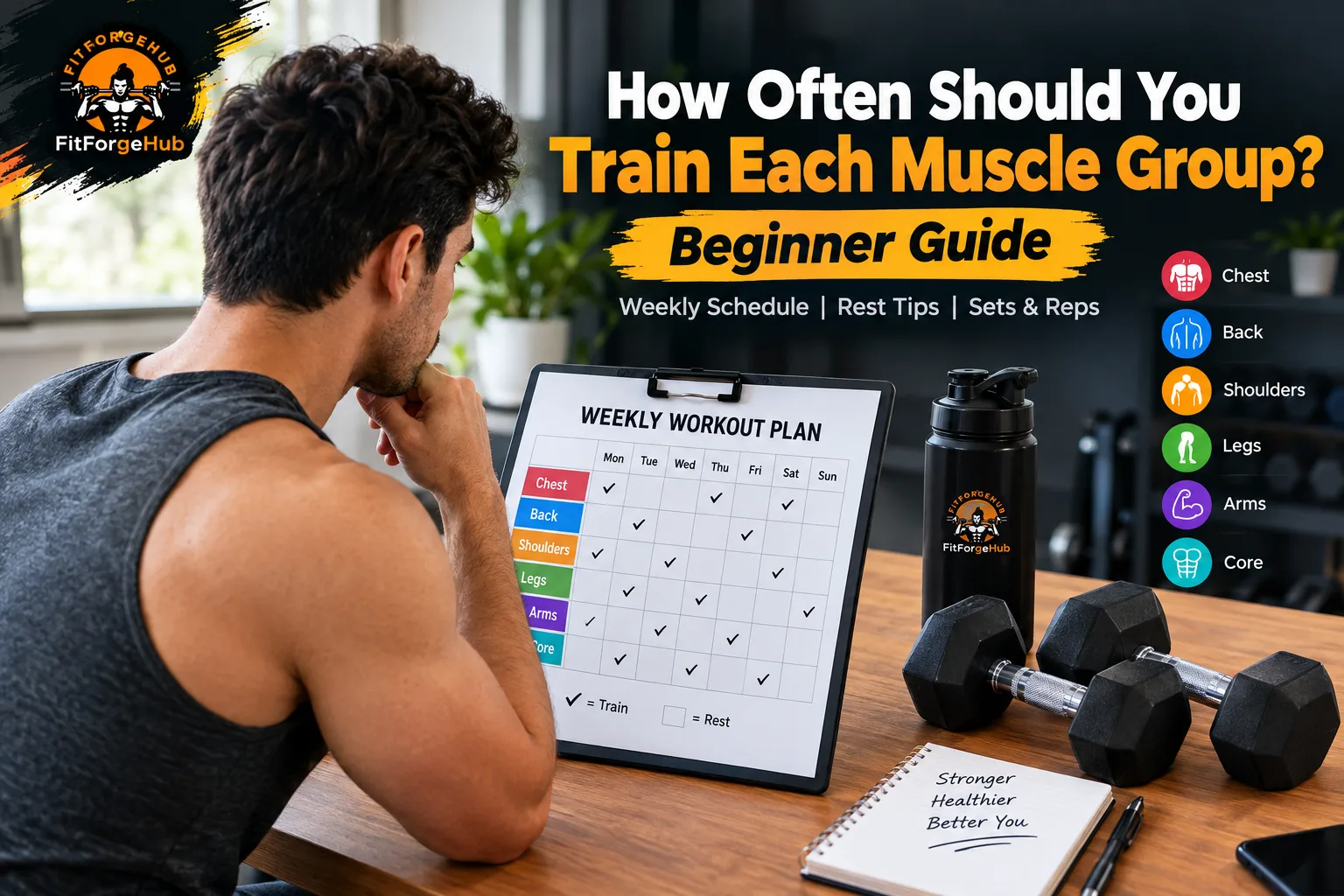
For more information, read our guide on [How Often Should You Train Each Muscle Group?].
Can You Build Muscle With PPL at Home?
Yes.
You don’t necessarily need a commercial gym to perform resistance training.
Dumbbells, resistance bands, and bodyweight exercises can all be used to create challenging workouts.
The important factor is whether the exercise provides enough resistance and whether you progressively challenge yourself over time.
And if you want to understand the bigger picture, read [How to Build Muscle at Home Without Weights].
PPL Workout Without Equipment
Don’t have dumbbells?
You can still create a basic PPL-style routine.
Push
- Push-ups
- Incline push-ups
- Pike push-ups
- Diamond push-ups
Pull
Pulling movements are more difficult without equipment.
Possible options include:
- Towel-based variations where appropriate
- Resistance-band rows if you have a band
- Backpack rows using a safely loaded backpack
Safety matters: Don’t use furniture or unstable objects as makeshift gym equipment unless you’re certain they can safely support the movement.
Legs
- Bodyweight squats
- Reverse lunges
- Split squats
- Glute bridges
- Calf raises
For a complete beginner home routine, also see [How to Start Working Out at Home for Beginners].
Common Beginner PPL Mistakes
1. Doing Too Much Too Soon
More exercises aren’t automatically better.
Start with a manageable workload.
2. Using Excessively Heavy Weights
If you have to swing the dumbbell to complete every repetition, the weight may be too heavy.
3. Ignoring Recovery
Muscle-building isn’t only about training.
Recovery, sleep, and nutrition matter too.
4. Changing the Routine Every Week
Give a routine enough time to evaluate whether you’re progressing.
5. Ignoring Technique
A controlled repetition is generally more useful than a rushed repetition with poor form.
6. Expecting Instant Muscle Growth
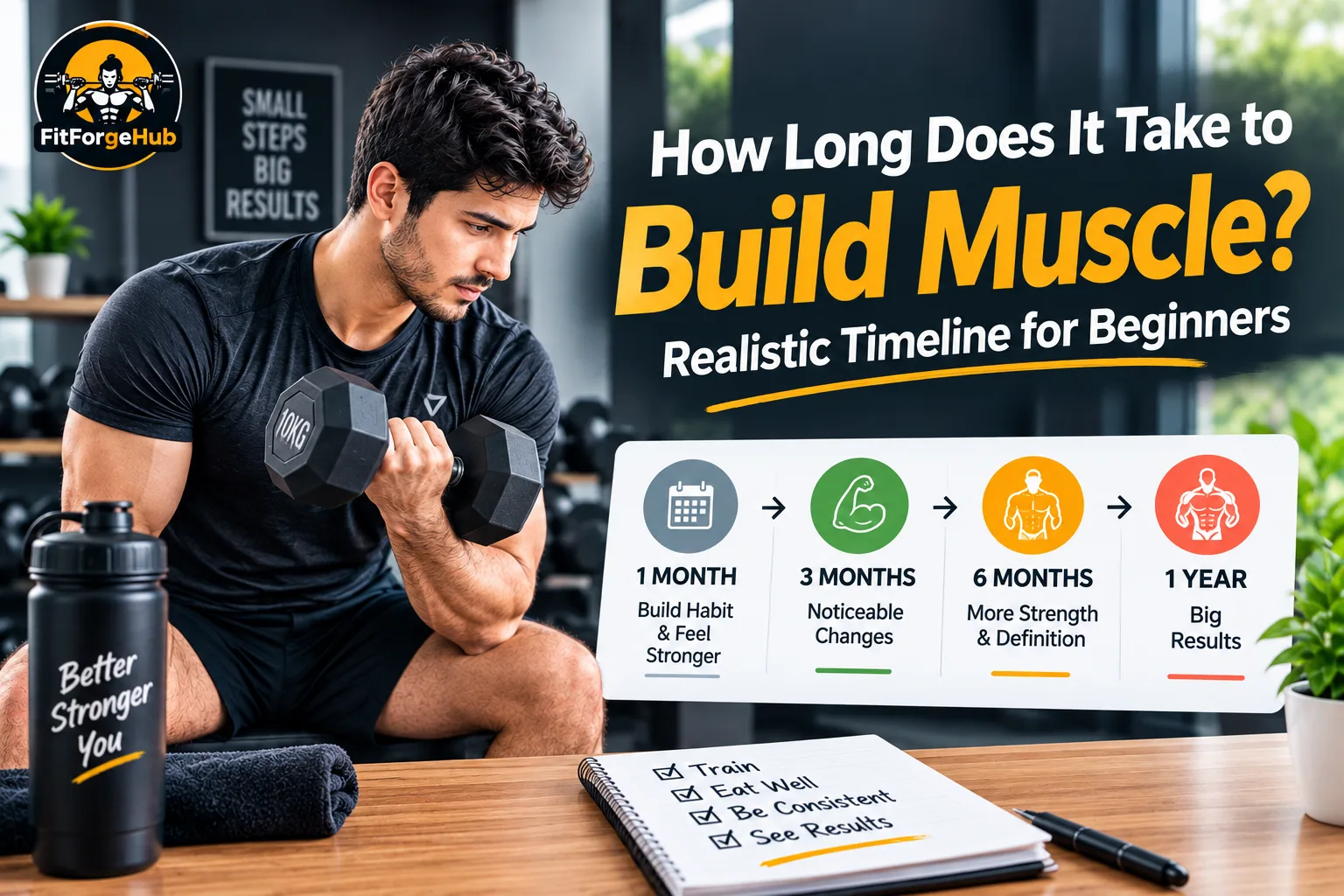
Building noticeable muscle takes time.
If you want a realistic timeline, read [How Long Does It Take to Build Muscle?].
How to Schedule Your 3-Day PPL Workout
Here’s an easy weekly schedule:
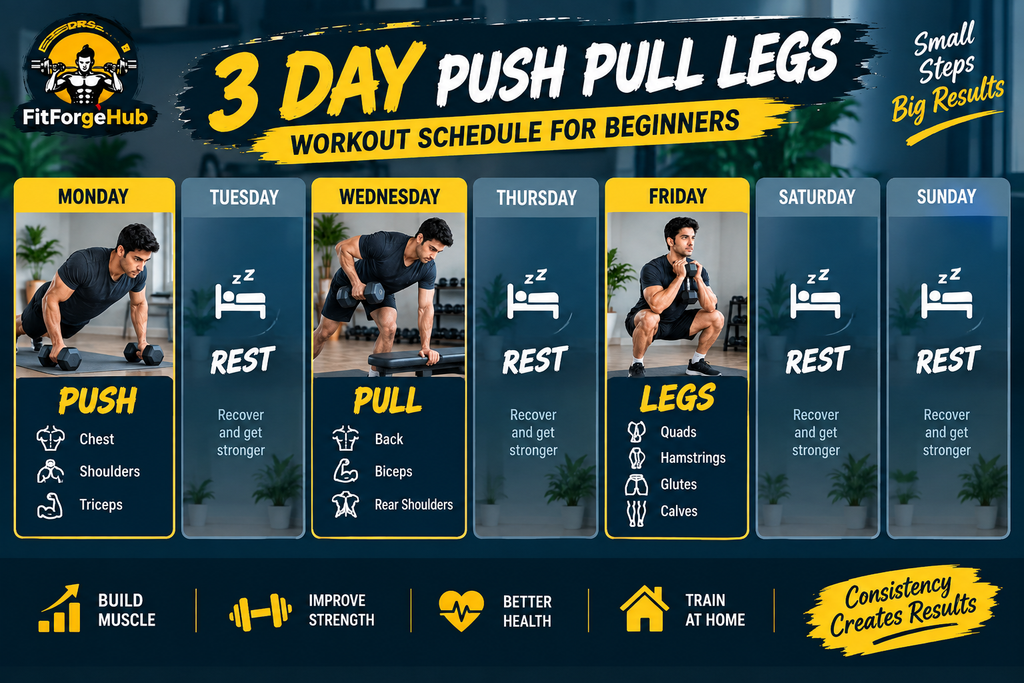
| Day | Workout |
|---|---|
| Monday | Push |
| Tuesday | Rest |
| Wednesday | Pull |
| Thursday | Rest |
| Friday | Legs |
| Saturday | Rest |
| Sunday | Rest |
If Monday doesn’t work for you, simply move the schedule.
For example:
Tuesday: Push
Thursday: Pull
Saturday: Legs
The best schedule is one you can consistently follow.
CDC guidance recommends adults perform muscle-strengthening activities on at least two days each week, working all major muscle groups.
Nutrition and Recovery for Muscle Growth
Your workout is only one part of the process.
To support muscle growth, pay attention to:
Protein
Include protein-rich foods such as:
- Eggs
- Chicken
- Fish
- Greek yogurt
- Milk
- Beans
- Lentils
- Tofu
- Lean meat
Calories
If muscle gain is your goal, your overall food intake should support your training and body-weight goals.
Carbohydrates
Foods such as rice, potatoes, oats, fruits, and whole grains can provide energy for training.
Sleep
Try to maintain a consistent sleep schedule and give your body enough time to recover.
Hydration
Drink fluids regularly, especially around workouts and during hot weather.
How Long Should a PPL Workout Take?
For most beginners, approximately 45–70 minutes is enough for this type of workout.
You don’t need to spend two hours in the gym, or at home, to have a productive workout.
A simple structure is:
5–10 minutes: Warm-up
35–50 minutes: Resistance training
5 minutes: Easy cooldown if desired
Frequently Asked Questions
Is PPL good for a beginner?
Yes. A simplified three-day PPL routine can be a practical way for beginners to organize resistance training.
Can I do Push Pull Legs 3 days a week?
Yes. A Monday-Wednesday-Friday or Tuesday-Thursday-Saturday schedule works well for many beginners.
Can I build muscle with PPL at home?
Yes. You can use dumbbells, resistance bands, or bodyweight exercises to create challenging resistance workouts.
How many exercises should beginners do per workout?
Around 4–6 exercises can be enough for a beginner. The exact amount depends on training experience, recovery, and goals.
Should beginners train to failure?
You don’t need to take every set to complete muscular failure. Focus first on controlled technique and consistent progression.
Can I do PPL without dumbbells?
Yes, although pulling exercises are harder to train effectively without equipment. Bodyweight and resistance-band exercises can help.
Is PPL better than a full-body workout?
Neither is automatically better for everyone. A full-body routine can be very convenient for beginners, while PPL provides a simple way to organize different muscle groups across the week.
Final Thoughts
A good beginner workout doesn’t need to be complicated.
This 3-day push pull legs workout at home gives you a simple structure for training your chest, shoulders, arms, back, legs, and other major muscle groups throughout the week.
Start with manageable weights, learn the movements, keep track of your workouts, and gradually increase the challenge.
Most importantly, don’t judge your progress after just a few workouts.
Consistency over months matters much more than having a perfect workout for one week.
About the Author
Riaz Ahmed
Riaz Ahmed holds a Master’s degree in Health and Physical Education and is the founder of FitForgeHub, where he shares practical fitness and workout information.
His goal is to make fitness easier to understand for beginners by providing straightforward workout plans, exercise guidance, and practical fitness education.
Website: FitForgeHub.com
Disclaimer:
The information provided in this article is for general educational purposes only. It is not medical advice or a substitute for advice from a qualified healthcare professional. If you have a medical condition, injury, or concerns about starting exercise, consult an appropriate healthcare professional before beginning a new training program.