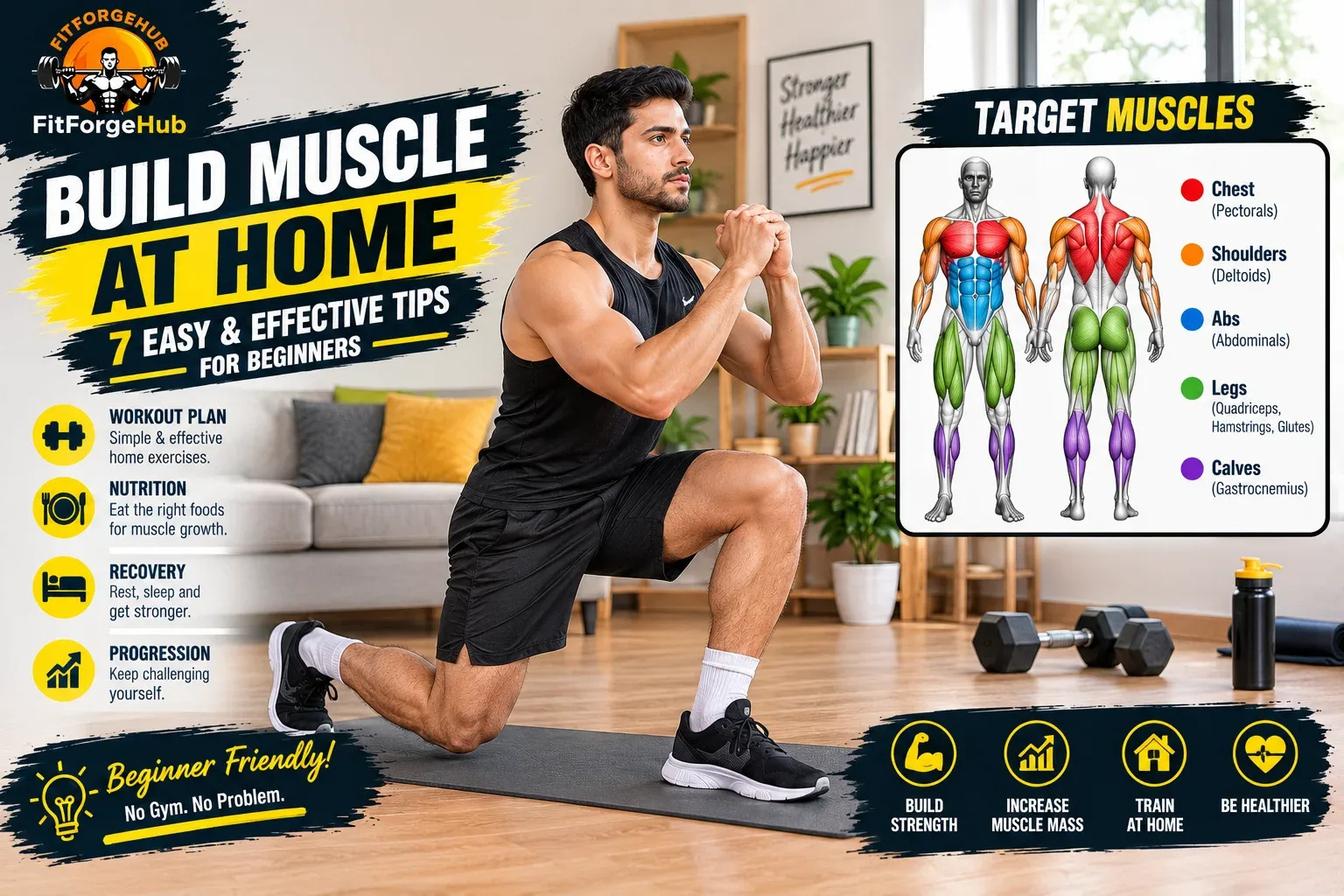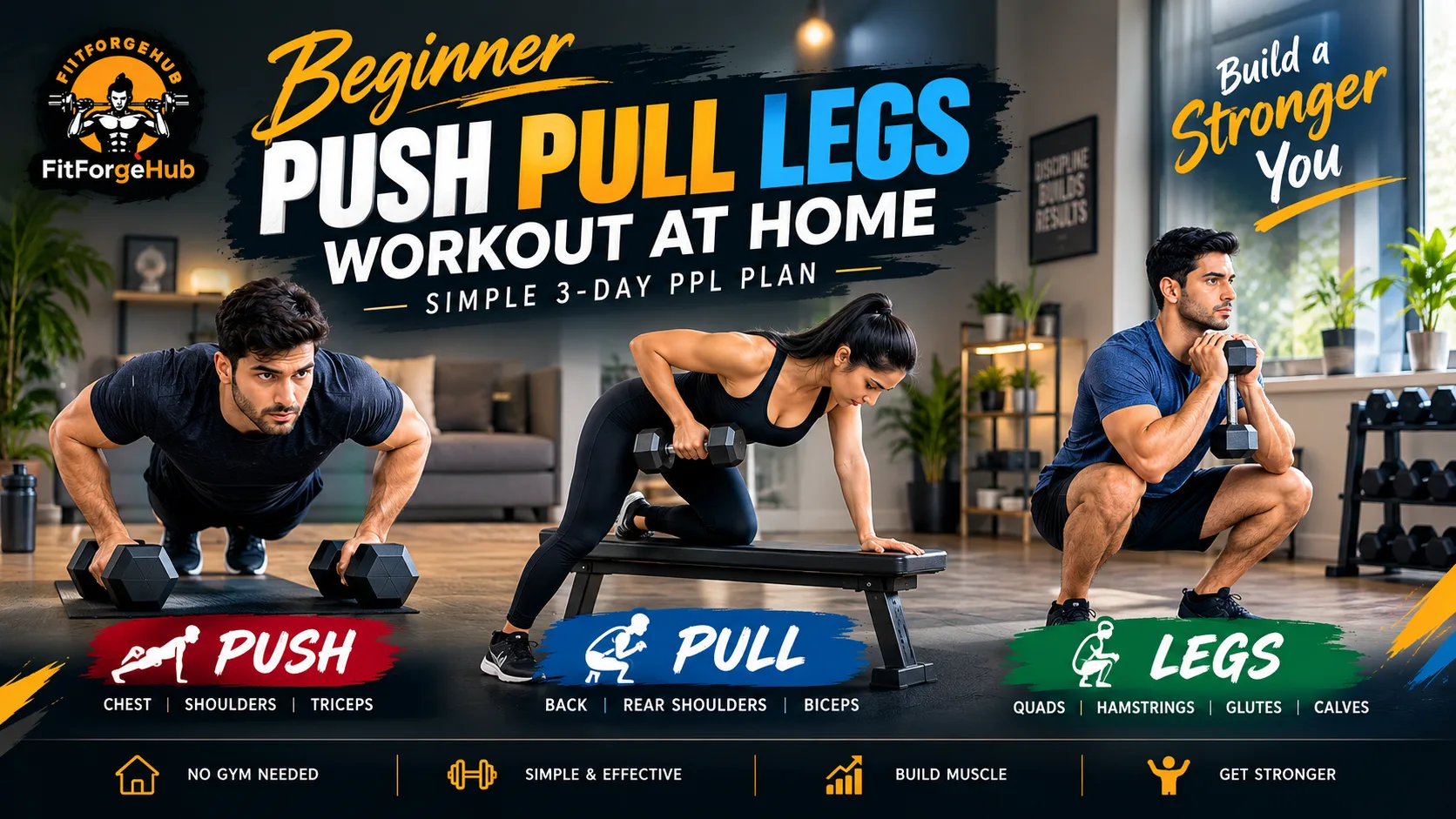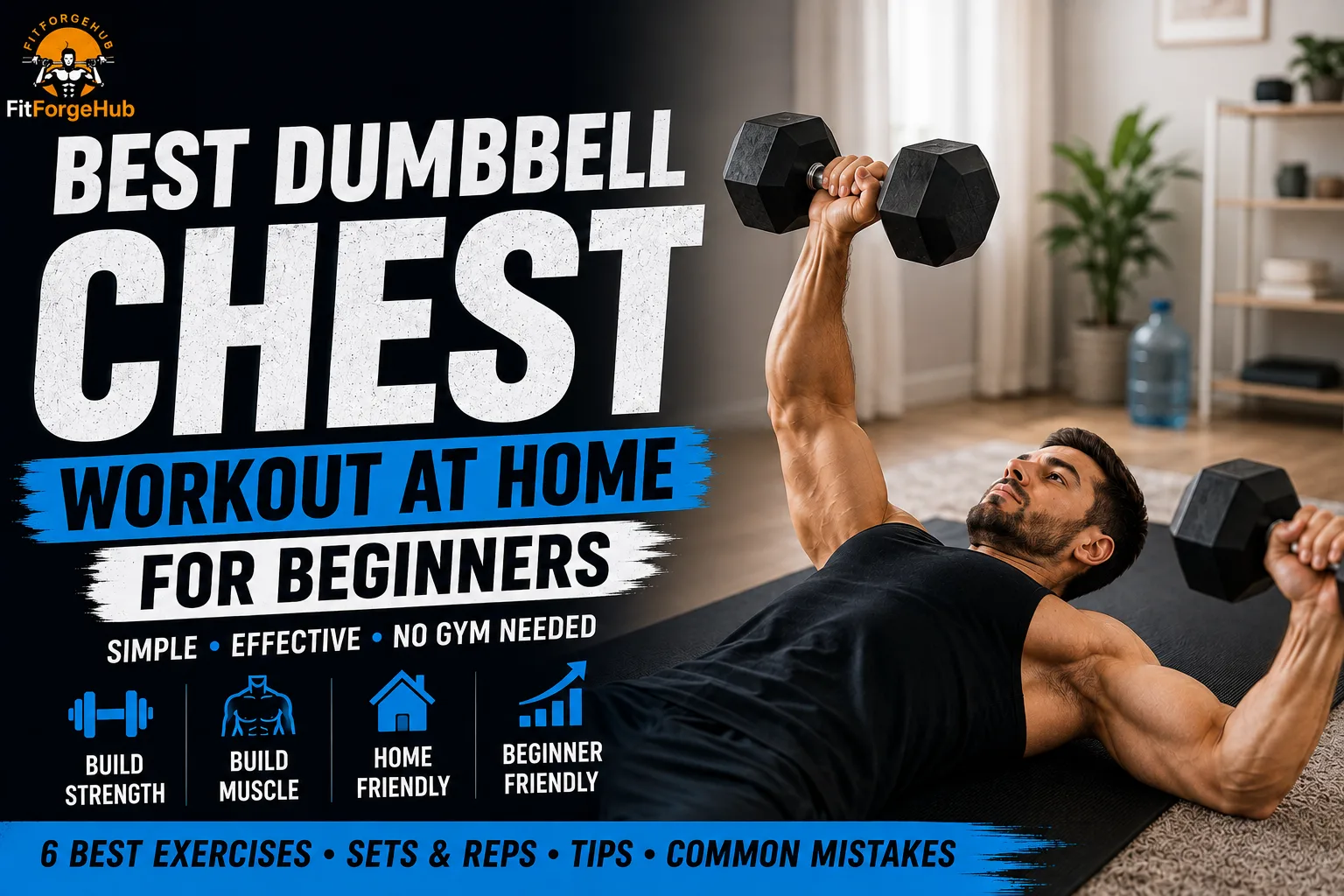
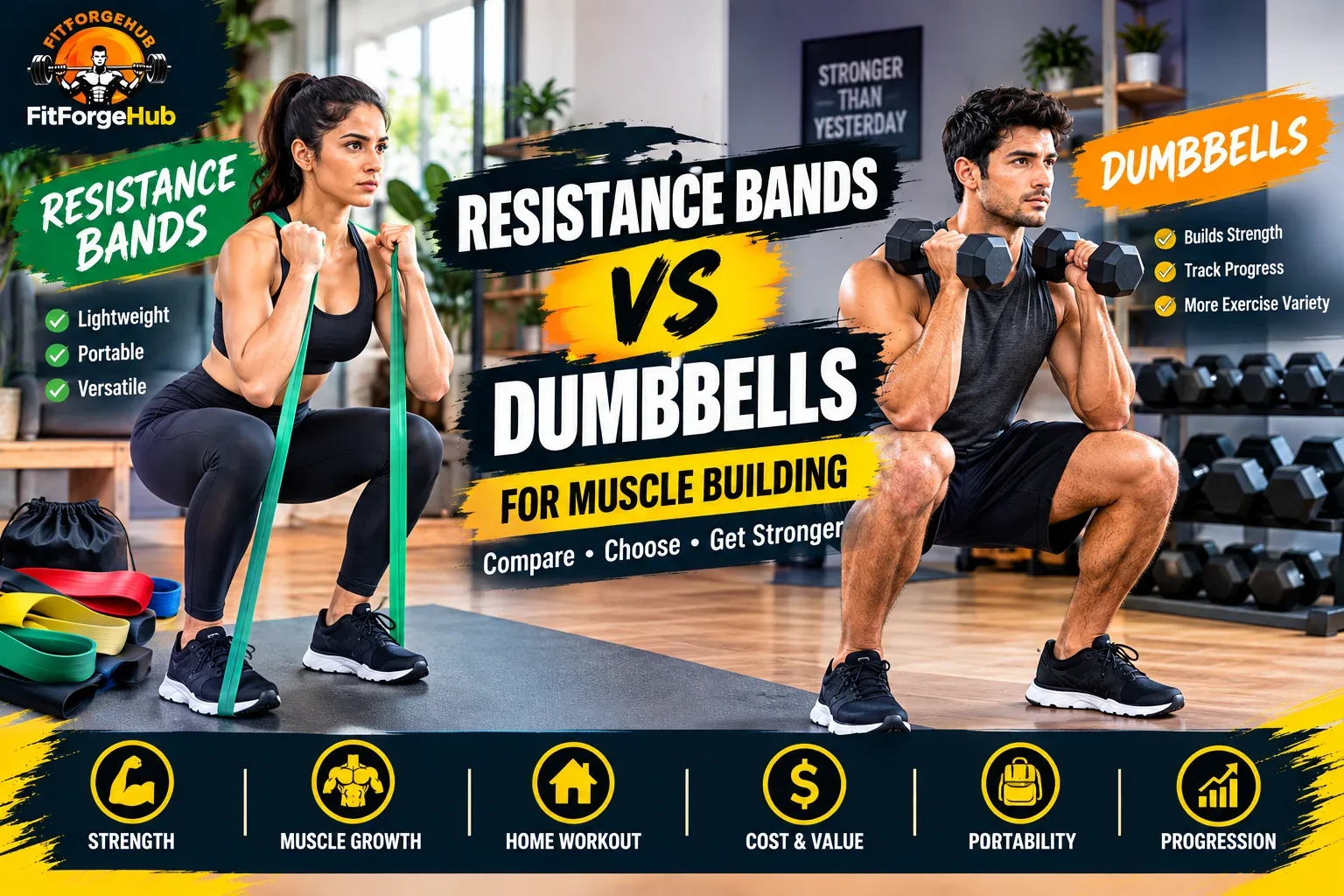
Choosing workout equipment can be confusing when you’re building a home gym.
Should you buy a set of dumbbells, resistance bands, or both?
The answer depends on your training goals, available space, budget, experience, and how you prefer to work out.
This guide compares resistance bands vs dumbbells for muscle building across resistance, exercises, progression, portability, cost, home workouts, and beginner-friendliness.
You’ll also learn how to choose between them and how to combine both tools in a practical home workout routine.
Understanding resistance bands vs dumbbells for muscle building can help beginners choose suitable equipment for their home workouts.
Important: This article is for general fitness education. If you have an injury, medical condition, or concerns about starting a new exercise program, consult an appropriate healthcare professional.
Table of Contents
- Resistance Bands vs Dumbbells: What’s the Difference?
- Can Resistance Bands Build Muscle?
- Can Dumbbells Build Muscle?
- Resistance Bands vs Dumbbells: 9 Key Differences
- Resistance Bands vs Dumbbells Comparison Table
- Which Is Better for Beginners?
- Which Is Better for Muscle Building?
- Can You Use Resistance Bands and Dumbbells Together?
- Best Resistance Band Exercises
- Best Dumbbell Exercises
- How to Progress With Bands and Dumbbells
- Sample Home Workout Plan
- Common Mistakes
- Frequently Asked Questions
- Final Thoughts
- About the Author
Resistance Bands vs Dumbbells: What’s the Difference?
Resistance bands and dumbbells both provide resistance during strength training, but they feel different and have different practical advantages.
Resistance Bands
Resistance bands are elastic bands that create tension as they stretch.
They are available in different resistance levels and can be used for exercises such as:
- Squats
- Rows
- Chest presses
- Shoulder presses
- Biceps curls
- Triceps extensions
- Glute bridges
- Lateral walks
- Core exercises
Dumbbells
Dumbbells are free weights that provide a relatively consistent external load during an exercise.
They can be used for:
- Squats
- Lunges
- Rows
- Chest presses
- Shoulder presses
- Curls
- Triceps extensions
- Romanian deadlifts
- Lateral raises
Both can be used for resistance training at home.
The CDC specifically lists resistance bands, weights, and bodyweight exercises among examples of muscle-strengthening activities.[CDC]
Can Resistance Bands Build Muscle?
Yes, resistance bands can be part of an effective muscle-building program.
The important factors are not simply the type of equipment you own. Your muscles need an appropriate training challenge, enough consistency, and progressive increases in difficulty over time.
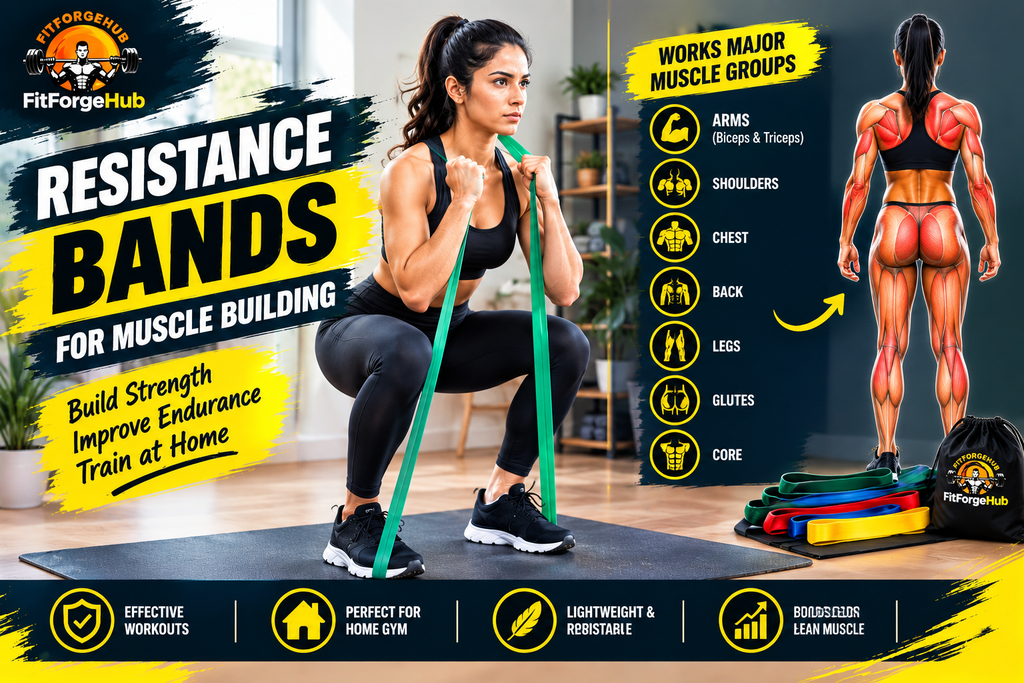
For example, beginners can gradually increase resistance, repetitions, sets, or exercise difficulty as they become stronger.
The 2026 American College of Sports Medicine resistance-training guidance notes that elastic bands and home-based training can be effective options, and that more complicated equipment or advanced techniques are not automatically necessary for the average healthy adult. [ACSM]
For example, a beginner can make a band workout progressively harder by:
- Using a stronger band
- Increasing repetitions
- Adding sets
- Increasing range of motion
- Improving control
- Choosing a more challenging variation
For a complete routine, see:
Resistance Band Workout for Beginners
Can Dumbbells Build Muscle?
Yes. Dumbbells are versatile resistance-training tools that can be used for compound and isolation exercises to train different muscle groups at home.
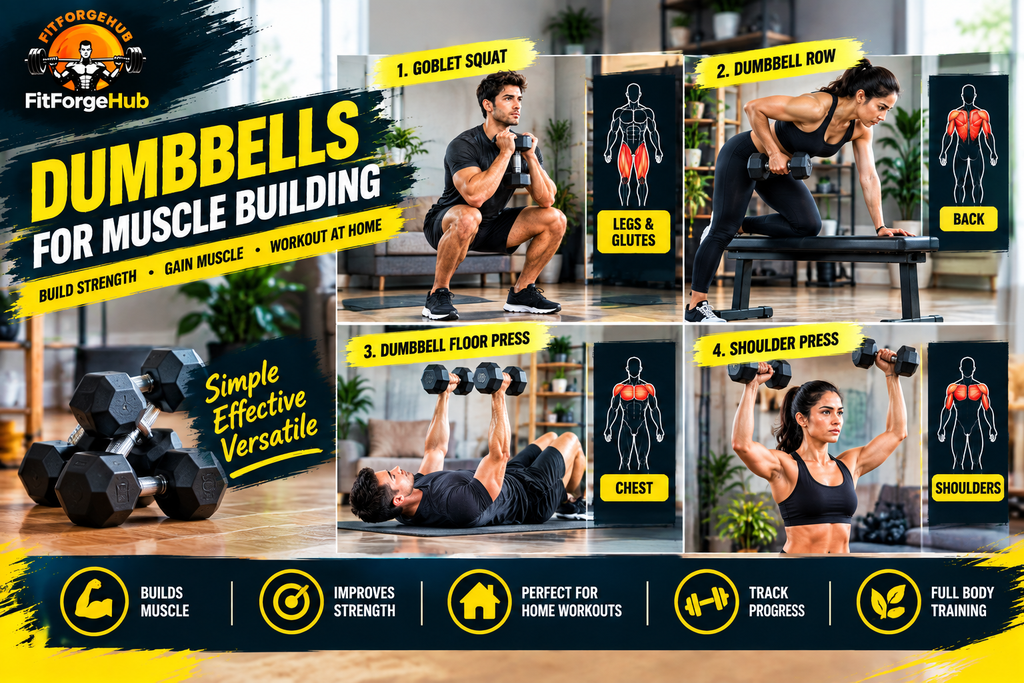
Exercises such as goblet squats, dumbbell rows, floor presses, and shoulder presses provide a practical foundation for a beginner’s strength-training routine.
You can use dumbbells to train:
- Chest
- Back
- Shoulders
- Arms
- Legs
- Glutes
- Core
One advantage of dumbbells is that the load is easy to identify and track. For example, if you perform a dumbbell row with 20 lb in each hand, you can record that load and compare your performance over time.
For beginners who already have dumbbells at home, a structured routine can provide a simple way to organize training.
See our:
Complete Dumbbell Workout Guide for Beginners
Resistance Bands vs Dumbbells: 9 Key Differences
1. Resistance Feel
One of the biggest differences is how the resistance feels during an exercise.
When comparing resistance bands vs dumbbells for muscle building, it’s important to understand how each tool provides resistance throughout an exercise.
Resistance Bands
Bands generally become more challenging as they stretch farther.
This means the resistance can increase during parts of the movement.
Dumbbells
Dumbbells provide a fixed external load.
A 20-lb dumbbell remains a 20-lb dumbbell throughout the exercise, although the perceived difficulty can change based on your body’s position and leverage.
Bottom line: The resistance feels different with each tool, so neither needs to be treated as simply a lighter or heavier version of the other.
2. Progressive Overload
Both options can support progressive overload, which is an important part of resistance bands vs dumbbells for muscle building.
Progressive overload means gradually increasing the training challenge as you become stronger.
With dumbbells, progression can be straightforward:
15 lb → 20 lb → 25 lb
With bands, you can progress by:
lighter band → stronger band → more reps → more sets → harder variation
The 2026 ACSM position stand emphasizes gradual progression and consistency rather than unnecessarily complicated training methods.
For beginners, the key is to track what you’re doing rather than randomly changing exercises every workout.
3. Exercise Selection
Both tools allow you to perform many exercises, but some movements are easier to set up with one than the other.
Resistance Band Exercises
Good examples include:
- Band squats
- Band rows
- Band chest presses
- Band shoulder presses
- Band curls
- Band triceps extensions
- Glute bridges
- Lateral walks
Dumbbell Exercises
Common examples include:
- Goblet squats
- Dumbbell rows
- Dumbbell floor presses
- Shoulder presses
- Romanian deadlifts
- Lunges
- Biceps curls
- Lateral raises
For chest training, check:
Best Home Chest Workout Without a Bench
4. Portability
This is where resistance bands have a major practical advantage.
A few bands can fit inside a small bag and can easily be taken to:
- Work
- Travel
- A hotel
- A park
- Another room in your home
Dumbbells are much heavier and take up more space.
If portability is important, resistance bands can make it easier to maintain a consistent routine.
5. Storage Space
Resistance bands require very little storage space.
You can keep several bands in a drawer, closet, or small storage container.
Dumbbells require more space, especially if you own several different weights.
Adjustable dumbbells can reduce the amount of space needed compared with a large rack of fixed dumbbells.
6. Cost
The price of both options depends on the quality, resistance levels, and equipment type you choose.
In general, a basic resistance-band setup can require less upfront space and equipment than a complete collection of dumbbells.
A dumbbell setup can become more expensive as you add heavier weights or additional pairs.
Instead of focusing only on price, consider:
- How often you’ll use the equipment
- Your available space
- Your training goals
- Whether you need multiple resistance levels
- Whether you’ll eventually need heavier resistance
The best equipment is the equipment that fits your actual training routine and that you can use consistently.
7. Beginner-Friendliness
For beginners, resistance bands vs dumbbells for muscle building is largely a matter of personal preference, budget, and available space.
Both options can work for beginners.
Resistance Bands
Bands can be a convenient starting point because they are lightweight and easy to store.
Beginners should still learn how to control the band and maintain good form.
Dumbbells
Dumbbells can also be beginner-friendly because you can choose a manageable weight and clearly track your load.
For someone starting with dumbbells, learning basic movements such as squats, rows, presses, and curls can create a useful foundation.
You can also start with our:
How to Start Working Out at Home for Beginners
8. Home Workout Convenience
If your main goal is working out in a small space, resistance bands are extremely convenient.
You can complete many exercises with little equipment.
Dumbbells are also excellent for home workouts, but they require a dedicated storage area and enough space to use them safely.
For a small apartment, resistance bands may be easier to store.
For someone with a dedicated home gym, dumbbells can offer a wider range of load options.
9. Muscle-Building Potential
The choice between resistance bands vs dumbbells for muscle building depends on training consistency, appropriate resistance, and progression.
This is one of the most important questions.
Instead of asking only:
“Which equipment builds more muscle?”
Ask:
“Which equipment allows me to train consistently and progressively?”
The current ACSM guidance supports resistance training using different practical approaches, including elastic bands and home-based training, while emphasizing consistency and progressive training.
For healthy adults, equipment choice is only one part of the overall training program.
Your results also depend on:
- Training consistency
- Exercise selection
- Training effort
- Progressive overload
- Nutrition
- Protein intake
- Recovery
- Sleep
Resistance Bands vs Dumbbells Comparison Table
| Feature | Resistance Bands | Dumbbells |
|---|---|---|
| Home use | Excellent | Excellent |
| Portability | Excellent | Limited |
| Storage | Very easy | Requires more space |
| Resistance | Changes with stretch | Fixed external load |
| Exercise variety | High | Very high |
| Beginner friendly | Yes | Yes |
| Progressive overload | Yes | Yes |
| Muscle building | Can support muscle growth | Can support muscle growth |
| Travel workouts | Very convenient | Less convenient |
| Tracking load | Less straightforward | Very straightforward |
| Best for small spaces | Excellent | Good |
| Best setup | Bands + anchor where appropriate | Fixed or adjustable dumbbells |
The comparison above highlights the practical differences between resistance bands and dumbbells. Both options can support strength training, but they differ in resistance feel, portability, storage, and load progression. Your choice depends on your available space, budget, and training preferences.
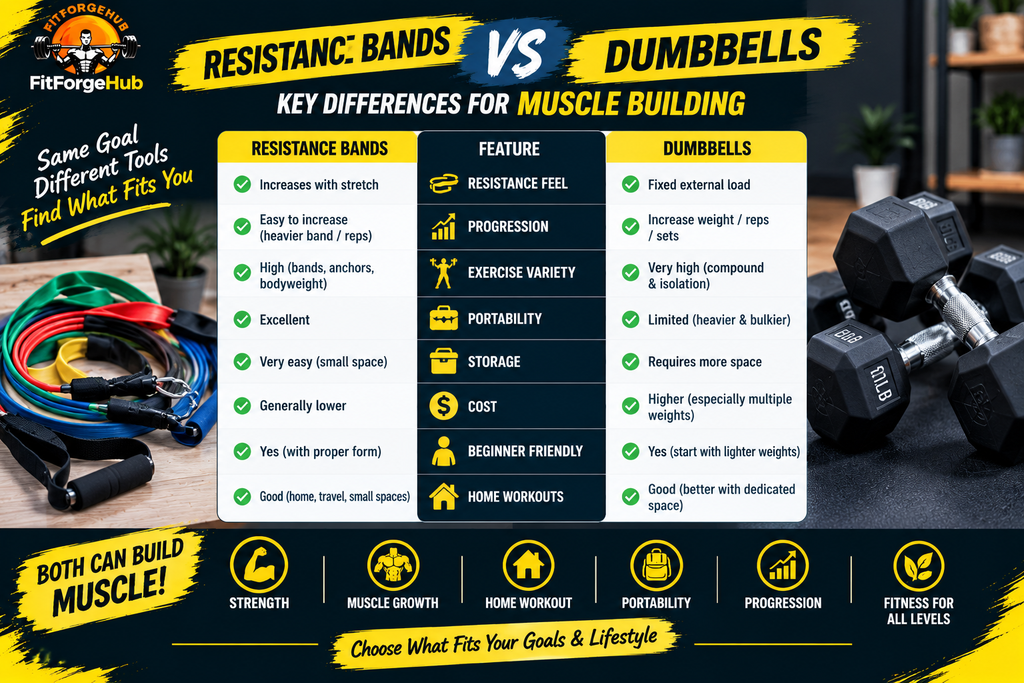
Both resistance bands and dumbbells can be used in beginner-friendly home workouts, with different advantages for portability, equipment setup, and training progression.
Which Is Better for Beginners?
There isn’t one universal choice for every beginner.
Resistance bands may fit you if:
- You have limited space.
- You travel frequently.
- You want lightweight equipment.
- You prefer home workouts.
- You have a smaller equipment budget.
- You want a simple setup.
Dumbbells may fit you if:
- You have more storage space.
- You want clearly measurable loads.
- You enjoy free-weight training.
- You want many traditional strength exercises.
- You have room for multiple weights or adjustable dumbbells.
The most useful option is the one you can use safely and consistently.
Which Is Better for Muscle Building?
For muscle building, both can be used effectively when the program provides enough training stimulus and progresses over time.
ACSM’s 2026 resistance-training guidance specifically states that elastic bands and home-based training can be effective options and that complicated equipment isn’t required for the average healthy adult.
That doesn’t mean bands and dumbbells feel identical.
They provide different resistance profiles and different exercise setups.
If you enjoy dumbbell training and can progressively increase your loads, dumbbells can be a practical long-term option.
If you prefer bands and can progressively increase resistance and training difficulty, bands can also be a practical long-term option.
Can You Use Resistance Bands and Dumbbells Together?
Absolutely. Combining resistance bands and dumbbells can provide more exercise options for a home workout. Each piece of equipment offers different resistance characteristics and can complement the other in a balanced training routine.
Combining both can give you more exercise options without requiring a large home gym.
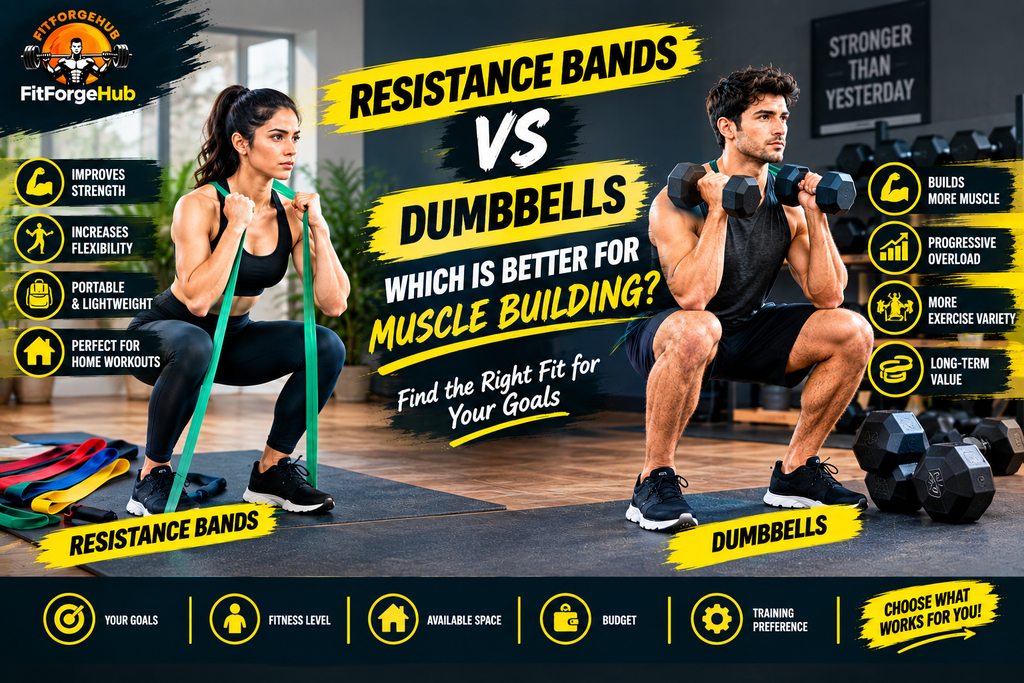
For example, you can use dumbbells for goblet squats and floor presses, then incorporate resistance bands for rows, lateral walks, or triceps extensions. Choose exercises and resistance levels that match your current fitness level.
For example:
Lower Body
Goblet Squat — Dumbbell
3 × 8–12
Lateral Band Walk — Band
2 × 10–15 steps per side
Romanian Deadlift — Dumbbells
3 × 8–12
Upper Body
Dumbbell Floor Press — Dumbbells
3 × 8–12
Resistance Band Row — Band
3 × 10–15
Biceps Curl — Dumbbells
2 × 10–15
Triceps Extension — Band
2 × 10–15
This approach can be particularly useful for a home gym because each tool can complement the other.
Best Resistance Band Exercises
If you choose resistance bands, start with these movements:
- Resistance Band Squat
- Resistance Band Row
- Resistance Band Chest Press
- Resistance Band Shoulder Press
- Resistance Band Biceps Curl
- Resistance Band Triceps Extension
- Resistance Band Glute Bridge
- Resistance Band Lateral Walk
- Pallof Press
For the complete routine:
Full Body Resistance Band Workout at Home
Best Dumbbell Exercises
If you choose dumbbells, these exercises provide a strong foundation:
- Goblet Squat
- Dumbbell Romanian Deadlift
- One-Arm Dumbbell Row
- Dumbbell Floor Press
- Dumbbell Shoulder Press
- Dumbbell Lateral Raise
- Dumbbell Biceps Curl
- Dumbbell Hammer Curl
- Dumbbell Triceps Extension
You can build a complete beginner routine by combining several of these exercises.
How to Progress With Bands and Dumbbells
Your equipment doesn’t need to change every week.
Instead, track your training.
With Dumbbells
You can progress by:
- Increasing weight
- Increasing repetitions
- Adding a set
- Improving technique
- Increasing range of motion
Example:
Week 1: 15 lb × 10 reps
Week 2: 15 lb × 12 reps
Week 3: 20 lb × 10 reps
With Resistance Bands
You can progress by:
- Moving to a stronger band
- Increasing repetitions
- Adding a set
- Increasing band tension
- Using a more challenging exercise variation
- Improving control
The goal is not to make every workout exhausting. The goal is to create a manageable training stimulus and gradually improve.
Sample Home Workout Plan
Here’s a simple three-day approach using both types of equipment.
Monday — Full Body
- Goblet Squat — 3 × 8–12
- Band Row — 3 × 10–15
- Dumbbell Floor Press — 3 × 8–12
- Dumbbell Shoulder Press — 2 × 8–12
- Band Glute Bridge — 2 × 12–20
Wednesday — Full Body
- Dumbbell Romanian Deadlift — 3 × 8–12
- Band Chest Press — 3 × 8–15
- One-Arm Dumbbell Row — 3 × 8–12
- Band Lateral Walk — 2 × 10–15/side
- Dumbbell Curl — 2 × 10–15
Friday — Full Body
- Goblet Squat — 3 × 10–12
- Band Row — 3 × 10–15
- Dumbbell Floor Press — 3 × 8–12
- Band Triceps Extension — 2 × 10–15
- Dumbbell Romanian Deadlift — 2 × 8–12
A consistent weekly schedule can help beginners organize their resistance training, balance workouts with recovery, and develop a sustainable home fitness routine.
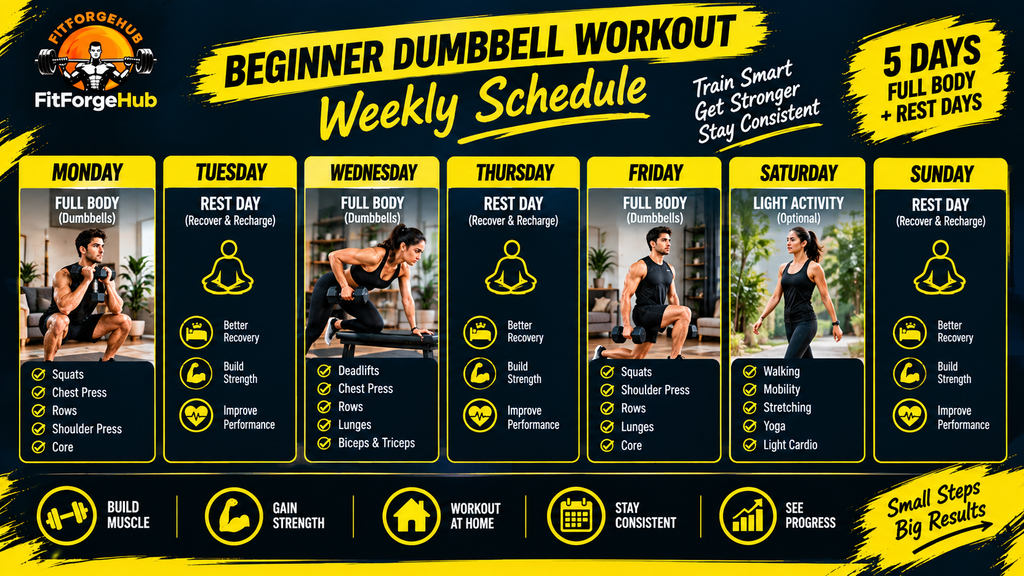
Beginners can adjust their workout days, exercise selection, and training volume according to their fitness level and recovery. Resistance bands and dumbbells can be combined where appropriate.
The CDC recommends adults perform muscle-strengthening activity on at least 2 days per week, involving all major muscle groups.[CDC]
Common Mistakes
1. Buying Equipment Without a Plan
Don’t buy equipment simply because it looks impressive.
Choose equipment that matches your workout goals and available space.
2. Using Resistance That’s Too Light
If the final repetitions are always extremely easy, you may need more resistance or a more challenging variation.
3. Using Dumbbells That Are Too Heavy
Heavy weights can make it difficult to maintain proper technique.
4. Changing Exercises Constantly
You don’t need a completely different workout every week.
Consistency allows you to track progress.
5. Ignoring Recovery
Your training plan should include rest and recovery.
6. Focusing Only on Equipment
Equipment is a tool.
Your training consistency, exercise technique, progression, nutrition, and recovery also matter.
Frequently Asked Questions
Are resistance bands as good as dumbbells for muscle building?
Both can be used for resistance training and muscle-building programs. They provide different resistance characteristics, so the better fit depends on your training preferences, goals, available space, and ability to progress.
Can resistance bands replace dumbbells?
For many home exercises, yes. However, they don’t feel exactly the same as dumbbells, and some exercises may be easier to load or track with free weights.
Are dumbbells better for beginners?
Dumbbells can be very beginner-friendly when you start with manageable weights and learn proper technique.
Can I build muscle at home with resistance bands?
Yes. Resistance bands can be incorporated into progressive resistance-training programs, and current ACSM guidance recognizes elastic bands and home-based resistance training as viable options.
Should I buy resistance bands or dumbbells first?
Consider your budget, available space, training preferences, and goals. Bands are especially convenient for portability and storage, while dumbbells make external load tracking straightforward.
Can I use bands and dumbbells on the same day?
Yes. Combining them can give you more exercise options and allow you to use each tool for movements where it works well.
How often should I train with bands or dumbbells?
A beginner can structure resistance training around two or more sessions per week, depending on recovery and the overall program. The CDC recommends at least 2 days of muscle-strengthening activity each week for adults.
Final Thoughts
When comparing resistance bands vs dumbbells for muscle building, there isn’t a single piece of equipment that every person needs.
Resistance bands offer excellent portability, easy storage, and a convenient way to train at home.
Dumbbells offer measurable external loads and a wide range of traditional strength exercises.
You can also combine both.
The most important factors are consistent resistance training, appropriate exercise selection, progressive overload, recovery, and a routine you can realistically follow. Current ACSM guidance similarly emphasizes choosing a routine that fits your schedule and goals and building gradually over time.
For your next workout, choose the equipment that fits your space, goals, and training style—and focus on getting stronger over time.
Ultimately, resistance bands vs dumbbells for muscle building comes down to which equipment helps you train consistently and progressively.”
👤 About the Author
Riaz Ahmed
Riaz Ahmed holds a Master’s degree in Health and Physical Education and is the founder of FitForgeHub, where he shares practical fitness and workout information.
His content focuses on beginner-friendly workouts, resistance training, muscle building, home fitness, weight management, and practical fitness education.
Website: FitForgeHub.com
Disclaimer
The information provided on FitForgeHub is for general educational and informational purposes only. It is not intended to replace professional medical advice, diagnosis, or treatment. Always use proper exercise technique and choose training methods appropriate for your individual fitness level.