Table of Contents
1. Introduction
2. Why Choose Home Workouts?
3. Benefits of Home Workouts
4. Who Should Follow This Plan?
5. Workout Equipment Needed
6. Warm-Up Routine
7. Weekly Home Workout Schedule
8. Monday Full Body Workout
9. Tuesday Recovery Workout
10. Wednesday Lower Body Workout
11. Thursday Active Recovery
12. Friday Upper Body Workout
13. Saturday Core and Cardio Workout
14. Nutrition Guide
15. Beginner Mistakes
16. Frequently Asked Questions
17. Final Thoughts
18. Conclusion
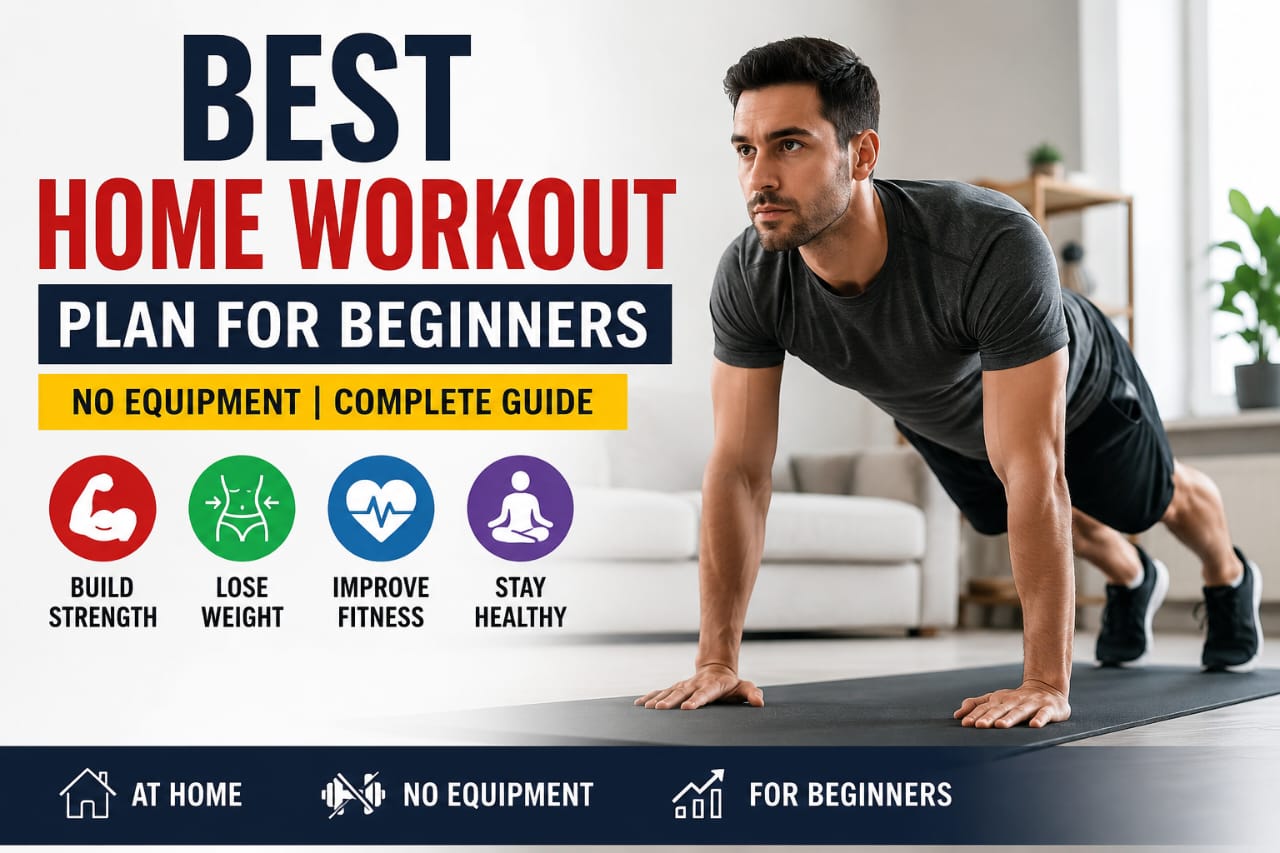
Best Home Workout Plan for Beginners (No Equipment) | Complete Fitness Guide 2026
This home workout plan for beginners is perfect if you’re looking for a beginner fitness routine that requires no equipment.
Starting your fitness journey can feel overwhelming, especially if you’ve never exercised before or don’t have access to a gym. The good news is that you don’t need expensive equipment or a gym membership to get fit. A well-designed home workout plan can help you build strength, burn fat, improve flexibility, and boost your overall health, all from the comfort of your home.
Whether your goal is weight loss, muscle toning, improving stamina, or simply becoming healthier, this guide provides everything you need to start safely and confidently.
This beginner-friendly workout plan focuses on bodyweight exercises that are simple to perform yet highly effective. These exercises improve your overall fitness while helping you develop proper movement patterns before progressing to more advanced training.
If you’re completely new to fitness, you can also follow our 30-Day Beginner Workout Plan for a structured day-by-day routine.
Why Choose Home Workouts?
Home workouts have become increasingly popular because they are convenient, affordable, and suitable for people of all fitness levels. Beginners often feel intimidated in gyms, but exercising at home allows you to learn at your own pace.
Some major benefits include:
- Home workout without gym
- No expensive equipment
- Flexible workout schedule
- Saves travel time
- Suitable for men and women
- Easy to stay consistent
The most important factor in fitness is consistency. A simple workout done regularly produces far better results than an advanced workout performed only occasionally.
Can Beginners Build Muscle at Home?
Absolutely.
One of the biggest myths in fitness is that muscle can only be built in a gym. In reality, beginners experience rapid progress even with bodyweight exercises.
Movements such as:
- Push-ups
- Squats
- Lunges
- Planks
- Glute Bridges
activate multiple muscle groups simultaneously. As your strength improves, you can increase repetitions, add more sets, or slow down the movement to continue challenging your muscles.
Benefits of Following a Structured Beginner Workout Plan
Following a proper workout schedule offers many advantages:
Build Strength
Your muscles gradually adapt to exercise, making daily activities easier.
Improve Heart Health
Regular workouts improve blood circulation and cardiovascular endurance.
Burn Calories
Bodyweight exercises increase calorie expenditure and help reduce body fat.
Increase Mobility
Stretching and controlled movements improve flexibility and joint mobility.
Boost Mental Health
Exercise releases endorphins that reduce stress, anxiety, and depression.
Develop Healthy Habits
A structured plan makes it easier to stay committed to long-term fitness goals.
Who Should Follow This Workout Plan?
This guide is ideal for:
- Complete beginners
- People returning after a long break
- Students
- Office workers
- Busy professionals
- Stay-at-home parents
- People without gym access
No previous fitness experience is required.
What You Need Before Starting
One of the best things about this workout plan is its simplicity.
You only need:
- Comfortable workout clothes
- Athletic shoes
- Water bottle
- Exercise mat (optional)
- Small towel
That’s it.
No dumbbells.
No machines.
No expensive equipment.
Basic Workout Principles Every Beginner Should Know
Before jumping into exercises, it’s important to understand some basic fitness principles.
Consistency Beats Intensity
Many beginners try to exercise intensely during their first week and then quit because they become too sore.
Instead:
- Exercise regularly.
- Start slowly.
- Improve gradually.
Fitness is a marathon, not a sprint.
Proper Form Is More Important Than Speed
Never rush through exercises.
Incorrect technique increases injury risk and reduces effectiveness.
Focus on:
- Controlled movements
- Full range of motion
- Proper breathing
- Good posture
Quality repetitions always beat quantity.
Rest Is Essential
Your muscles grow during recovery—not during workouts.
Beginners should aim for:
- 7–9 hours of sleep
- At least one full rest day each week
- Proper hydration
- Balanced nutrition
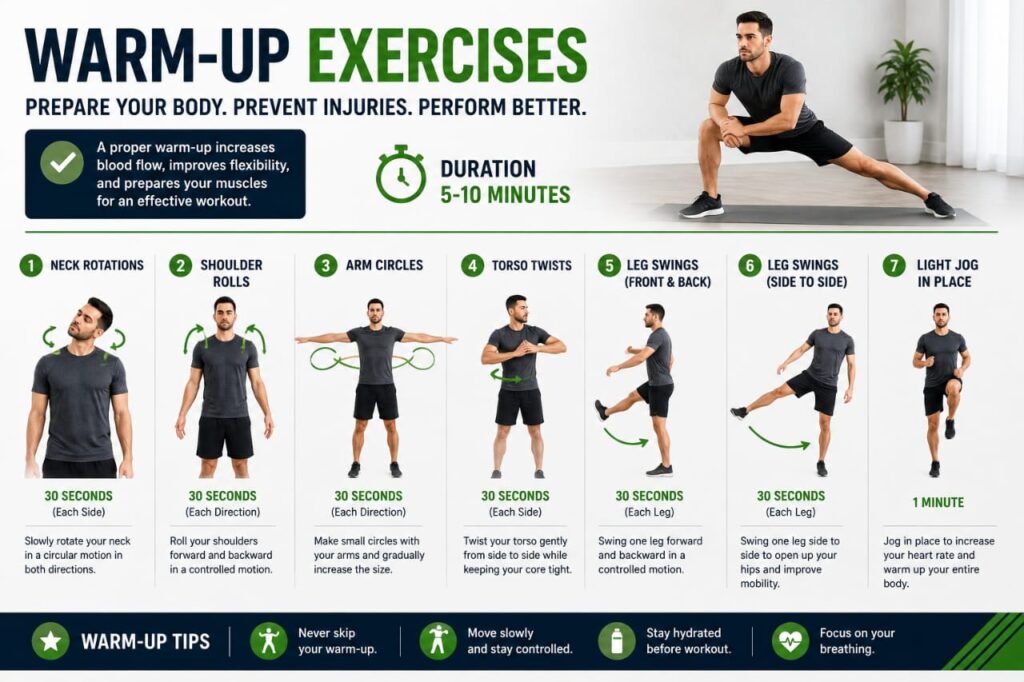
Warm-Up Before Every Workout
Never skip your warm-up.
A proper warm-up prepares your muscles and joints for exercise while reducing injury risk.
Spend 5–10 minutes performing the following:
1. March in Place – 1 Minute
Slowly raise your knees while swinging your arms naturally.
2. Arm Circles – 30 Seconds Forward + 30 Seconds Backward
This loosens your shoulders and improves mobility.
3. Hip Rotations – 30 Seconds
Rotate your hips clockwise and counterclockwise.
4. High Knees – 1 Minute
Lift your knees comfortably without rushing.
5. Jumping Jacks – 1 Minute
Perform at a moderate pace.
6. Bodyweight Squats – 15 Repetitions
Move slowly and focus on technique.
Understanding Workout Intensity
Beginners often ask:
“How hard should I exercise?”
The answer is simple.
Your workout should feel challenging but not exhausting.
On a scale from 1 to 10:
- 1 = Sitting
- 3 = Walking
- 5 = Comfortable Exercise
- 7 = Challenging
- 10 = Maximum Effort
Aim to train around 6–7.
You should still be able to speak in short sentences while exercising.
Beginner Home Workout Schedule
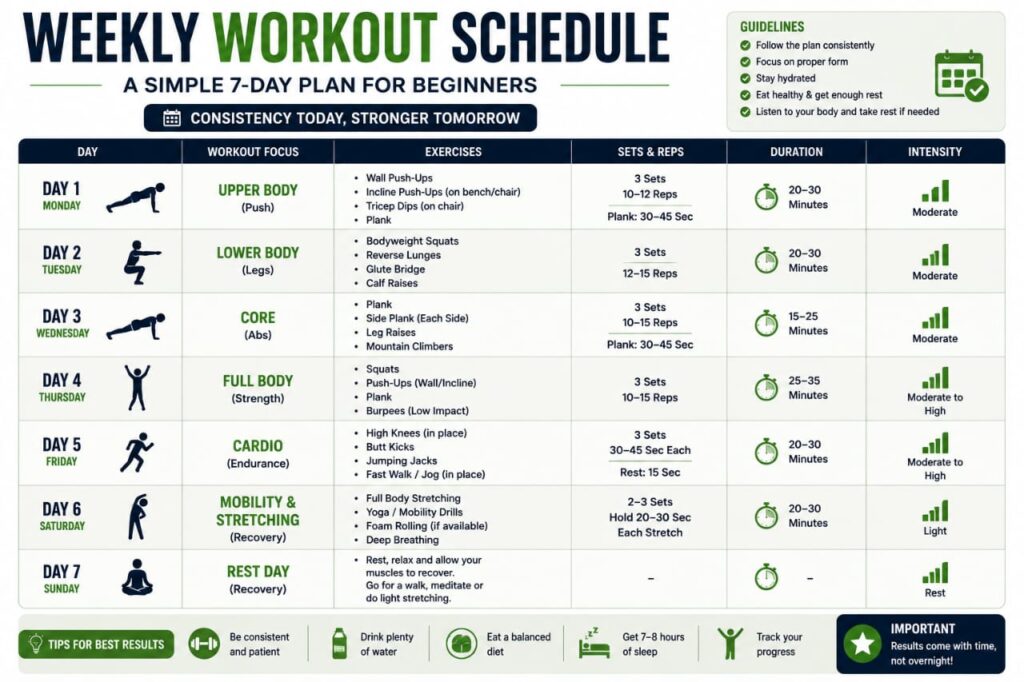
This program follows a balanced weekly routine.
| Day | Workout |
| Monday | Full Body Workout |
| Tuesday | Walking + Stretching |
| Wednesday | Lower Body |
| Thursday | Active Recovery |
| Friday | Upper Body |
| Saturday | Core + Cardio |
| Sunday | Rest |
Following this schedule helps your body recover while making steady progress.
Beginner workout routine Full Body Workout – Day 1
Perform the following exercises.
Bodyweight Squats
Sets: 3
Repetitions: 12
Benefits:
- Strengthens legs
- Builds glutes
- Improves balance
- Burns calories
How to perform:
Stand shoulder-width apart.
Push your hips backward.
Lower until your thighs become almost parallel to the floor.
Keep your chest up.
Stand back slowly.
Common mistakes:
- Knees collapsing inward
- Rounded back
- Lifting heels
Wall Push-Ups
Sets: 3
Repetitions: 10
Perfect for complete beginners.
Benefits:
- Strengthens chest
- Improves shoulder stability
- Builds arm strength
Technique:
Stand facing a wall.
Place your hands shoulder-width apart.
Slowly bend your elbows.
Push yourself back.
Breathe out while pushing.
Complete Weekly Workout Routine
In Part 1, we discussed why home workouts are effective, who this workout plan is for, and the importance of warming up before every session. Now it’s time to follow the actual workout routine.
Remember, you don’t need fancy equipment or a large workout space. Your own body weight is enough to improve strength, endurance, and overall fitness. Focus on proper form rather than speed, and increase the difficulty only when the exercises start to feel easy.
Monday – Full Body Workout
1. Bodyweight Squats
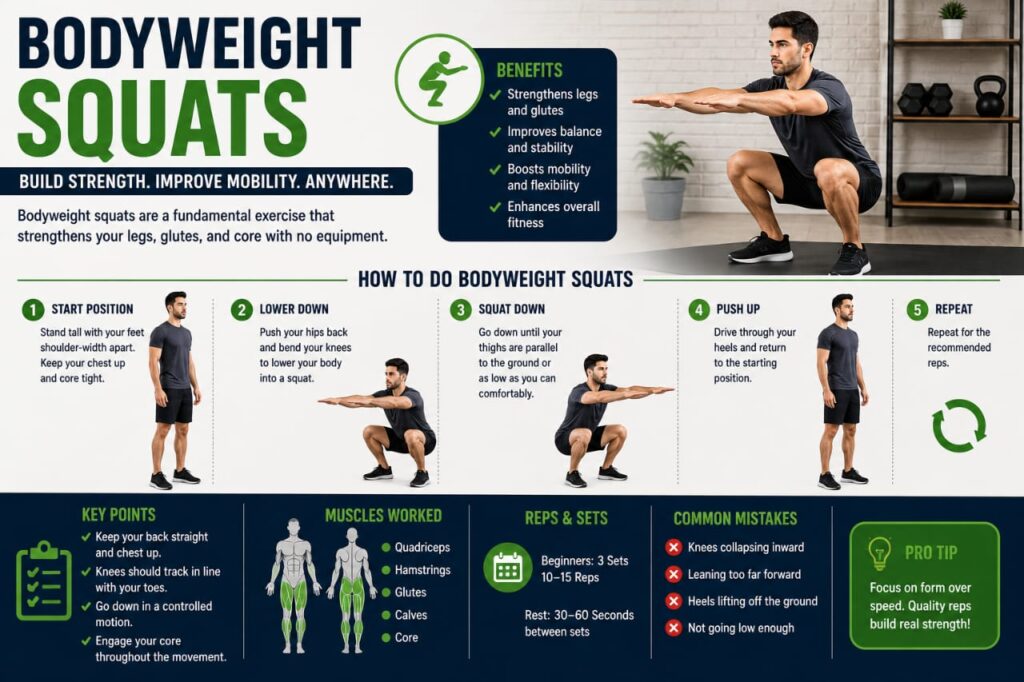
Sets: 3
Reps: 12–15
Target Muscles:
- Quadriceps
- Hamstrings
- Glutes
- Core
Keep your feet shoulder-width apart, lower yourself slowly, and push through your heels to stand back up.
Tip: Keep your chest up and avoid letting your knees cave inward.
2. Wall Push-Ups
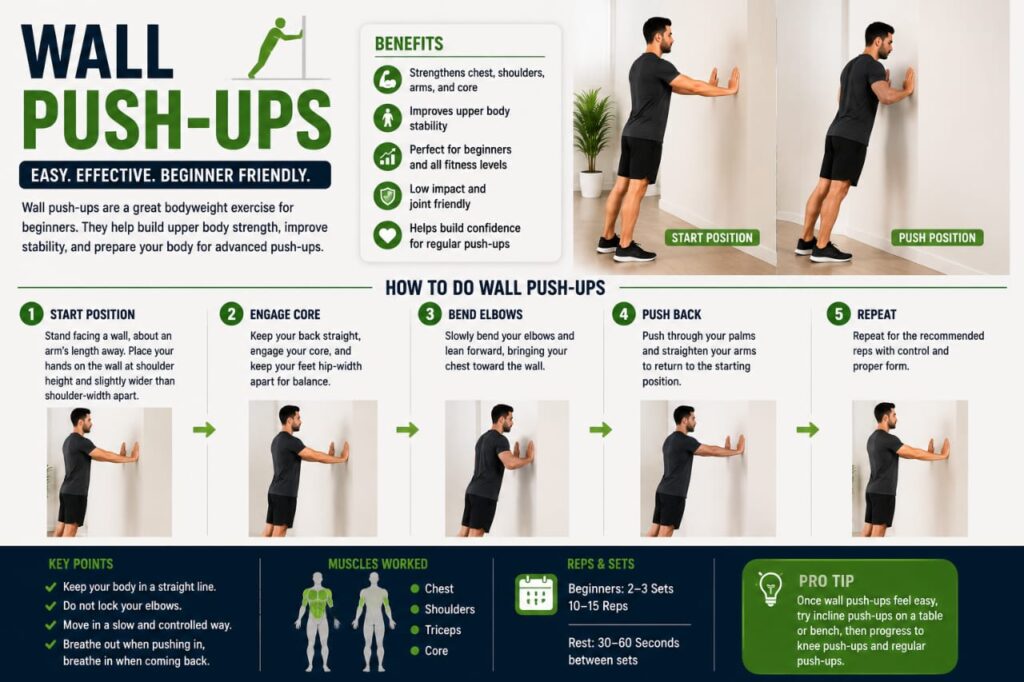
Sets: 3
Reps: 10–12
Wall push-ups are perfect for beginners because they build upper-body strength without placing too much pressure on your joints.
Once these become easy, progress to incline push-ups using a bench or sturdy table.
3. Glute Bridges
Sets: 3
Reps: 15
Lie on your back with your knees bent and feet flat on the floor.
Push through your heels and lift your hips until your body forms a straight line.
Pause for two seconds before lowering.
Benefits include:
- Stronger glutes
- Better posture
- Reduced lower back pain
4. Plank
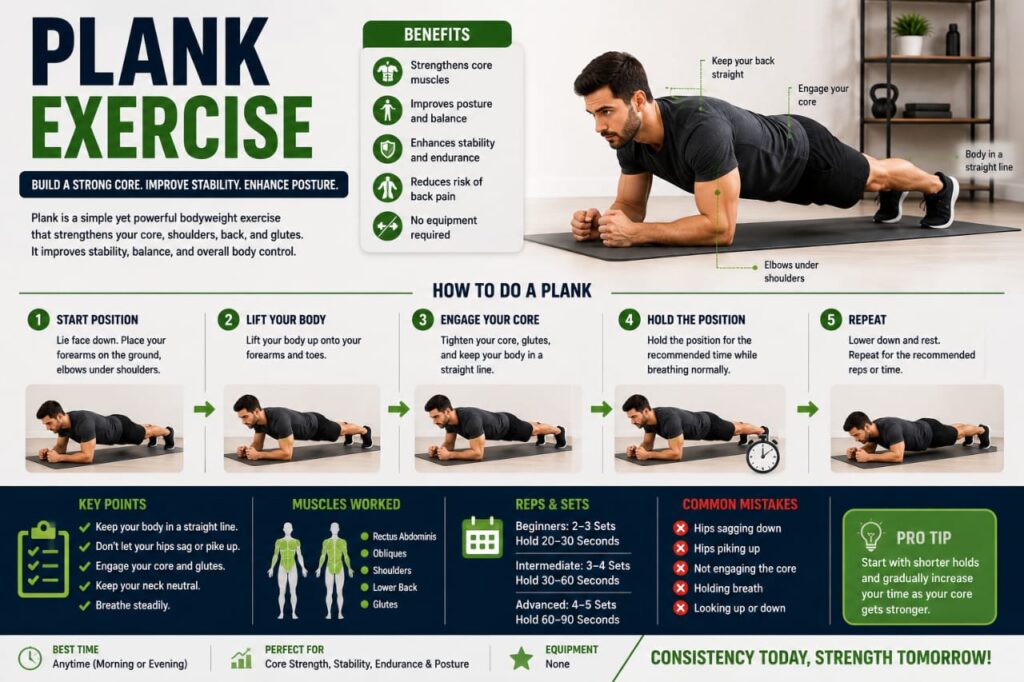
Sets: 3
Hold: 20–30 Seconds
The plank is one of the best core exercises because it trains your entire midsection.
Keep your body straight from head to heels.
Avoid letting your hips sag.
5. March in Place
Duration: 2 Minutes
Finish the workout with light marching to keep your heart rate elevated.
Tuesday – Walking & Stretching
Recovery is just as important as exercise.
Spend 30–40 minutes walking at a comfortable pace.
After walking, perform these stretches.
Hamstring Stretch
Hold for 30 seconds.
Quadriceps Stretch
Hold for 30 seconds each leg.
Calf Stretch
Hold for 30 seconds.
Chest Stretch
Hold for 30 seconds.
Shoulder Stretch
Hold for 30 seconds.
Stretching improves flexibility and reduces muscle tightness.
Wednesday – Lower Body Workout
Today focuses on strengthening your legs.
Bodyweight Squats
4 Sets × 15 Reps
Reverse Lunges
3 Sets × 10 Reps Each Leg
Step backward instead of forward.
This variation is easier for beginners.
Benefits include:
- Better balance
- Stronger legs
- Improved coordination
Glute Bridges
4 Sets × 15 Reps
Squeeze your glutes at the top.
Don’t rush.
Standing Calf Raises
3 Sets × 20 Reps
Rise onto your toes slowly.
Pause.
Lower yourself under control.
Strong calves improve walking, running, and jumping performance.
Wall Sit
3 Sets
Hold 20–30 Seconds
Lean against a wall while keeping your thighs parallel to the floor.
Excellent for building leg endurance.
Thursday – Active Recovery
Today isn’t a complete rest day.
Instead, keep your body moving.
Choose any of these activities:
- 30-minute walk
- Easy cycling
- Yoga
- Light stretching
- Mobility exercises
Active recovery helps reduce soreness while improving blood circulation.
Friday – Upper Body Workout
Today focuses on your chest, shoulders, arms, and upper back.
Incline Push-Ups
3 Sets × 10–12 Reps
Use a sturdy chair or bench.
Lower yourself slowly.
Push back explosively.
If you cannot perform incline push-ups, continue doing wall push-ups until you become stronger.
Pike Shoulder Press
3 Sets × 10 Reps
This exercise targets the shoulders.
Keep your hips high.
Lower your head toward the floor.
Push back up.
Chair Triceps Dips
3 Sets × 10 Reps
Use a stable chair.
Lower yourself until your elbows reach approximately 90 degrees.
Push yourself back up.
Don’t drop too low.
Superman Exercise
3 Sets × 15 Reps
Lie face down.
Raise both arms and legs.
Hold for two seconds.
Lower slowly.
Benefits:
- Strong lower back
- Better posture
- Improved spinal stability
Forearm Plank
3 Sets
30 Seconds
This finishes your upper-body workout while strengthening your core.
Saturday – Core & Cardio Workout
Core strength improves almost every movement in daily life.
Today’s workout combines abdominal exercises with cardio.
Jumping Jacks
3 Sets × 30 Seconds
Maintain a comfortable rhythm.
Avoid landing heavily.
Mountain Climbers
3 Sets × 20 Reps
Move slowly.
Don’t sacrifice form for speed.
Dead Bug
3 Sets × 12 Reps
Lie on your back.
Extend opposite arm and leg simultaneously.
Return slowly.
This exercise improves coordination and core stability.
Bicycle Crunches
3 Sets × 15 Reps
Rotate your shoulders instead of simply moving your elbows.
Control every repetition.
Side Plank
2 Sets
20 Seconds Each Side
Strengthens the oblique muscles.
Improves balance.
Supports the lower back.
High Knees
3 Rounds
30 Seconds
Raise your knees comfortably.
Swing your arms naturally.
Keep breathing steadily.
Sunday – Complete Rest
Your muscles need recovery to become stronger.
Avoid intense exercise today.
Instead:
- Stay hydrated.
- Take a light walk if you wish.
- Eat healthy meals.
- Sleep at least eight hours.
Recovery is where real progress happens.
Beginner Progression Plan
Many beginners wonder when they should make workouts harder.
Follow these simple rules.
Increase repetitions first.
Example:
Week 1
10 Squats
Week 2
12 Squats
Week 3
15 Squats
Week 4
20 Squats
After reaching the maximum repetitions comfortably, increase the number of sets.
Finally, slow down the movement to increase difficulty.
Breathing Technique
Proper breathing makes every exercise easier.
General rule:
Inhale during the lowering phase.
Exhale during the lifting phase.
Examples:
Squat
Go down → Inhale
Stand up → Exhale
Push-Up
Lower yourself → Inhale
Push upward → Exhale
Plank
Take slow deep breaths.
Never hold your breath.
Hydration Tips
Water is essential for performance and recovery.
Drink:
- One glass after waking up
- One glass 30 minutes before exercise
- Small sips during workouts
- Water immediately after finishing
Aim for 2–3 liters daily, depending on your activity level and climate.
Signs You’re Progressing
Don’t rely only on the scale.
Progress also includes:
- More energy
- Better sleep
- Improved posture
- Stronger muscles
- Easier daily activities
- Increased endurance
- Better balance
- Reduced fatigue
These improvements often appear before major changes in body weight.
Nutrition Guide for Beginners
Exercise alone cannot produce the best results. Your body also needs proper nutrition to recover, build muscle, and maintain energy. Whether your goal is weight loss or muscle gain, healthy eating plays a major role in your fitness journey.
Many beginners spend hours exercising but ignore their diet. This often slows progress and leads to frustration. Eating balanced meals every day will help you recover faster and improve your workout performance.
The Importance of Protein
Protein is one of the most important nutrients for your body.
It helps repair muscle tissue after workouts and supports muscle growth. Without enough protein, your recovery will be slower, and your strength gains may be limited.
Good protein sources include:
Chicken breast
Eggs
Fish
Greek yogurt
Milk
Paneer
Beans
Lentils
Chickpeas
Tofu
Try to include a source of protein in every meal.
Healthy Carbohydrates
Carbohydrates provide your body with energy for exercise.
Many people think carbs are unhealthy, but healthy carbohydrates are essential for an active lifestyle.
Choose foods such as:
Oats
Brown rice
Sweet potatoes
Whole wheat bread
Bananas
Apples
Oranges
Quinoa
Avoid relying on sugary snacks and soft drinks for energy.
Healthy Fats
Healthy fats support hormone production, brain function, and overall health.
Good sources include:
Avocados
Almonds
Walnuts
Peanuts
Olive oil
Pumpkin seeds
Sunflower seeds
Eat these foods in moderation because they are high in calories.
Vegetables and Fruits
Vegetables and fruits provide vitamins, minerals, antioxidants, and fiber.
Try to eat colorful vegetables every day.
Examples include:
Spinach
Broccoli
Carrots
Bell peppers
Tomatoes
Cucumber
Fruits are also excellent snacks.
Choose options like:
Bananas
Apples
Berries
Oranges
Papaya
Watermelon
Sample Beginner Meal Plan
Breakfast
Oatmeal with milk
One banana
Two boiled eggs
Mid Morning Snack
Apple
A handful of almonds
Lunch
Grilled chicken
Brown rice
Mixed vegetables
Afternoon Snack
Greek yogurt
Dinner
Grilled fish or chicken
Sweet potato
Green salad
Before Bed
A glass of milk
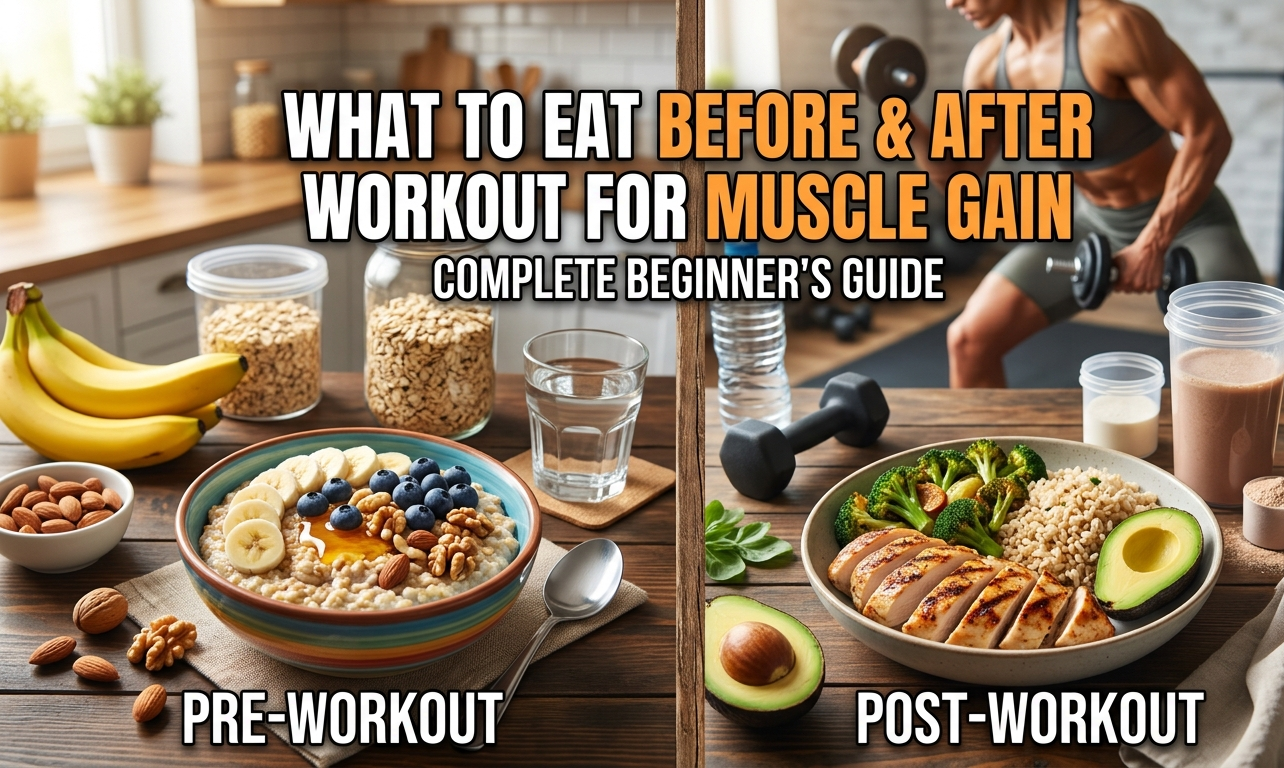
What to Eat Before a Workout
Choosing the right foods before and after exercise is just as important as training. Read our complete guide on What to Eat Before and After Workout for Muscle Gain.
Eating before exercise provides energy and improves performance.
Eat your meal about one to two hours before training.
Good pre workout foods include:
Banana
Oatmeal
Whole wheat toast
Greek yogurt
Peanut butter
Avoid heavy fried foods before exercising.
What to Eat After a Workout
After your workout, your body needs protein and carbohydrates for recovery.
Choose foods like:
Chicken with rice
Eggs and toast
Greek yogurt with fruit
Protein smoothie
Milk and banana
Try to eat within one hour after your workout.
Common Beginner Mistakes
Many beginners make simple mistakes that slow their progress.
Skipping warm ups
Using incorrect exercise form
Training every day without rest
Not drinking enough water
Sleeping too little
Eating unhealthy food regularly
Expecting quick results
Comparing themselves with experienced athletes
Avoiding these mistakes will help you stay consistent and injury free.
Staying Motivated
Motivation comes and goes, but habits last.
Set realistic goals.
Track your workouts.
Celebrate small achievements.
Take progress photos every month.
Exercise with a friend if possible.
Remember why you started.
Even a short workout is better than skipping your session completely.
Why Sleep Matters
Sleep is one of the most overlooked parts of fitness.
During sleep, your muscles recover and grow stronger.
Aim for seven to nine hours of quality sleep every night.
Poor sleep may reduce your energy, increase cravings, and slow muscle recovery.
Do Beginners Need Supplements?
Most beginners do not need supplements.
A healthy diet should always come first.
If your protein intake is low, a quality whey protein supplement may help you meet your daily needs.
Other supplements should only be used after consulting a healthcare professional.
How Long Does It Take to See Results?
Results depend on your consistency, diet, and recovery.
Most beginners notice:
Better energy within two weeks.
Improved strength within three to four weeks.
Visible body changes after six to eight weeks.
Significant fitness improvements after three months.
Stay patient and trust the process.
Fitness Is a Lifestyle
Don’t think of exercise as a temporary challenge.
Think of it as a healthy lifestyle.
Small daily improvements create lasting results.
Keep learning.
Stay active.
Eat nutritious foods.
Take care of your body.
Your future self will thank you.
Frequently Asked Questions
Can I lose weight with this home workout plan?
Yes. This workout plan can help you lose weight when combined with a healthy diet and a calorie deficit. Consistency is the key to achieving long-term results.
Can I build muscle without equipment?
Yes. Beginners can build muscle using bodyweight exercises such as squats, push ups, lunges, glute bridges, and planks. As you become stronger, you can increase repetitions and sets to continue making progress.
How many days a week should beginners work out?
Most beginners should exercise four to five days per week while allowing enough time for recovery. Rest days are important because muscles grow during recovery.
How long should each workout last?
A beginner workout should last between 30 and 45 minutes. This includes warming up, exercising, and cooling down.
Is this workout suitable for men and women?
Yes. This workout plan is designed for both men and women who are new to fitness.
What if I miss a workout?
Missing one workout is not a problem. Simply continue with your schedule the next day. Avoid trying to do two workouts in one day to make up for the missed session.
Can teenagers follow this workout plan?
Healthy teenagers can generally follow beginner bodyweight workouts. However, anyone with a medical condition should consult a healthcare professional before starting a new exercise program.
Should I exercise every day?
No. Your body needs time to recover. One or two rest days every week help prevent injuries and improve performance.
Expert Fitness Tips for Beginners
Always begin each workout with a proper warm up.
Focus on learning the correct exercise technique before increasing repetitions.
Drink enough water throughout the day.
Eat enough protein to support muscle recovery.
Sleep at least seven to nine hours every night.
Track your progress every week.
Increase workout intensity gradually.
Stay patient because lasting results take time.
Avoid comparing yourself with others.
Make exercise a regular habit instead of relying on motivation alone.
Weekly Progress Checklist
Complete all scheduled workouts.
Drink at least two liters of water daily.
Sleep seven to nine hours every night.
Eat protein with every main meal.
Walk for at least thirty minutes on recovery days.
Stretch after every workout.
Record your weight and measurements once every week.
Take one progress photo every month.
Safety Guidelines
Stop exercising immediately if you experience severe pain, dizziness, chest pain, or difficulty breathing.
Wear comfortable shoes with good support.
Exercise in a clean and safe area with enough space to move freely.
Do not skip your warm up or cool down.
Increase workout intensity slowly to reduce the risk of injury.
If you have a medical condition or recent injury, speak with your doctor before beginning any fitness program.
Final Thoughts
Starting your fitness journey does not require expensive equipment or a gym membership. What truly matters is consistency, proper technique, and patience.
This beginner home workout plan is designed to help you build strength, improve endurance, increase flexibility, and create healthy habits that last a lifetime. Every workout you complete brings you one step closer to your fitness goals.
Remember that progress is not always visible in the mirror during the first few weeks. Your body is becoming stronger, your heart is getting healthier, and your confidence is growing with every session.
Stay committed to your routine, eat nutritious meals, drink plenty of water, and prioritize quality sleep. Small improvements made every day lead to remarkable results over time.
Fitness is not about being perfect. It is about becoming a little better than you were yesterday.
Start today, stay consistent, and enjoy the journey toward a healthier and stronger version of yourself.
Conclusion
If your goal is to improve overall health while reducing body fat, don’t miss our detailed guide on Weight Loss Programs That Really Work.
The best home workout plan for beginners is one that is simple, effective, and easy to follow. By combining bodyweight exercises, balanced nutrition, proper recovery, and a positive mindset, you can achieve excellent results without any equipment.
Whether your goal is losing weight, building muscle, or improving overall fitness, this complete beginner workout guide gives you a strong foundation for long-term success. Stay consistent, trust the process, and make fitness a part of your daily life.
Planning to join a gym later? Our Complete First Month Gym Starter Guide will help you prepare for your fitness journey.
References
World Health Organization Physical Activity Guidelines
https://www.who.int/news-room/fact-sheets/detail/physical-activity
CDC Physical Activity Recommendations
American Heart Association Exercise Recommendations
About Author
Riaz Ahmed
Riaz Ahmed holds a Master’s degree in Health and Physical Education and is the founder of FitForgeHub, where he shares practical fitness and workout information.