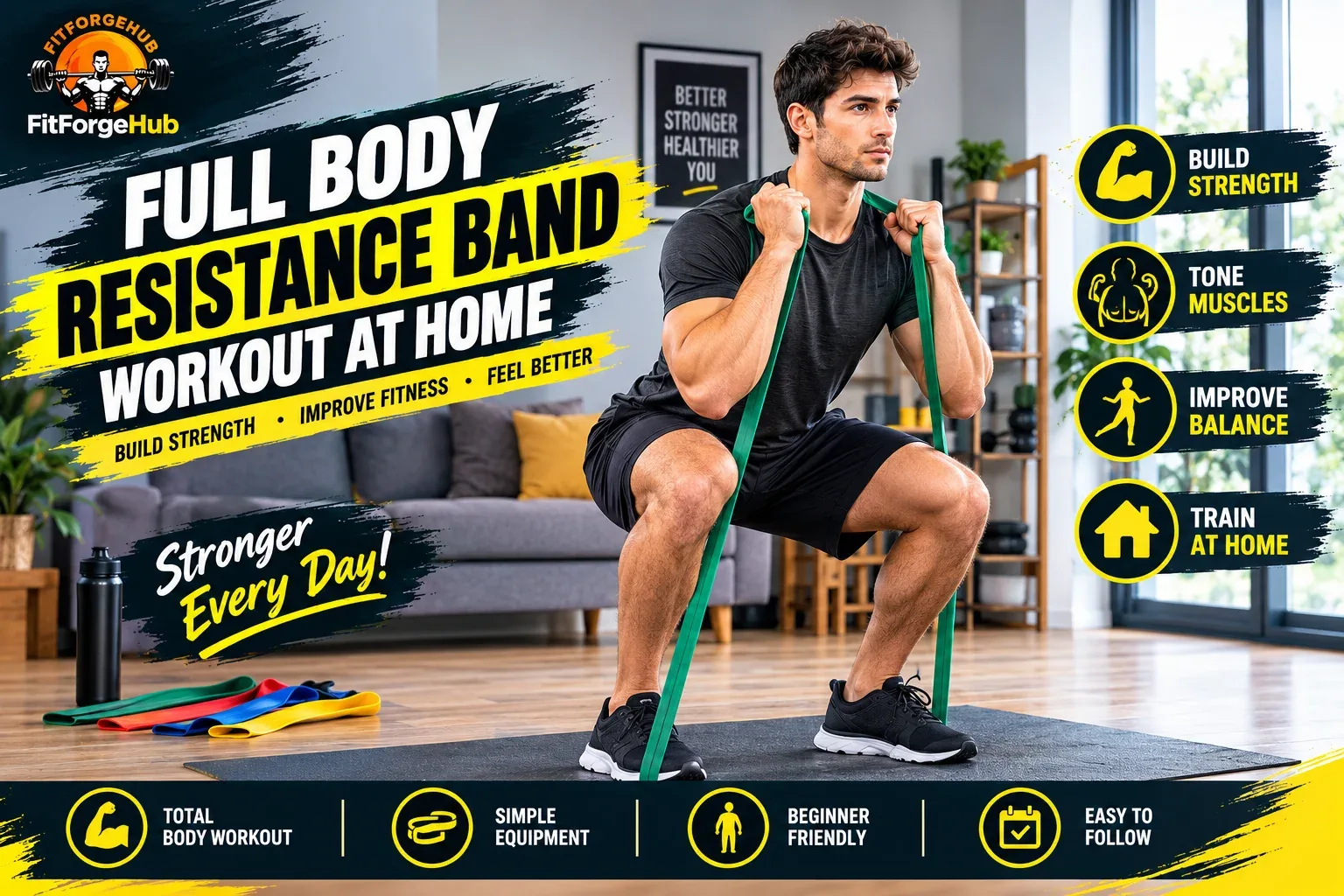
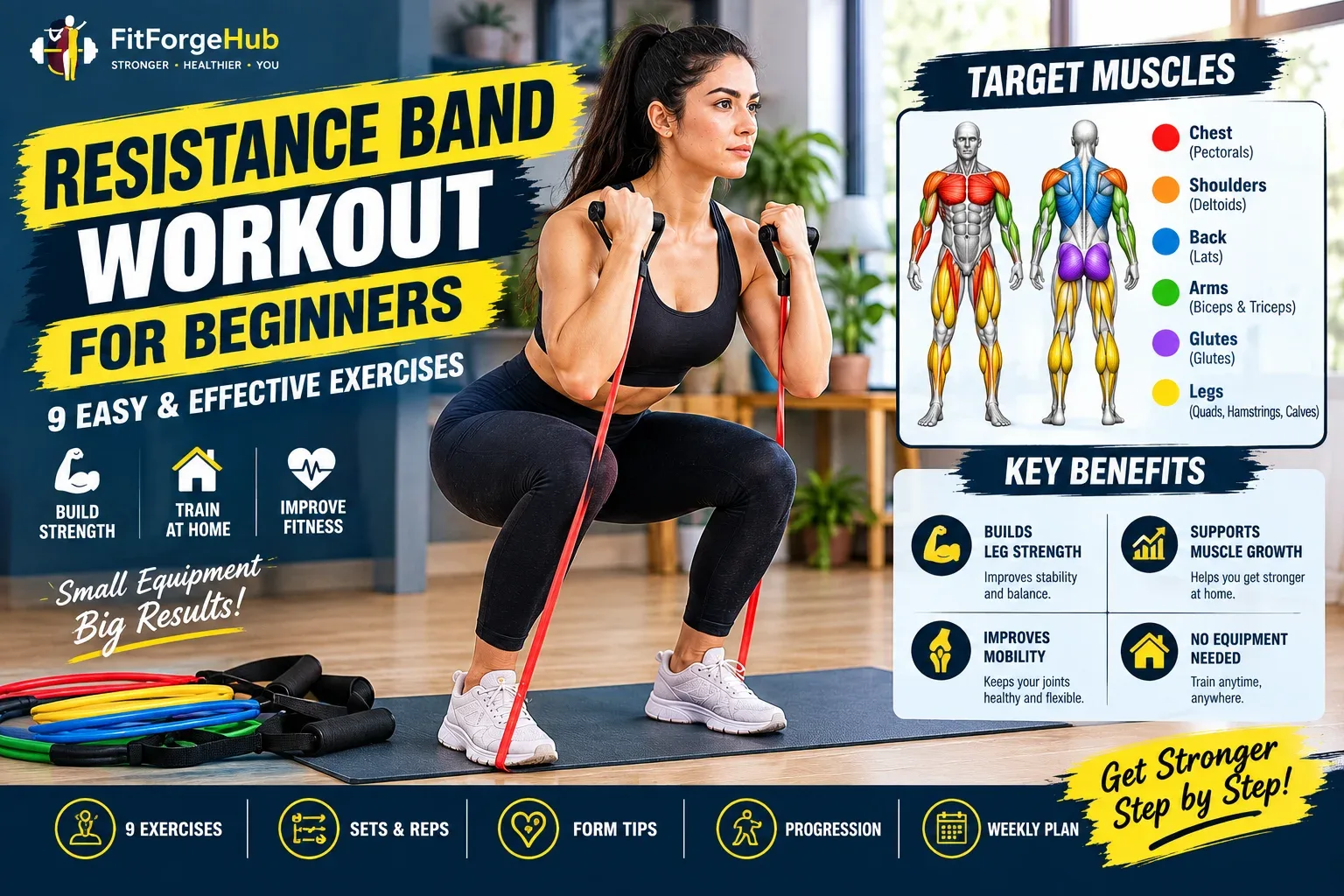
Resistance bands are a simple and versatile way to add resistance to your home workouts. They are lightweight, easy to store, and can be used for exercises that train your legs, chest, back, shoulders, arms, and core.
For beginners, a resistance band workout can be an effective starting point for developing strength and learning basic resistance-training movements without needing a full home gym.
In this guide, you’ll learn how to perform a resistance band workout for beginners, including 9 exercises, recommended sets and reps, rest periods, progression strategies, common mistakes, and a simple weekly workout plan.
If you’re new to resistance training, this resistance band workout for beginners gives you a simple way to train your full body at home.
Disclaimer: This article is for general educational and fitness information only. It is not medical advice. If you have an injury, medical condition, or concerns about starting resistance training, consult a qualified healthcare professional before beginning a new exercise program.
Table of Contents
- What Is a Resistance Band Workout?
- Are Resistance Bands Good for Beginners?
- Benefits of Resistance Band Training
- 9 Best Resistance Band Exercises for Beginners
- Beginner Resistance Band Workout
- Sets, Reps, and Rest
- How to Progress With Resistance Bands
- Full-Body Resistance Band Workout at Home
- Resistance Band Workout Without an Anchor
- How Often Should Beginners Use Resistance Bands?
- Common Resistance Band Training Mistakes
- Resistance Band Safety Tips
- Resistance Bands vs. Dumbbells
- Nutrition and Recovery for Muscle Growth
- Simple Weekly Schedule
- Frequently Asked Questions
- Final Thoughts
- About the Author
What Is a Resistance Band Workout?
A resistance band workout uses elastic bands to provide resistance while you move through an exercise.
Unlike traditional free weights, resistance bands become more challenging as the band is stretched. Different band thicknesses and lengths can provide different levels of resistance.
You can use resistance bands for:
- Squats
- Rows
- Chest presses
- Shoulder presses
- Biceps curls
- Triceps extensions
- Glute exercises
- Lunges
- Core exercises
This makes them useful for both beginner home workouts and more advanced resistance-training routines.
The CDC recognizes resistance bands as one option for muscle-strengthening activity.
Are Resistance Bands Good for Beginners?
Yes.
Resistance bands can be a practical option for beginners because they are:
- Lightweight
- Portable
- Relatively inexpensive
- Easy to store
- Useful at home
- Available in different resistance levels
- Suitable for many basic movements
However, beginners should focus on controlled movement and proper technique rather than simply choosing the strongest band available.
If a band makes you lose control of the exercise, use a lighter resistance.
The goal is to gradually become stronger while maintaining good form.
Benefits of Resistance Band Training
1. Convenient Home Workouts
You don’t need a large workout space.
A resistance band and a small area of floor space can be enough for many exercises.
2. Easy to Store
Bands take up much less space than a barbell, weight plates, or a large collection of dumbbells.
This makes them especially useful for apartment workouts and small home gyms.
3. Full-Body Training
With the right exercises, you can train:
- Chest
- Back
- Shoulders
- Arms
- Legs
- Glutes
- Core
That makes resistance bands useful for a complete full-body resistance band workout.
4. Adjustable Resistance
You can increase difficulty by:
- Using a stronger band
- Stretching the band farther
- Increasing repetitions
- Adding a set
- Slowing the movement
- Using a more difficult exercise variation
- Reducing assistance from other muscles
5. Beginner Friendly
Resistance bands allow you to start with relatively manageable resistance and gradually increase the challenge.
A resistance band workout for beginners can also be adjusted easily as your strength and fitness level improve.
9 Best Resistance Band Exercises for Beginners
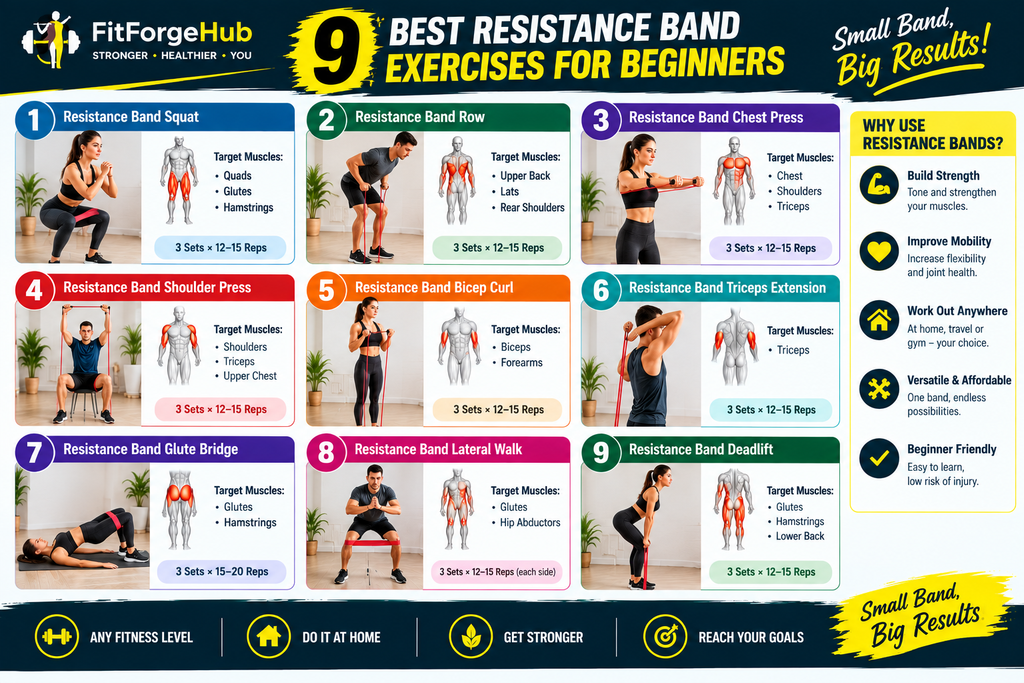
Here are nine exercises you can use to build a balanced beginner routine.
1. Resistance Band Squat
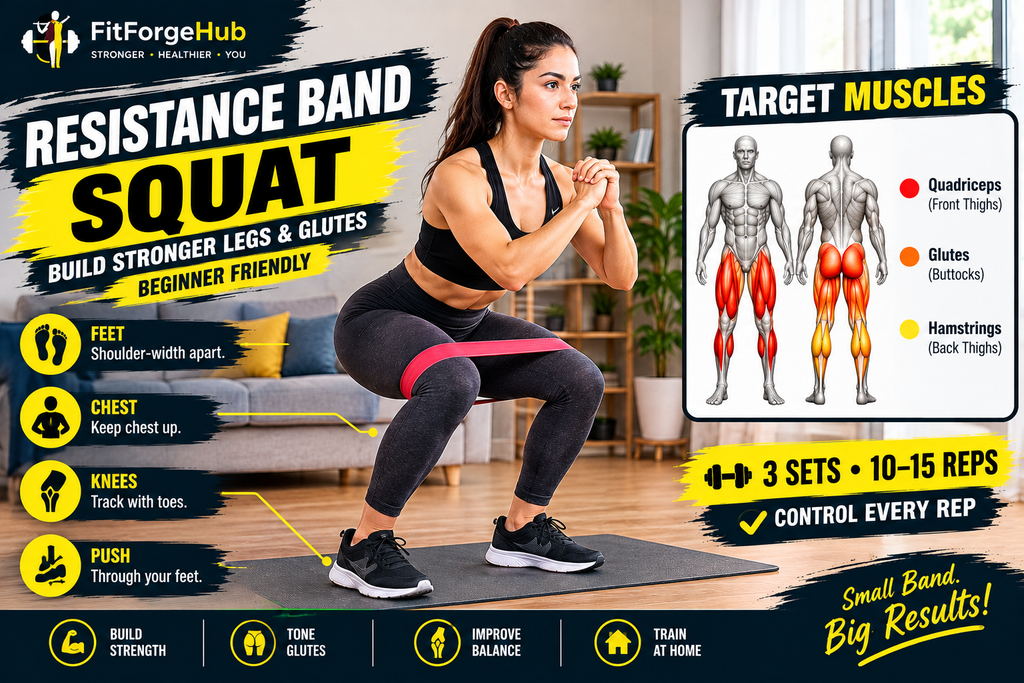
Primary muscles: Quadriceps, glutes
How to do it:
- Stand on the middle of the resistance band.
- Hold the band handles or ends near your shoulders.
- Keep your chest up and core engaged.
- Push your hips back and bend your knees.
- Lower into a comfortable squat.
- Push through your feet to return to standing.
Sets: 3
Reps: 10–15
Beginner Tip
Start with a lighter band and focus on controlled repetitions.
2. Resistance Band Row
Primary muscles: Upper back, lats, rear shoulders
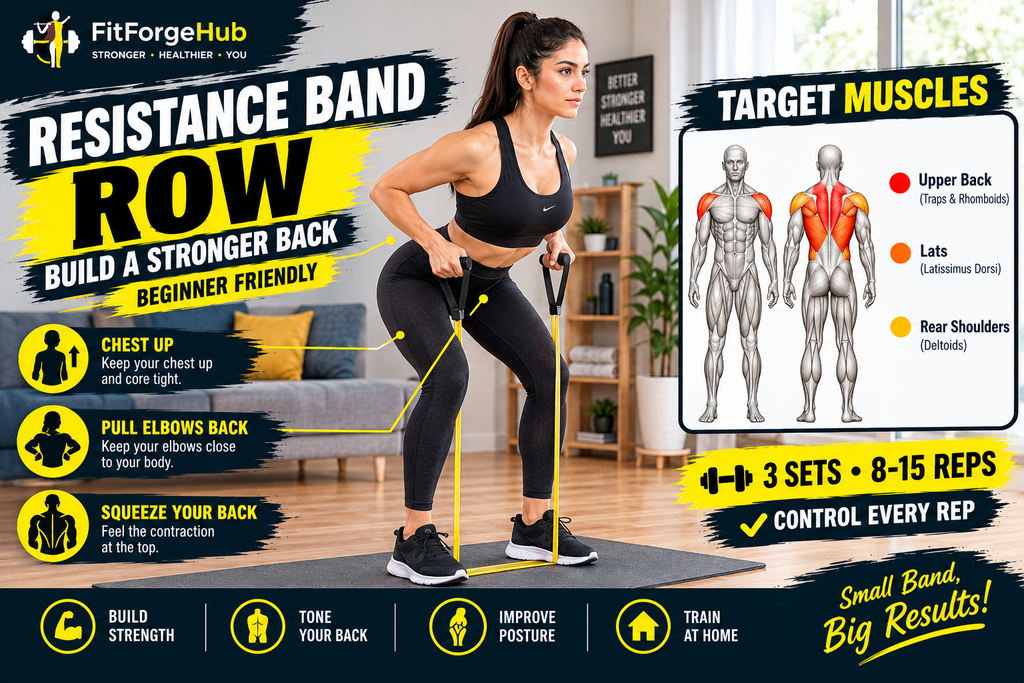
Resistance band row for beginners targeting the upper back, lats, and rear shoulders.A resistance band row is one of the most useful pulling exercises for a beginner.
How to do it:
- Secure the band safely or use an appropriate foot-anchored setup.
- Hold the handles.
- Keep your spine neutral.
- Pull your elbows toward your torso.
- Squeeze your upper back.
- Slowly return to the starting position.
Sets: 3
Reps: 8–15
Avoid shrugging your shoulders toward your ears.
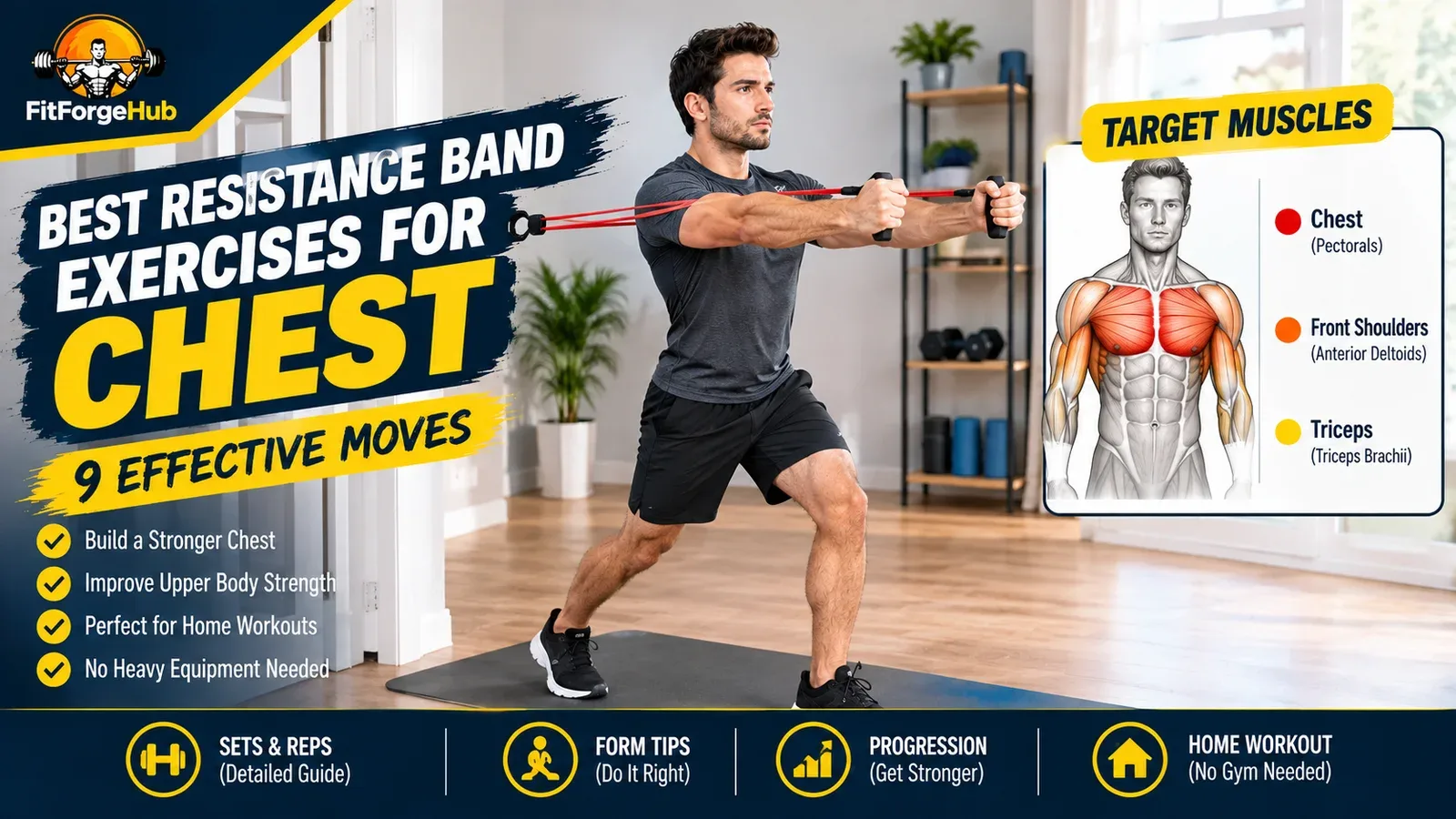
3. Resistance Band Chest Press
Primary muscles: Chest, shoulders, triceps
How to do it:
- Secure the band behind you using a safe anchor.
- Hold the handles at chest level.
- Stand in a stable position.
- Press your hands forward.
- Fully control the return movement.
- Repeat.
Sets: 3
Reps: 8–15
Important: Only use an anchor designed for resistance-band exercises and follow its instructions.
4. Resistance Band Shoulder Press
Primary muscles: Shoulders, triceps
How to do it:
- Stand on the middle of the band.
- Hold the handles around shoulder height.
- Brace your core.
- Press the handles overhead.
- Lower them slowly.
Sets: 2–3
Reps: 8–12
Don’t arch your lower back excessively to complete a repetition.
5. Resistance Band Biceps Curl
Primary muscles: Biceps
How to do it:
- Stand on the band.
- Hold the handles with your palms facing forward.
- Keep your elbows close to your sides.
- Curl your hands toward your shoulders.
- Squeeze your biceps.
- Slowly lower the handles.
Sets: 2–3
Reps: 10–15
Avoid swinging your body to move the band.
6. Resistance Band Triceps Extension
Primary muscles: Triceps
You can perform this exercise overhead or with an appropriate anchor setup.
How to do it:
- Hold the band securely.
- Keep your elbows controlled.
- Extend your arms against the band’s resistance.
- Squeeze your triceps.
- Return slowly.
Sets: 2–3
Reps: 10–15
Use a resistance level that allows you to control the entire movement.
7. Resistance Band Glute Bridge
Primary muscles: Glutes, hamstrings
How to do it:
- Place the band around your thighs if it is designed for this setup.
- Lie on your back.
- Bend your knees.
- Keep your feet flat.
- Drive through your feet.
- Lift your hips.
- Squeeze your glutes at the top.
- Lower with control.
Sets: 3
Reps: 12–20
8. Resistance Band Lateral Walk
Primary muscles: Glutes, hip muscles
How to do it:
- Place a suitable loop band around your thighs or lower legs.
- Bend your knees slightly.
- Keep your chest up.
- Take controlled steps sideways.
- Maintain band tension throughout the movement.
Sets: 2–3
Reps: 8–15 steps each direction
Avoid letting your knees collapse inward.
9. Resistance Band Pallof Press
Primary muscles: Core
The Pallof press is an anti-rotation exercise that challenges your core to resist unwanted trunk movement.
How to do it:
- Secure the band at about chest height.
- Stand sideways to the anchor.
- Hold the band with both hands.
- Bring your hands toward your chest.
- Press your hands forward.
- Resist the band’s pull.
- Return slowly.
Sets: 2–3
Reps: 8–12 per side
Keep your hips and shoulders facing forward.
Beginner Resistance Band Workout
Now combine the exercises into a simple routine.
Before starting this resistance band workout for beginners, warm up for 5–10 minutes with light movement and dynamic exercises.
| Exercise | Sets | Reps |
|---|---|---|
| Band Squat | 3 | 10–15 |
| Band Chest Press | 3 | 8–15 |
| Band Row | 3 | 8–15 |
| Band Shoulder Press | 2 | 8–12 |
| Band Glute Bridge | 3 | 12–20 |
| Band Biceps Curl | 2 | 10–15 |
| Band Triceps Extension | 2 | 10–15 |
| Lateral Band Walk | 2 | 8–15/side |
| Pallof Press | 2 | 8–12/side |
Rest: Approximately 60–120 seconds between sets.
You don’t necessarily need to perform all nine exercises in your first workout.
If you’re completely new to resistance training, start with fewer exercises and gradually build up.
Sets, Reps, and Rest
There is no single repetition range that is perfect for every beginner.
A practical starting point is:
Compound movements
8–15 reps
Examples:
- Squats
- Rows
- Chest presses
- Shoulder presses
Isolation movements
10–20 reps
Examples:
- Biceps curls
- Triceps extensions
- Lateral walks
Core exercises
8–15 controlled reps
Or use timed sets when appropriate.
The most important factors are appropriate resistance, controlled technique, and gradual progression.
How to Progress With Resistance Bands
Your resistance band workout for beginners should become gradually more challenging as your strength improves.
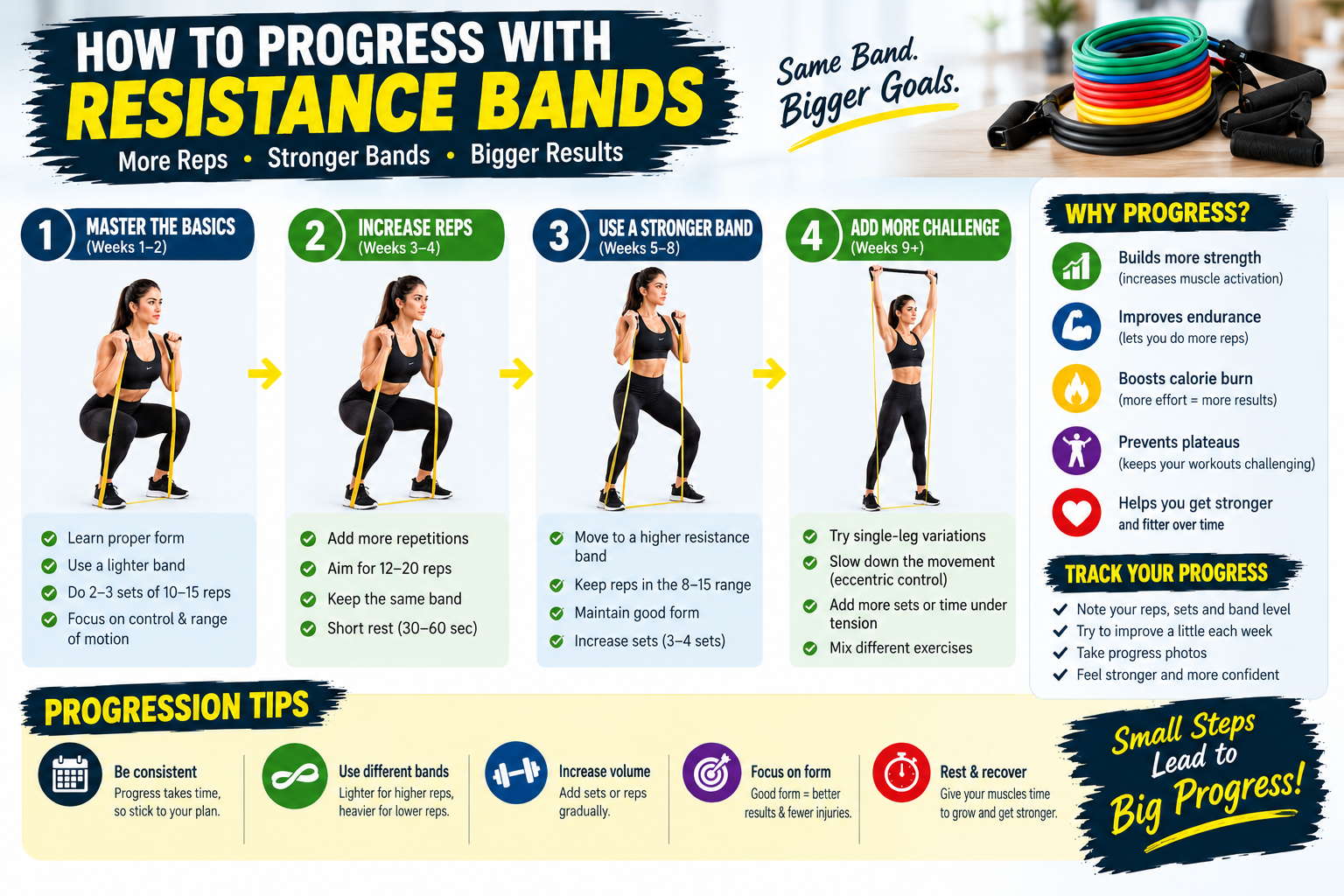
Here are several ways to progress.
Method 1: Add Repetitions
If you can comfortably perform:
3 × 10
Work toward:
3 × 12
Then:
3 × 15
Method 2: Increase Band Resistance
Once your current band becomes too easy, move to a stronger band.
Method 3: Increase Range of Motion
A controlled, larger range of motion can make some movements more challenging.
Method 4: Add a Set
For selected exercises, you can progress from:
2 sets → 3 sets
Don’t increase everything at once.
Method 5: Improve Technique
Progress doesn’t always mean adding resistance.
Better control, consistent range of motion, and cleaner repetitions are also meaningful improvements.
ACSM’s 2026 position stand highlights consistency as a major part of successful resistance training and provides different recommendations depending on whether the goal is strength, muscle growth, or other outcomes.
CSM: 2026 Resistance Training Guidabnce
The key to making this resistance band workout for beginners more effective is gradually increasing the challenge as you get stronger.
Full-Body Resistance Band Workout at Home
If your main goal is general strength and fitness, train your major muscle groups during the week.
Learn how to progress with resistance bands by increasing reps, using stronger bands, and gradually adding more challenge.A simple session could include:
Lower body
- Band squats
- Glute bridges
Push
- Band chest press
- Band shoulder press
Pull
- Band rows
Arms
- Biceps curls
- Triceps extensions
Core
- Pallof press
This gives you a balanced full-body resistance band workout at home without requiring a large amount of equipment.
The CDC recommends that adults perform muscle-strengthening activity at least two days per week and work all major muscle groups.
Resistance Band Workout Without an Anchor
Not every resistance-band exercise requires a door anchor.
You can perform several movements without an anchor, including:
- Squats
- Glute bridges
- Lateral walks
- Biceps curls
- Shoulder presses
- Some triceps exercises
- Romanian deadlift variations
- Good mornings
For exercises that require anchoring, use equipment specifically designed for that purpose and follow the manufacturer’s instructions.
Never attach a band to an unstable object or use a damaged band.
How Often Should Beginners Use Resistance Bands?
A beginner can start with 2–3 resistance-training sessions per week, depending on fitness level, recovery, and overall activity.
For example:
| Day | Workout |
|---|---|
| Monday | Resistance Band Full Body |
| Tuesday | Rest / Walking |
| Wednesday | Rest |
| Thursday | Resistance Band Full Body |
| Friday | Rest |
| Saturday | Optional Light Workout |
| Sunday | Rest |
The CDC recommends muscle-strengthening activity on at least two days per week for adults.
If you’re brand new to exercise, starting with two sessions and gradually increasing activity can be more manageable than immediately training hard several days per week.
CDC Adult Physical Activity Guidelines
Common Resistance Band Training Mistakes
1. Using Too Much Resistance
A stronger band isn’t automatically better.
If you cannot control the movement, use less resistance.
2. Moving Too Quickly
Fast repetitions can make it harder to control the exercise.
Use a controlled tempo.
3. Ignoring the Return Phase
Don’t simply let the band pull your limbs back.
Control the eccentric portion of the movement.
4. Poor Band Position
Incorrect band placement can change the movement or create unnecessary discomfort.
Follow the exercise instructions carefully.
5. Never Increasing Difficulty
If your current band becomes extremely easy, your workout may no longer provide enough challenge.
Track your reps and resistance so you know when to progress.
Resistance Band Safety Tips
Before every workout:
- Inspect the band for cracks or damage.
- Check handles and attachment points.
- Make sure anchors are secure.
- Keep the band away from sharp edges.
- Don’t use damaged bands.
- Maintain controlled movement.
- Don’t stretch the band beyond its recommended range.
- Keep enough space around you.
For anchored exercises, make sure the anchor is appropriate for resistance-band use.
If the band or anchor looks damaged, replace it rather than trying to repair it.
Resistance Bands vs. Dumbbells
Both can be useful for home resistance training.
| Feature | Resistance Bands | Dumbbells |
|---|---|---|
| Storage | Very easy | Requires more space |
| Portability | Excellent | Moderate |
| Resistance | Elastic | Fixed load |
| Home use | Excellent | Excellent |
| Exercise variety | High | High |
| Progression | Band/reps/variation | Weight/reps/variation |
| Beginner friendly | Yes | Yes |
The best choice depends on your available space, budget, training preferences, and goals.
If you already have dumbbells, you can combine both tools.
For more information, read our:
Complete Dumbbell Workout Guide for Beginners
Nutrition and Recovery for Muscle Growth
Resistance training is only one part of a muscle-building routine.
If your goal is to build muscle, pay attention to:
Protein
Include protein-rich foods such as:
- Eggs
- Chicken
- Fish
- Lean meat
- Greek yogurt
- Milk
- Cottage cheese
- Beans
- Lentils
- Soy foods
Carbohydrates
Examples include:
- Rice
- Oats
- Potatoes
- Whole-grain bread
- Pasta
- Fruit
Healthy Fats
Examples include:
- Nuts
- Seeds
- Peanut butter
- Avocado
- Olive oil
Recovery
Allow adequate recovery between challenging workouts.
Sleep, nutrition, hydration, and rest all contribute to your ability to train consistently.
If your goal is specifically muscle gain, you can also read:
What to Eat Before and After Workout for Muscle Gain
Simple Weekly Resistance Band Schedule
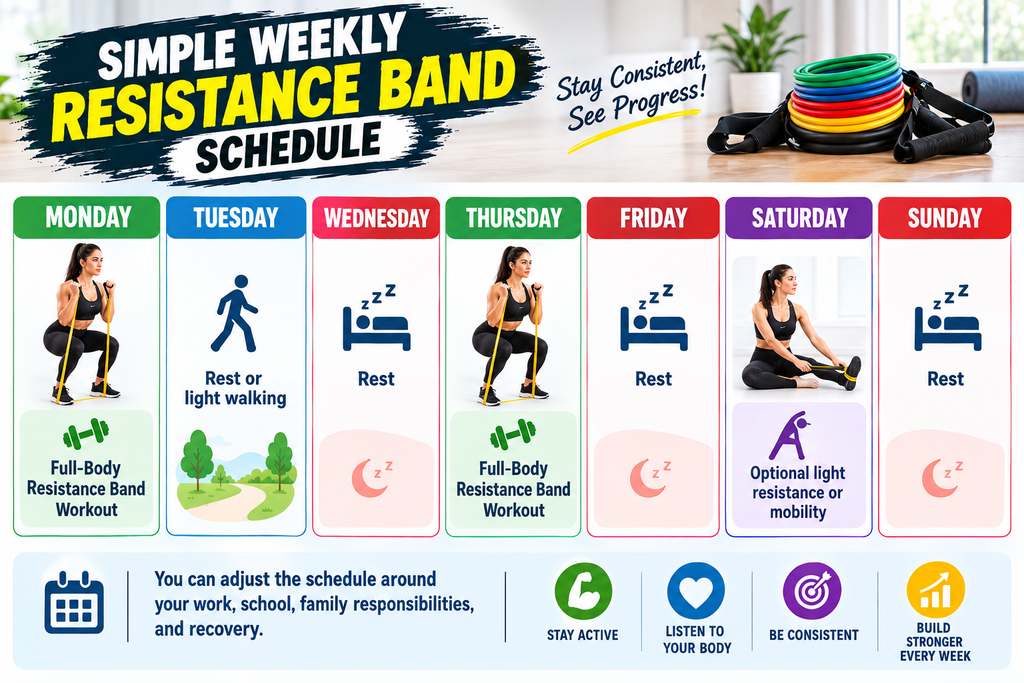
Here’s an easy beginner schedule:
Monday
Full-Body Resistance Band Workout
Tuesday
Rest or light walking
Wednesday
Rest
Thursday
Full-Body Resistance Band Workout
Friday
Rest
Saturday
Optional light resistance or mobility
Sunday
Rest
You can adjust the schedule around your work, school, family responsibilities, and recovery.
How Long Should a Resistance Band Workout Last?
A beginner session can often fit into approximately 30–50 minutes, depending on the number of exercises, sets, warm-up, and rest periods.
You don’t need to make every workout extremely long.
A consistent, well-structured workout is more useful than an excessively long session that you cannot maintain.
Can Resistance Bands Build Muscle?
Resistance bands can provide resistance for muscle-strengthening exercises.
For beginners, they can be useful for developing strength and building a consistent resistance-training routine.
As you become stronger, you may need to increase resistance, repetitions, sets, range of motion, or exercise difficulty.
For a complete muscle-building approach, see:
Build Muscle at Home: 7 Easy & Effective Tips for Beginners
Frequently Asked Questions
Are resistance bands good for beginners?
Yes. Resistance bands are a practical option for beginners because they are portable, easy to store, and can be used for many basic resistance exercises.
Can I build muscle with resistance bands?
Resistance bands can provide resistance for muscle-strengthening exercises. Beginners can use them as part of a progressive resistance-training program.
How many days a week should I use resistance bands?
Two to three resistance-training sessions per week can be a practical starting point for many beginners, depending on fitness level and recovery.
How many reps should beginners do with resistance bands?
A practical starting range is about 8–15 repetitions for many compound exercises and 10–20 repetitions for some isolation movements.
Are resistance bands better than dumbbells?
Neither is automatically better for everyone.
Resistance bands are portable and easy to store, while dumbbells provide a more consistent external load.
Your choice depends on your goals, equipment, space, and preferences.
Can I do a resistance band workout every day?
You don’t need to perform hard resistance training every day.
Allow your muscles adequate recovery between challenging sessions, especially when you’re new to training.
Can I use resistance bands for a full-body workout?
Yes. You can use resistance bands to train your legs, chest, back, shoulders, arms, glutes, and core.
Do I need an anchor for resistance bands?
No. Many exercises don’t require an anchor.
However, certain chest, back, and triceps movements work better with an appropriate anchor.
Always use a secure setup designed for resistance bands.
Final Thoughts
A resistance band workout for beginners can be a simple way to start resistance training at home.
You can train your entire body with a relatively small amount of equipment, and you can gradually increase the challenge as your strength improves.
Start with manageable resistance, learn proper technique, track your workouts, and progress gradually.
You don’t need a complicated home gym to begin.
Consistency is the foundation. Progress comes next.
For another beginner-friendly option, check out:
Beginner Push Pull Legs Workout at Home
Overall, this resistance band workout for beginners is a practical starting point for building strength and improving your fitness at home
About the Author
Riaz Ahmed
Riaz Ahmed holds a Master’s degree in Health and Physical Education and is the founder of FitForgeHub, where he shares practical fitness and workout information.
His content focuses on beginner-friendly workout routines, strength training, muscle-building guidance, home workouts, nutrition basics, and practical fitness education.
Website: FitForgeHub.com
Disclaimer: The information provided on FitForgeHub is for general educational and informational purposes only. It is not intended to replace professional medical, nutritional, or fitness advice. Consult a qualified healthcare professional before starting a new exercise or nutrition program, particularly if you have an existing health condition or injury.