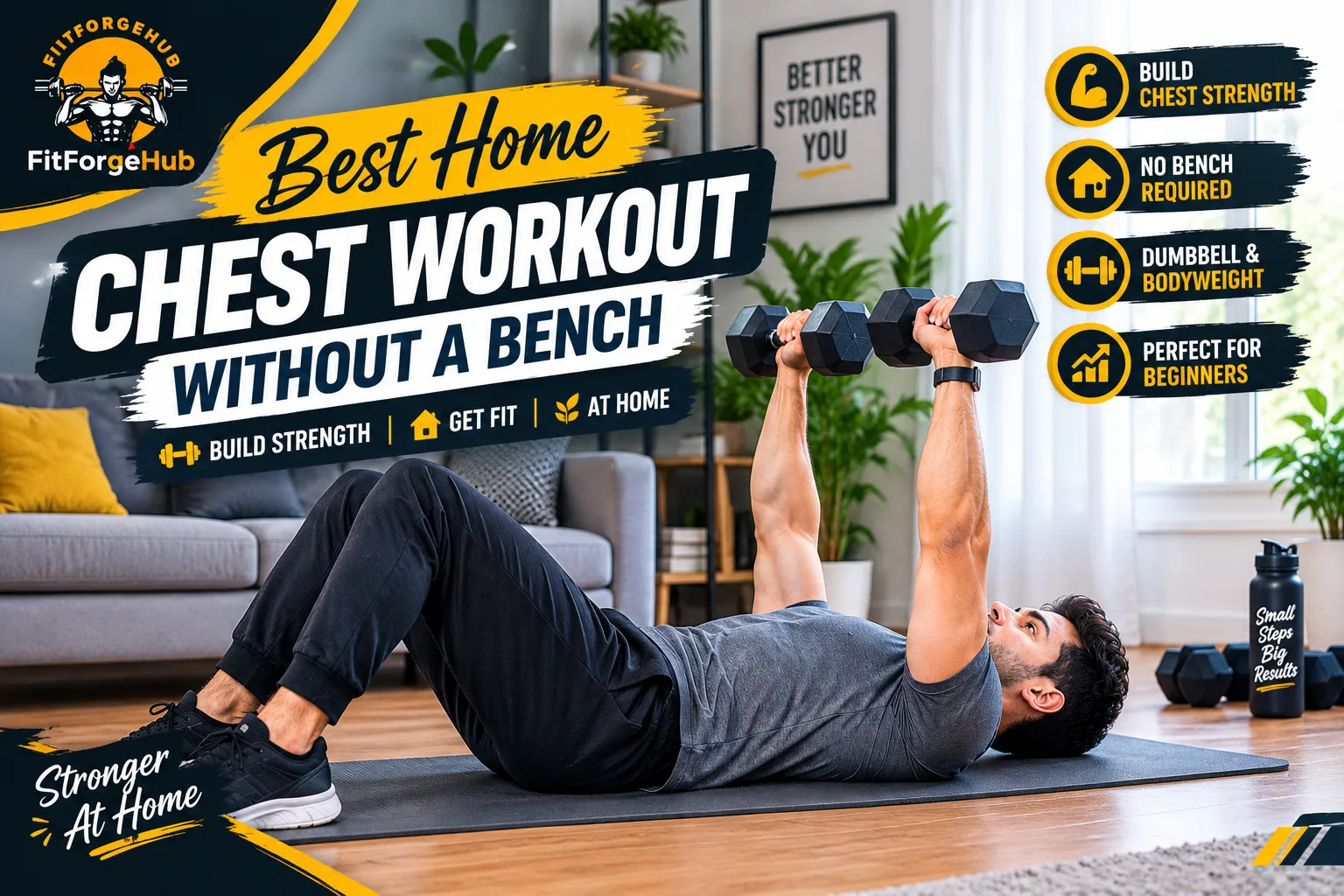
You don’t need a gym bench to train your chest effectively at home. With a pair of dumbbells, your body weight, and the right exercise selection, you can create a simple chest workout that fits into a beginner home training routine.
The key is not having a complicated setup. Instead, focus on controlled repetitions, a comfortable range of motion, good technique, and gradually making the exercises more challenging over time.
In this guide, you’ll learn the best home chest workout without a bench, including dumbbell and bodyweight exercises, sets and reps, rest periods, beginner modifications, progression tips, and common mistakes to avoid.
Quick note: This is general fitness information, not medical advice. If you have an injury or medical condition, consider getting individual guidance from a qualified professional before starting a new exercise program.
Table of Contents
- Can You Build Your Chest Without a Bench?
- Best Home Chest Workout Without a Bench
- 1. Dumbbell Floor Press
- 2. Push-Ups
- 3. Dumbbell Squeeze Press
- 4. Dumbbell Floor Fly
- 5. Wide Push-Ups
- How Many Sets and Reps Should Beginners Do?
- How Long Should You Rest Between Sets?
- How to Progress Without a Bench
- Beginner Chest Workout Schedule
- Common Mistakes to Avoid
- How to Combine This Workout With Your Other Training
- Frequently Asked Questions
- Final Thoughts
- About the Author
Can You Build Your Chest Without a Bench?
Yes, you can train your chest at home without a bench.
A bench can be useful, but it isn’t essential for a beginner chest workout. Floor presses, push-ups, and other variations can provide resistance for the chest while also involving the shoulders and triceps.
If you’re looking for the best home chest workout without a bench, the goal is to choose exercises that provide enough resistance while allowing you to maintain good form.
The CDC includes push-ups and weight lifting among examples of muscle-strengthening activities and recommends working the major muscle groups, including the chest. It also notes that beginners can use sets of roughly 8–12 repetitions as a practical starting point, with additional sets providing more work.
For home training, the most important things are:
- Consistent workouts
- Proper exercise technique
- Appropriate resistance
- Controlled repetitions
- Gradual progression
- Adequate recovery
You don’t need an expensive home gym to get started.
Best Home Chest Workout Without a Bench
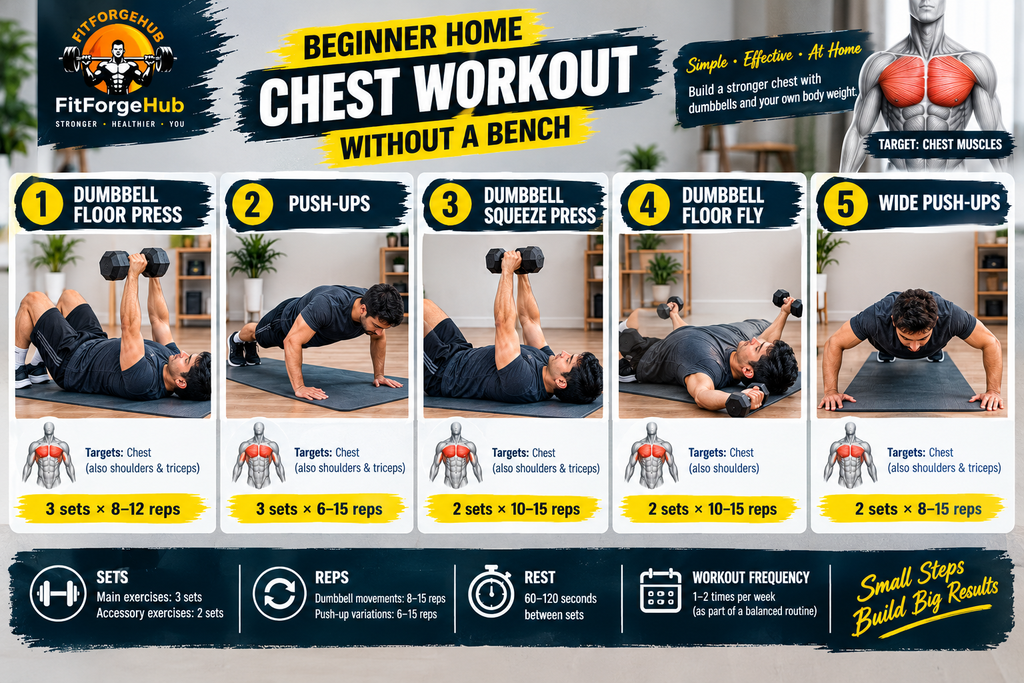
Here is a simple beginner-friendly routine you can perform at home.
| Exercise | Sets | Reps |
|---|---|---|
| Dumbbell Floor Press | 3 | 8–12 |
| Push-Ups | 3 | 6–15 |
| Dumbbell Squeeze Press | 2 | 10–15 |
| Dumbbell Floor Fly | 2 | 10–15 |
| Wide Push-Ups | 2 | 8–15 |
Rest: 60–120 seconds between sets.
If you’re completely new to training, start with fewer sets and focus on learning the movements.
1. Dumbbell Floor Press
The dumbbell floor press is one of the most useful chest exercises when you don’t have a bench.
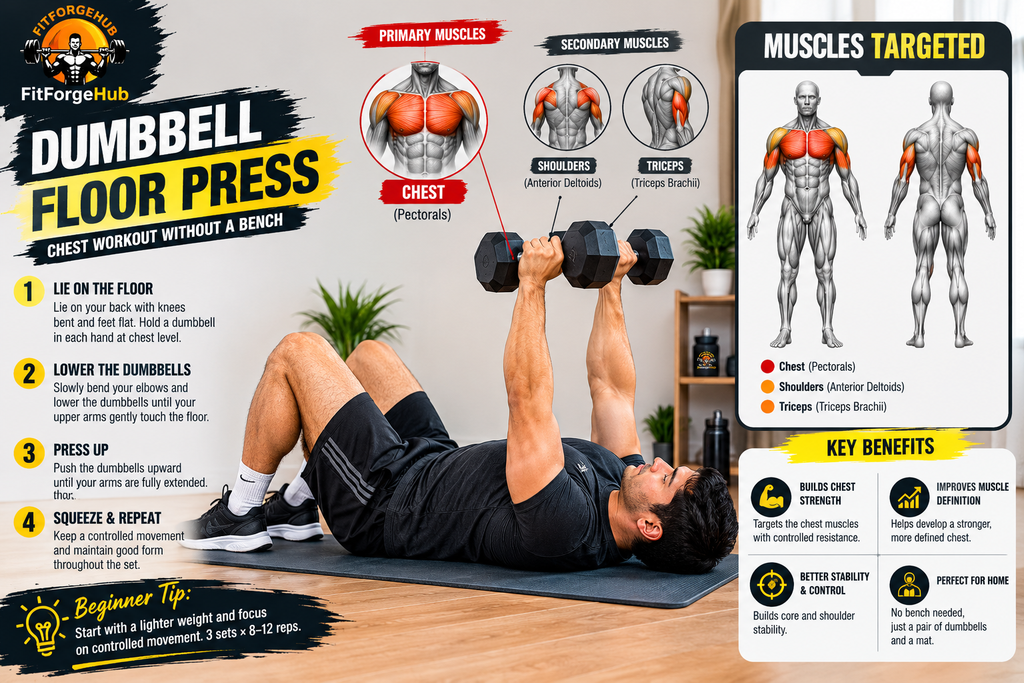
Instead of lying on a bench, you lie on the floor and press the dumbbells upward.
The dumbbell floor press is a key movement in this best home chest workout without a bench because it allows you to train your chest without needing a traditional workout bench.
How to Perform It
- Lie on your back with a dumbbell in each hand.
- Bend your knees and keep your feet flat on the floor.
- Position the dumbbells around chest level.
- Press both dumbbells upward.
- Lower them slowly until your upper arms gently contact the floor.
- Pause briefly and press again.
Beginner Recommendation
3 sets × 8–12 reps
Focus on controlled movement rather than using the heaviest dumbbells possible.
2. Push-Ups
Push-ups are one of the simplest ways to train your chest without equipment.
They also involve your shoulders, triceps, and core.
How to Perform Push-Ups
- Place your hands slightly wider than shoulder width.
- Extend your legs behind you.
- Keep your body relatively straight.
- Lower your chest toward the floor.
- Push through your hands to return to the starting position.
Don’t worry if you cannot perform many standard push-ups yet.
Beginner Modification
Perform push-ups with your hands elevated on a sturdy surface.
For example, you can use a stable table or countertop.
As you become stronger, gradually move toward standard floor push-ups.
Beginner Recommendation
3 sets × 6–15 reps
Stop the set when your technique starts to break down.
3. Dumbbell Squeeze Press
The dumbbell squeeze press is another useful option for a home chest workout without a bench.
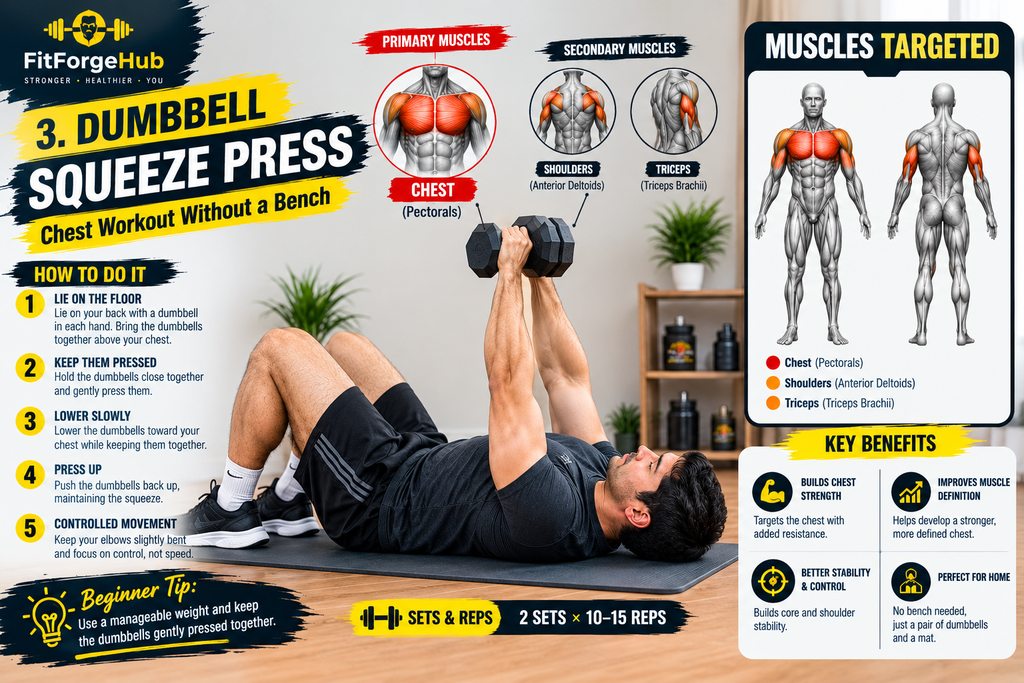
Because you are pressing the dumbbells together while performing the movement, it gives you another way to challenge your chest.
How to Perform It
- Lie on the floor.
- Hold two dumbbells close together above your chest.
- Keep them gently pressed against each other.
- Lower the dumbbells toward your chest in a controlled manner.
- Press them back upward while maintaining the squeeze.
Sets and Reps
2 sets × 10–15 reps
Use a manageable weight and concentrate on controlled movement.
4. Dumbbell Floor Fly
The dumbbell floor fly can be used as an accessory movement after your pressing exercises.
Because the floor limits how far your arms can travel, don’t force a deep stretch.
How to Perform It
- Lie on your back.
- Hold a light dumbbell in each hand.
- Start with the dumbbells above your chest.
- Keep a slight bend in your elbows.
- Slowly lower your arms toward the floor.
- Bring the dumbbells back together above your chest.
Sets and Reps
2 sets × 10–15 reps
Use lighter dumbbells than you would normally use for a pressing movement.
5. Wide Push-Ups
Wide push-ups can be used as a second bodyweight movement.
Place your hands somewhat wider than your normal push-up position and perform the movement under control.
Beginner Recommendation
2 sets × 8–15 reps
If standard wide push-ups are too difficult, perform them with your hands elevated.
The goal is to maintain good form rather than chasing a high repetition number.
How Many Sets and Reps Should Beginners Do?
For a beginner, 8–12 repetitions per exercise can be a useful general starting point for resistance training, while bodyweight movements may naturally fall into a wider repetition range depending on difficulty. The CDC describes 8–12 repetitions as one set and notes that one set is a starting point, with two or three sets providing more work.
For this workout, you can use:
- Main exercises: 3 sets
- Accessory exercises: 2 sets
- Dumbbell movements: 8–15 reps
- Push-up variations: 6–15 reps
You don’t have to force every exercise into exactly the same repetition range.
The right number depends on your current strength and the difficulty of the exercise.
How Long Should You Rest Between Sets?
A simple starting point is:
60–120 seconds between sets.
Take more rest if you need it to perform your next set with good technique.
For example:
Dumbbell Floor Press
Set 1 → Rest 90 seconds
Set 2 → Rest 90 seconds
Set 3 → Move to next exercise
Your workout doesn’t need to be rushed.
Quality repetitions are more important than trying to finish as quickly as possible.
How to Progress Without a Bench
Progressive overload doesn’t always mean buying heavier equipment.
You can make an exercise more challenging by gradually changing one variable at a time.
1. Increase Repetitions
For example:
Week 1: 8 reps
Week 2: 10 reps
Week 3: 12 reps
Once you can comfortably perform the upper end of your target range with good form, consider increasing resistance if you have heavier dumbbells available.
2. Increase Dumbbell Weight
If your current dumbbells become too easy, move to a slightly heavier pair.
3. Improve Your Technique
Slower, controlled repetitions can make an exercise more demanding without immediately increasing weight.
4. Add a Set
You can eventually add another set to selected exercises instead of adding volume everywhere at once.
5. Use a Harder Push-Up Variation
Progress from:
Wall Push-Up → Incline Push-Up → Standard Push-Up → Harder Variation
This gives beginners a simple progression path.
The 2026 ACSM resistance-training position stand emphasizes consistency, gradual progression, and choosing a routine that fits the individual. It also notes that effective resistance training does not require a gym and that home-based options such as bodyweight exercises and resistance bands can be useful.
ACSM — Resistance Training Position Stand
Beginner Chest Workout Schedule
You don’t need to train your chest every day.
You can perform this best home chest workout without a bench once or twice per week as part of a balanced resistance-training routine.
A simple weekly structure could look like this:
Monday
Chest + Shoulders + Triceps
Tuesday
Rest or light activity
Wednesday
Back + Biceps
Thursday
Rest
Friday
Legs + Core
Saturday
Optional light activity
Sunday
Rest
If you’re following a full-body or push-pull-legs routine, you can also place this workout inside your existing program.
For general health, the CDC recommends adults perform muscle-strengthening activities on at least two days per week and work all major muscle groups.
CDC — Adult Physical Activity Guidelines
Common Mistakes to Avoid
1. Using Dumbbells That Are Too Heavy
Heavy weights aren’t automatically better.
If you cannot control the dumbbells, reduce the weight.
2. Doing Extremely Fast Repetitions
Fast repetitions can make it harder to maintain good control.
Try to use a steady tempo.
3. Ignoring Push-Up Form
Don’t allow your hips to sag excessively or rush through repetitions just to reach a higher number.
4. Training Chest Every Day
Your muscles need time to recover between challenging workouts.
More training isn’t automatically better.
5. Changing Your Workout Every Few Days
Beginners often make the mistake of constantly searching for new exercises.
Stick with a basic routine long enough to track your progress.
6. Focusing Only on Chest
A balanced workout should also include your back, legs, shoulders, arms, and core.
A stronger overall program is usually more useful than doing chest exercises every day.
How to Combine This Workout With Your Other Training
This chest workout can work well as part of a larger home workout routine.
For example:
Chest: Floor Press, Push-Ups
Back: Dumbbell Rows
Shoulders: Dumbbell Shoulder Press
Legs: Goblet Squats
Arms: Dumbbell Curls and Triceps Extensions
If you want a more complete dumbbell routine, you can continue with our Complete Dumbbell Workout Guide for Beginners.
You can also combine this article with your existing Full Body Dumbbell Workout for Beginners article when planning your weekly training.
For beginners who are completely new to exercise, our How to Start Working Out at Home for Beginners guide can help with the basics before moving into a more structured routine.
What If I Don’t Have Dumbbells?
You can still train your chest.
Try:
- Standard push-ups
- Incline push-ups
- Knee push-ups
- Wide push-ups
- Slow-tempo push-ups
You can also use a sturdy elevated surface for easier push-up variations.
The important thing is to choose an exercise difficulty that allows you to maintain controlled technique.
Can I Build Muscle With a Home Chest Workout?
Yes, home-based resistance training can contribute to strength and muscle development.
The 2026 ACSM position stand specifically notes that effective resistance training does not require a traditional gym and that bodyweight and home-based training can be effective options.
However, your results depend on several factors, including:
- Training consistency
- Exercise selection
- Progressive overload
- Nutrition
- Protein intake
- Sleep
- Recovery
- Your starting fitness level
Don’t expect dramatic changes after only a few workouts.
Focus on becoming gradually stronger and more consistent.
Frequently Asked Questions
Can I do a chest workout without a bench?
Yes. Push-ups, dumbbell floor presses, squeeze presses, and other floor-based exercises can train the chest without a bench.
What is the best home chest workout without a bench?
For beginners, the dumbbell floor press and push-ups are practical starting options because they require relatively little equipment.
How often should I train my chest?
Beginners can include chest training as part of a balanced resistance-training routine rather than training the same muscles every day.
Can push-ups build chest muscles?
Push-ups provide resistance through your body weight and can be useful for developing chest and upper-body strength.
Are dumbbells necessary for a home chest workout?
No. Push-up variations can provide a bodyweight option. Dumbbells simply give you another way to add resistance.
How many chest exercises should beginners do?
You don’t need a large number of exercises. A routine with a few well-chosen movements can be enough when you perform them consistently and progress gradually.
How long should a beginner chest workout take?
This routine can generally fit into around 25–40 minutes, depending on your rest periods and experience level.
Final Thoughts
A good chest workout doesn’t require a bench or an expensive home gym.
If you’re a beginner, start with simple movements such as the dumbbell floor press and push-ups, learn proper technique, and gradually make the exercises more challenging.
The best home chest workout without a bench doesn’t need to be complicated.
Your goal shouldn’t be to make every workout exhausting.
Instead, focus on showing up consistently, recording your progress, and improving little by little.
A simple workout that you actually follow is more useful than a complicated routine that you abandon after a week.
About the Author
Riaz Ahmed
Riaz Ahmed holds a Master’s degree in Health and Physical Education and is the founder of FitForgeHub, where he shares practical fitness and workout information.
His goal is to make fitness easier to understand for beginners by providing practical workout routines, exercise guidance, muscle-building information, and realistic fitness tips.
Website: FitForgeHub.com
Disclaimer
The information provided on FitForgeHub is intended for general educational and informational purposes only. It is not medical advice and should not replace advice from a qualified healthcare or fitness professional. If you have an injury, medical condition, or concerns about starting a new exercise program, consult an appropriate professional before exercising.