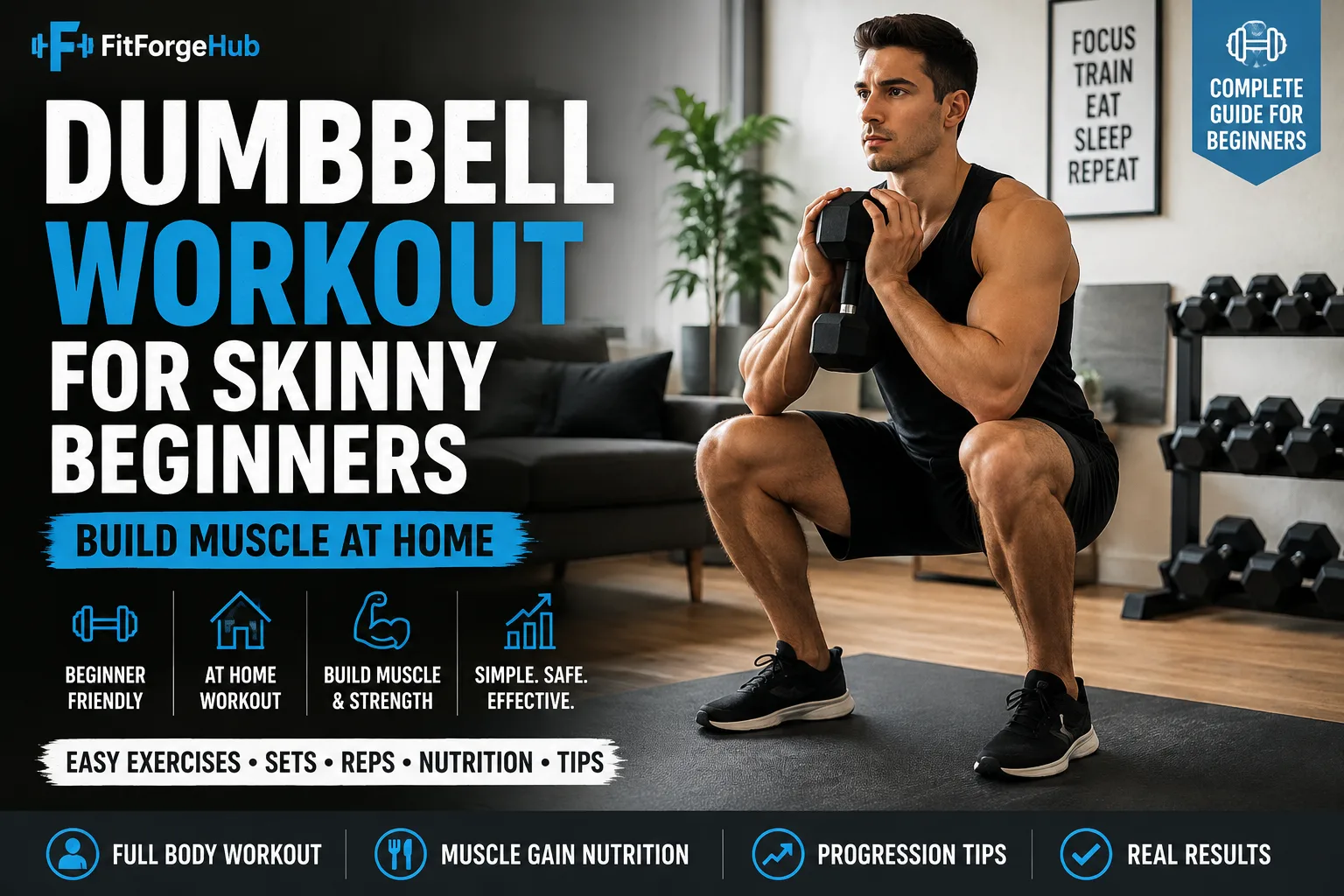
If you’re naturally skinny and want to build muscle, you don’t need to spend hours in a gym or follow an extremely complicated workout routine.
A pair of dumbbells, a consistent training schedule, enough food, and patience can give you a solid starting point.
The biggest mistake many skinny beginners make is trying to do too much too quickly. They jump between different workouts, change exercises every few days, or focus only on lifting heavier weights without paying attention to recovery and nutrition.
A better approach is simple: train consistently, progressively challenge your muscles, eat enough to support your goal, and give your body time to recover.
In this guide, you’ll find a beginner-friendly dumbbell workout for skinny beginners that you can perform at home, along with sets, reps, progression tips, nutrition guidance, common mistakes, and answers to frequently asked questions.
Table of Contents
- Can Skinny Beginners Build Muscle With Dumbbells?
- Why Dumbbells Are Good for Skinny Beginners
- What You Need for This Workout
- Dumbbell Workout for Skinny Beginners
- 1. Dumbbell Goblet Squat
- 2. Dumbbell Romanian Deadlift
- 3. Dumbbell Bench or Floor Press
- 4. One-Arm Dumbbell Row
- 5. Dumbbell Shoulder Press
- 6. Dumbbell Biceps Curl
- 7. Dumbbell Triceps Extension
- 8. Dumbbell Calf Raise
- How Many Days Should Skinny Beginners Work Out?
- How Heavy Should Your Dumbbells Be?
- How to Progress and Build Muscle
- What Should Skinny Beginners Eat to Gain Muscle?
- Common Mistakes Skinny Beginners Should Avoid
- Sample Weekly Dumbbell Workout Plan
- Frequently Asked Questions
- Final Thoughts
- About the Author
Can Skinny Beginners Build Muscle With Dumbbells?
Yes. Beginners can use dumbbells to build strength and muscle when their training, nutrition, and recovery are appropriate.
You don’t need a huge collection of equipment.
Dumbbells allow you to perform movements for your:
- Chest
- Back
- Shoulders
- Arms
- Legs
- Glutes
- Core
For someone just starting out, the goal shouldn’t be to find the “perfect” exercise.
The goal should be to establish a routine you can actually follow.
For example, performing a simple full-body workout three times per week is often more practical than trying to train a different muscle every day.
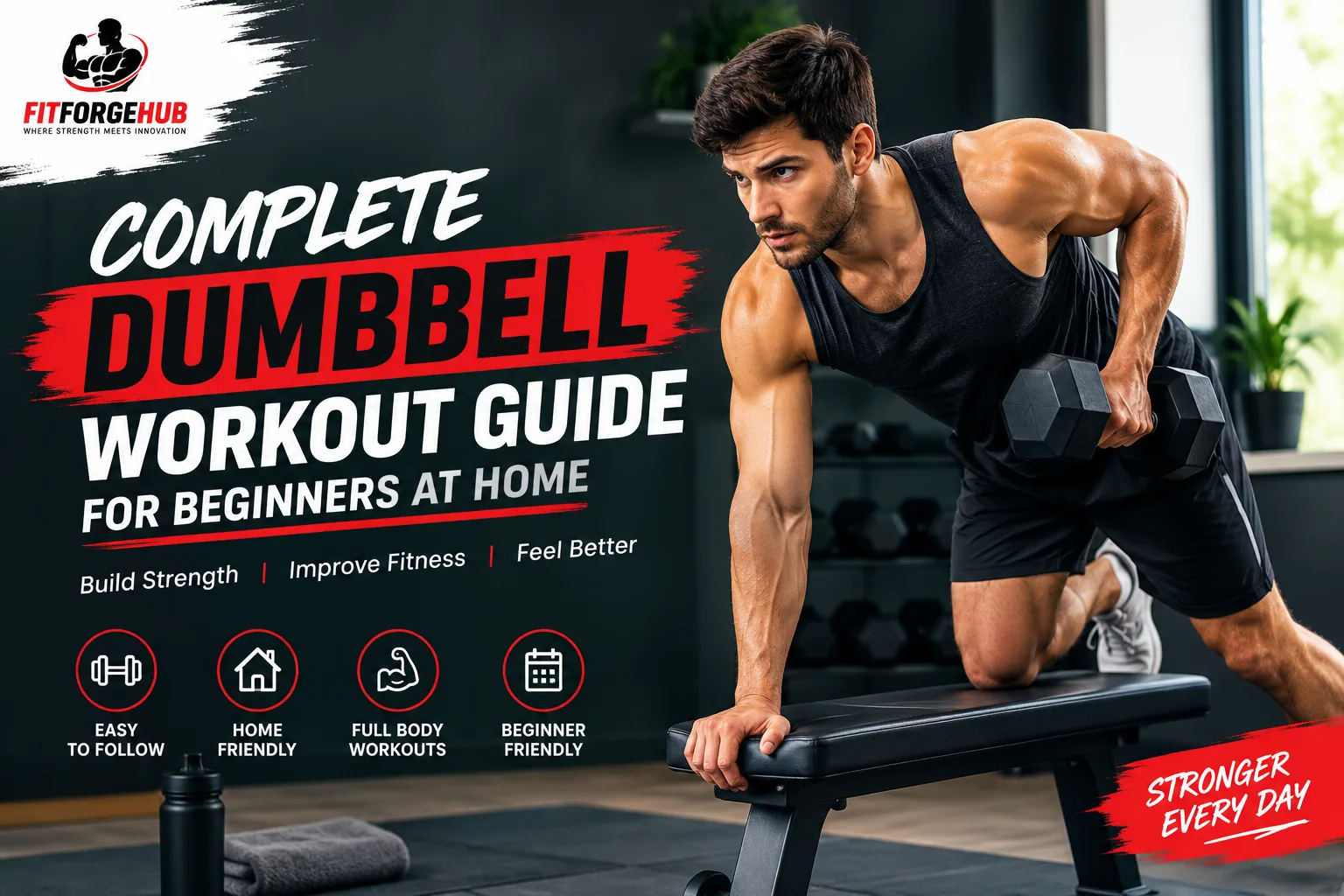
If you’re completely new to dumbbell training, start with our Full Body Dumbbell Workout for Beginners before making your routine more complicated.
Why Dumbbells Are Good for Skinny Beginners
Dumbbells are particularly useful for home workouts because they’re relatively simple and versatile.
1. They Don’t Require Much Space
You can perform many dumbbell exercises in a small workout area.
2. They’re Easy to Progress
As you become stronger, you can gradually increase resistance.
3. They Allow Different Exercises
One pair of dumbbells can be used for squats, presses, rows, curls, and many other movements.
4. They Work Well for Beginners
You can start with lighter weights and focus on learning proper movement patterns.
5. They Make Home Training Convenient
You don’t have to travel to a gym every time you want to exercise.
Convenience matters because consistency is one of the most important parts of a long-term training routine.
What You Need for This Workout
You only need a few basic things.
Required
- A pair of dumbbells
- Enough space to move safely
- A stable floor
Optional
- Exercise mat
- Stable bench
- Adjustable dumbbells
- Stable chair for supported exercises
You don’t need expensive equipment to begin.
If you’re eventually building a home gym, you may also want to read our future guide on home gym equipment for beginners.
Dumbbell Workout for Skinny Beginners
This routine focuses on major movement patterns rather than trying to isolate every muscle with numerous exercises.
Beginner Full-Body Workout
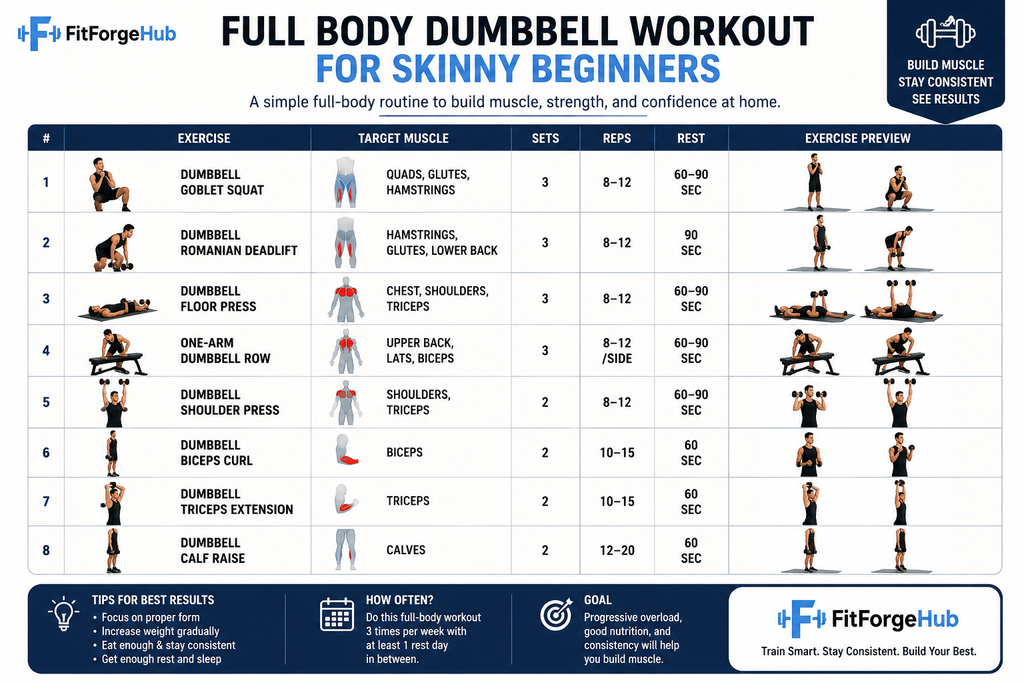
| Exercise | Sets | Reps | Rest |
| Dumbbell Goblet Squat | 3 | 8–12 | 60–90 sec |
| Dumbbell Romanian Deadlift | 3 | 8–12 | 90 sec |
| Dumbbell Floor Press | 3 | 8–12 | 60–90 sec |
| One-Arm Dumbbell Row | 3 | 8–12/side | 60–90 sec |
| Dumbbell Shoulder Press | 2 | 8–12 | 60–90 sec |
| Dumbbell Biceps Curl | 2 | 10–15 | 60 sec |
| Dumbbell Triceps Extension | 2 | 10–15 | 60 sec |
| Dumbbell Calf Raise | 2 | 12–20 | 60 sec |
Don’t Try to Max Out
The purpose of this workout is not to see how much weight you can lift.
Choose a weight that you can control while maintaining good technique.
If you’re completely new, you can start with fewer exercises and gradually build up.
1. Dumbbell Goblet Squat
The goblet squat is a simple way to introduce resistance into a squat pattern.
It primarily works the lower body, including the quadriceps and glutes.
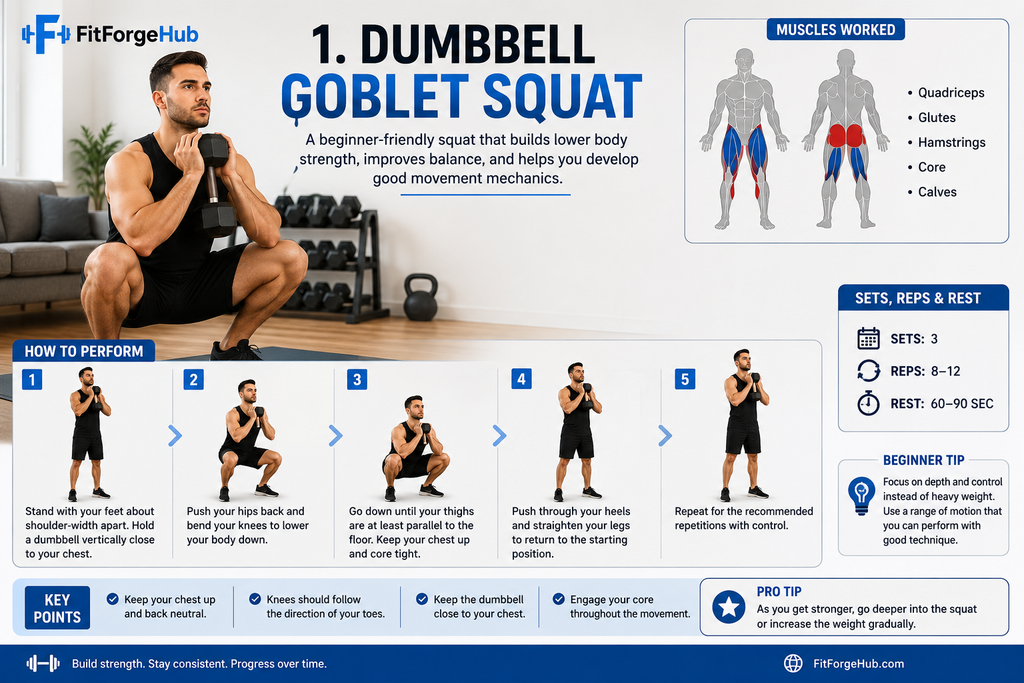
How to Perform It
- Stand with your feet around shoulder-width apart.
- Hold one dumbbell close to your chest.
- Brace your core.
- Push your hips back and bend your knees.
- Lower your body under control.
- Push through your feet to return to standing.
- Repeat.
Sets: 3
Reps: 8–12
Beginner Tip
Don’t worry about reaching an extremely deep squat.
Use a range of motion you can control comfortably while maintaining good technique.
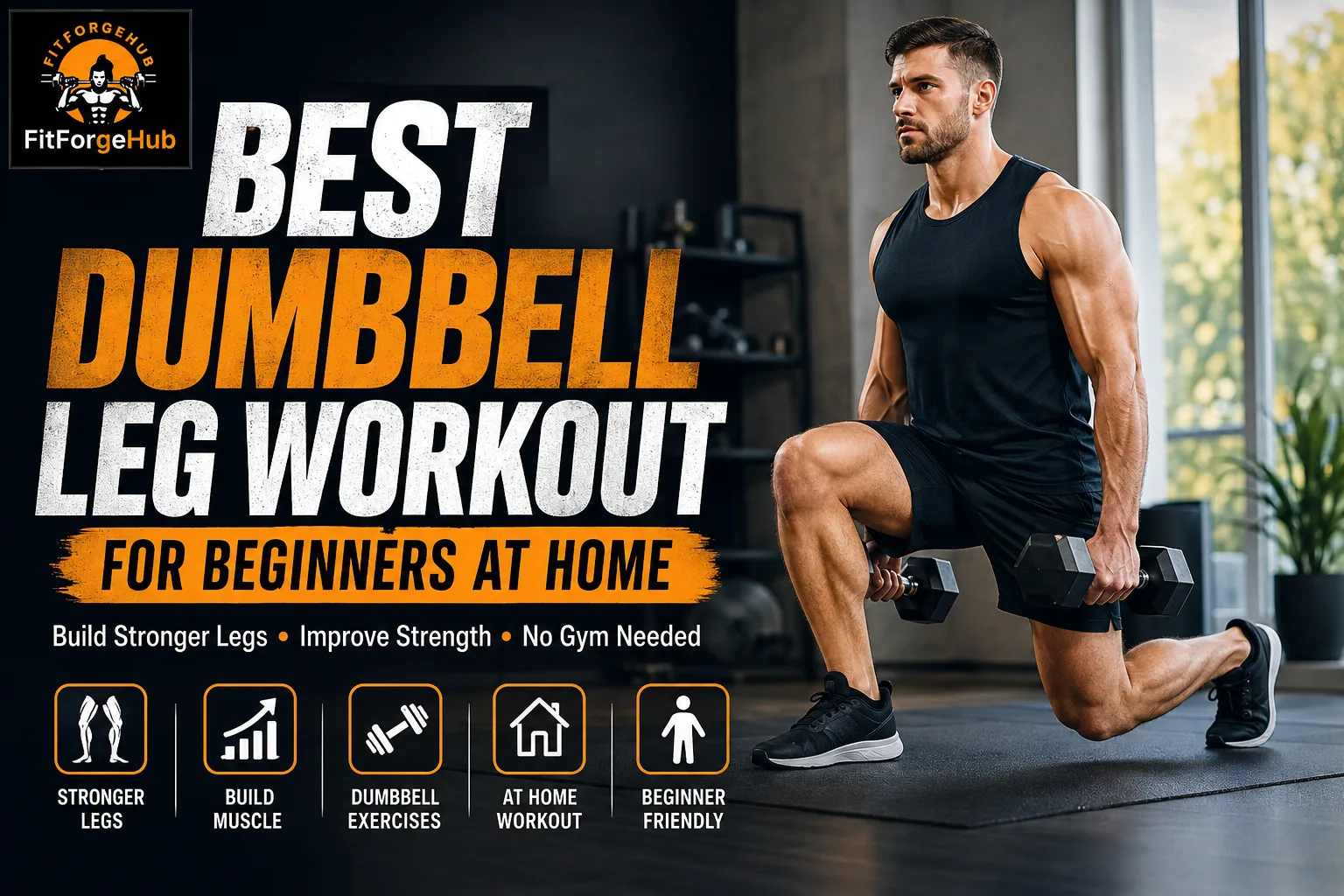
For more lower-body exercises, read our Best Dumbbell Leg Workout for Beginners.
2. Dumbbell Romanian Deadlift
The Romanian deadlift is a useful exercise for training the hamstrings and glutes while practicing the hip-hinge movement.
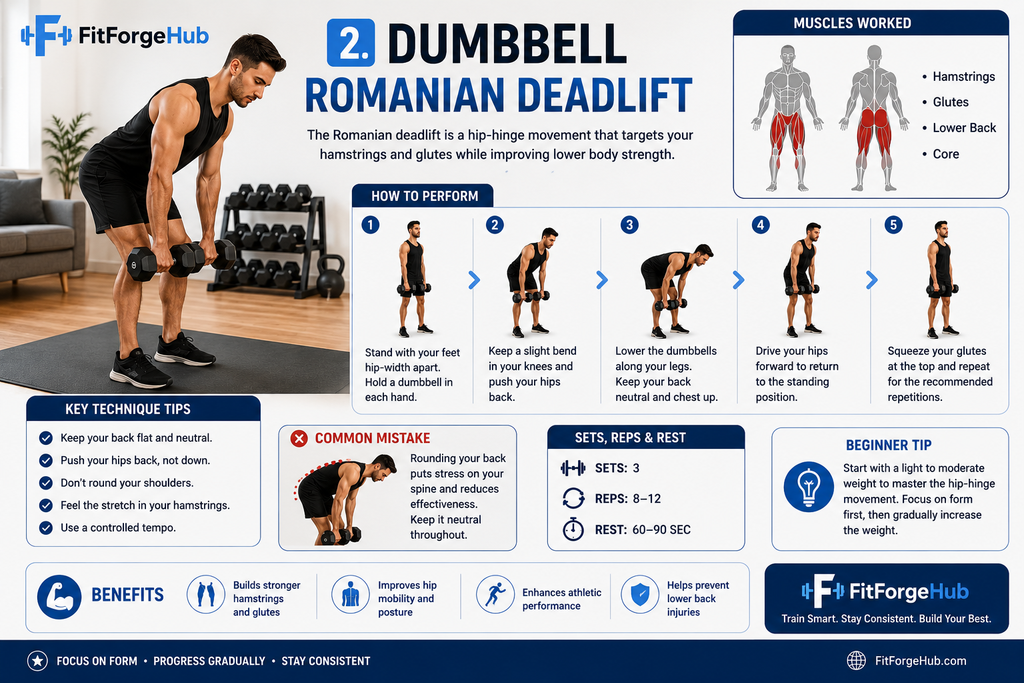
How to Perform It
- Stand with your feet around hip-width apart.
- Hold a dumbbell in each hand.
- Keep your knees slightly bent.
- Push your hips backward.
- Lower the dumbbells along your legs.
- Keep your back in a comfortable neutral position.
- Return to standing by driving your hips forward.
Sets: 3
Reps: 8–12
Common Mistake
Don’t turn the Romanian deadlift into a squat.
The movement should primarily come from your hips moving backward and forward.
Start with light weights while learning the technique.
3. Dumbbell Floor Press
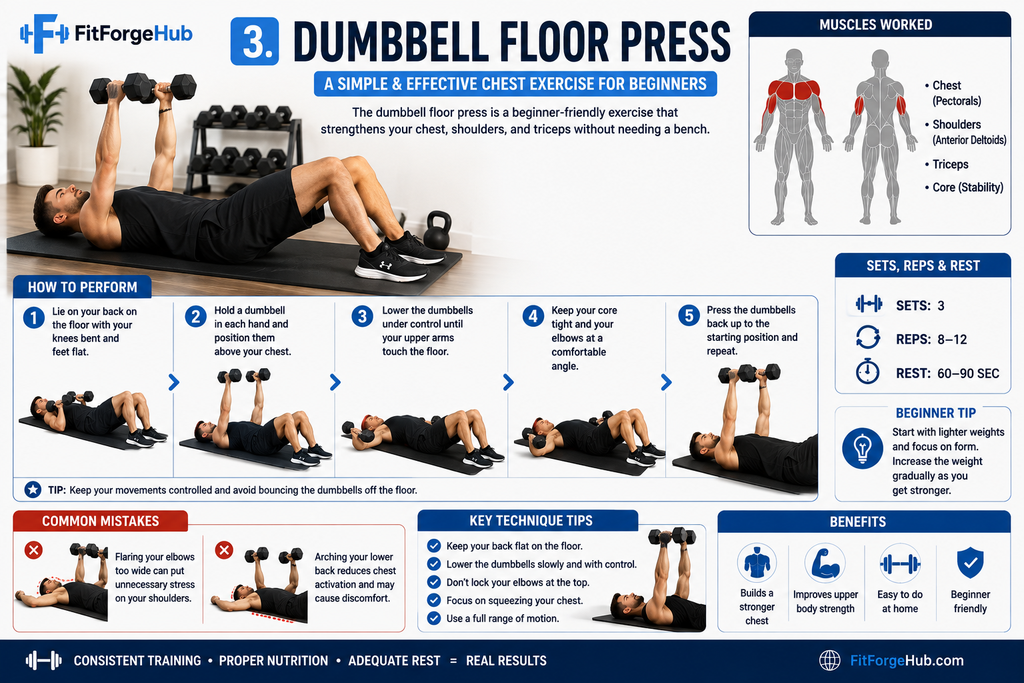
If you don’t have a bench, the dumbbell floor press is a practical chest-pressing option.
How to Perform It
- Lie on your back on a stable floor or mat.
- Hold a dumbbell in each hand.
- Position the weights above your chest.
- Lower the dumbbells under control.
- Keep your elbows in a comfortable position.
- Press the dumbbells back upward.
- Repeat.
Sets: 3
Reps: 8–12
For more chest-focused exercises, check out our:
Best Dumbbell Chest Workout at Home
4. One-Arm Dumbbell Row
The one-arm dumbbell row is a useful pulling exercise for the upper back.
How to Perform It
- Place one hand on a stable surface if needed.
- Hold a dumbbell with your other hand.
- Keep your back in a comfortable position.
- Pull the dumbbell toward your torso.
- Pause briefly.
- Lower it slowly.
- Complete your repetitions and switch sides.
Sets: 3
Reps: 8–12 per side
Focus on Control
Don’t yank the dumbbell upward.
Think about pulling your elbow backward while keeping the movement controlled.
For a complete back routine, read:
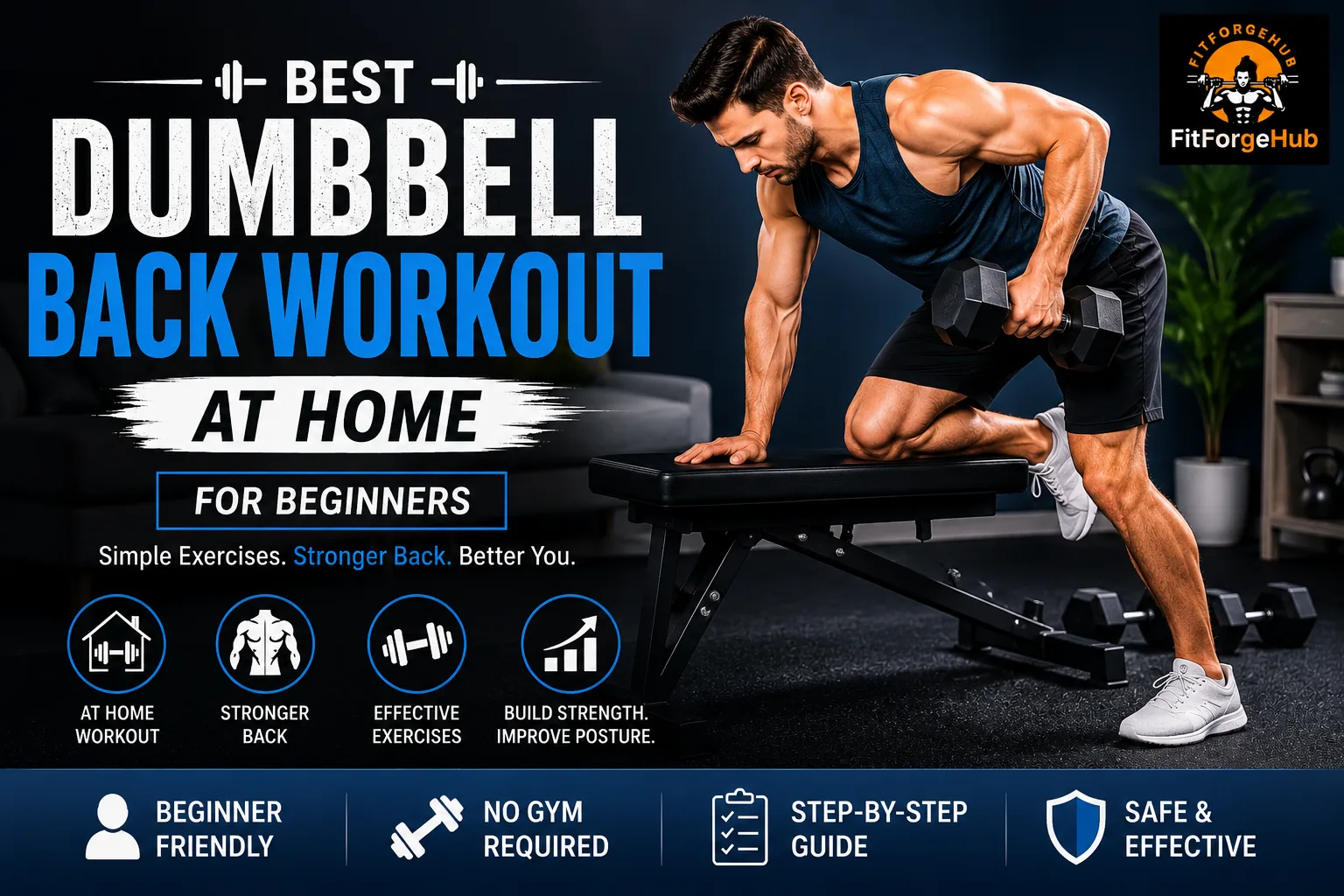
Best Dumbbell Back Workout at Home
5. Dumbbell Shoulder Press
The shoulder press adds an overhead pressing movement to your workout.
How to Perform It
- Hold a dumbbell in each hand.
- Bring the dumbbells near shoulder height.
- Brace your core.
- Press the weights upward.
- Lower them under control.
- Repeat.
Sets: 2
Reps: 8–12
Important
Don’t use excessive weight and lean backward to complete repetitions.
If you can’t maintain control, reduce the weight.
You can find a dedicated shoulder routine here:
Best Dumbbell Shoulder Workout at Home
6. Dumbbell Biceps Curl
Biceps curls are a simple accessory exercise for the front of your upper arms.
How to Perform It
- Stand upright.
- Hold dumbbells beside your body.
- Keep your elbows close to your torso.
- Curl the dumbbells upward.
- Pause briefly.
- Lower them slowly.
Sets: 2
Reps: 10–15
Avoid Swinging
If you need to swing your torso to lift the weight, the dumbbells are probably too heavy.
7. Dumbbell Triceps Extension
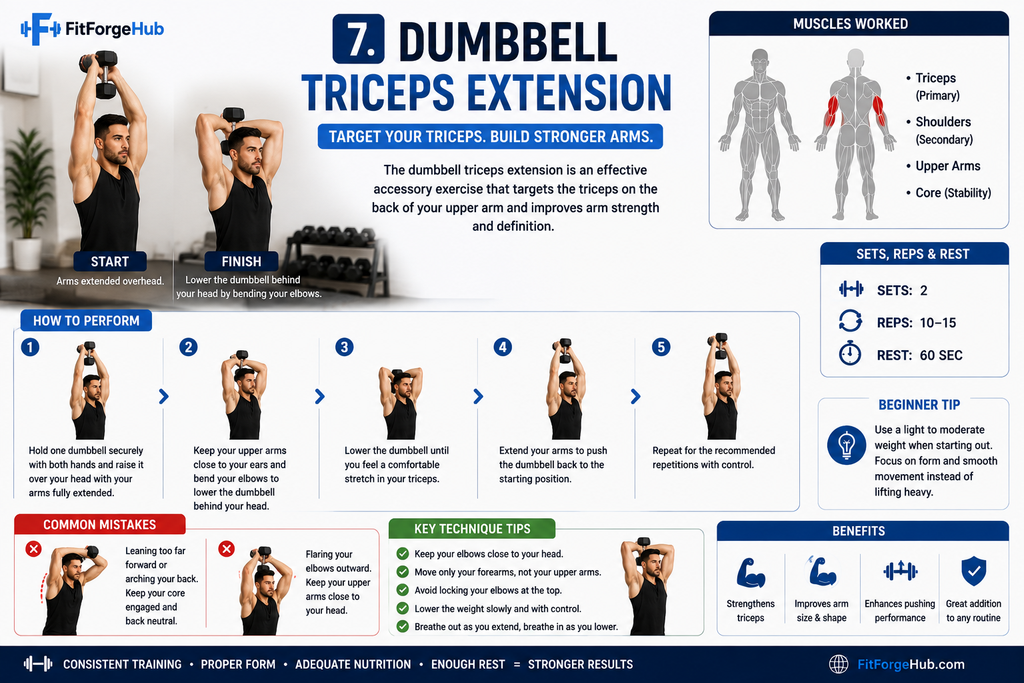
The triceps are located on the back of your upper arm.
A dumbbell extension can be used as an accessory movement after your compound exercises.
How to Perform It
- Hold one dumbbell securely.
- Position it above your head.
- Keep your upper arms relatively stable.
- Bend your elbows to lower the dumbbell.
- Extend your arms to return to the starting position.
- Repeat.
Sets: 2
Reps: 10–15
Use a weight you can control comfortably.
8. Dumbbell Calf Raise
Calf raises are a simple way to include direct lower-leg training.
How to Perform It
- Stand upright while holding dumbbells.
- Keep your feet stable.
- Raise your heels.
- Pause briefly at the top.
- Lower your heels slowly.
- Repeat.
Sets: 2
Reps: 12–20
Avoid bouncing through the movement.
How Many Days Should Skinny Beginners Work Out?
You don’t need to train seven days a week to build muscle.
For a beginner, a simple three-day full-body routine can be easier to manage.
Example
| Day | Activity |
| Monday | Dumbbell Full Body |
| Tuesday | Rest / Light Activity |
| Wednesday | Dumbbell Full Body |
| Thursday | Rest |
| Friday | Dumbbell Full Body |
| Saturday | Rest / Light Activity |
| Sunday | Rest |
The CDC recommends adults perform muscle-strengthening activities on at least two days per week as part of their overall physical activity.
CDC — Adult Physical Activity Guidelines
Your ideal schedule can vary depending on your experience, recovery, and other physical activity.
How Heavy Should Your Dumbbells Be?
There’s no universal “best dumbbell weight” for a skinny beginner.
Your starting weight depends on:
- Current strength
- Exercise
- Experience
- Technique
- Training goal
A good starting point is a weight that lets you complete your target repetitions with controlled technique.
For example, if your target is 8–12 repetitions, you shouldn’t choose a weight that forces you to stop at four repetitions.
At the same time, the weight shouldn’t be so light that every set feels effortless.
Remember
Technique first. Weight second.
How to Progress and Build Muscle
Building muscle isn’t about changing your workout every week.
Instead, try to gradually improve your performance.
You can progress by:
- Adding repetitions
- Increasing dumbbell weight
- Adding a set
- Improving technique
- Increasing range of motion where appropriate
- Performing the same weight with better control
Simple Example
Suppose you’re doing goblet squats for:
3 × 8–12
Week 1:
8 / 8 / 8
Week 2:
9 / 9 / 8
Week 3:
10 / 10 / 10
Week 4:
12 / 12 / 12
Once you’re consistently reaching the top of the range with good form, you can consider a small increase in weight.
Then gradually build your repetitions again.
This is much more useful than randomly increasing the weight every workout.
What Should Skinny Beginners Eat to Gain Muscle?
Training alone isn’t enough if your goal is to gain body weight and muscle.
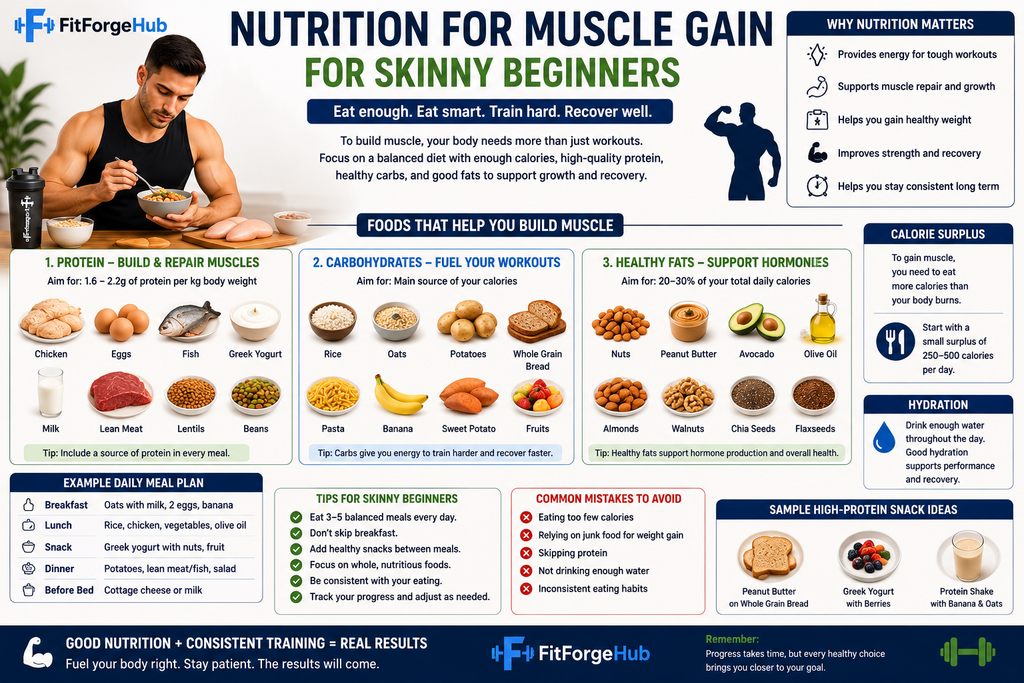
Healthy protein, carbohydrates, and fats can support a balanced muscle-gain diet for beginners.Your body needs energy and nutrients to support training and recovery.
Focus on eating balanced meals containing:
Protein
Examples include:
- Eggs
- Chicken
- Fish
- Milk
- Greek yogurt
- Beans
- Lentils
- Lean meat
Carbohydrates
Examples include:
- Rice
- Oats
- Potatoes
- Whole-grain bread
- Pasta
- Fruits
Healthy Fats
Examples include:
- Nuts
- Seeds
- Peanut butter
- Avocado
- Olive oil
Calories Matter
If you’re consistently eating fewer calories than your body uses, gaining weight can be difficult.
For practical guidance on gaining weight with a balanced diet, see the NHS guide to healthy weight gain.
NHS — Healthy Ways to Gain Weight
If muscle gain is your goal, consider gradually increasing your food intake while monitoring your body weight and progress.
You don’t need to force-feed yourself or rely on junk food.
A balanced diet with adequate energy and protein is a better long-term approach.
Common Mistakes Skinny Beginners Should Avoid
1. Changing Workouts Constantly
Don’t switch programs every few days.
Give your body enough time to adapt and measure progress.
2. Only Training the Upper Body
Don’t ignore your legs.
A balanced routine should train the whole body.
3. Using Very Heavy Weights
More weight doesn’t automatically mean more muscle.
Poor technique can reduce the quality of the exercise and increase injury risk.
4. Not Eating Enough
If you’re trying to gain weight but consistently under-eat, your progress may be limited.
5. Skipping Recovery
Your training program should include rest days.
6. Expecting Results Overnight
Building muscle takes time.
Focus on what you can control:
Training + Food + Recovery + Consistency
7. Doing Too Much Cardio
Cardio isn’t “bad” for skinny people.
However, if your main goal is gaining weight and muscle, extremely high amounts of activity combined with inadequate food intake can make the process harder.
Sample Weekly Dumbbell Workout Plan
Here’s a simple weekly structure for beginners.
Monday — Full Body
- Goblet Squat
- Romanian Deadlift
- Floor Press
- One-Arm Row
- Shoulder Press
- Biceps Curl
Tuesday — Rest
Walk or perform light activity if you feel comfortable.
Wednesday — Full Body
Repeat the workout while focusing on good technique.
Thursday — Rest
Allow your body to recover.
Friday — Full Body
Repeat the routine and try to make gradual progress.
Saturday — Optional Light Activity
Walking or another comfortable activity.
Sunday — Rest
Prepare for the next training week.
Frequently Asked Questions
Can skinny beginners build muscle with dumbbells?
Yes. Beginners can use resistance training with dumbbells to build strength and muscle when combined with appropriate nutrition and recovery.
How many days a week should a skinny beginner work out?
Three full-body strength sessions per week can be a practical starting structure. Beginners can adjust their schedule according to recovery and experience.
Can I build muscle at home without a gym?
Yes. Dumbbells can provide enough resistance for many effective exercises at home.
How long does it take to gain muscle?
There is no universal timeline. Progress depends on factors such as training consistency, nutrition, recovery, genetics, training experience, and starting point.
Should skinny people lift heavy weights?
You should use enough resistance to make your target repetitions challenging while maintaining good technique. Don’t sacrifice form simply to lift heavier weights.
How many reps should I do to build muscle?
Many beginner exercises can be performed effectively in the 8–15 repetition range, although different repetition ranges can be useful depending on the exercise and program.
Do I need protein supplements to build muscle?
No. Protein supplements aren’t required if you can get enough protein from your regular diet. Supplements can be convenient, but they’re not a replacement for a balanced diet.
Should I eat junk food to gain weight?
No. You can increase your calorie intake using nutritious foods rather than relying heavily on processed junk food.
Can I do this workout with one dumbbell?
Yes. Some exercises can be performed using a single dumbbell, although having two dumbbells makes several exercises more convenient.
What if I can’t complete all the exercises?
That’s completely fine.
Start with fewer exercises and gradually build your workout as your fitness improves.
What if I feel pain during an exercise?
Stop if an exercise causes significant or unusual pain. Don’t force painful movement. If you have an injury or persistent symptoms, consult a qualified healthcare professional.
Final Thoughts
Being skinny doesn’t mean you can’t build strength or muscle.
You don’t need a complicated gym program to get started.
A simple dumbbell routine built around:
- Squats
- Romanian deadlifts
- Presses
- Rows
- Shoulder exercises
- Arm exercises
can give beginners a solid foundation.
The bigger challenge is usually staying consistent.
Train regularly, gradually make your workouts more challenging, eat enough nutritious food, prioritize protein, and give your body enough time to recover.
Don’t compare your progress with someone else’s.
Your goal during the first few months should be to become stronger, learn good technique, and build habits that you can maintain.
If you’re continuing through the FitForgeHub dumbbell series, you can now explore the individual workouts for your chest, back, legs, and shoulders.
About the Author
Riaz Ahmed
Riaz Ahmed holds a Master’s degree in Health and Physical Education and is the founder of FitForgeHub, where he shares practical fitness and workout information.
Website: FitForgeHub.com
Disclaimer
The information published on FitForgeHub is intended for general educational purposes and isn’t medical advice. Exercise needs and fitness goals vary between individuals. If you have an injury, medical condition, or concerns about starting a new exercise program, consult a qualified healthcare professional before beginning a new workout routine.