Starting a home workout can feel frustrating when an exercise looks simple in a video but becomes surprisingly difficult when you try it yourself. You might struggle to complete a standard push-up, lose your balance during lunges, or find it difficult to maintain a plank without your hips dropping. These experiences are common among people who are new to exercise.
Fortunately, you do not need to perform advanced movements to begin building strength and improving fitness. Beginner exercise modifications allow you to adjust exercises to match your current ability. In this guide, you will learn 10 practical modifications, step-by-step instructions, suggested sets and repetitions, progression strategies, and a simple weekly workout plan you can follow at home.
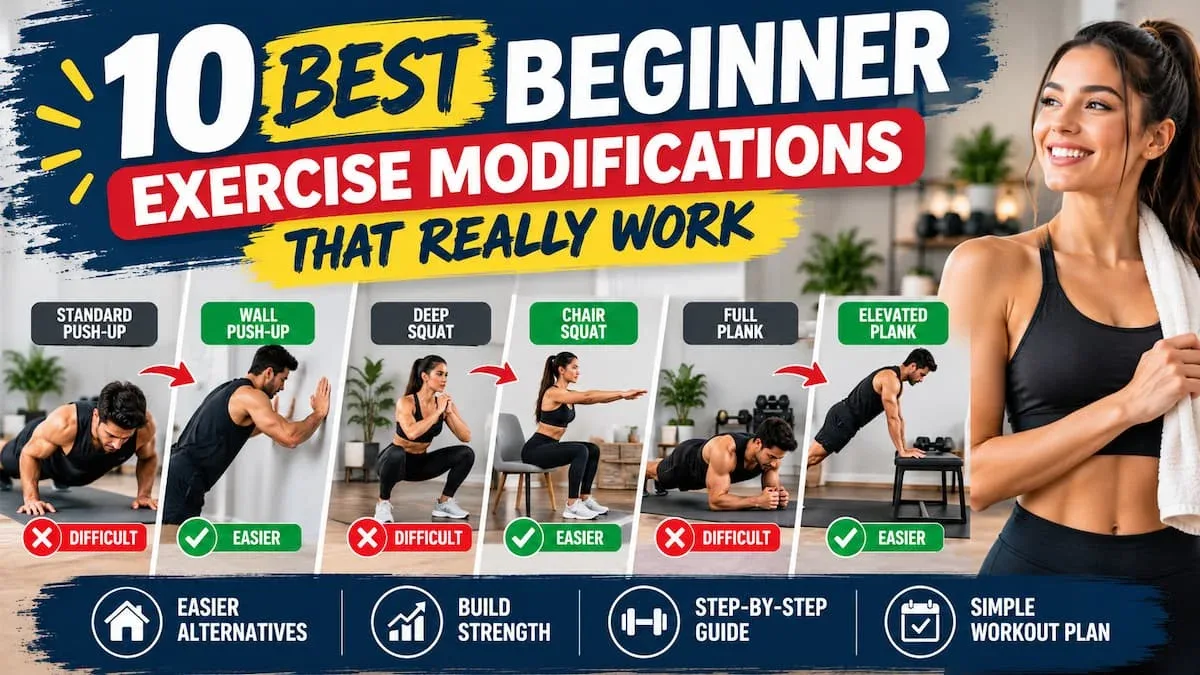
Quick Answer: Beginner exercise modifications make standard movements easier by reducing resistance, adding support, shortening the range of motion, or simplifying the movement. Examples include wall push-ups instead of floor push-ups, chair squats instead of deep squats, and elevated planks instead of floor planks.
Important: This guide is for general fitness education and is not personalized medical advice. Stop exercising if you experience sharp pain, dizziness, or unusual symptoms. If you have an injury, medical condition, or concerns about exercising, seek guidance from a qualified healthcare professional.
What Are Beginner Exercise Modifications?
Beginner exercise modifications are adjustments that make a movement more manageable without completely changing its basic purpose. They can involve changing your body position, reducing the weight you lift, using a stable surface for support, or selecting a simpler movement pattern.
For example, a standard push-up requires you to support and move a significant portion of your body weight. A wall push-up follows a similar pressing pattern but reduces the amount of resistance, making it easier for someone who is still developing upper-body strength.
Exercise modifications are not shortcuts. They provide a practical starting point for learning proper technique and gradually improving your physical abilities.
If you are completely new to exercise, our guide to starting workouts at home for beginners explains how to organize your first routine.
Why Should Beginners Modify Exercises?
Choosing the right exercise difficulty can make a major difference in how comfortably and consistently you train. A movement that is too challenging may cause you to rush, lose control, or stop your workout before completing a useful amount of training.
Appropriate modifications help beginners focus on the quality of each repetition rather than simply trying to complete an advanced exercise.
- Better technique: Easier variations allow you to practice the movement with more control.
- Greater confidence: Completing manageable exercises can make workouts feel less intimidating.
- Improved consistency: A realistic routine is easier to repeat throughout the week.
- Gradual strength development: You can increase difficulty as your ability improves.
- Less equipment: Many modifications use body weight or simple household items.
- Individual flexibility: You can choose a version that suits your current strength and coordination.
The American College of Sports Medicine (ACSM) highlights the importance of consistency, individual goals, and sustainable resistance-training programs. Its 2026 guidance also recognizes bodyweight exercises and home-based training as useful options.
10 Beginner Exercise Modifications at a Glance
The following table compares common exercises with easier alternatives. Use it as a quick reference when planning your home workouts.
| Standard Exercise | Beginner Modification | Main Benefit |
|---|---|---|
| Floor Push-Up | Wall Push-Up | Reduced upper-body resistance |
| Deep Squat | Chair Squat | More consistent movement depth |
| Forward Lunge | Supported Split Squat | Less balance demand |
| Floor Plank | Elevated Plank | Reduced bodyweight loading |
| Jumping Jacks | Step Jacks | Lower-impact cardio |
| Heavy Standing Shoulder Press | Light Seated Shoulder Press | More stable body position |
| Unsupported Bent-Over Row | Supported One-Arm Row | Additional torso support |
| Single-Leg Glute Bridge | Two-Leg Glute Bridge | Reduced single-leg strength demand |
| Fast Mountain Climbers | Slow Elevated Knee Drives | More controlled movement |
| Burpees | Standing Squat and Reach | No jump or floor transition |
Not every modification will feel equally easy for everyone. Select a variation that allows you to move comfortably while maintaining good technique.
How to Perform the 10 Beginner Exercise Modifications
1. Wall Push-Ups Instead of Floor Push-Ups

Wall push-ups are one of the simplest ways to begin practicing an upper-body pressing movement. They involve the chest, shoulders, and triceps while placing less resistance on the arms than a traditional floor push-up.
How to Perform:
- Stand facing a sturdy wall.
- Place both palms against the wall around shoulder height.
- Walk your feet backward until your arms are comfortably extended.
- Keep your body aligned from your head to your heels.
- Bend your elbows and move your chest toward the wall.
- Push away slowly to return to the starting position.
Sets: 2
Reps: 8–12
Rest: 60 seconds
Common Mistake: Letting your hips sag or moving only your head toward the wall.
When to Progress: Once you can complete controlled wall push-ups comfortably, try an incline push-up against a sturdy, non-slip elevated surface.
2. Chair Squats Instead of Deep Squats

Chair squats help you practice a basic lower-body movement using a chair as a reference point. This can be particularly helpful when you are still learning how to control your hips and knees during squats.
How to Perform:
- Place a sturdy chair against a wall to prevent sliding.
- Stand in front of the chair with your feet approximately shoulder-width apart.
- Move your hips backward as you bend your knees.
- Lower yourself until you lightly touch the chair or sit briefly.
- Press through your feet to return to standing.
- Repeat at a controlled pace.
Sets: 2
Reps: 8–12
Rest: 60–90 seconds
Common Mistake: Dropping quickly onto the chair instead of lowering your body with control.
When to Progress: Practice standing squats without using the chair while maintaining a comfortable range of motion.
For more lower-body movements, see our home leg workout without equipment.
3. Supported Split Squats Instead of Forward Lunges
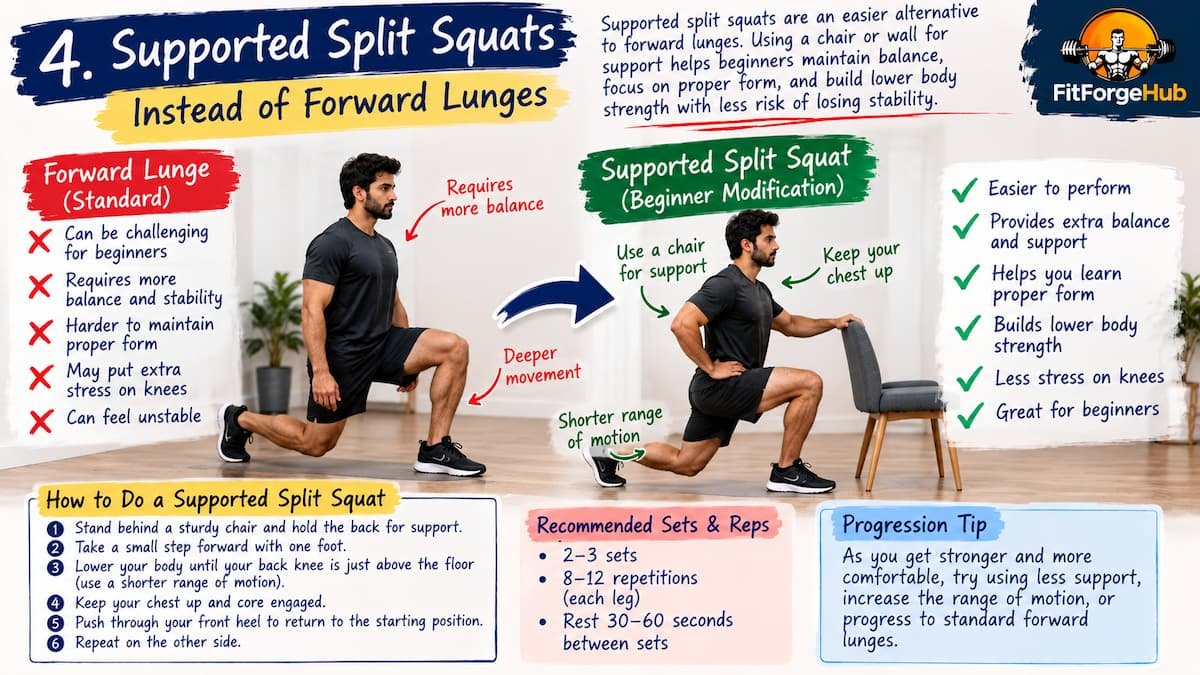
Forward lunges involve stepping, lowering, and pushing back to the starting position. These movements require balance and coordination. Supported split squats simplify the exercise by keeping your feet in place.
How to Perform:
- Stand beside a stable wall or railing.
- Place one foot in front of the other in a comfortable split stance.
- Use the support lightly for balance.
- Bend both knees and lower your body within a comfortable range.
- Push through your feet to return upright.
- Complete the repetitions before switching legs.
Sets: 2
Reps: 6–10 per leg
Rest: 60–90 seconds
Common Mistake: Taking an excessively narrow stance that makes balance difficult.
When to Progress: Gradually reduce your reliance on support and increase your comfortable range of motion.
4. Elevated Planks Instead of Floor Planks

Planks challenge the muscles responsible for stabilizing your trunk. If a traditional floor plank is too difficult, placing your hands on an elevated surface can reduce the amount of bodyweight resistance.
How to Perform:
- Place your hands on a sturdy countertop or stable elevated surface.
- Walk your feet backward until your body forms a straight line.
- Gently brace your abdominal muscles.
- Keep your hips from dropping or rising excessively.
- Continue breathing normally while holding the position.
Sets: 2
Duration: 10–20 seconds
Rest: 45–60 seconds
Common Mistake: Holding your breath or allowing your lower back to sag.
When to Progress: Increase your hold time gradually or use a slightly lower, stable surface.
5. Step Jacks Instead of Jumping Jacks
Jumping jacks are a familiar cardio exercise, but the repeated jumping may feel uncomfortable or difficult for some beginners. Step jacks provide a lower-impact alternative that still encourages continuous movement.
How to Perform:
- Stand upright with your arms relaxed.
- Step your right foot outward while raising your arms comfortably.
- Bring your right foot back to the center.
- Repeat the movement with your left foot.
- Continue alternating sides.
Sets: 2
Duration: 30–45 seconds
Rest: 30–60 seconds
Common Mistake: Moving too quickly and losing balance.
When to Progress: Increase your stepping speed or duration while maintaining control.
6. Light Seated Shoulder Press Instead of Heavy Standing Presses
A standing shoulder press requires upper-body strength along with trunk stability. A seated variation using light dumbbells can reduce balance demands and help beginners concentrate on controlled pressing.
How to Perform:
- Sit upright on a sturdy chair, preferably with back support.
- Keep your feet flat on the floor.
- Hold light dumbbells around shoulder height.
- Press the weights upward through a comfortable range.
- Lower them slowly without leaning backward.
- Repeat while keeping your torso stable.
Sets: 2
Reps: 8–12
Rest: 60–90 seconds
Common Mistake: Using weights that force you to arch your lower back.
When to Progress: Increase repetitions first, then consider slightly heavier dumbbells when your technique is consistent.
Our complete dumbbell workout guide for beginners explains how to select weights and structure a home strength-training routine.
7. Supported One-Arm Rows Instead of Unsupported Bent-Over Rows
Dumbbell rows help train the upper back and other pulling muscles. If maintaining a bent-over position is difficult, using a stable support with one hand can make the movement easier to control.
How to Perform:
- Place one hand on a sturdy, stable surface that can safely support you.
- Position your feet comfortably apart.
- Hold a light dumbbell in your free hand.
- Keep your torso stable.
- Pull the dumbbell toward your hip without twisting your body.
- Lower the weight slowly.
- Complete the repetitions and switch sides.
Sets: 2
Reps: 8–12 per side
Rest: 60–90 seconds
Common Mistake: Rotating your torso to lift a weight that is too heavy.
When to Progress: Increase repetitions or resistance gradually while maintaining control.
For additional pulling exercises, explore our dumbbell back workout at home.
8. Two-Leg Glute Bridges Instead of Single-Leg Bridges
Glute bridges train the muscles involved in extending your hips. Single-leg versions are more demanding because one leg supports most of the effort. Starting with both feet on the floor is a simpler way to learn the movement.
How to Perform:
- Lie on your back with your knees bent.
- Place both feet flat on the floor.
- Keep your arms relaxed beside your body.
- Press through your feet and lift your hips.
- Pause briefly without excessively arching your back.
- Lower your hips slowly.
Sets: 2
Reps: 10–15
Rest: 60 seconds
Common Mistake: Lifting the hips by excessively arching the lower back.
When to Progress: Improve your control and comfortable range before trying more demanding variations.
9. Slow Elevated Knee Drives Instead of Fast Mountain Climbers
Traditional mountain climbers combine a plank position with repeated knee movements. This can be difficult for beginners who are still developing core stability. An elevated version performed slowly provides a more manageable starting point.
How to Perform:
- Place your hands on a stable, non-slip elevated surface.
- Step your feet backward into an inclined plank.
- Bring one knee toward your torso slowly.
- Return that foot to its starting position.
- Repeat with the opposite leg.
- Keep your hips and torso relatively stable.
Sets: 2
Reps: 6–10 per side
Rest: 45–60 seconds
Common Mistake: Moving the legs too quickly and allowing the torso to twist excessively.
When to Progress: Add controlled repetitions or lower the support height gradually.
10. Standing Squat and Reach Instead of Burpees
Burpees combine several demanding movements, including a squat, a transition toward the floor, and often a jump. Beginners who find these transitions difficult can use a standing squat and reach as a simpler full-body movement.
This modification does not create exactly the same training stimulus as a burpee, but it can help you practice coordinated lower-body movement without jumping or moving to the floor.
How to Perform:
- Stand with your feet approximately shoulder-width apart.
- Lower into a comfortable bodyweight squat.
- Return to standing.
- Reach both arms overhead through a comfortable range.
- Lower your arms and repeat.
Sets: 2
Reps: 8–12
Rest: 60 seconds
Common Mistake: Rushing the squat or forcing the shoulders into an uncomfortable overhead position.
When to Progress: Increase repetitions or practice more challenging full-body movements as your coordination and fitness improve.
A Simple Beginner Workout Using Exercise Modifications

You do not need to perform all 10 exercises during one workout. A shorter routine that includes lower-body, upper-body, and core movements can be a more manageable starting point.
Begin with approximately five minutes of easy walking in place, arm circles, gentle hip movements, and comfortable bodyweight squats. Then complete the following workout.
| Exercise | Sets | Reps or Duration | Rest |
|---|---|---|---|
| Chair Squat | 2 | 8–12 reps | 60–90 sec |
| Wall Push-Up | 2 | 8–12 reps | 60–90 sec |
| Two-Leg Glute Bridge | 2 | 10–15 reps | 60 sec |
| Supported One-Arm Row | 2 | 8–12 per side | 60–90 sec |
| Elevated Plank | 2 | 10–20 sec | 45–60 sec |
Estimated Workout Duration: Approximately 20–30 minutes, including the warm-up and rest periods.
Equipment: A sturdy chair, a stable elevated surface, an exercise mat, and an optional light dumbbell for rows.
If you do not own a dumbbell, you can begin with the other movements and add an appropriate pulling exercise once suitable equipment becomes available. Avoid using unstable furniture or improvised equipment that could slip or collapse.
When Should Beginners Do This Workout?
Many beginners can start with two full-body strength-training sessions per week on nonconsecutive days. This provides opportunities to practice the movements while allowing recovery between workouts.
According to the Centers for Disease Control and Prevention (CDC), adults should aim for at least 150 minutes of moderate-intensity aerobic activity each week, along with muscle-strengthening activity on at least two days. These are general public-health recommendations, and beginners can work toward them gradually.
Here is a simple example of how to organize your week:
| Day | Suggested Activity |
|---|---|
| Monday | Modified Full-Body Workout |
| Tuesday | Comfortable Walking or Rest |
| Wednesday | Rest or Gentle Mobility |
| Thursday | Modified Full-Body Workout |
| Friday | Light Activity or Rest |
| Saturday | Optional Walking or Gentle Mobility |
| Sunday | Rest |
This is a starting schedule, not a requirement. You can adjust the training days based on your energy, recovery, and other responsibilities. As your fitness improves, you may add another session or gradually increase your weekly activity.
How to Know When You Are Ready for a Harder Exercise
Progressing from an easier movement to a more challenging one should depend on your technique, strength, and ability to recover rather than a fixed number of days or weeks.
The ACSM resistance-training guidance emphasizes consistency and choosing a training approach that fits your goals and abilities. For beginners, that means building a reliable foundation before adding unnecessary complexity.
Check Your Technique First
Before moving to a harder exercise, ask whether you can complete the current variation with controlled repetitions, stable posture, and a comfortable range of motion.
For example, if you can perform 12 wall push-ups but your hips sag during the final repetitions, you may benefit from practicing the same variation longer before progressing.
Use a Repetition Range
Rather than increasing resistance every workout, select a repetition range and work toward its upper end.
Suppose your goal is two sets of 8–12 wall push-ups. Your training log might look like this:
| Session | Set 1 | Set 2 | Observation |
|---|---|---|---|
| Session 1 | 8 reps | 8 reps | Learning technique |
| Session 2 | 10 reps | 9 reps | Improving control |
| Session 3 | 12 reps | 12 reps | Consider a harder variation |
This example illustrates one possible progression, not a guaranteed timeline. Some people will need more sessions to develop strength and coordination.
Change One Variable at a Time
When an exercise becomes manageable, you can increase the challenge by changing one factor:
- Add one or two controlled repetitions.
- Increase the duration of a plank hold slightly.
- Use a more challenging body position.
- Increase resistance by a small amount.
- Improve your comfortable range of motion.
Avoid increasing the weight, sets, repetitions, and exercise difficulty all at once. Small, manageable adjustments make it easier to understand how your body responds.
Common Mistakes When Modifying Exercises
Choosing an Exercise That Is Still Too Difficult
An easier variation should actually be manageable. If you cannot perform a few controlled repetitions, reduce the resistance or choose a simpler movement.
Using Momentum Instead of Control
Rushing through repetitions can make an exercise appear easier without helping you practice the movement properly. Use a comfortable pace and maintain control throughout each repetition.
Using Unstable Furniture
Chairs, tables, and other household surfaces are not automatically suitable for supporting body weight. Make sure any support is sturdy, secure, and unlikely to slide or tip.
Progressing Too Quickly
Improvement does not require making every workout harder than the previous one. Repeating a manageable routine with good technique can be valuable, particularly when you are new to strength training.
Ignoring Pain or Unusual Symptoms
Muscular effort is expected during resistance training, but sharp pain or concerning symptoms should not be ignored. Stop the exercise and seek appropriate professional guidance when needed.
How to Build Confidence With Modified Workouts
One of the most useful aspects of beginner exercise modifications is that they provide a clear starting point. Instead of comparing yourself with someone performing advanced exercises, you can focus on improvements in your own performance.
Keep a simple training record that includes the exercise variation, number of sets, repetitions, and how challenging the workout felt.
For example, your notes might say: “Wall push-ups, 2 sets of 10 repetitions, controlled movement.” During your next workout, you can use that information to decide whether to repeat the same target or make a small adjustment.
Once you become comfortable with the basic movements, you may want to explore a more structured program such as our full-body dumbbell workout for beginners.
If you prefer dividing your training into different muscle groups, our beginner push pull legs workout at home provides another option after you have developed a basic training foundation.
Frequently Asked Questions
Are Modified Exercises Effective for Beginners?
Yes. An appropriately challenging modification can help beginners practice movement patterns, develop strength, and improve exercise confidence. The key is selecting a variation that is manageable but still provides enough resistance to challenge your current ability.
Can You Build Muscle With Easier Exercise Variations?
Potentially, yes. Muscle development depends on several factors, including exercise difficulty, training consistency, nutrition, and recovery. A movement that appears easy for an experienced person may still provide meaningful resistance for a beginner.
How Many Exercises Should a Beginner Do Per Workout?
Four to six well-selected movements can provide a practical starting point. You do not need to complete all 10 exercises in this guide during one workout.
How Long Should You Use Beginner Modifications?
There is no fixed timeline. Continue using an exercise variation while it allows you to train with good technique and an appropriate level of challenge. Move to a harder variation when you are ready.
Can Beginners Work Out Every Day?
Daily intense strength training is not necessary. Many beginners start with two or three strength-training sessions per week, allowing recovery between demanding sessions. Light activity, such as comfortable walking, can be included on other days.
What If Even the Modified Exercise Is Too Difficult?
Reduce the resistance, range of motion, or number of repetitions further. You may also need additional support or a different movement. If an exercise remains painful or unusually difficult, seek individualized professional guidance rather than forcing it.
Final Thoughts
Beginner exercise modifications make home workouts more accessible by allowing you to match each movement to your current strength, balance, and coordination. You do not need to master standard push-ups, deep squats, advanced planks, or demanding cardio exercises before starting a fitness routine.
Begin with manageable exercises, maintain controlled technique, and follow a realistic weekly schedule. Record your progress and increase the difficulty gradually as your confidence and strength improve.
Consistency, appropriate resistance, and recovery are more valuable than rushing toward advanced movements. A simple workout you can repeat regularly is a strong foundation for long-term fitness progress.