Starting your first month at the gym can feel overwhelming. You may not know which machines to use, how much weight to lift, or how to create a workout schedule. Seeing experienced gym members lifting heavy weights can make you wonder whether you are ready to begin. The good news is that you do not need advanced exercises or expensive equipment to start improving your fitness.
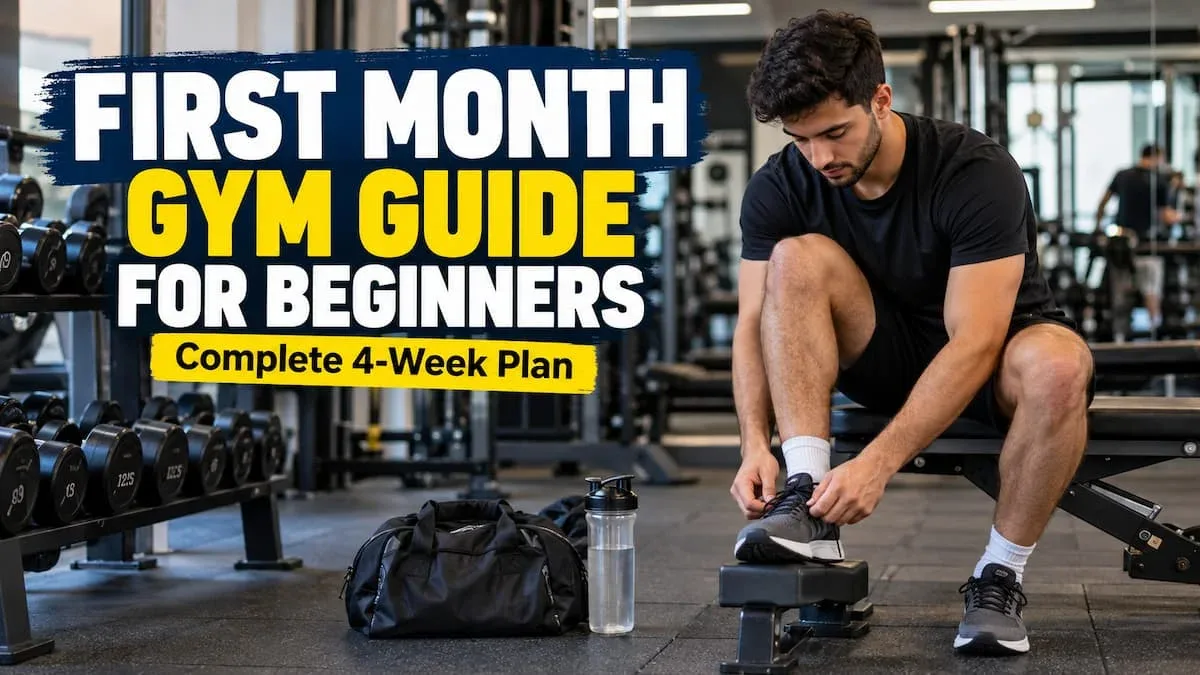
This first month gym guide for beginners will help you prepare for your first visit, understand common gym equipment, learn proper exercise techniques, and follow a practical four-week workout plan. You will also discover how to select suitable weights, manage recovery, improve your nutrition, avoid common mistakes, and measure your progress without expecting unrealistic results.
What Is a First Month Gym Guide for Beginners?
A first month gym guide for beginners is a structured introduction to regular strength training and physical activity. It helps new gym members learn fundamental exercises, become familiar with equipment, and develop consistent workout habits.
Rather than following complicated bodybuilding routines, beginners focus on basic movements such as squatting, pushing, pulling, and hip hinging. These movements train major muscle groups and prepare the body for more challenging workouts later.
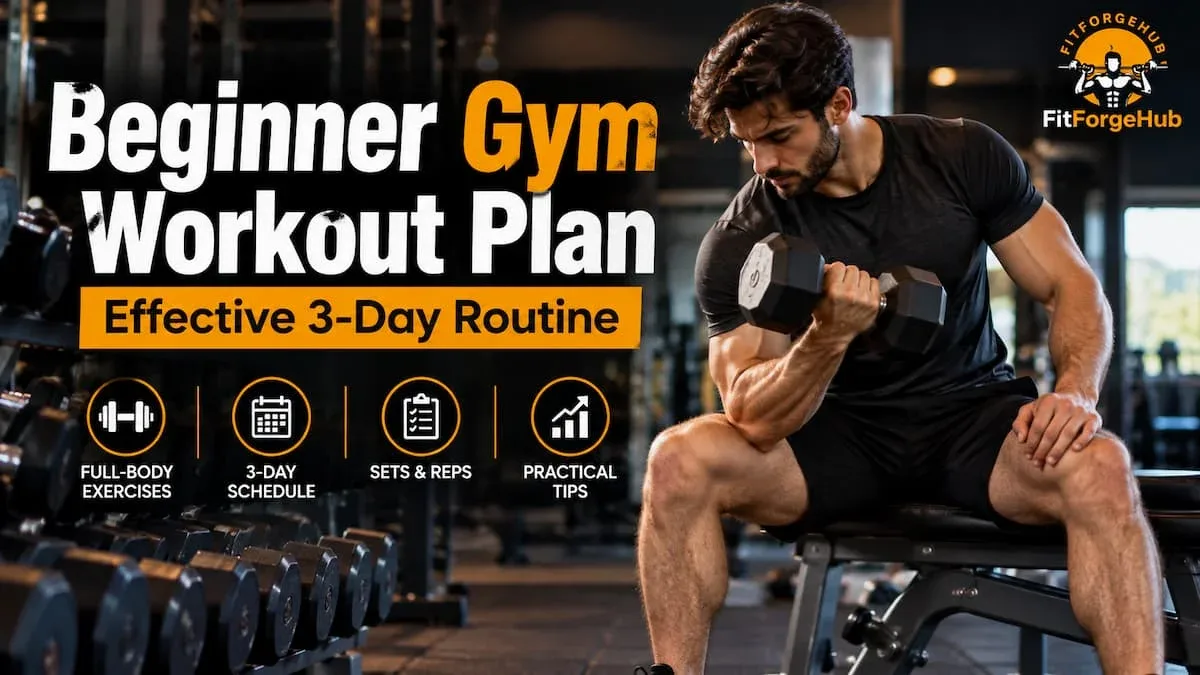
If you want another structured routine to compare with this first month gym guide for beginners, read our Beginner Gym Workout Plan for practical exercise guidance and a three-day training schedule.
The main purpose of your first month is to improve movement quality, understand how your body responds to exercise, and build a routine you can maintain.
Why Beginners Need a Structured Gym Routine
Walking into the gym without a plan often leads to random exercises and inconsistent training. You might spend too much time on one muscle group while ignoring others.
A structured routine gives every workout a clear purpose. This beginner program explains which exercises to perform, how many sets and repetitions to complete, and when to rest.
- Consistency: A fixed schedule makes regular attendance easier.
- Better technique: Repeating foundational exercises helps you develop control.
- Balanced development: Full-body training covers major muscle groups.
- Progress tracking: You can compare weights, repetitions, and performance.
- Recovery: Planned rest days help you manage fatigue.
According to the Centers for Disease Control and Prevention (CDC), adults should work toward at least 150 minutes of moderate-intensity aerobic activity per week and muscle-strengthening activities on at least two days. Beginners can gradually build toward these recommendations.
How to Prepare for Your First Gym Visit

Choose a Gym That Fits Your Schedule
A gym close to your home or workplace can make regular attendance more convenient. Look for basic strength-training equipment, helpful staff, a clean environment, and opening hours that match your daily routine.
You do not need an expensive gym with dozens of advanced machines. A facility with dumbbells, resistance machines, and basic cardio equipment can provide everything needed for this first month gym guide for beginners.
Pack the Essential Items
Prepare comfortable workout clothes, suitable athletic shoes, a water bottle, a towel, and your membership card. A notebook or workout-tracking application can help you record your training progress.
Learn Basic Gym Etiquette
Return dumbbells and weight plates after using them. Clean equipment when required, respect other members’ personal space, and avoid interrupting someone during a set.
If you do not understand how a machine works, ask a qualified staff member for assistance before using it.
Essential Gym Equipment for Beginners

Understanding basic gym equipment will make your first few visits less confusing. You do not need to use every machine immediately. Start with a small selection and learn how each one works.
The equipment in this first month gym guide for beginners was selected to help you practice common strength-training movements without requiring an advanced gym setup.
| Equipment | Main Purpose | Beginner Advice |
|---|---|---|
| Treadmill | Walking and aerobic exercise | Begin at a comfortable walking speed. |
| Stationary Bike | Low-impact cardio | Adjust the seat before starting. |
| Leg Press | Lower-body strength | Use controlled movements and manageable resistance. |
| Chest Press Machine | Chest, shoulders, and triceps | Adjust the handles to approximately chest height. |
| Cable Machine | Upper-body pulling exercises | Start with light resistance and stable posture. |
| Dumbbells | Free-weight strength exercises | Select appropriate weights for each exercise. |
How to Warm Up Before Your Gym Workout

Before lifting weights, spend approximately five to ten minutes preparing your body for exercise. Begin with comfortable walking or cycling to gradually increase your activity level.
Afterward, practice the movement patterns you will use during your workout. For example, perform a few bodyweight squats before leg presses or light chest press repetitions before your working sets.
A warm-up should help you feel prepared rather than exhausted. Each beginner workout should start with a manageable warm-up.
Complete 4-Week First Month Gym Guide for Beginners
This four-week program uses two alternating full-body workouts. Each session includes exercises for major muscle groups and allows recovery time between strength-training days.
The schedule in this first month gym guide for beginners is designed around Monday, Wednesday, and Friday workouts. If three sessions feel too demanding, start with two nonconsecutive training days and gradually add a third.
Four-Week Training Schedule
Follow this schedule to alternate Workout A and Workout B throughout your first month. Strength-training sessions are placed on nonconsecutive days to allow time for recovery.
| Week | Monday | Wednesday | Friday |
|---|---|---|---|
| Week 1 | Workout A | Workout B | Workout A |
| Week 2 | Workout B | Workout A | Workout B |
| Week 3 | Workout A | Workout B | Workout A |
| Week 4 | Workout B | Workout A | Workout B |
What to Do on Other Days
- Tuesday: Rest or take a comfortable walk.
- Thursday: Rest or perform gentle activity.
- Saturday: Optional walking or easy cycling.
- Sunday: Rest and recovery.
If three weekly strength sessions feel too demanding, start with Monday and Thursday only. Continue alternating Workout A and Workout B at your next session rather than trying to catch up on missed workouts.
Keep the same exercise routine throughout the four weeks. Focus on learning proper technique, completing comfortable repetitions, and gradually improving your performance. You do not need to increase the weight every week.
Workout A for Beginners

Workout A focuses on basic lower-body pushing, upper-body pushing and pulling, shoulder strength, and core stability.
As you follow this first month gym guide for beginners, use manageable resistance and prioritize controlled repetitions rather than lifting as much weight as possible.
How to Start: Before your first working set, perform a few light practice repetitions. During Week 1, beginners who are unfamiliar with an exercise can start with one comfortable working set and focus on correct technique. Gradually work toward the listed sets when they can perform the movements comfortably. The listed repetitions are targets, not a requirement to push through poor form.
| Exercise | Sets | Reps | Rest |
|---|---|---|---|
| Leg Press | 2 | 8–12 | 90 seconds |
| Machine Chest Press | 2 | 8–12 | 90 seconds |
| Seated Cable Row | 2 | 8–12 | 90 seconds |
| Machine Shoulder Press | 1–2 | 8–12 | 60–90 seconds |
| Dead Bug | 2 | 6–10 per side | 45–60 seconds |
1. Leg Press
Sit on the machine with your back supported. Place your feet comfortably on the platform and bend your knees slowly. Lower the weight through a comfortable range while keeping your lower back against the seat.
Push through your feet to return to the starting position without forcefully locking your knees.
Common Mistake: Using excessive weight or allowing your lower back to lift away from the seat.
2. Machine Chest Press
Adjust the seat so the handles are approximately level with your mid-chest. Keep your back supported and press the handles forward in a controlled movement.
Slowly return the handles without allowing the weights to slam down.
Common Mistake: Raising your shoulders, bouncing the resistance, or arching excessively.
3. Seated Cable Row
Sit upright with your feet supported. Hold the handle and pull it toward your lower ribs while keeping your torso relatively stable.
Extend your arms slowly to return to the starting position.
Common Mistake: Swinging your upper body to move heavier resistance.
4. Machine Shoulder Press
Adjust the seat and handles to a comfortable position. Press upward smoothly while keeping your torso stable.
Lower the handles slowly and avoid excessive arching of your lower back.
Common Mistake: Using weights that force you to twist or change your posture.
5. Dead Bug
Lie on your back with your knees bent above your hips and arms pointing toward the ceiling.
Slowly extend one arm and the opposite leg while keeping your trunk stable. Return to the starting position and repeat on the opposite side.
Common Mistake: Allowing your lower back to arch excessively.
Workout B for Beginners

Workout B introduces a squat movement, hip-hinge exercise, vertical pull, upper-body push, and another core stability exercise.
In this first month gym guide for beginners, Workout B complements Workout A by helping you practice different movement patterns while keeping the overall routine simple.
| Exercise | Sets | Reps | Rest |
|---|---|---|---|
| Goblet Squat | 2 | 8–12 | 90 seconds |
| Dumbbell Romanian Deadlift | 2 | 8–12 | 90 seconds |
| Lat Pulldown | 2 | 8–12 | 90 seconds |
| Incline Push-Up | 2 | 6–12 | 60–90 seconds |
| Bird Dog | 2 | 6–10 per side | 45–60 seconds |
1. Goblet Squat
Hold a light dumbbell close to your chest and stand with your feet comfortably apart.
Bend your hips and knees, lowering your body under control. Push through your feet to return to standing.
Beginner Modification: Practice bodyweight squats or chair squats before adding dumbbells.
2. Dumbbell Romanian Deadlift
Hold light dumbbells in front of your thighs. Keep a slight bend in your knees and move your hips backward while keeping the dumbbells close to your legs.
Lower to a comfortable depth without rounding your back. Return to standing by moving your hips forward.
Common Mistake: Forcing the dumbbells toward the floor instead of controlling the hip movement.
3. Lat Pulldown
Adjust the thigh pad so you are seated securely. Hold the bar with a comfortable grip and pull it toward your upper chest.
Keep your torso relatively stable and slowly return the bar overhead.
Common Mistake: Pulling the bar behind your neck or using excessive momentum.
4. Incline Push-Up
Place your hands on a sturdy, stable elevated surface. Keep your body aligned from head to heels.
Bend your elbows to lower your chest toward the surface, then press away smoothly.
Beginner Modification: Use a higher surface to make the exercise easier.
5. Bird Dog
Begin on your hands and knees. Extend one arm and the opposite leg while keeping your hips level.
Pause briefly, return slowly, and switch sides.
Common Mistake: Rotating your hips or raising your leg too high.
How to Progress Through Your First Four Weeks

Progressive training means gradually increasing the challenge as your body adapts. During your first month, this does not necessarily mean lifting heavier weights every week.
You can progress by improving exercise technique, completing more repetitions, or maintaining better control throughout each set. The program emphasizes these practical improvements before major weight increases.
| Week | Main Focus | Training Goal |
|---|---|---|
| Week 1 | Learning | Practice technique, learn equipment settings, and choose comfortable weights. Begin with one set when necessary. |
| Week 2 | Consistency | Work toward completing the listed sets and repetitions with good form. |
| Week 3 | Improvement | Add repetitions where appropriate without sacrificing movement control. |
| Week 4 | Review | Compare workout records and consider small weight increases when exercises feel manageable. |
For example, you might begin with two sets of eight chest press repetitions and gradually reach two sets of twelve. Once you can complete all planned repetitions with consistent technique, a small resistance increase may be appropriate.
If you want to become more confident with free weights, our Complete Dumbbell Workout Guide for Beginners explains fundamental dumbbell exercises and progression strategies.
How Much Weight Should a Beginner Lift?
There is no universal starting weight for every beginner. Appropriate resistance depends on the exercise, your strength, movement experience, and ability to maintain correct technique.
Choose a weight that allows you to complete your target repetitions with control while feeling that you could perform approximately two or three additional repetitions before your technique begins to deteriorate.
If you struggle to complete the minimum repetitions, reduce the weight. If the exercise feels very easy, consider increasing the resistance slightly.
The American College of Sports Medicine (ACSM) resistance training position stand discusses how progressive resistance training can improve strength and physical function, with training approaches adapted to individual needs and experience.
For this first month gym guide for beginners, proper technique and manageable resistance are more important than reaching a particular number on the weight stack.
How Long Should Beginner Gym Workouts Last?
Many beginners can complete the workouts in this guide in approximately 30 to 50 minutes, including a warm-up and appropriate rest periods.
Your first sessions may take longer because you are learning machine adjustments and exercise techniques. There is no need to rush.
The first month gym guide for beginners focuses on productive sessions rather than spending a particular number of hours in the gym.
When Should Beginners Add Cardio?
Cardiovascular exercise supports heart health, aerobic endurance, and overall physical fitness.
Beginners can start with approximately 10 to 20 minutes of comfortable walking or cycling on two or three days per week. Increase the duration gradually as your fitness improves.
You can perform easy cardio after strength training or on separate days, depending on your schedule and recovery.
For cardio, the beginner plan is intended as a manageable starting point. Over time, work toward recommended weekly activity levels.
Nutrition and Recovery During Your First Month
Eat Balanced Meals
Your body needs adequate energy and nutrients to support exercise. Include a variety of protein sources, carbohydrates, vegetables, fruit, and healthy fats in your regular meals.
Protein-rich foods include eggs, fish, poultry, beans, lentils, yogurt, and tofu. Carbohydrate sources such as oats, rice, potatoes, and fruit provide energy for daily activities and workouts.
Stay Hydrated
Drink water throughout the day and during exercise as needed. Your fluid requirements depend on factors such as temperature, exercise duration, and individual needs.
Prioritize Sleep
Many adults benefit from approximately seven to nine hours of sleep each night. Regular sleep supports recovery and general well-being.
Allow Enough Rest
Include recovery days between demanding full-body workouts. If you feel unusually tired or sore, consider reducing workout difficulty or allowing additional recovery time.
Recovery is an essential part of this first month gym guide for beginners because your body needs time to adapt to unfamiliar training.
Common Beginner Gym Mistakes to Avoid
1. Lifting Too Heavy Too Soon
Using excessive resistance can make it difficult to maintain proper technique. Begin with manageable weights and increase the challenge gradually.
2. Skipping the Warm-Up
A short warm-up prepares you for your planned movements and allows you to practice before using heavier resistance.
3. Training Intensely Every Day
Beginners do not need demanding strength workouts seven days a week. Recovery days help manage fatigue and support consistent training.
4. Changing Exercises Too Frequently
Repeating foundational movements makes it easier to develop technique and measure progress.
5. Ignoring Lower-Body Exercises
A balanced program should include your legs and hips alongside upper-body exercises.
6. Expecting Immediate Physical Changes
Your first month is mainly about building a foundation. Better exercise control, improved strength, and increased confidence are meaningful achievements even if visible changes take longer.
Avoid these mistakes while following this first month gym guide for beginners, and judge your progress by consistent training rather than unrealistic expectations.
How to Track Your Gym Progress
Recording your workouts helps you understand whether you are improving. After each session, note the exercise, resistance, sets, repetitions, and any important technique observations.
Tracking is an important part of this first month gym guide for beginners because it gives you a practical way to recognize small improvements.
| Exercise | Machine or Weight Setting | Set 1 | Set 2 | Notes |
|---|---|---|---|---|
| Leg Press | Record your setting | 10 reps | 9 reps | Controlled movement |
| Chest Press | Record your setting | 10 reps | 10 reps | Comfortable resistance |
| Seated Row | Record your setting | 12 reps | 11 reps | Stable posture |
These numbers are examples, not recommended starting weights. Different machines may use different resistance systems.
You can also track workout attendance, exercise confidence, and whether movements feel more controlled over time.
What to Do After Your First Month at the Gym
After four weeks, review your workout records and consider how comfortably you are completing your sessions.
If the routine still challenges you, continue using it. You do not need to switch immediately to an advanced workout split.
After completing this first month gym guide for beginners, you may want to explore another training structure. Our Beginner Push Pull Legs Workout at Home explains how to organize pushing, pulling, and lower-body exercises.
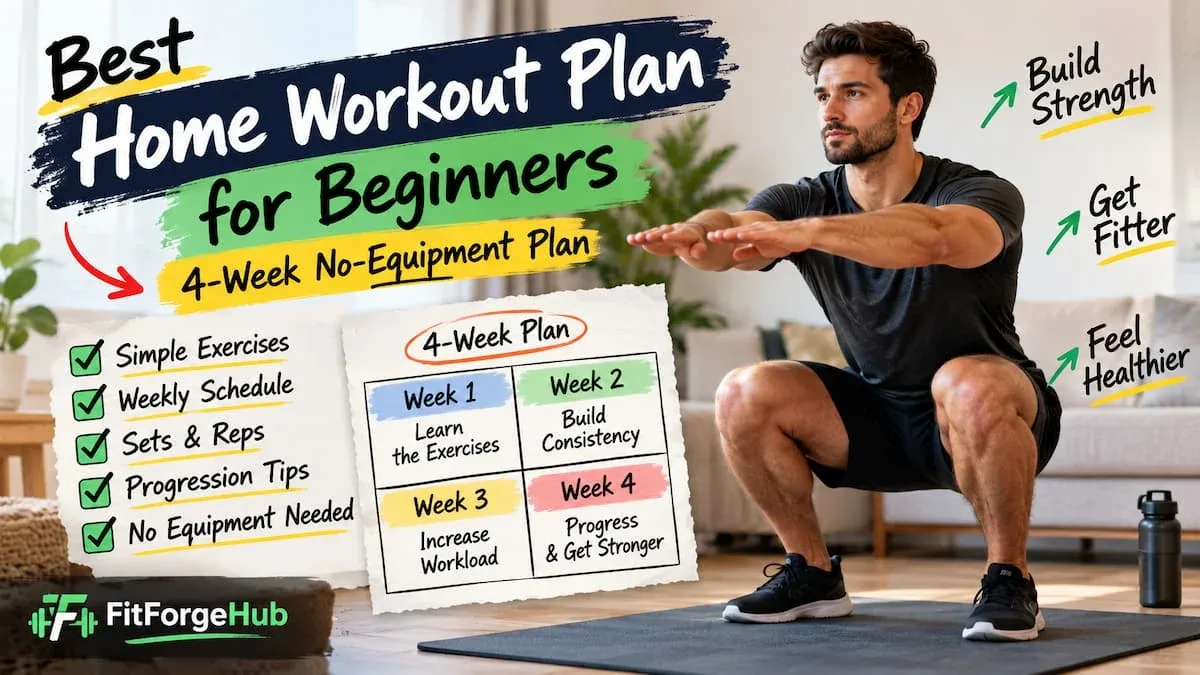
If you cannot visit the gym regularly, the Best Home Workout Plan for Beginners offers a structured no-equipment alternative.
Choose the routine that fits your schedule, available equipment, and fitness goals.
Frequently Asked Questions
Is This First Month Gym Guide for Beginners Suitable for Complete Beginners?
Yes. The program focuses on basic strength-training exercises and manageable workout sessions. Complete beginners can start with two sessions weekly or fewer sets when needed.
Is Three Days a Week Enough for Gym Beginners?
Yes. Three full-body strength workouts per week can be a practical option for beginners. If you are new to resistance training or need more recovery time, start with two sessions per week and gradually increase your training frequency.
Should Beginners Use Machines or Dumbbells?
Both can be effective. Machines provide guided movement, while dumbbells offer flexible exercise options. Choose equipment you can use comfortably with good technique.
Can Beginners Build Muscle in the First Month?
Beginners can begin adapting to resistance training during their first month. However, the amount of muscle gained varies, and noticeable physical changes may take longer.
Should I Do Cardio Before or After Weight Training?
A short, easy cardio warm-up before lifting can help prepare you for exercise. Longer cardio sessions can be performed afterward or on separate days depending on your goals.
How Do I Know When to Increase the Weight?
Consider increasing the resistance slightly when you can complete your planned sets and repetitions with consistent technique and the current weight feels manageable.
What if I Miss a Workout?
Continue with your next planned session. You do not need to double your workout volume to compensate for an occasional missed day.
Is Muscle Soreness Normal for Beginners?
Mild soreness can occur after unfamiliar activity. Sharp pain, significant swelling, or severe or persistent symptoms should not be ignored.
Do Beginners Need Supplements?
Supplements are not required to begin a gym routine. Balanced meals, appropriate training, recovery, and consistency are more important starting priorities.
Final Thoughts
Your first month at the gym should help you develop confidence, learn fundamental exercises, and establish consistent workout habits. You do not need advanced equipment, heavy lifting, or complicated training schedules to begin.
This first month gym guide for beginners provides a practical foundation for learning exercises, organizing workouts, and gradually improving performance. Start with manageable resistance, practice controlled movements, record your progress, and allow sufficient recovery between sessions.
By the end of four weeks, you may feel more confident using gym equipment and better prepared to continue your fitness journey.
About the Author
Disclaimer
This article provides general fitness education and does not replace individualized medical advice. If you have an injury, medical condition, or concerns about beginning an exercise program, consult a qualified healthcare professional before starting. Stop exercising if you experience chest pain, dizziness, sharp pain, or other concerning symptoms.