You don’t need a gym membership, squat rack, or expensive equipment to start training your legs.
For beginners, the best home leg workout without equipment should be simple enough to follow and challenging enough to support gradual progress.
A simple bodyweight routine can challenge your quads, hamstrings, glutes, calves, and supporting muscles while helping you build a consistent exercise habit at home.
If you’re a beginner, the biggest challenge is usually not finding hundreds of exercises. It’s knowing which exercises to choose, how many sets and reps to perform, how often to train, and how to make the workout harder as you improve.
This guide gives you a simple best home leg workout without equipment that you can perform in a small space with little or no equipment.
You’ll also learn beginner modifications, progression strategies, common mistakes, recovery tips, and how to fit leg training into a weekly workout schedule.
Quick note: This article provides general fitness information for educational purposes. It isn’t medical advice. If you have an injury, medical condition, or concerns about exercise, speak with an appropriate healthcare professional before starting a new routine.
Table of Contents
- Can You Build Stronger Legs Without Equipment?
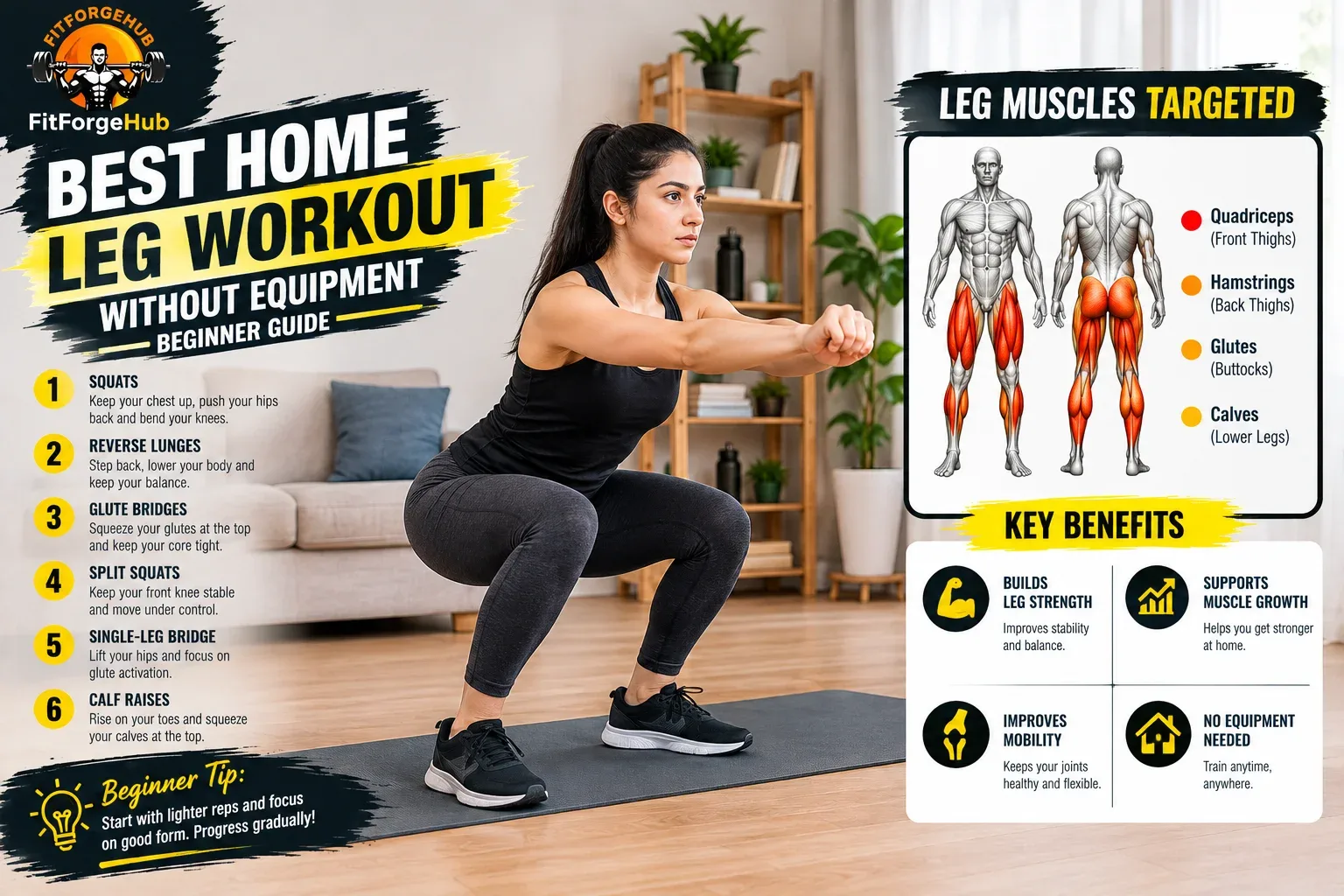
- Best Home Leg Workout Without Equipment
- 1. Bodyweight Squats
- 2. Reverse Lunges
- 3. Glute Bridges
- 4. Bulgarian Split Squats
- 5. Single-Leg Glute Bridge
- 6. Standing Calf Raises
- How Many Sets and Reps Should Beginners Do?
- How Long Should You Rest Between Sets?
- How to Make a No-Equipment Leg Workout Harder
- Beginner Weekly Leg Workout Schedule
- Common Leg Workout Mistakes
- How to Warm Up Before Leg Day
- Can You Build Muscle With Bodyweight Leg Exercises?
- How to Combine Leg Training With Your Other Workouts
- Frequently Asked Questions
- Final Thoughts
- About the Author
Can You Build Stronger Legs Without Equipment?
Yes.
Bodyweight exercises can provide resistance for your lower body, especially when you’re new to structured resistance training.
Exercises such as squats, lunges, split squats, glute bridges, and calf raises allow you to train your legs without dumbbells or gym machines.
The CDC lists bodyweight exercises as one way to perform muscle-strengthening activity and recommends that adults work all major muscle groups, including the legs and hips, as part of their weekly strengthening routine.
CDC — What Counts as Physical Activity for Adults
The important part is to make the exercise challenging enough while maintaining good technique.
As you become stronger, you can gradually increase:
- Repetitions
- Sets
- Exercise difficulty
- Range of motion
- Tempo
- Training consistency
You can eventually add dumbbells, resistance bands, or other equipment if you want additional resistance, but equipment isn’t required to begin.
That’s why the best home leg workout without equipment focuses on consistent training rather than complicated equipment.
Best Home Leg Workout Without Equipment
Here’s a simple beginner routine you can perform at home.
Before starting the best home leg workout without equipment, spend a few minutes warming up and preparing your legs for the exercises.
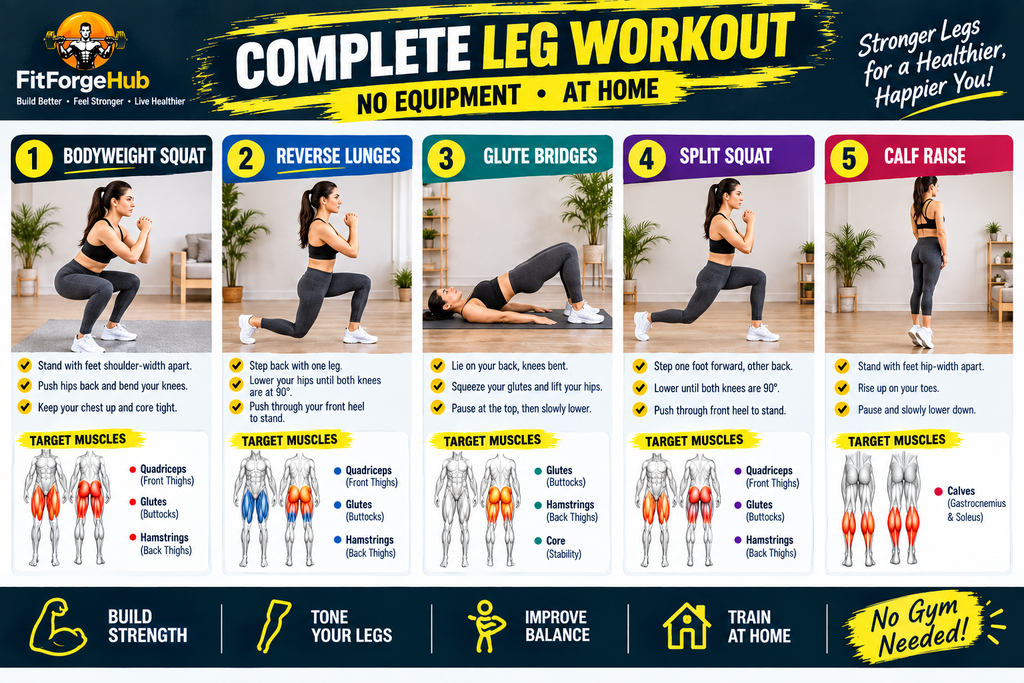
| Exercise | Sets | Reps |
|---|---|---|
| Bodyweight Squats | 3 | 10–15 |
| Reverse Lunges | 2 | 8–12/leg |
| Glute Bridges | 3 | 10–15 |
| Bulgarian Split Squats | 2 | 8–12/leg |
| Single-Leg Glute Bridges | 2 | 8–12/leg |
| Standing Calf Raises | 3 | 12–20 |
Rest: 60–120 seconds between sets.
If you’re completely new to exercise, start with the lower end of the volume and concentrate on learning the movements.
1. Bodyweight Squats
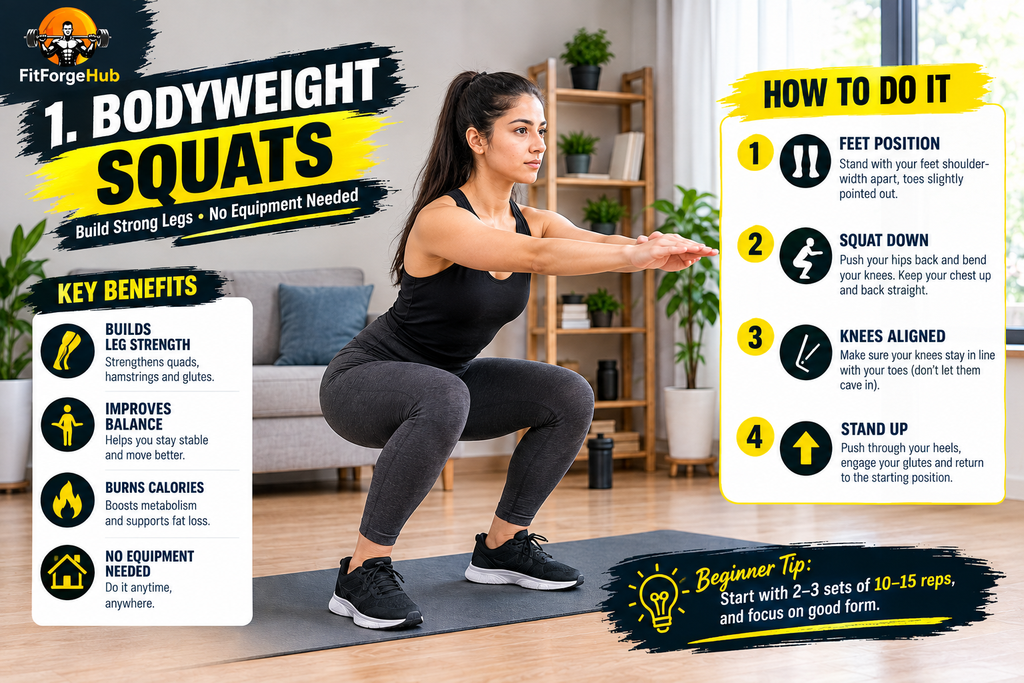
Bodyweight squats are one of the simplest ways to start training your legs at home.
They primarily challenge the quadriceps and glutes, while your hamstrings and core also contribute to the movement.
How to Perform Bodyweight Squats
- Stand with your feet approximately shoulder-width apart.
- Keep your chest comfortably upright.
- Brace your midsection.
- Bend your knees and push your hips back.
- Lower yourself under control.
- Go as low as you can comfortably while maintaining good form.
- Push through your feet to return to standing.
Beginner Recommendation
3 sets × 10–15 reps
Don’t worry about reaching a very deep squat if your mobility or balance doesn’t allow it yet.
Focus on controlled movement.
Beginner Modification
If squats feel difficult, use a sturdy chair behind you as a target.
Lower yourself toward the chair and stand back up without completely relaxing onto it.
2. Reverse Lunges
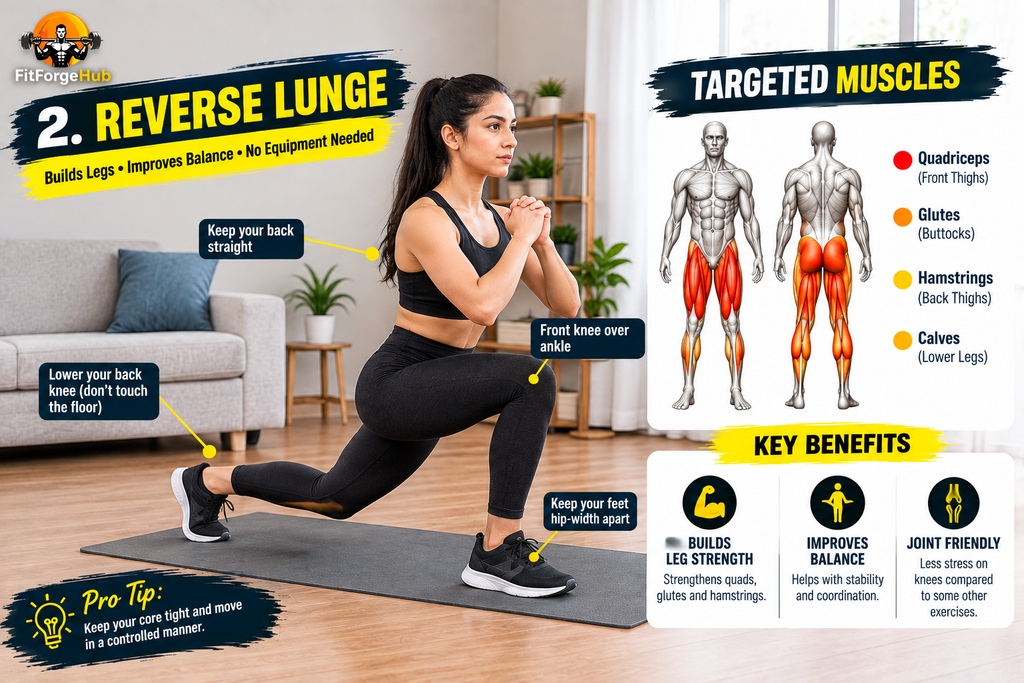
Reverse lunges are a useful unilateral exercise that allows you to train one leg at a time.
They work the quads and glutes while also challenging balance and coordination.
How to Perform Reverse Lunges
- Stand tall with your feet together.
- Step one foot backward.
- Lower your body under control.
- Keep your front foot stable.
- Push through the front foot to return to the starting position.
- Repeat on the opposite side.
Beginner Recommendation
2 sets × 8–12 reps per leg
If balance is difficult, lightly hold a wall or sturdy surface for support.
Form Tip
Don’t rush the movement.
A controlled reverse lunge is generally easier to manage than rapidly stepping backward and forward.
3. Glute Bridges
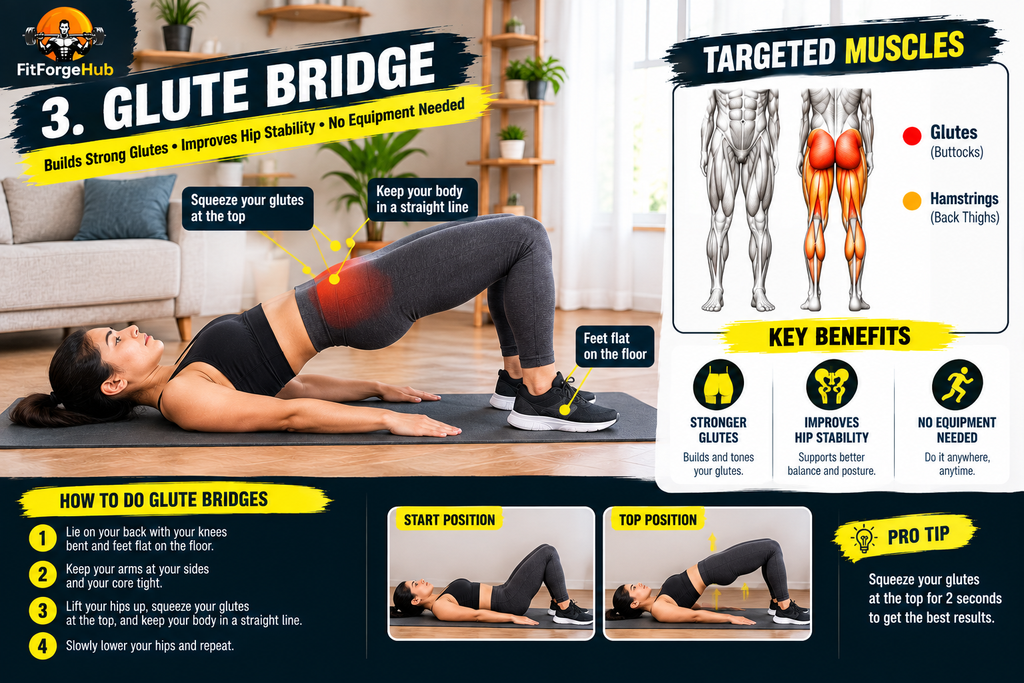
Glute bridges are a simple floor-based exercise for your posterior chain.
They primarily target the glutes and can be included in a beginner lower-body routine.
How to Perform Glute Bridges
- Lie on your back.
- Bend your knees.
- Keep your feet flat on the floor.
- Place your arms comfortably beside your body.
- Push through your feet.
- Lift your hips toward the ceiling.
- Pause briefly at the top.
- Lower your hips under control.
Beginner Recommendation
3 sets × 10–15 reps
Don’t overarch your lower back to get your hips higher.
Instead, focus on controlled hip movement.
4. Bulgarian Split Squats
Bulgarian split squats are more challenging than standard squats because they place more of the work on one leg at a time.
You can perform them using a stable chair or sofa behind you.
How to Perform Them
- Stand a short distance in front of a sturdy elevated surface.
- Place one foot behind you.
- Keep your front foot stable.
- Lower your body slowly.
- Push through your front foot to return to the starting position.
Beginner Recommendation
2 sets × 8–12 reps per leg
If this exercise is too difficult, start with regular split squats where your back foot stays on the floor.
Important Safety Tip
Only use a sturdy surface that does not slide or tip.
5. Single-Leg Glute Bridge
Once regular glute bridges become easier, you can progress to the single-leg version.
This increases the challenge by placing more of the work on one side at a time.
How to Perform It
- Lie on your back.
- Bend one knee and keep that foot on the floor.
- Extend the opposite leg.
- Push through the planted foot.
- Lift your hips.
- Lower slowly.
- Complete your repetitions and switch sides.
Beginner Recommendation
2 sets × 8–12 reps per leg
If you struggle to control the movement, return to regular glute bridges.
6. Standing Calf Raises
Calf raises are simple but easy to overlook.
They directly train the calf muscles and require no equipment.
How to Perform Calf Raises
- Stand upright.
- Keep your feet approximately hip-width apart.
- Hold onto a wall if needed for balance.
- Raise your heels.
- Pause briefly at the top.
- Lower your heels slowly.
Beginner Recommendation
3 sets × 12–20 reps
As this becomes easy, you can eventually progress to single-leg calf raises.
How Many Sets and Reps Should Beginners Do?
There isn’t one perfect number of repetitions for every person or every exercise.
The CDC gives 8–12 repetitions per activity as a general starting point for muscle-strengthening work and notes that one set is a starting point, while two or three sets can provide more work.
For general guidance on muscle-strengthening activities, see the [CDC guidance on muscle-strengthening activities].
For this routine, a practical starting point is:
- Squats: 10–15 reps
- Lunges: 8–12 reps per leg
- Glute bridges: 10–15 reps
- Split squats: 8–12 reps per leg
- Calf raises: 12–20 reps
If you’re new to exercise, you don’t need to immediately perform every set listed.
Start with a manageable amount and build gradually.
A simple starting point is 60–120 seconds between sets.
How Long Should You Rest Between Sets?
For easier exercises, you may need less rest.
For challenging exercises such as Bulgarian split squats, you may need more.
Your goal should be to recover enough to perform your next set with controlled technique.
Don’t turn every set into a race.
How to Make a No-Equipment Leg Workout Harder
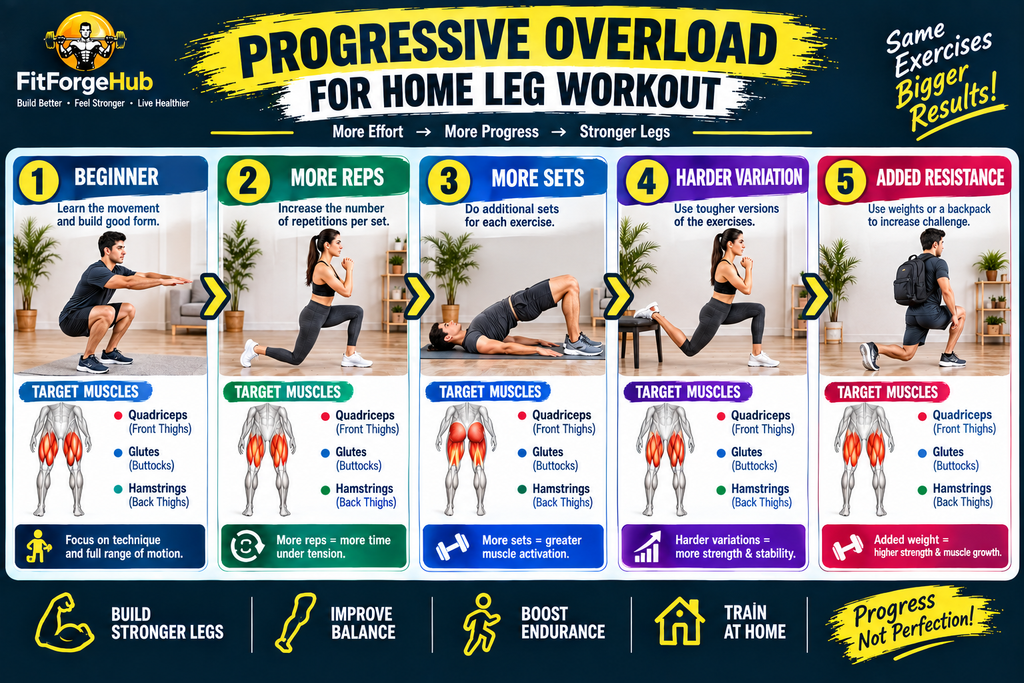
Eventually, bodyweight squats may become too easy.
That’s when progression becomes important.
The best home leg workout without equipment can continue to challenge you as long as you gradually increase the difficulty.
1. Add Repetitions
For example:
Week 1: 10 reps
Week 2: 12 reps
Week 3: 15 reps
You don’t have to increase repetitions every week. Progress when you’re ready.
2. Add a Set
If you’re comfortably completing your current sets, you can add another set to selected exercises.
3. Slow Down the Repetition
Try performing the lowering portion of a squat or lunge more slowly.
This can increase the challenge without requiring additional equipment.
4. Increase Range of Motion
As your mobility and technique improve, you may be able to use a comfortable larger range of motion.
5. Move to a Harder Variation
For example:
Squat → Split Squat → Bulgarian Split Squat → Single-Leg Variation
Or:
Glute Bridge → Single-Leg Glute Bridge
6. Add External Resistance Later
If your goal eventually shifts toward more muscle-building volume, you can add dumbbells or resistance bands.
ACSM’s 2026 resistance-training guidance emphasizes consistency and gradual progression and notes that home-based and bodyweight training can be effective options.
For additional resistance-training guidance, see the [ACSM resistance training guidance].
Beginner Weekly Leg Workout Schedule
You don’t need to train your legs every day.
A simple beginner schedule could look like this:
Monday
Leg Workout
Tuesday
Light walking or rest
Wednesday
Upper Body Workout
Thursday
Rest or light activity
Friday
Leg Workout
Saturday
Optional light activity
Sunday
Rest
However, your exact schedule should depend on your overall training program and recovery.
The CDC recommends muscle-strengthening activity on at least 2 days per week, with all major muscle groups included.
You don’t necessarily need a separate leg-only session twice a week if your full-body workouts already train your legs.
For broader weekly activity recommendations, see the [CDC Physical Activity Guidelines for Adults].
Common Leg Workout Mistakes
1. Doing Too Many Repetitions Too Quickly
More repetitions aren’t automatically better.
If your technique falls apart, reduce the repetitions or choose an easier variation.
2. Ignoring Warm-Up
Starting immediately with hard sets can feel uncomfortable.
Spend a few minutes gradually preparing your body for movement.
3. Using Unstable Furniture
Don’t perform elevated exercises using chairs or furniture that can move unexpectedly.
Safety comes first.
4. Training Through Sharp Pain
Normal exercise effort and muscle fatigue are different from sharp or unusual pain.
Stop an exercise if something feels wrong and seek professional guidance when appropriate.
5. Training Legs Every Day
Your muscles need recovery.
Give challenging leg sessions enough time between them.
6. Only Training the Front of Your Legs
A balanced lower-body workout should include movements that involve the quads, glutes, hamstrings, and calves.
That’s why this routine includes squats, lunges, hip-extension movements, and calf raises.
How to Warm Up Before Leg Day
You don’t need a complicated warm-up.
Try 5–8 minutes of easy movement followed by a few controlled practice repetitions.
For example:
- Easy marching
- Bodyweight squats
- Hip circles
- Reverse lunges
- Glute bridges
- Ankle movements
Start slowly and gradually increase the effort.
If you’re new to exercise or returning after a long break, keep the initial session easier and build gradually.
Can You Build Muscle With Bodyweight Leg Exercises?
Bodyweight training can be an effective form of resistance training, especially when exercises are challenging enough and performed consistently.
ACSM’s 2026 position stand notes that bodyweight and home-based resistance training can improve strength and other resistance-training outcomes, and that complicated training methods aren’t necessary for the average healthy adult.
However, your results depend on several factors, including:
- Your training consistency
- Exercise difficulty
- Progression
- Nutrition
- Protein intake
- Sleep
- Recovery
- Your starting fitness level
If a bodyweight exercise becomes extremely easy, you’ll eventually need to increase the challenge if you want to continue progressing.
That could mean using a harder variation, increasing volume, slowing the movement, or eventually adding resistance.
If you are following the best home leg workout without equipment consistently, progression becomes especially important as your strength improves.
How to Combine Leg Training With Your Other Workouts
A leg workout is only one part of a balanced training program.
For example, you could organize your home training like this:
Day 1 — Push
Chest, shoulders, and triceps
Day 2 — Pull
Back and biceps
Day 3 — Legs
Quads, hamstrings, glutes, and calves
This is similar to a beginner Push Pull Legs structure.
For a complete PPL routine, see:
Beginner Push Pull Legs Workout at Home
You can also combine this workout with your existing:
The goal is to create a balanced routine rather than repeatedly training only one muscle group.
Frequently Asked Questions
Can I do a leg workout at home without equipment?
Yes. Bodyweight squats, lunges, split squats, glute bridges, and calf raises can all be performed without traditional gym equipment.
What is the best home leg workout without equipment?
For beginners, a combination of squats, lunges, glute bridges, split squats, and calf raises provides a practical starting routine.
Can I build bigger legs without weights?
You can build strength and improve muscular fitness using challenging bodyweight exercises. As you become stronger, you may eventually need additional resistance or harder exercise variations for continued progression.
How many days a week should I train legs?
There isn’t one schedule that works for everyone. Two weekly muscle-strengthening days is part of the CDC’s general adult activity guidance, but your total training schedule should determine how often you directly train your legs.
How many squats should a beginner do?
A practical starting point is 2–3 sets of 10–15 controlled repetitions, adjusting the amount based on your current fitness level.
Are bodyweight squats enough for legs?
They can be a useful starting exercise, but a balanced leg routine should include different movement patterns rather than relying only on squats.
How long should a home leg workout take?
For most beginners, this routine can fit into approximately 25–40 minutes, depending on rest periods and how many sets you perform.
Can I do this workout every day?
It’s generally better to allow recovery between challenging leg sessions rather than repeating the same demanding workout every day.
Final Thoughts
The best home leg workout without equipment doesn’t need to be complicated or time-consuming.
You don’t need a gym or expensive equipment to start training your legs.
A simple routine built around squats, lunges, glute bridges, split squats, and calf raises can give beginners a practical starting point.
The key is consistency.
Start with a manageable amount of work, learn the movements, and gradually increase the challenge as your strength improves.
Don’t worry about making your first workout perfect.
Build the habit first, track your progress, and give yourself time to improve.
About the Author
Riaz Ahmed
Riaz Ahmed holds a Master’s degree in Health and Physical Education and is the founder of FitForgeHub, where he shares practical fitness and workout information.
His goal is to make fitness easier to understand for beginners by providing practical workout routines, exercise guidance, muscle-building information, and realistic fitness tips.
Website: FitForgeHub.com
Disclaimer
The information provided on FitForgeHub is intended for general educational and informational purposes only. It is not medical advice and should not replace advice from a qualified healthcare, fitness, or medical professional. If you have an injury, medical condition, or concerns about starting a new exercise program, consult an appropriate professional before exercising.