Starting a workout routine can feel confusing.
Should you train every day? How heavy should your dumbbells be? How many exercises should you do? And do you really need a gym to build strength?
The good news is that beginners don’t need a complicated program.
With a pair of dumbbells, a little space, and a consistent routine, you can train your major muscle groups at home and gradually become stronger.
This complete dumbbell workout guide for beginners brings together the most important exercises, training principles, sets, reps, rest periods, progression tips, and recovery advice you need to get started.
Whether your goal is to build muscle, improve strength, become more active, or simply create a sustainable home workout routine, this guide gives you a practical starting point.
Quick Answer: Beginners can start with a full-body dumbbell routine 2–3 days per week, using exercises for the legs, chest, back, shoulders, and arms. Start with manageable weights, focus on good technique, and gradually increase the challenge as you become stronger.
Table of Contents
- Why Use Dumbbells for Beginner Workouts?
- Can Beginners Build Muscle With Dumbbells at Home?
- What Equipment Do You Need?
- Beginner Dumbbell Workout at a Glance
- 1. Dumbbell Goblet Squat
- 2. Dumbbell Romanian Deadlift
- 3. Dumbbell Chest Press
- 4. One-Arm Dumbbell Row
- 5. Dumbbell Shoulder Press
- 6. Dumbbell Lateral Raise
- 7. Dumbbell Biceps Curl
- 8. Dumbbell Triceps Extension
- 9. Dumbbell Calf Raise
- Complete Beginner Dumbbell Workout Routine
- How Many Days a Week Should Beginners Use Dumbbells?
- How Many Sets and Reps Should Beginners Do?
- How Heavy Should Your Dumbbells Be?
- How to Progress With Dumbbells
- How Long Should a Dumbbell Workout Last?
- Common Beginner Dumbbell Workout Mistakes
- Dumbbell Workout for Skinny Beginners
- Nutrition and Recovery
- Beginner Dumbbell Workout Weekly Schedule
- How to Stay Consistent With Home Workouts
- Frequently Asked Questions
- Final Thoughts
- About the Author
Why Use Dumbbells for Beginner Workouts?
Dumbbells are one of the most practical pieces of equipment for a home workout.
You don’t need a large room or a complete home gym.
A pair of dumbbells can be used for exercises that train your:
- Legs
- Glutes
- Chest
- Back
- Shoulders
- Biceps
- Triceps
- Core and stabilizing muscles
Another advantage is that dumbbells make it relatively easy to adjust the difficulty of an exercise.
You can start light, learn the movement, and gradually increase the resistance as your strength improves.
For beginners, that simplicity can make it easier to stay consistent.
Can Beginners Build Muscle With Dumbbells at Home?
Yes.
Resistance training provides a stimulus for your muscles to adapt and become stronger.
Dumbbells can provide that resistance without requiring a gym membership.
However, building muscle isn’t simply about lifting weights.
Your results also depend on:
- Consistent training
- Appropriate resistance
- Adequate nutrition
- Sufficient protein
- Recovery
- Sleep
- Gradual progression
This is why doing hundreds of random exercises isn’t necessarily better.
A simple program that you follow consistently is often a better starting point.
What Equipment Do You Need?
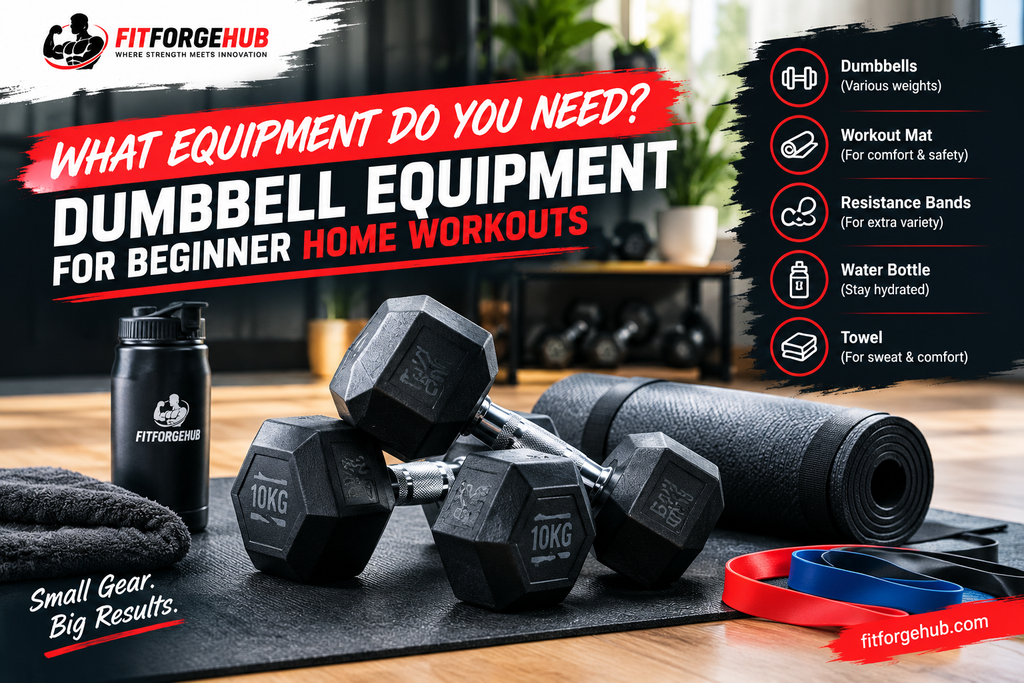
Essential dumbbell equipment for effective beginner workouts at home.You can start with surprisingly little equipment.
Basic Equipment
- Pair of dumbbells
- Stable floor
- Enough room to exercise safely
Optional Equipment
- Exercise mat
- Adjustable dumbbells
- Stable bench
- Resistance bands
You don’t need to buy everything at once.
If you’re just beginning, start with the equipment you can use consistently.
Beginner Dumbbell Workout at a Glance
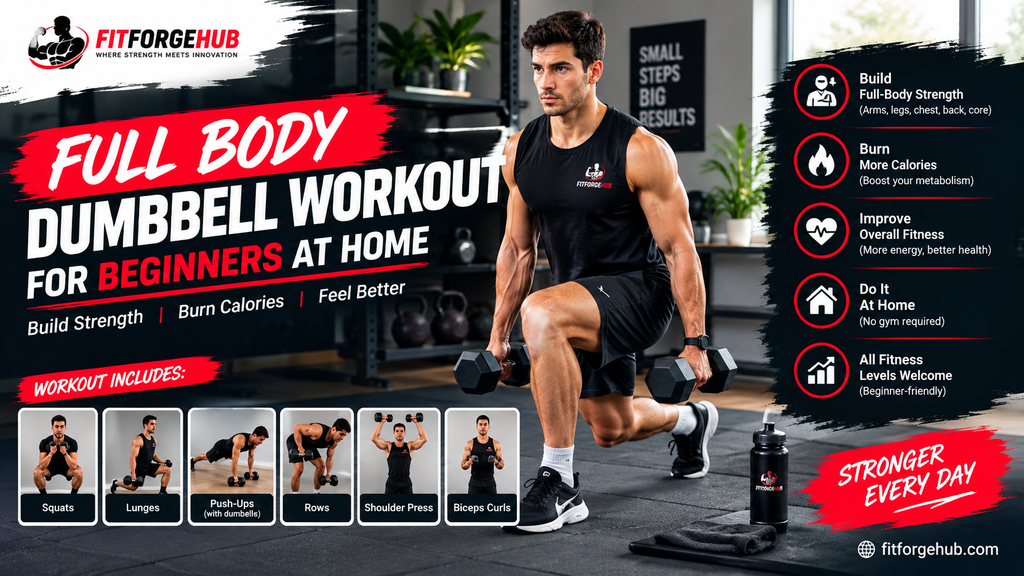
Here is a complete full-body routine.
| Exercise | Sets | Reps | Rest |
| Goblet Squat | 3 | 8–12 | 60–90 sec |
| Romanian Deadlift | 3 | 8–12 | 90 sec |
| Dumbbell Chest Press | 3 | 8–12 | 60–90 sec |
| One-Arm Dumbbell Row | 3 | 8–12/side | 60–90 sec |
| Shoulder Press | 2 | 8–12 | 60–90 sec |
| Lateral Raise | 2 | 10–15 | 60 sec |
| Biceps Curl | 2 | 10–15 | 60 sec |
| Triceps Extension | 2 | 10–15 | 60 sec |
| Calf Raise | 2 | 12–20 | 60 sec |
Important
You do not have to perform all nine exercises from your first workout.
If you’re completely new, start with 4–6 exercises and add more gradually.
The objective is to build a routine you can maintain.
A simple full-body dumbbell workout for beginners at home.1. Dumbbell Goblet Squat
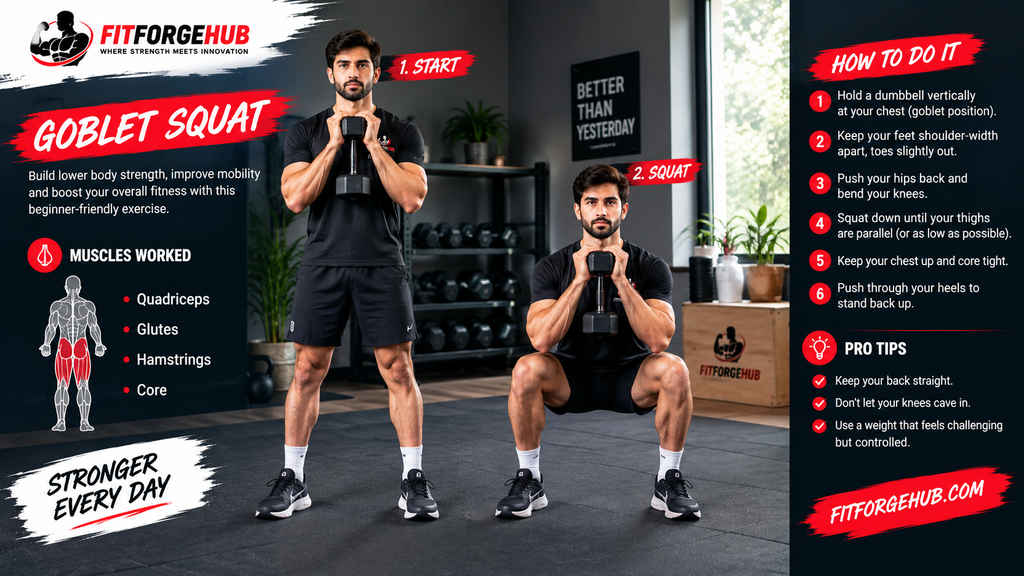
The goblet squat is a beginner-friendly lower-body exercise.
It primarily works the quadriceps and glutes while also requiring your core to stabilize your body.
How to Perform
- Stand with your feet around shoulder-width apart.
- Hold one dumbbell close to your chest.
- Brace your core.
- Push your hips back and bend your knees.
- Lower yourself under control.
- Push through your feet to stand.
- Repeat.
Sets: 3
Reps: 8–12
Beginner Tip
Don’t worry about using a heavy dumbbell.
Learn the movement first.
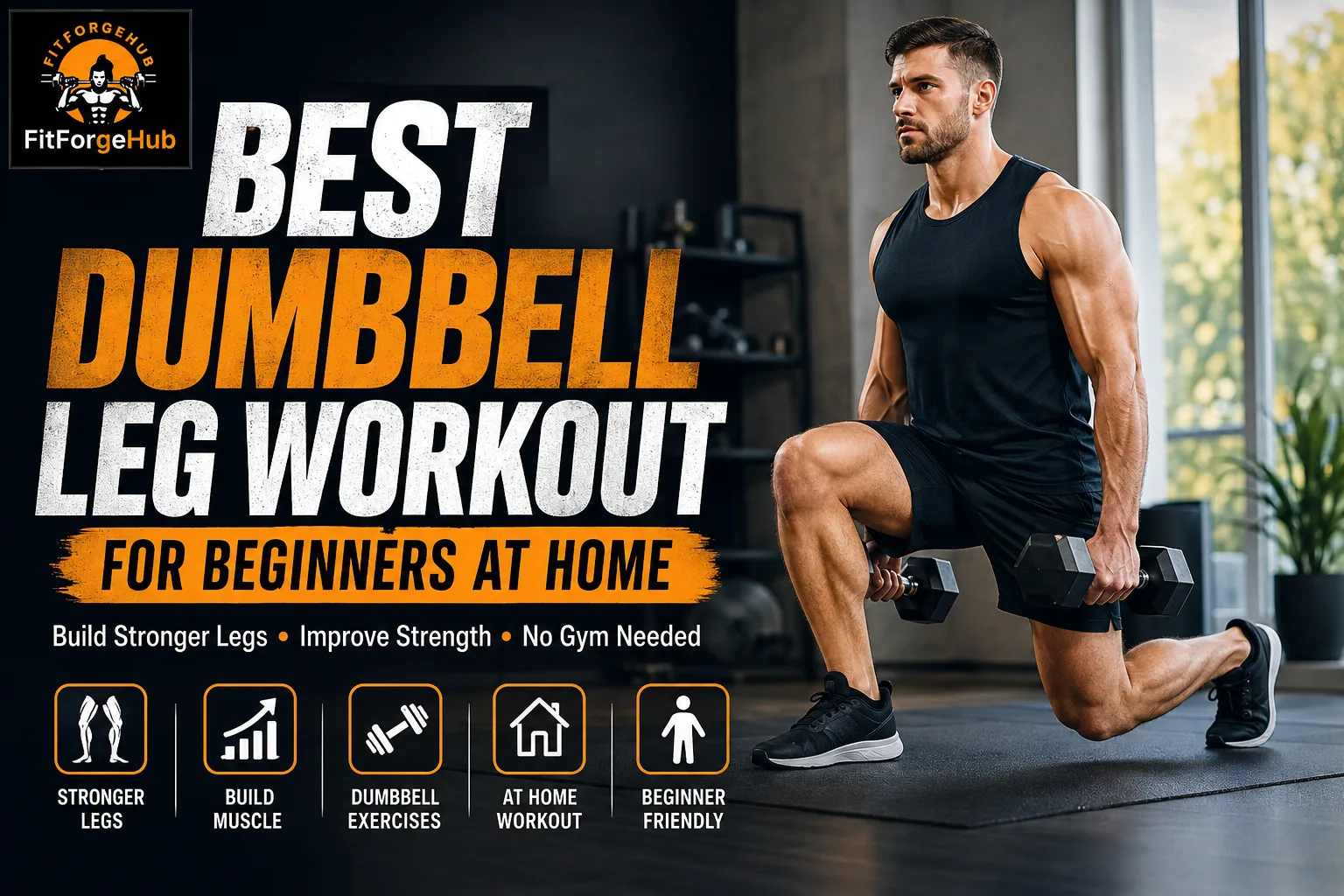
For more lower-body exercises, read:
Best Dumbbell Leg Workout for Beginners
2. Dumbbell Romanian Deadlift
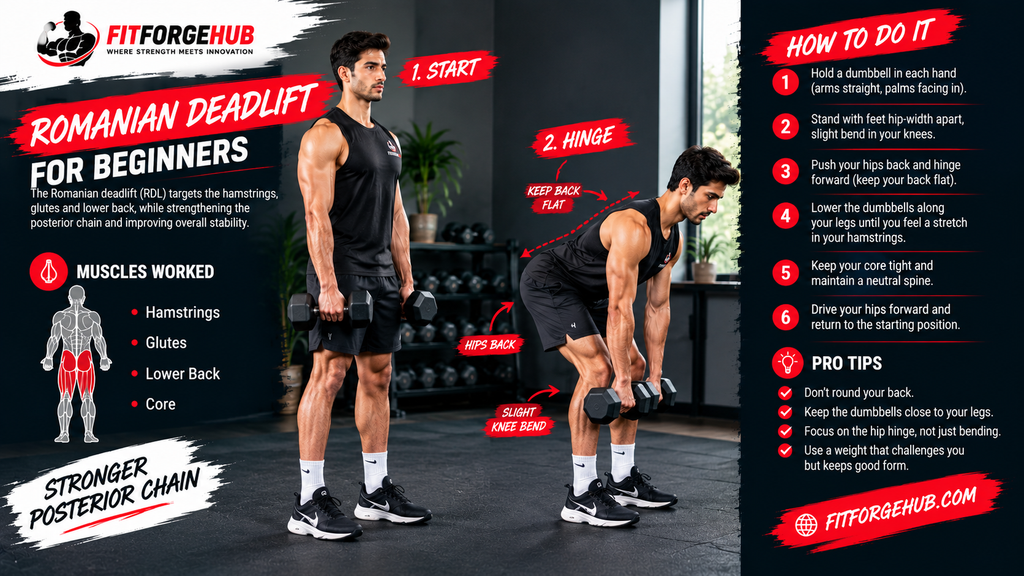
The dumbbell Romanian deadlift trains the hamstrings and glutes and teaches an important hip-hinge movement.
How to Perform
- Stand with your feet approximately hip-width apart.
- Hold dumbbells in front of your thighs.
- Keep your knees slightly bent.
- Push your hips backward.
- Lower the dumbbells along your legs.
- Keep your back in a comfortable neutral position.
- Drive your hips forward to return to standing.
Sets: 3
Reps: 8–12
Common Mistake
Don’t turn the movement into a squat.
Think:
Hips back → controlled lowering → hips forward.
3. Dumbbell Chest Press
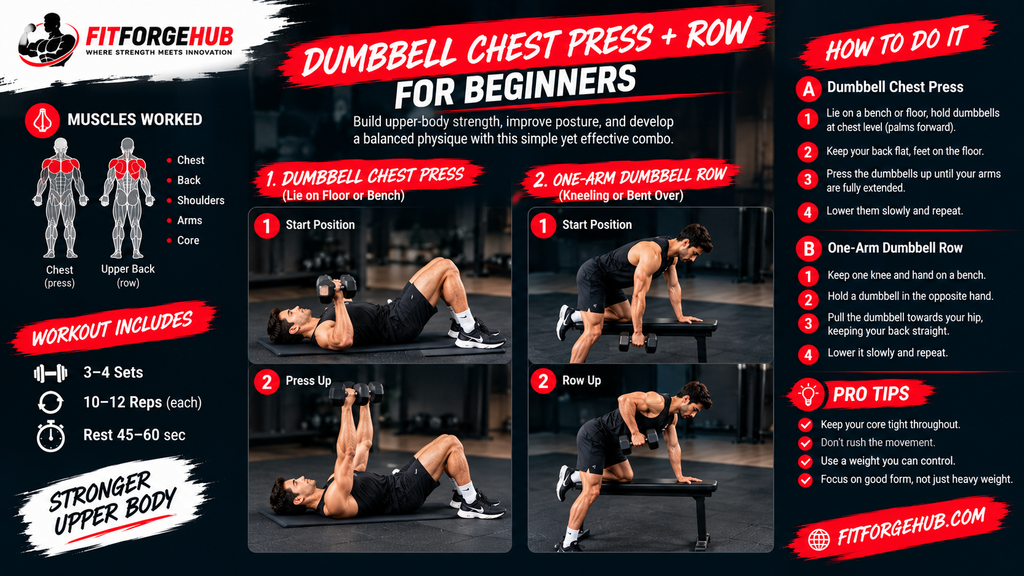
The dumbbell chest press is a fundamental upper-body pushing exercise.
If you don’t have a bench, a dumbbell floor press is a practical alternative.
How to Perform
- Lie on a stable bench or floor.
- Hold a dumbbell in each hand.
- Position the weights above your chest.
- Lower them slowly.
- Keep your elbows in a comfortable position.
- Press the dumbbells upward.
- Repeat.
Sets: 3
Reps: 8–12
For a dedicated chest routine:
Best Dumbbell Chest Workout at Home
4. One Arm Dumbbell Row
The one-arm dumbbell row is a pulling movement that targets the upper back.
How to Perform
- Place one hand on a stable surface if needed.
- Hold the dumbbell with the opposite hand.
- Keep your back in a comfortable position.
- Pull the dumbbell toward your torso.
- Pause briefly.
- Lower it under control.
- Switch sides.
Sets: 3
Reps: 8–12 per side
Don’t use momentum to throw the weight upward.
Focus on controlled movement.
For more back exercises:
Best Dumbbell Back Workout at Home
5. Dumbbell Shoulder Press
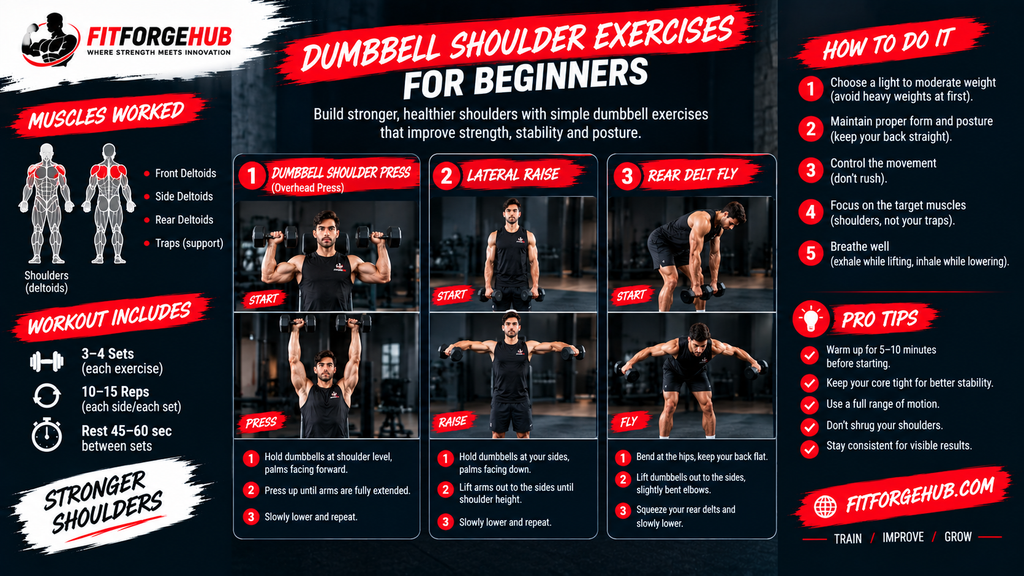
The shoulder press trains the shoulders while also involving the triceps.
How to Perform
- Hold a dumbbell in each hand.
- Bring the dumbbells to shoulder height.
- Brace your core.
- Press the weights upward.
- Lower them slowly.
- Repeat.
Sets: 2
Reps: 8–12
Avoid using excessive weight that causes you to lean backward.
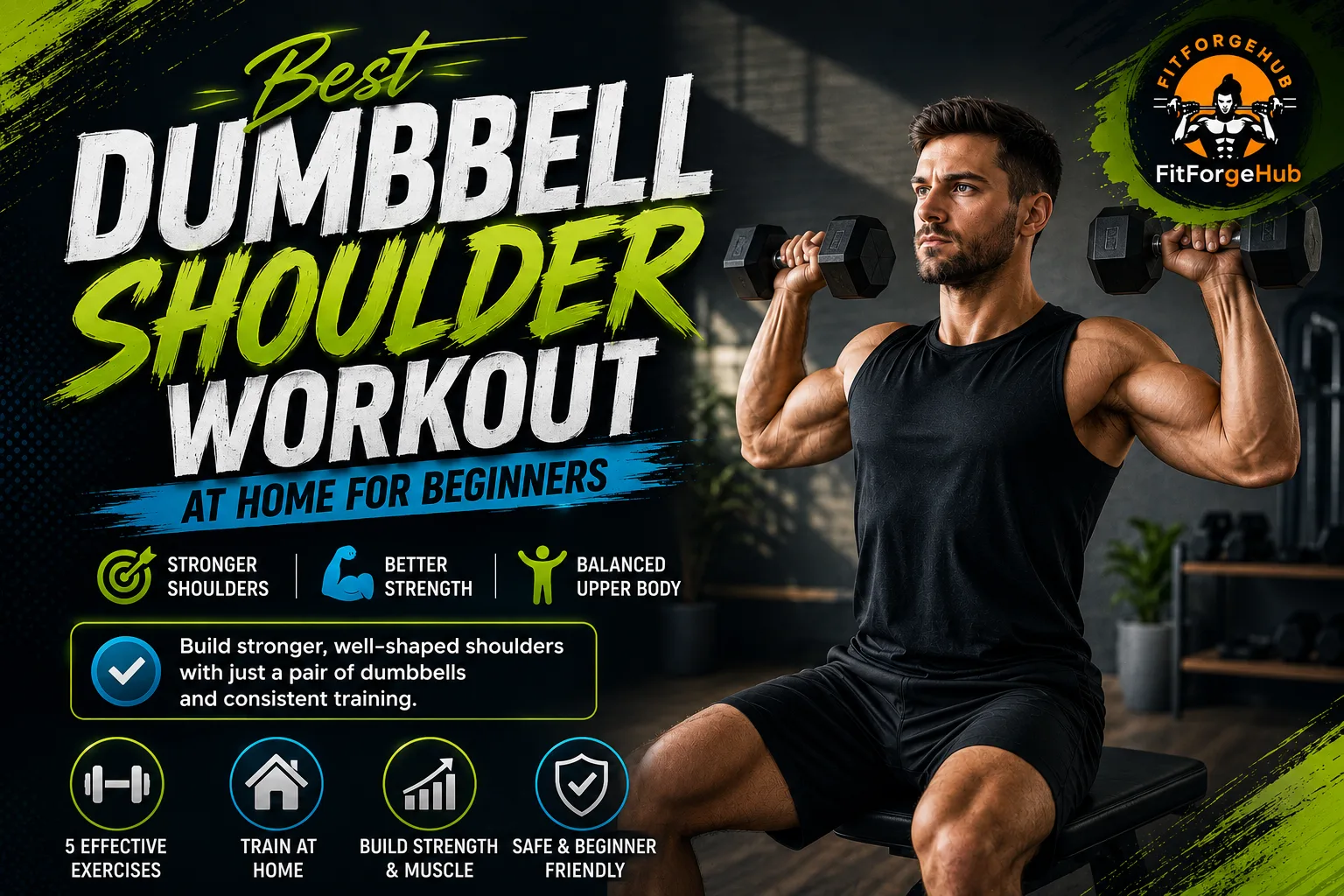
For a complete shoulder routine:
Best Dumbbell Shoulder Workout at Home
6. Dumbbell Lateral Raise
Lateral raises can be used to specifically train the side deltoids.
How to Perform
- Stand upright.
- Hold light dumbbells beside your body.
- Keep a slight bend in your elbows.
- Raise your arms outward.
- Pause briefly.
- Lower them slowly.
Sets: 2
Reps: 10–15
Don’t Go Too Heavy
This is an exercise where beginners often make the mistake of choosing dumbbells that are too heavy.
If you have to swing your entire body, reduce the weight.
7. Dumbbell Biceps Curl
Biceps curls are a straightforward accessory exercise for the upper arms.
How to Perform
- Stand upright.
- Hold dumbbells beside your body.
- Keep your elbows near your torso.
- Curl the weights upward.
- Pause briefly.
- Lower them slowly.
Sets: 2
Reps: 10–15
Keep your torso relatively still throughout the movement.
8. Dumbbell Triceps Extension
The triceps make up a large portion of the upper arm.
A dumbbell triceps extension can be included after your larger compound exercises.
How to Perform
- Hold one dumbbell securely.
- Position it above your head.
- Keep your upper arms relatively stable.
- Bend your elbows.
- Lower the dumbbell behind your head.
- Extend your elbows.
- Repeat.
Sets: 2
Reps: 10–15
Use a manageable weight and don’t force the range of motion.
9. Dumbbell Calf Raise
Calf raises provide direct lower-leg training.
How to Perform
- Stand upright with dumbbells at your sides.
- Keep your feet stable.
- Raise your heels.
- Pause briefly.
- Lower your heels slowly.
- Repeat.
Sets: 2
Reps: 12–20
Avoid bouncing.
Controlled repetitions are the priority.
Complete Beginner Dumbbell Workout Routine
If you’re completely new, you can start with this shorter version.
| Exercise | Sets | Reps |
| Goblet Squat | 3 | 8–12 |
| Romanian Deadlift | 3 | 8–12 |
| Floor Press | 3 | 8–12 |
| One-Arm Row | 3 | 8–12 |
| Shoulder Press | 2 | 8–12 |
This gives you a full-body foundation without making your first workout unnecessarily long.
After 2–4 Weeks
You can gradually add:
- Lateral raises
- Biceps curls
- Triceps extensions
- Calf raises
How Many Days a Week Should Beginners Use Dumbbells?
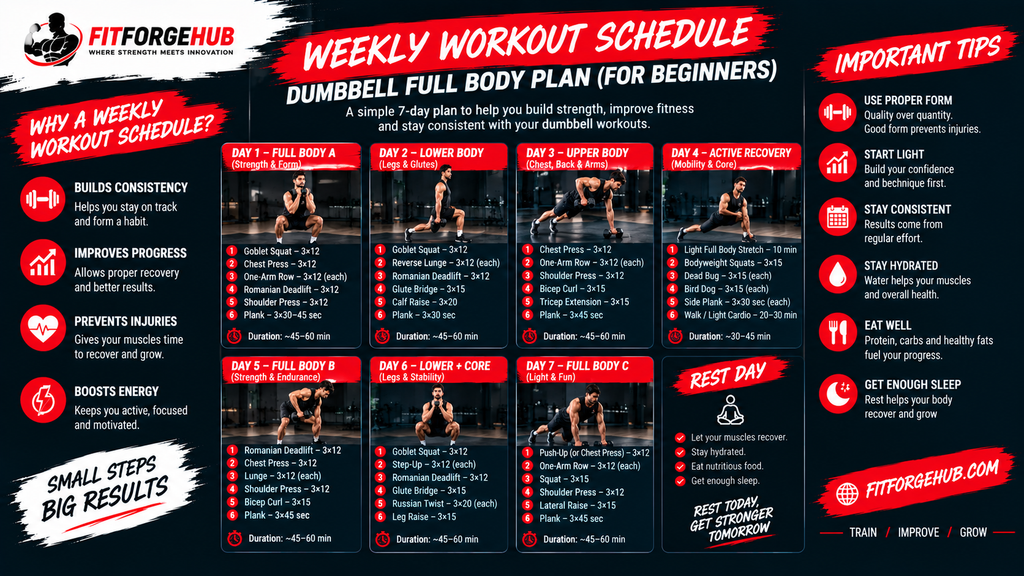
For many beginners, 2–3 strength-training sessions per week are a practical starting point.
One simple schedule is:
| Day | Training |
| Monday | Full Body Dumbbell Workout |
| Tuesday | Rest |
| Wednesday | Full Body Dumbbell Workout |
| Thursday | Rest |
| Friday | Full Body Dumbbell Workout |
| Saturday | Light Activity |
| Sunday | Rest |
The CDC recommends adults perform muscle-strengthening activities on at least two days per week.
Your own schedule should account for your training experience, recovery, and other physical activities.
CDC — Adult Activity Guidelines
How Many Sets and Reps Should Beginners Do?
There’s no single repetition range that every beginner must follow.
For this program, a practical starting point is:
For general physical activity guidance, see the U.S. Physical Activity Guidelines for Americans.
Physical Activity Guidelines for Americans — HHS
Compound Exercises
2–3 sets × 8–12 reps
Examples:
- Squats
- Romanian deadlifts
- Chest press
- Rows
- Shoulder press
Isolation Exercises
2 sets × 10–15 reps
Examples:
- Lateral raises
- Biceps curls
- Triceps extensions
Calves
2 sets × 12–20 reps
The important thing is to use a resistance that makes the set challenging while allowing you to maintain good technique.
How Heavy Should Your Dumbbells Be?
Don’t choose dumbbells simply because someone else uses that weight.
Your starting weight should match your current ability.
For example:
If you’re doing 10–12 reps and your form breaks down at rep 5, the weight is too heavy.
If you can perform 30 repetitions without the set becoming challenging, you may eventually need more resistance.
A Better Approach
Start lighter.
Learn the exercise.
Then gradually increase resistance as your technique improves.
This is particularly important for exercises such as lateral raises and rear-delt movements.
How to Progress With Dumbbells
Muscle and strength improvements require progressive challenge.
You don’t necessarily need to add weight every workout.
You can progress by:
- Adding repetitions
- Increasing weight
- Adding a set
- Improving technique
- Increasing control
- Using a harder variation
Example
Suppose you’re doing:
Goblet Squat — 3 × 8–12
You start with:
8 / 8 / 8
Over time:
10 / 10 / 9
Then:
12 / 12 / 12
Once you can consistently hit the top of your range with good form, you can consider increasing the dumbbell weight.
Then build your repetitions again.
This creates a simple progression system that beginners can actually follow.
How Long Should a Dumbbell Workout Last?
A beginner full-body dumbbell workout can often be completed in roughly 30–60 minutes, depending on:
- Number of exercises
- Sets
- Rest periods
- Training experience
- How quickly you move between exercises
You don’t need to spend two hours exercising to make progress.
A focused workout that you perform consistently is more useful than an extremely long session that you can’t maintain.
Common Beginner Dumbbell Workout Mistakes
1. Using Too Much Weight
Heavy dumbbells can make it difficult to learn proper technique.
Start with manageable resistance.
2. Changing the Workout Every Week
If you constantly change exercises, it becomes harder to measure your progress.
Give your routine enough time to work.
3. Training Every Day
More training isn’t automatically better.
Your body needs recovery.
4. Ignoring the Legs
A complete program should train your lower body as well as your upper body.
5. Doing Only Isolation Exercises
Curls and lateral raises are useful, but beginners should also build their routine around larger movements.
6. Not Tracking Progress
If you don’t record your weights and repetitions, it can be difficult to know whether you’re improving.
Keep a simple workout log.
7. Expecting Immediate Results
Strength and muscle development take time.
Focus on consistency rather than daily changes in the mirror.
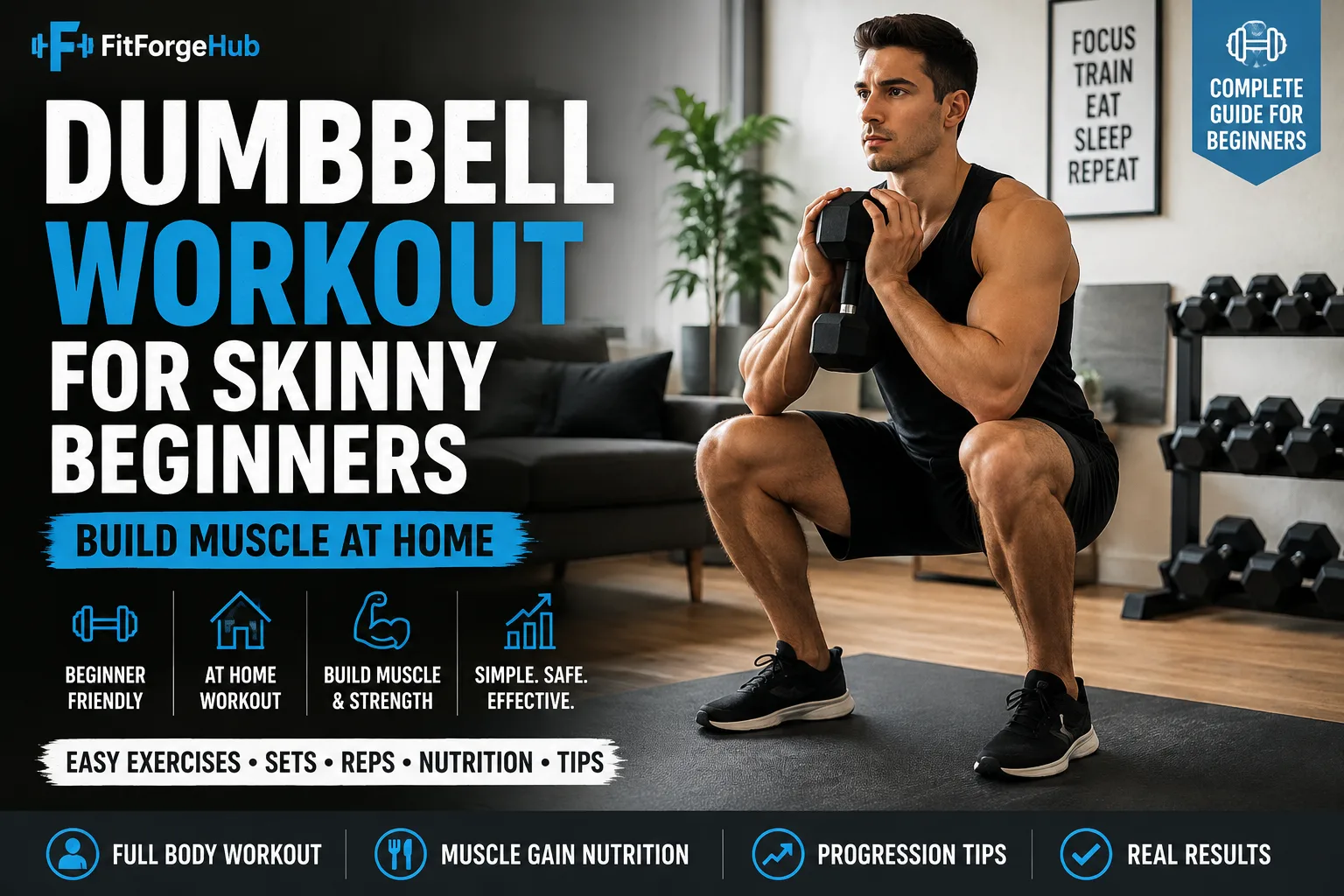
Dumbbell Workout for Skinny Beginners
If you’re naturally thin and your goal is to gain muscle and body weight, your approach needs to include both training and nutrition.
Our dedicated guide:
Dumbbell Workout for Skinny Beginners
covers:
- Full-body exercises
- Sets and reps
- Weekly schedule
- Weight selection
- Nutrition
- Muscle-building progression
The most important point is that training doesn’t replace nutrition.
If you’re trying to gain muscle but consistently don’t eat enough to support your activity, progress may be more difficult.
Nutrition and Recovery
Your workout is only one part of the process.
Protein
Include protein-rich foods such as:
- Eggs
- Chicken
- Fish
- Milk
- Greek yogurt
- Beans
- Lentils
- Lean meat
Carbohydrates
Carbohydrates can provide useful training energy.
Examples include:
- Rice
- Oats
- Potatoes
- Pasta
- Bread
- Fruits
Healthy Fats
Include foods such as:
- Nuts
- Seeds
- Peanut butter
- Avocado
- Olive oil
Sleep and Recovery
Don’t underestimate recovery.
Your training plan should include rest days, and you should aim for consistent, adequate sleep.
If your goal is muscle gain, don’t judge your progress based on one workout or one day of eating.
Look at the bigger picture over several weeks.
Beginner Dumbbell Workout Weekly Schedule
Here’s a simple schedule you can follow.
Monday
Full Body Dumbbell Workout
Tuesday
Rest / Light Activity
Wednesday
Full Body Dumbbell Workout
Thursday
Rest
Friday
Full Body Dumbbell Workout
Saturday
Optional Light Activity
Sunday
Rest
If three workouts are too demanding at first, begin with two sessions per week and build from there.
How to Stay Consistent With Home Workouts
This is one of the most overlooked parts of fitness.
A perfect workout doesn’t help much if you stop doing it after two weeks.
Try these simple strategies.
Keep Your Dumbbells Visible
If your equipment is easy to access, you’re more likely to use it.
Choose Specific Workout Days
Instead of saying “I’ll work out sometime this week,” choose your days.
Track Your Progress
Write down:
- Exercise
- Weight
- Reps
- Sets
Don’t Chase Perfection
Missing one workout doesn’t mean you’ve failed.
Return to your routine at the next opportunity.
Make the Routine Simple
You don’t need a different workout every day.
Consistency beats unnecessary complexity.
Frequently Asked Questions
Is a dumbbell workout enough for beginners?
Yes. Dumbbells can provide resistance for a wide range of exercises that train the major muscle groups.
Can I build muscle with dumbbells at home?
Yes. Consistent resistance training combined with appropriate nutrition and recovery can support muscle growth.
How many days should a beginner train with dumbbells?
Two to three full-body strength sessions per week can be a practical starting point.
What dumbbell weight should a beginner use?
Choose a weight that allows you to perform your target repetitions with controlled technique.
Should I use dumbbells every day?
You don’t need to perform intense resistance training every day. Recovery is part of your training program.
Can I build muscle without a bench?
Yes. You can perform many exercises standing or use floor-based variations such as the dumbbell floor press.
How long should a beginner dumbbell workout last?
Around 30–60 minutes can be enough for many beginner sessions, depending on the workout structure.
How many exercises should I do?
Start with around 4–6 exercises. You can gradually add exercises as your fitness and experience improve.
Is it better to use heavy or light dumbbells?
Use a resistance appropriate for the exercise that allows you to challenge your muscles while maintaining good technique.
How quickly will I see results?
Everyone progresses differently. Your results depend on training consistency, nutrition, recovery, genetics, starting point, and other factors.
Do I need supplements to build muscle?
No. Supplements aren’t required for everyone. A balanced diet can provide the nutrients needed for training and recovery.
What if an exercise causes pain?
Stop the movement if it causes significant or unusual pain. If you have an injury or persistent symptoms, seek advice from a qualified healthcare professional.
Final Thoughts
You don’t need a complicated gym membership to begin strength training.
A pair of dumbbells can give you enough options to train your whole body at home.
Start with the basics:
Squat. Hinge. Push. Pull. Press.
Then add smaller exercises for your shoulders and arms as you become more comfortable.
Most importantly, don’t try to transform your body in a week.
Build a routine you can actually follow.
Train consistently, record your progress, eat appropriately for your goal, recover properly, and gradually make your workouts more challenging.
That’s the foundation of a sustainable fitness routine.
If you’re following the FitForgeHub beginner series, use the individual guides below to dive deeper into each muscle group:
- Full Body Dumbbell Workout for Beginners
- Best Dumbbell Chest Workout at Home
- Best Dumbbell Back Workout at Home
- Best Dumbbell Leg Workout for Beginners
- Best Dumbbell Shoulder Workout at Home
- Dumbbell Workout for Skinny Beginners
This page should serve as your main beginner dumbbell guide, while the individual articles provide more detail about each workout.
About the Author
Riaz Ahmed holds a Master’s degree in Health and Physical Education and is the founder of FitForgeHub, where he shares practical fitness and workout information.
Website: FitForgeHub.com
Disclaimer
The information published on FitForgeHub is intended for general educational purposes and isn’t medical advice. Exercise needs and fitness goals vary between individuals. If you have an injury, medical condition, or concerns about starting a new exercise program, consult an appropriately qualified healthcare professional before beginning a new workout routine.