Author: FitForgeHub Editorial Team
Last Updated: August 17, 2026
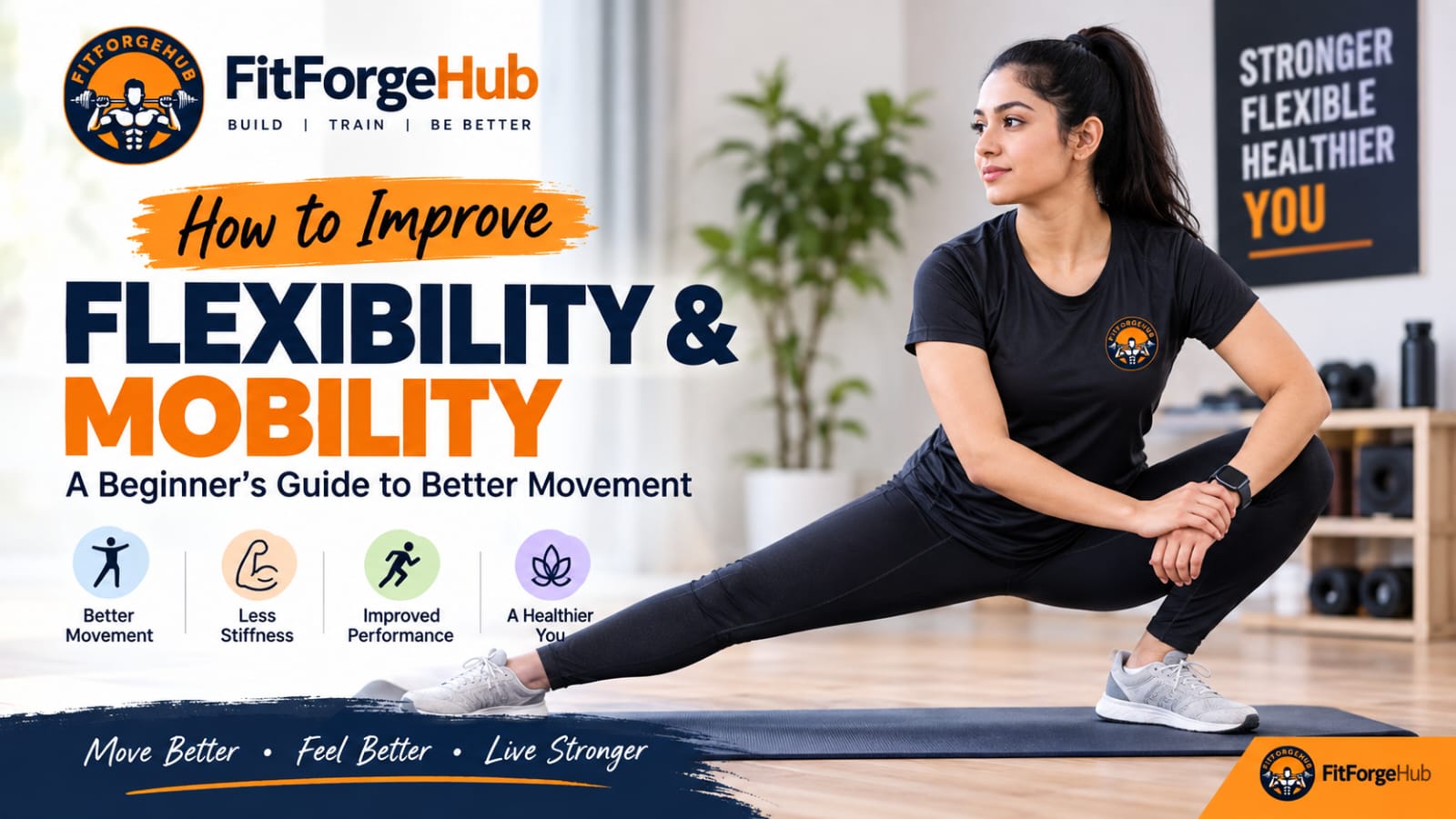
Flexibility and mobility are important parts of overall fitness, but many beginners overlook them. You may be strong enough to lift weights or active enough to exercise regularly, yet limited mobility can make certain workouts and everyday movements more difficult.
The good news is that you do not need expensive equipment to improve your flexibility and mobility. With consistent stretching, mobility exercises, proper technique, and a few minutes of daily practice, you can gradually improve how your body moves.
In this beginner-friendly guide, you’ll learn how to improve flexibility and mobility, the difference between flexibility and mobility, the best exercises to try at home, common mistakes to avoid, and a simple 10-minute routine.
Table of Contents
- What Is Flexibility?
- What Is Mobility?
- Why Are Flexibility and Mobility Important?
- Best Flexibility and Mobility Exercises for Beginners
- A Simple 10-Minute Mobility Routine
- Should You Stretch Before or After a Workout?
- How Often Should You Work on Flexibility and Mobility?
- Common Mistakes to Avoid
- How Long Does It Take to Improve Flexibility?
- Tips for Better Flexibility and Mobility
- Frequently Asked Questions
- Final Thoughts
- About the Author
What Is Flexibility?
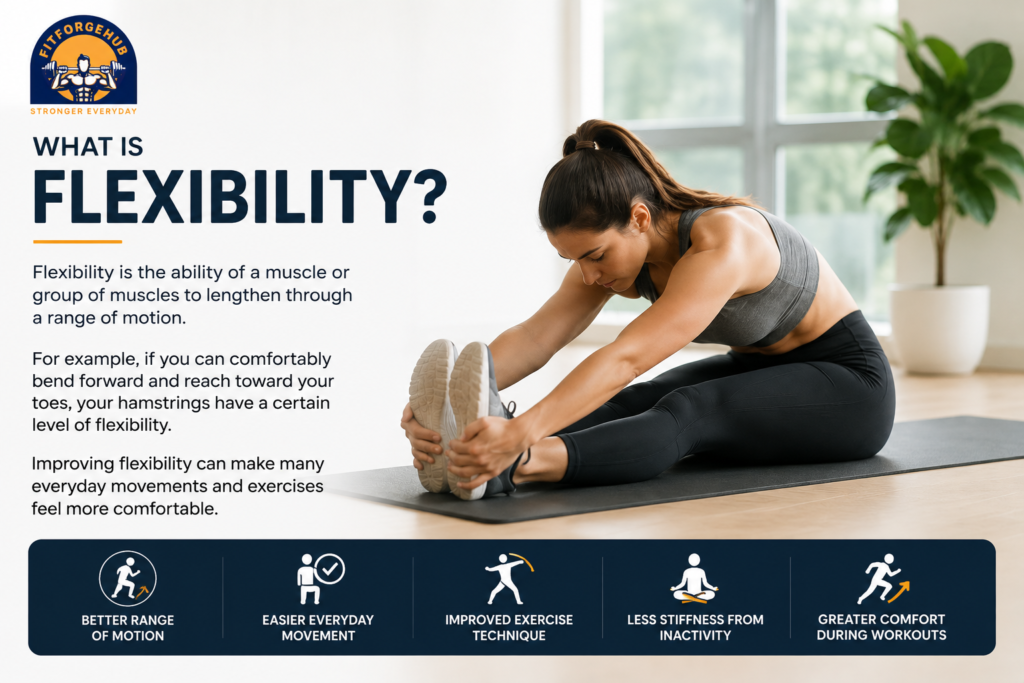
Flexibility is the ability of a muscle or group of muscles to lengthen through a range of motion.
For example, if you can comfortably bend forward and reach toward your toes, your hamstrings have a certain level of flexibility.
Flexibility can vary from person to person because of factors such as age, activity level, genetics, previous injuries, and daily habits.
Improving flexibility can make many everyday movements and exercises feel more comfortable.
Regular stretching can help improve flexibility and joint range of motion.
What Is Mobility?
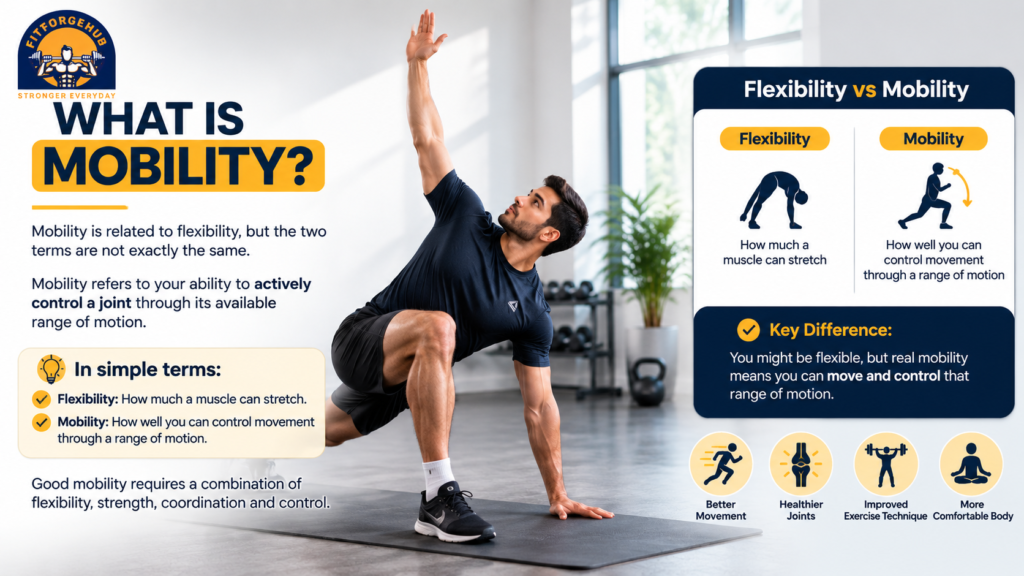
Mobility is related to flexibility, but the two terms are not exactly the same.
Mobility refers to your ability to actively control a joint through its available range of motion.
For example, someone may have flexible shoulders but still have poor shoulder mobility if they cannot control that range of motion properly.
In simple terms:
- Flexibility: How much a muscle can stretch.
- Mobility: How well you can control movement through a range of motion.
Good mobility requires a combination of flexibility, strength, coordination, and control.
Why Are Flexibility and Mobility Important?
Improving flexibility and mobility can support better movement and make physical activities more comfortable.
Potential benefits include:
- Better range of motion
- Easier everyday movement
- Improved exercise technique
- Better body awareness
- Less stiffness from inactivity
- Improved movement quality
- Greater comfort during workouts
- Better ability to perform certain exercises
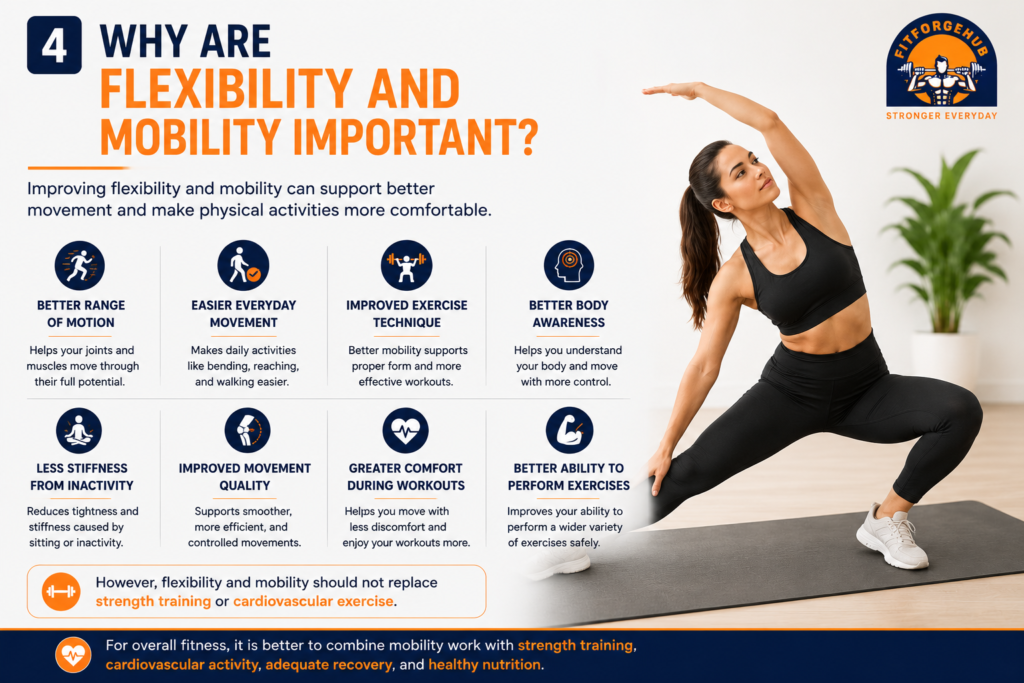
However, flexibility and mobility should not replace strength training or cardiovascular exercise.
For overall fitness, it is better to combine mobility work with strength training, cardiovascular activity, adequate recovery, and healthy nutrition.
If your goal also includes building muscle at home, you can combine mobility work with a structured strength routine.
Best Flexibility and Mobility Exercises for Beginners
You can perform many effective mobility and stretching exercises at home without equipment.
Start slowly and focus on controlled movements instead of forcing your body into a position.
1. Cat-Cow Stretch
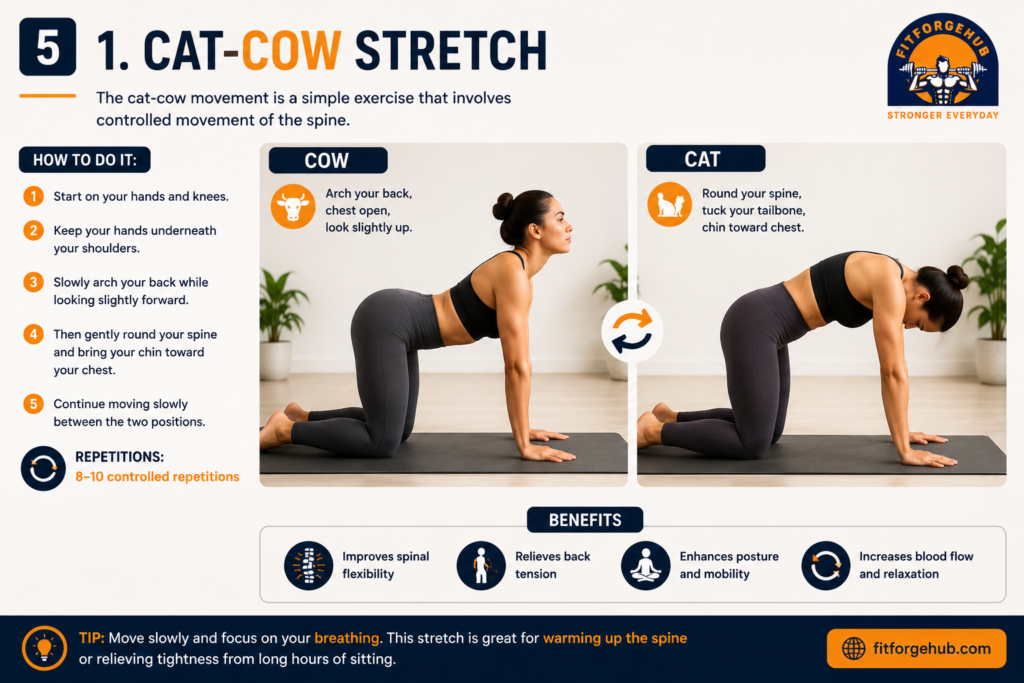
The cat-cow movement is a simple exercise that involves controlled movement of the spine.
How to do it:
- Start on your hands and knees.
- Keep your hands underneath your shoulders.
- Slowly arch your back while looking slightly forward.
- Then gently round your spine and bring your chin toward your chest.
- Continue moving slowly between the two positions.
Repetitions: 8–10 controlled repetitions.
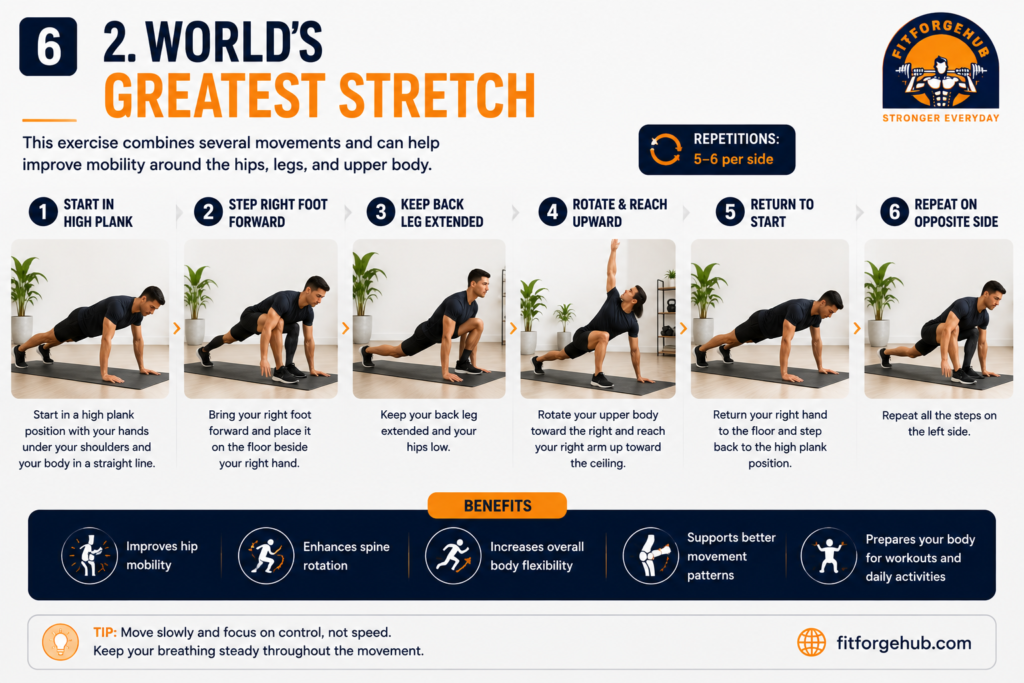
2. World’s Greatest Stretch
This exercise combines several movements and can help improve mobility around the hips, legs, and upper body.
How to do it:
- Start in a high plank position.
- Bring your right foot forward beside your right hand.
- Keep your back leg extended.
- Rotate your upper body and reach your right arm toward the ceiling.
- Return to the starting position.
- Repeat on the opposite side.
Repetitions: 5–6 per side.
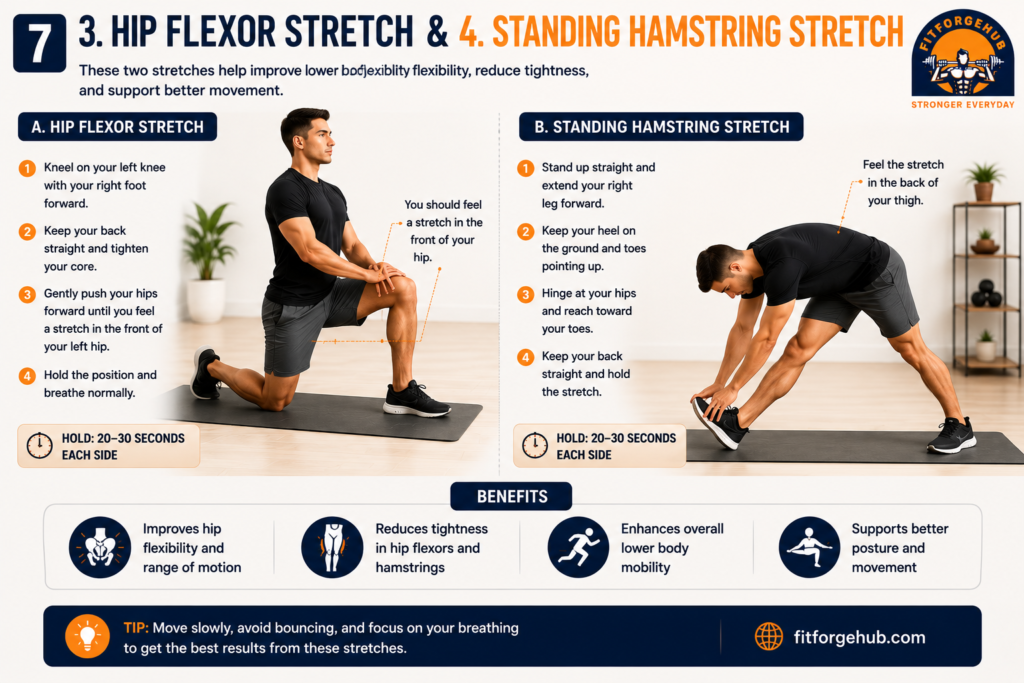
3. Hip Flexor Stretch
Hip flexor stretches can be useful for people who spend a lot of time sitting.
How to do it:
- Kneel with one knee on the floor.
- Place the opposite foot in front of you.
- Keep your chest upright.
- Gently move your hips forward.
- Hold the stretch comfortably.
- Switch sides.
Hold: 20–30 seconds per side.
4. Standing Hamstring Stretch
This simple stretch targets the muscles at the back of your thighs.
How to do it:
- Stand with your feet about hip-width apart.
- Place one heel slightly forward.
- Keep the extended leg relatively straight.
- Hinge forward from your hips.
- Stop when you feel a comfortable stretch.
- Repeat on the other side.
Avoid aggressively pulling yourself toward your toes.
5. Child’s Pose
Child’s pose is a gentle movement that can help stretch several areas while allowing you to relax.
How to do it:
- Start on your hands and knees.
- Slowly move your hips toward your heels.
- Extend your arms forward.
- Relax your shoulders.
- Breathe normally.
- Hold the position comfortably.
Hold: 20–40 seconds.
6. Ankle Mobility Exercise
Ankle mobility is useful for movements such as squats, walking, running, and climbing stairs.
How to do it:
- Stand facing a wall.
- Place one foot a short distance away from the wall.
- Keep your heel on the floor.
- Slowly move your knee toward the wall.
- Return to the starting position.
- Repeat and then switch sides.
Repetitions: 8–12 per side.
7. Shoulder Circles
Shoulder circles are simple and can be performed almost anywhere.
How to do it:
- Stand tall with your arms relaxed.
- Slowly move your shoulders forward, upward, backward, and down.
- Make controlled circles.
- Repeat in the opposite direction.
Repetitions: 8–10 circles in each direction.
A Simple 10-Minute Mobility Routine
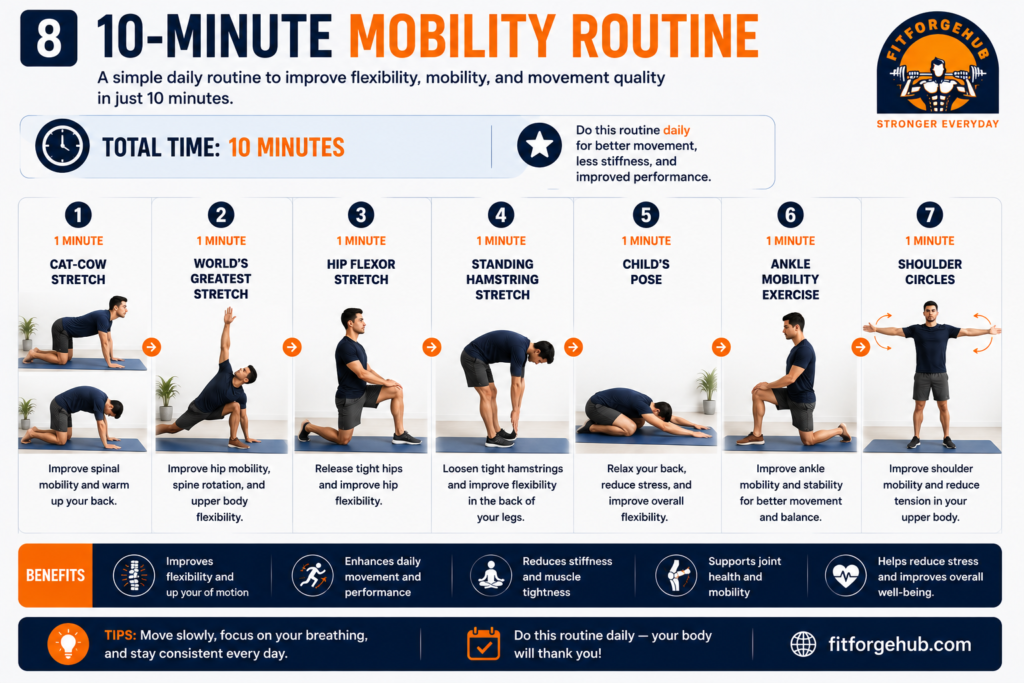
If you are new to mobility training, you do not need a complicated program.
Try this simple routine:
| Exercise | Time |
| Shoulder Circles | 1 minute |
| Cat-Cow | 1 minute |
| Hip Flexor Stretch | 2 minutes |
| Hamstring Stretch | 2 minutes |
| Ankle Mobility | 2 minutes |
| Child’s Pose & Breathing | 2 minutes |
| Total | 10 minutes |
You can perform this routine in the morning, after a workout, or during a break from prolonged sitting.
The most important thing is consistency.
Should You Stretch Before or After a Workout?
The type of stretching you use can depend on when you are exercising.
Before a Workout
Before exercise, dynamic movements can help prepare your body for activity.
Examples include:
- Arm circles
- Leg swings
- Walking lunges
- Controlled bodyweight movements
- Light cardio
Start with easy movements and gradually increase the intensity.
After a Workout
After training, you can include gentle static stretches if they feel comfortable.
A simple approach is:
Before exercise: Warm up and use dynamic movements.
After exercise: Cool down and use gentle stretches.
You do not need to spend a very long time stretching before every workout. Consistency is more important than making every session lengthy.
How Often Should You Work on Flexibility and Mobility?
Beginners can start with 5–10 minutes of mobility or flexibility work most days of the week.
You can also include longer sessions two or three times per week if your schedule allows.
Your progress will depend on several factors, including your starting level, activity habits, age, consistency, and individual body structure.
Avoid trying to force rapid progress. Gradual improvement is usually more sustainable.
Common Mistakes to Avoid
1. Stretching Too Aggressively
Stretching should generally create mild tension rather than sharp or severe pain.
Do not force your body into uncomfortable positions.
2. Holding Your Breath
Try to breathe normally during stretches.
Slow and relaxed breathing can help you remain comfortable and focused.
3. Expecting Instant Results
Flexibility does not usually change dramatically after one session.
Consistent practice over time is more important than trying to achieve fast results.
4. Ignoring Strength
Mobility is not only about stretching.
Strength and control are also important because your body needs to control the range of motion you have.
5. Sitting for Long Periods Without Moving
Long periods of inactivity can make you feel stiff.
Try taking short movement breaks throughout the day.
How Long Does It Take to Improve Flexibility?
There is no single timeline that works for everyone.
Some people may notice that certain movements feel easier after several weeks of consistent practice, while more significant improvements can take longer.
Your goal should not simply be to become extremely flexible.
Instead, focus on developing comfortable movement, control, and a useful range of motion that supports your everyday activities and fitness goals.
Tips for Better Flexibility and Mobility
Follow these simple tips to make your routine more effective:
- Practice consistently.
- Move slowly and with control.
- Avoid bouncing during static stretches.
- Breathe normally.
- Focus on proper technique.
- Work both sides of your body.
- Include mobility exercises as well as stretching.
- Combine mobility work with strength training.
- Stay active throughout the day.
- Take movement breaks if you sit for long periods.
- Increase difficulty gradually.
- Stop if an exercise causes sharp or unusual pain.
Frequently Asked Questions
Can I improve flexibility at home?
Yes. Many flexibility and mobility exercises can be performed at home without equipment. A small amount of floor space is enough for many beginner exercises.
Many flexibility and mobility exercises can be performed at home without equipment, just like beginner-friendly home workouts.
How many minutes should I stretch every day?
Beginners can start with around 5–10 minutes per day. You can gradually increase the duration as your routine becomes easier to maintain.
Is stretching good for beginners?
Yes. Beginners can include gentle stretching and mobility exercises in their fitness routines. The key is to use proper technique and avoid forcing painful ranges of motion.
Can flexibility improve posture?
Flexibility and mobility can support comfortable movement and positioning, but posture is influenced by many factors, including strength, daily habits, workstation setup, and individual anatomy.
Should I stretch every day?
Gentle flexibility and mobility work can be included regularly. However, the exercises and intensity should match your fitness level and recovery needs.
Can mobility exercises help with workouts?
Mobility exercises can help you practice controlled movement through a range of motion and may make certain exercises easier to perform correctly. They work best as part of a balanced fitness program.
Final Thoughts
Learning how to improve flexibility and mobility does not require expensive equipment or a complicated workout program.
Simple exercises such as cat-cow, hip flexor stretches, hamstring stretches, shoulder circles, and ankle mobility drills can easily be added to your daily routine.
The key is consistency.
Start with just 5–10 minutes, focus on controlled movements, and gradually build your routine over time.
Better mobility can help you move more comfortably and support your overall fitness journey. Make flexibility and mobility a regular part of your lifestyle rather than something you only do occasionally.
Start small, stay consistent, and improve your movement step by step.
About the Author
FitForgeHub Editorial Team
FitForgeHub Editorial Team creates beginner-friendly fitness and wellness content designed to make exercise, nutrition, workouts, and healthy lifestyle habits easier to understand.
Our content focuses on practical, easy-to-follow information for people who want to improve their fitness and build healthier daily habits.
Editorial Note: This article is for general educational purposes and is not a substitute for individualized medical or professional advice. If you have an injury, persistent pain, or a medical condition, consult an appropriately qualified healthcare professional before starting a new exercise routine.