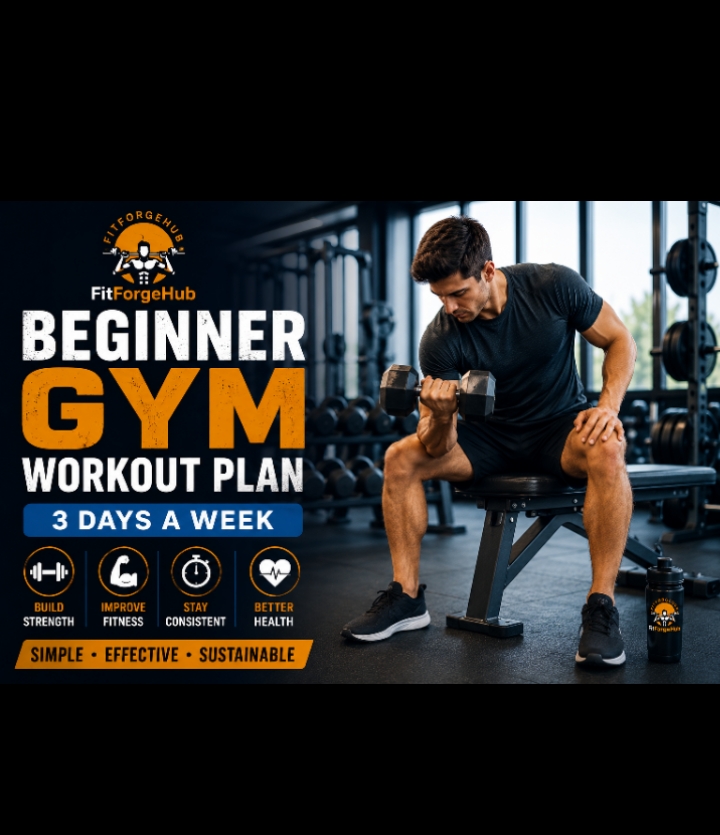
Starting your first gym workout can feel confusing, especially if you are not sure which exercises to do, how often to train, or how much weight to use.
This 3-day beginner gym workout plan gives you a simple full-body routine you can follow on Monday, Wednesday, and Friday. It combines beginner-friendly machine, cable, and dumbbell exercises to train your major muscle groups while allowing recovery between workouts.
In this guide, you’ll learn exactly what to do on each training day, how many sets and reps to perform, how much weight to use, how long to rest, and how to progress as a beginner.
If you prefer training at home with dumbbells instead of gym machines, see our [complete dumbbell workout guide for beginners].
Important: This article is for general fitness and educational purposes. If you have an injury, medical condition, or are unsure whether exercise is appropriate for you, speak with a qualified healthcare professional before starting a new exercise program.
If you’re completely new to the gym, our First Month Gym Starter Guide can help you understand what to expect during your first few weeks.
Table of Contents
- Why a 3-Day Gym Workout Plan Is Good for Beginners
- Beginner Gym Workout Schedule
- How to Warm Up Before a Beginner Gym Workout
- Workout A: Full Body Beginner Gym Workout
- Workout B: Full Body Beginner Gym Workout
- Full Body Beginner Gym Workout
- How to Follow This Beginner Gym Workout Plan
- How Much Weight Should a Beginner Lift?
- How Long Should a Beginner Gym Workout Take?
- How Long Should You Rest Between Sets?
- How to Progress as a Beginner
- Common Beginner Gym Mistakes
- Beginner Gym Workout Tips
- Frequently Asked Questions
- Final Thoughts
Why a 3-Day Gym Workout Plan Is Good for Beginners
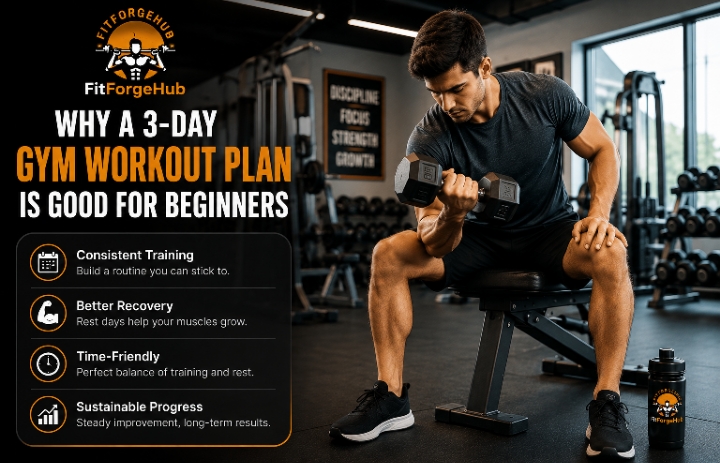
When you’re new to resistance training, consistency is more important than having an advanced program.
Training three days per week gives you regular opportunities to practice the basic movements without requiring you to spend every day at the gym.
For example, you could train on Monday, Wednesday, and Friday, leaving rest days between your workouts.
This also makes the routine easier to fit around work, study, family, or other responsibilities.
Current physical-activity guidance recommends muscle-strengthening activity on at least two days per week for adults, while the exact training schedule can be adjusted according to your goals and circumstances.
If you’re completely new to fitness, you can also follow our 30-Day Beginner Workout Plan for a structured routine.
Beginner Gym Workout Schedule
Here’s a simple weekly schedule:
| Day | Workout |
| Monday | Workout A |
| Tuesday | Rest |
| Wednesday | Workout B |
| Thursday | Rest |
| Friday | Workout A |
| Saturday | Rest |
| Sunday | Rest |
The following week, simply switch the order:
| Day | Workout |
| Monday | Workout B |
| Tuesday | Rest |
| Wednesday | Workout A |
| Thursday | Rest |
| Friday | Workout B |
| Saturday | Rest |
| Sunday | Rest |
This alternating approach allows you to practice both workouts regularly.
Beginner tip: Don’t feel that you have to train six or seven days a week to make progress. A routine that you can consistently follow is much more useful than an aggressive routine that you abandon after two weeks.
How to Warm Up Before a Beginner Gym Workout
Before each workout, spend about 5–10 minutes preparing your body for exercise. Start with light cardio such as walking or cycling, followed by a few controlled movements for the joints and muscles you will train.
You can also perform one or two lighter warm-up sets before your first major exercise. The goal is to prepare for the workout rather than fatigue yourself before the main sets.
Workout A: Full Body Beginner Gym Workout
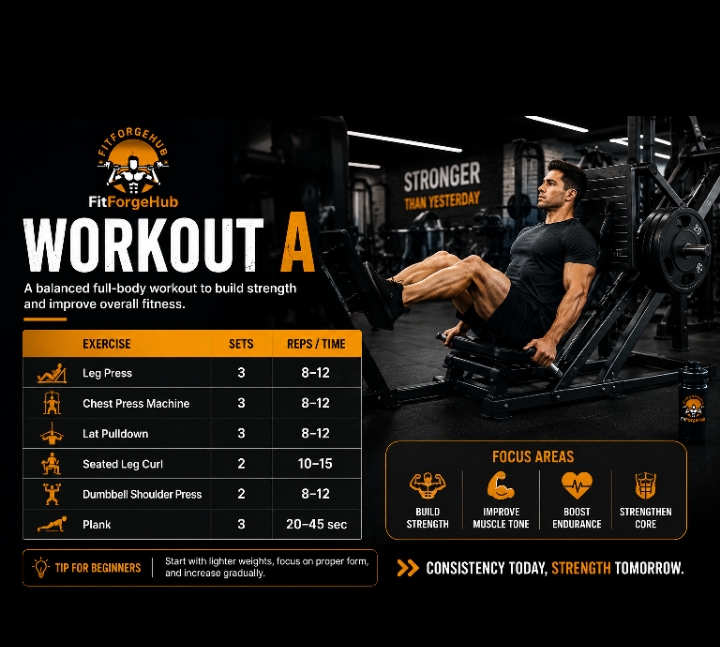
| Exercise | Sets | Reps | Rest |
|---|---|---|---|
| Leg Press | 3 | 8–12 | 2 min |
| Chest Press Machine | 3 | 8–12 | 1–2 min |
| Lat Pulldown | 3 | 8–12 | 1–2 min |
| Seated Leg Curl | 2 | 10–15 | 1–2 min |
| Dumbbell Shoulder Press | 2 | 8–12 | 1–2 min |
| Plank | 3 | 20–45 sec | 30–60 sec |
1. Leg Press
The leg press is a practical exercise for beginners because the machine provides support while you learn how to train your lower body.
It mainly works the muscles of your legs, including the quadriceps and glutes.
Start with a weight that allows you to perform the movement comfortably and maintain control throughout each repetition.
Don’t make the common beginner mistake of loading the machine with too much weight just because someone else is lifting heavy. Your first goal should be learning the movement.
2. Chest Press Machine
The chest press machine trains your chest, shoulders, and triceps.
Adjust the seat so that the handles are positioned comfortably around chest level.
Push the handles forward in a controlled manner and return them without allowing the weight to slam back into the machine.
If you’re new to resistance training, a machine can be easier to learn than jumping straight into heavy free-weight exercises.
3. Lat Pulldown
The lat pulldown is a good exercise for developing your upper-back muscles while also involving your arms.
Sit securely, keep your torso relatively stable, and pull the bar toward your upper chest.
Avoid swinging your entire body to move the weight.
A useful beginner habit is to concentrate on feeling the muscles doing the work rather than simply moving the weight from one position to another.
4. Seated Leg Curl
The seated leg curl focuses mainly on the muscles at the back of your thighs.
Keep the movement controlled and avoid using momentum.
You don’t need a very heavy weight here. A lighter weight that you can control properly is usually a better starting point.
5. Dumbbell Shoulder Press
The dumbbell shoulder press works your shoulders and also involves your triceps.
Choose relatively light dumbbells when you’re learning the exercise.
Keep your movements controlled and avoid turning the exercise into a full-body movement by swinging the weights.
6. Plank
The plank is a simple exercise for training your core.
Start with a duration that you can maintain while keeping good body position.
If holding a plank for 45 seconds is too difficult, start with 15–20 seconds and gradually build up.
Quality matters more than the stopwatch.
Workout B: Full Body Beginner Gym Workout
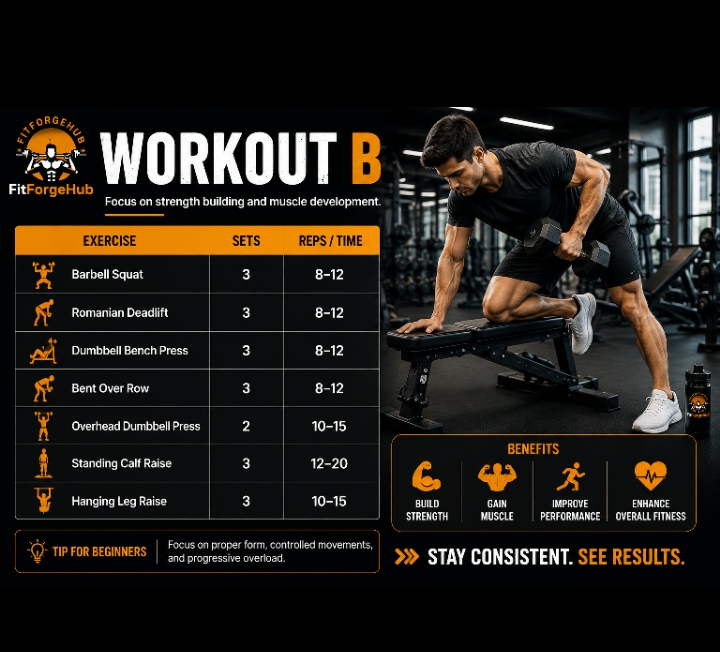
| Exercise | Sets | Reps |
| Goblet Squat | 3 | 8–12 |
| Seated Cable Row | 3 | 8–12 |
| Incline Dumbbell Press | 3 | 8–12 |
| Romanian Deadlift | 2 | 8–12 |
| Dumbbell Lateral Raise | 2 | 10–15 |
| Dead Bug | 3 | 8–12 per side |
1. Goblet Squat
The goblet squat is a useful way for beginners to practice the basic squat movement.
Hold a dumbbell close to your chest and squat down while keeping control of your body.
If you’ve never performed a squat before, practice the movement without weight first.
Once your technique feels comfortable, you can gradually introduce a light dumbbell.
2. Seated Cable Row
The seated cable row trains your upper and middle back.
Sit upright, keep your chest reasonably open, and pull the handle toward your torso.
Try not to jerk the cable or lean excessively backward to move more weight.
Think about pulling with control rather than trying to finish the set as quickly as possible.
3. Incline Dumbbell Press
The incline dumbbell press works your chest, shoulders, and triceps.
Use a manageable weight and concentrate on controlling both the lifting and lowering phases.
If you’re struggling to keep the dumbbells stable, reduce the weight.
4. Romanian Deadlift
The Romanian deadlift trains the hamstrings and glutes and teaches an important hip-hinge movement.
For beginners, technique should come before weight.
Start very light and learn how to move from the hips while keeping control of your posture.
If you’re unsure about the movement, ask a qualified gym trainer to demonstrate and check your technique.
5. Dumbbell Lateral Raise
Lateral raises are commonly used to train the shoulder muscles.
Use light dumbbells and avoid swinging your body to lift them.
This is one of those exercises where lighter weight and controlled repetitions can be much more useful than trying to lift heavy.
6. Dead Bug
The dead bug is a beginner-friendly core exercise that challenges you to keep your trunk controlled while moving your arms and legs.
Move slowly and focus on maintaining control.
If you find the full movement difficult, reduce the range of motion until you can perform it comfortably.
How to Follow This Beginner Gym Workout Plan
Follow this beginner gym workout plan three days per week, such as Monday, Wednesday, and Friday. Start each workout with a short warm-up, then complete the exercises in the order listed. Use a weight that allows you to maintain good form throughout your target repetitions.
Rest between training days and avoid adding extra exercises simply because you feel you need to do more. For beginners, consistency and gradually improving your performance are more important than doing a high volume of exercises.
How Much Weight Should a Beginner Lift?
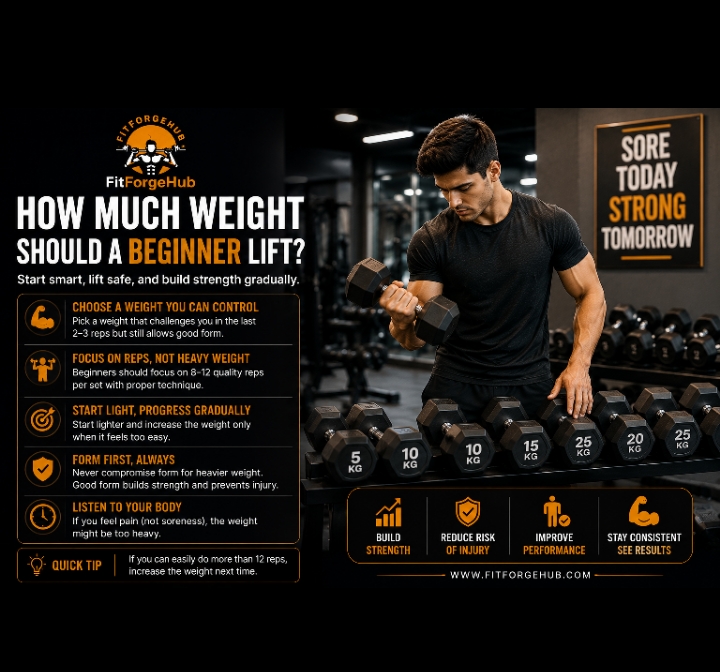
There isn’t one perfect starting weight for every beginner.
The appropriate weight depends on your current fitness level, training experience, technique, and the exercise you’re performing.
A simple rule is:
Choose a weight that allows you to complete your target repetitions with good technique and control.
If your form starts breaking down badly before you finish the set, reduce the weight.
On the other hand, if the final repetitions feel extremely easy and you could comfortably perform many more repetitions, you may be ready to gradually increase the resistance.
The goal isn’t to find the heaviest weight you can lift on your first day.
The goal is to become stronger over time.
Current resistance-training guidance emphasizes tailoring load and training volume to the individual rather than relying on one universal program.
How Long Should a Beginner Gym Workout Take?
A beginner doesn’t need to spend two or three hours in the gym.
Depending on your warm-up, rest periods, and pace, this type of workout may take roughly 45–60 minutes.
Don’t worry if your first few workouts take longer because you’re learning where the equipment is or figuring out how to adjust machines.
As you become familiar with the gym, your workouts will naturally become more efficient.
Your goal should be a productive workout—not simply spending the maximum possible amount of time inside the gym.
How Long Should You Rest Between Sets?
Rest time depends on the exercise, your fitness level, and how difficult the set was.
As a simple starting point:
| Exercise Type | Suggested Rest |
| Larger compound exercises | 1–3 minutes |
| Smaller exercises | 1–2 minutes |
| Core exercises | 30–90 seconds |
These aren’t strict rules.
If you need additional recovery before performing the next set safely and with good technique, take more time.
There is no prize for rushing through your workout.
How to Progress as a Beginner
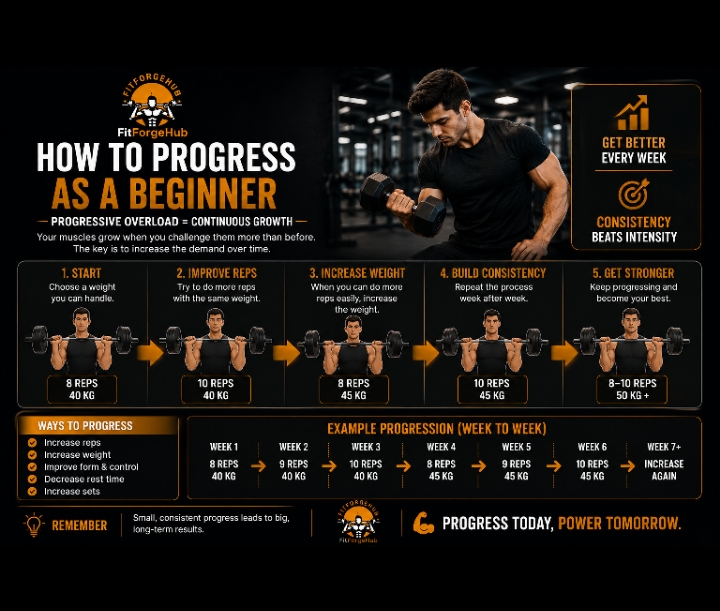
One of the biggest questions beginners ask is:
“When should I increase the weight?”
You don’t necessarily need to increase the weight every workout.
Instead, try to gradually improve your performance.
For example:
Week 1:
3 sets × 8 reps
Week 2:
3 sets × 9 reps
Week 3:
3 sets × 10 reps
Once you’re comfortably reaching the higher end of your target repetition range with good technique, you can consider a small increase in resistance.
Then you may return toward the lower end of the repetition range and build up again.
This is a simple form of progressive overload.
The important thing is that the challenge increases gradually over time rather than trying to make huge jumps from one workout to the next.
Common Beginner Gym Mistakes
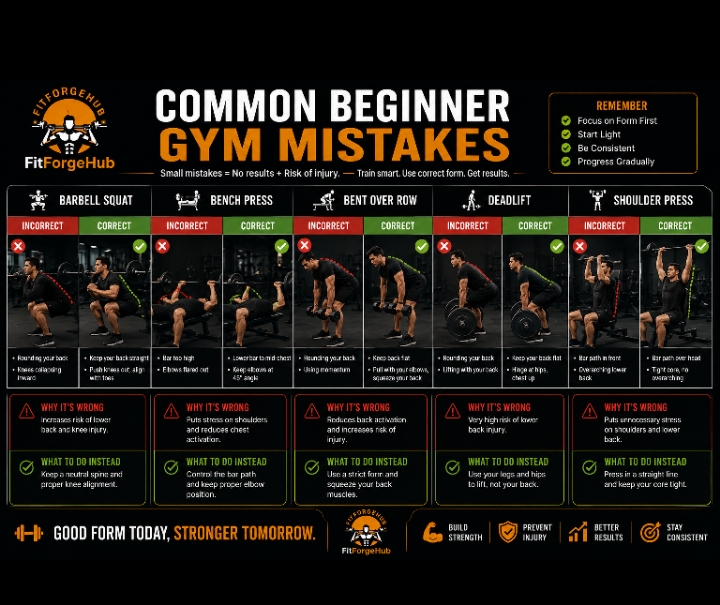
1. Trying to Lift Too Much Weight
This is probably one of the most common mistakes new gym members make.
Seeing someone else lifting heavy doesn’t mean you need to match them.
Start at your own level and focus on learning proper technique.
2. Skipping the Warm-Up
A short warm-up can help you prepare for your workout.
You can begin with a few minutes of light activity and then perform lighter warm-up sets for the exercises you’re about to do.
You don’t need an unnecessarily long warm-up, but going from sitting at a desk directly into your heaviest set isn’t a great habit.
3. Changing Your Workout Every Week
Beginners sometimes believe they need a new workout every few days.
You don’t.
Repeating the same basic movements gives you the opportunity to improve your technique and track your progress.
4. Training Hard Every Day
More isn’t always better.
Your body needs time to recover between demanding training sessions.
That’s one reason this plan includes rest days between workouts.
5. Ignoring Nutrition and Sleep
Your workout is only one part of the picture.
Your overall routine also includes:
- Nutrition
- Hydration
- Sleep
- Recovery
- Daily activity
If your goal is muscle gain, you may also want to read our [What to Eat Before and After Workout for Muscle Gain] guide.
6. Comparing Yourself With Other People
This is an underrated mistake.
Someone at the gym may have been training for five years while you’re on your fifth day.
Don’t compare your chapter one with someone else’s chapter twenty.
Track your own weights, repetitions, technique, and consistency.
Beginner Gym Workout Tips
Before you start following this routine, keep these simple points in mind:
- Start with manageable weights.
- Learn the correct technique before increasing resistance.
- Keep a record of your workouts.
- Increase resistance gradually.
- Give yourself adequate recovery.
- Stay hydrated.
- Get enough sleep.
- Don’t compare your progress with other gym members.
- Be consistent rather than trying to be perfect.
- Stop an exercise if you experience unusual or significant pain.
One of the easiest ways to stay consistent is to write down your workout after each session.
For example:
Leg Press — 40 kg — 3 × 10
Next time, you have an actual record to compare against instead of trying to remember what you did last week.
Frequently Asked Questions
Is 3 days a week enough for a beginner at the gym?
Yes. Three days per week can be a practical starting point for beginners. It gives you regular resistance-training sessions while leaving recovery days between workouts.
The exact schedule should depend on your goals, fitness level, and ability to recover.
Should beginners train every day?
No. Beginners don’t need to train every day.
Rest and recovery are important parts of a training routine. A consistent three-day plan can be more sustainable than trying to exercise intensely every day.
How long should a beginner workout at the gym?
Many beginners can complete a structured workout in approximately 45–60 minutes, although the actual time will vary.
Don’t focus too much on the clock. Focus on completing your exercises with good technique.
Should I do cardio before or after weights?
It depends on your main goal.
If strength training is your priority, you may prefer to perform your resistance workout before a longer cardio session.
You can also include light cardio as part of your warm-up.
How quickly can a beginner see results?
Results are different for everyone.
Your progress can be influenced by your training consistency, nutrition, sleep, recovery, starting fitness level, and individual characteristics.
Instead of expecting dramatic changes within a few days, look for smaller signs of progress such as improved technique, increased strength, better exercise tolerance, or greater consistency.
Can I use this workout plan for muscle gain?
This routine can provide a basic strength-training structure, but muscle gain also depends on factors such as training volume, nutrition, recovery, and individual response.
If muscle gain is your specific goal, combine your training with an appropriate nutrition strategy.
If your goal is muscle gain, focus on a combination of resistance training, adequate nutrition, protein intake, and recovery.
What should I do if an exercise is uncomfortable?
First, stop and assess the movement.
Normal muscular effort and fatigue are different from sharp, unusual, or significant pain.
If an exercise consistently causes pain, don’t simply force yourself through it. Consider getting advice from an appropriately qualified professional.
Final Thoughts
Starting the gym doesn’t have to be complicated.
You don’t need a huge list of exercises or a seven-day workout schedule. A simple 3-day beginner gym workout plan can give you a clear starting point while you learn the basics of strength training.
Start with manageable weights, focus on technique, record your workouts, and gradually make the exercises more challenging as your ability improves.
And remember one thing:
Your first goal isn’t to become an advanced lifter. Your first goal is to become consistent.
Once going to the gym becomes part of your normal routine, you can gradually adjust your workout according to your goals.
If you are looking for a home-based alternative, check out our [Best Home Workout Plan for Beginners].
Author
Riaz Ahmed
Riaz Ahmed holds a Master’s degree in Health and Physical Education and is the founder of FitForgeHub, where he shares practical fitness and workout information.
Medical disclaimer: The information provided on FitForgeHub is for general educational purposes and should not replace individualized medical advice, diagnosis, or treatment.
Sources & Further Reading
For the exercise recommendations and general physical-activity guidance in this article, refer to: