Starting cardio at home sounds simple until you open a workout video and see jumping jacks, burpees, and fast movements that feel impossible to follow. If you are new to exercise, those intense routines can leave you discouraged before you have even developed a habit. A low impact cardio workout for beginners offers another way to get moving without making jumping or running part of your first session.
You can begin with marching, side steps, gentle knee lifts, and other controlled movements in a small space. You do not need a treadmill, expensive equipment, or perfect coordination. This guide explains eight practical exercises, shows you how to combine them into a 15-minute session, and provides a four-week progression that you can adjust to your fitness level.
What Is Low Impact Cardio?
Low impact cardio is aerobic activity performed without repeated jumping or hard landings. Many low impact movements keep at least one foot in contact with the ground. Examples include walking, marching in place, step touches, and controlled side stepping.
Cardio describes activity that increases your breathing and heart rate. Low impact describes how the movement affects the body during ground contact. These are related but different ideas. A workout can be low impact and still become challenging when you increase its pace or duration.
For example, slow marching might feel easy, while brisk marching with coordinated arm movements may raise your heart rate noticeably. You can change the intensity without turning the exercise into a jumping movement.
A low impact cardio workout for beginners is particularly useful when you want to learn movement patterns before attempting more demanding exercise. It can also be a convenient choice for apartment workouts because it generally involves less jumping and stomping.
Why Choose Low Impact Cardio as a Beginner?
When you are starting from a low activity level, the most important challenge is often consistency. A workout that leaves you completely exhausted may be difficult to repeat. A manageable session gives you a better opportunity to learn technique and return to exercise regularly.
Low impact movements also offer useful ways to adjust difficulty. You can take smaller steps, reduce your speed, shorten the session, or hold a stable support when appropriate.
- Accessible movements: Many exercises use familiar actions such as walking and stepping.
- Flexible intensity: You control how quickly and how long you move.
- Minimal equipment: A clear floor space and supportive footwear are usually enough.
- Indoor convenience: Weather and access to a gym do not have to determine your routine.
- Easy progression: You can gradually add time before increasing speed.
Low impact does not mean risk-free. Some movements can still aggravate an existing injury or joint condition. Choose comfortable ranges of motion and stop any exercise that produces sharp or worsening pain.
Benefits of Low Impact Cardio for Beginners
Regular aerobic activity supports cardiovascular fitness and can make everyday activities feel easier over time. Walking up stairs, moving around the house, and completing errands may become more comfortable as your endurance develops.
Physical activity can also support sleep, mood, and overall health. However, these benefits depend on your activity level, consistency, and individual circumstances. A single workout is not a substitute for a long-term routine.
The Centers for Disease Control and Prevention (CDC) explains that adults should generally work toward 150 minutes of moderate-intensity aerobic activity each week, alongside muscle-strengthening activity. Beginners do not need to reach that amount immediately. Shorter sessions are a practical starting point.
What You Need Before Starting
Prepare your workout space before beginning. Move small furniture, loose rugs, cables, and anything else that could cause you to trip. A flat, nonslip surface is preferable to an unstable or slippery floor.
Wear comfortable clothing and supportive shoes if they help you feel stable. Keep water nearby, and choose a room with enough ventilation. You can use a phone timer instead of trying to count every second while moving.
If balance is a concern, exercise near a sturdy counter or wall. Avoid using lightweight chairs that may slide when you lean on them.
Before starting a low impact cardio workout for beginners, spend two or three minutes moving gently. Slow walking, relaxed shoulder rolls, and easy arm swings can help you transition from sitting to activity.
8 Best Low Impact Cardio Exercises at Home
These eight exercises form the foundation of the routine. Practice each movement slowly before increasing the pace. You do not have to master all eight in one day.
1. Marching in Place
Marching is one of the easiest ways to begin because it closely resembles walking. It requires very little space and lets you control how high you lift your feet.
- Stand upright with your feet about hip-width apart.
- Lift one foot slightly off the floor.
- Place it down gently and lift the opposite foot.
- Continue alternating while swinging your arms naturally.
Starting time: 30 to 60 seconds.
Easier option: March while seated in a sturdy chair or lift your heels alternately.

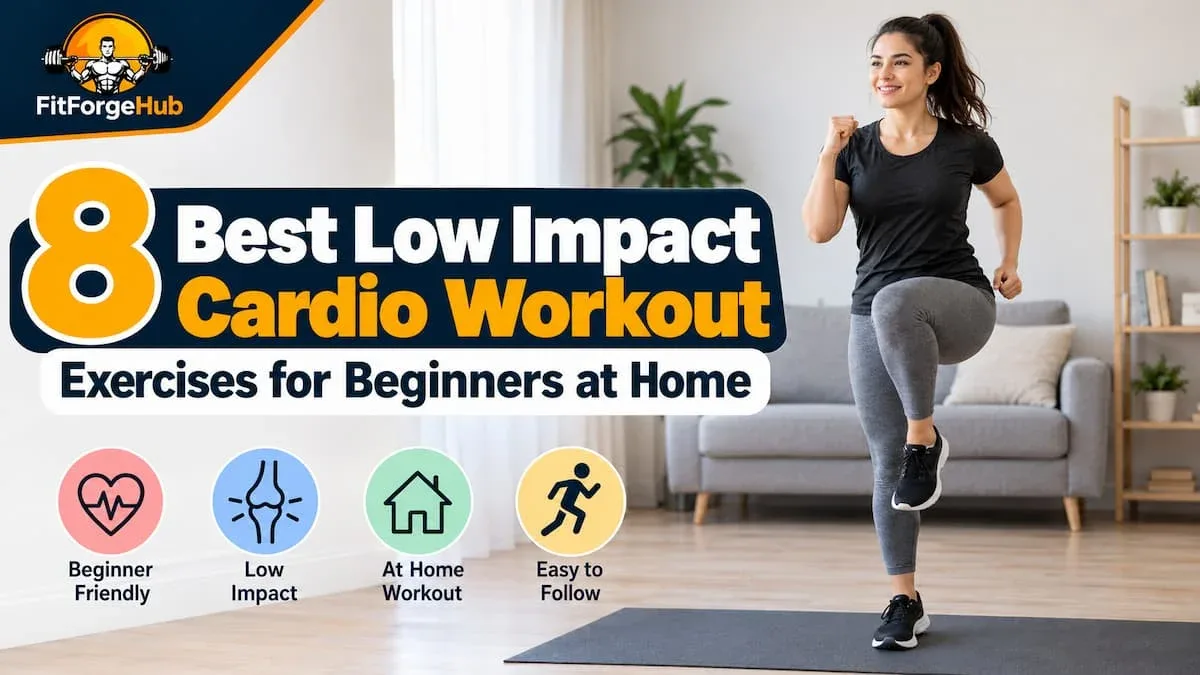
Marching in place is a simple low impact cardio exercise for beginners.
2. Side Steps
Side steps add sideways movement to a routine that might otherwise involve only walking forward. They are helpful for practicing coordination in a small space.
- Stand with your knees relaxed.
- Take one comfortable step to the right.
- Bring your left foot toward your right foot.
- Repeat toward the left and continue alternating.
Starting time: 30 to 45 seconds.
Easier option: Take smaller steps and use a stable counter for support if needed.
3. Step Touches
Step touches are similar to side steps, but you gently tap the trailing foot next to the leading foot instead of fully transferring your weight. They work well when you want a simple, steady rhythm.
- Step to the right with your right foot.
- Tap your left foot beside it.
- Step to the left and tap your right foot beside it.
- Add relaxed arm movements once the footwork feels natural.
Starting time: 45 seconds.
Easier option: Perform the movement slowly without adding your arms.
4. Gentle Knee Lifts
Controlled knee lifts introduce a slightly different movement from regular marching. The goal is not to lift your knees as high as possible. Instead, focus on balance and comfortable movement.
- Stand tall near a stable support if necessary.
- Lift one knee to a comfortable height.
- Lower your foot gently.
- Alternate legs without leaning backward.
Starting time: 30 seconds.
Easier option: Use small knee lifts or perform seated marching.
5. Heel Digs
Heel digs provide an easy change of movement when your legs begin to feel tired from marching. They involve stepping one heel slightly forward while keeping the action controlled.
- Stand with your weight evenly distributed.
- Place your right heel slightly forward.
- Return your foot to the starting position.
- Repeat with your left heel.
Starting time: 30 to 45 seconds.
Easier option: Keep the forward movement very small.
6. Low Impact Step Jacks
Step jacks are a no-jumping alternative to traditional jumping jacks. Instead of hopping both feet outward, you step one foot to the side at a time.
- Stand with your arms by your sides.
- Step your right foot outward.
- Raise your arms only as high as comfortable.
- Bring your foot back and repeat on the left.
Starting time: 30 seconds.
Easier option: Keep your hands near waist height or skip the arm movement.
7. Standing Toe Taps
Toe taps can help you maintain a gentle rhythm while changing how your legs move. You do not need a raised step or platform.
- Stand comfortably with your feet hip-width apart.
- Tap your right toes slightly forward.
- Bring your foot back under your body.
- Repeat with your left foot.
Starting time: 45 seconds.
Easier option: Tap closer to your standing foot and move more slowly.
8. Indoor Walking
Walking around a room or hallway is an effective way to finish the exercise sequence. It allows you to maintain activity without learning another complicated movement.
- Choose a clear, safe walking path.
- Begin at a comfortable pace.
- Keep your shoulders relaxed and look ahead.
- Slow down when you need a recovery period.
Starting time: 1 to 3 minutes.
Easier option: Walk for 30 seconds, pause, and repeat.
If walking is your preferred activity, you can also follow a dedicated walking schedule rather than combining several exercises. The important point is choosing an approach you can repeat consistently.
15 Minute Low Impact Cardio Workout for Beginners
This low impact cardio workout for beginners uses short intervals and simple transitions. The goal is to finish feeling active, not completely drained. You can stop the timer to rest whenever necessary.

Warm Up: 3 Minutes
Start with one minute of easy marching, one minute of gentle side steps, and one minute of relaxed indoor walking. Keep your breathing comfortable.
Main Workout: 10 Minutes
Perform each movement for 45 seconds, followed by 15 seconds of easy standing or walking recovery. Complete the five exercises below, then repeat the sequence once.
| Exercise | Work | Recovery |
|---|---|---|
| Marching in Place | 45 seconds | 15 seconds |
| Step Touches | 45 seconds | 15 seconds |
| Gentle Knee Lifts | 45 seconds | 15 seconds |
| Heel Digs | 45 seconds | 15 seconds |
| Low Impact Step Jacks | 45 seconds | 15 seconds |
Repeat these five intervals for a second round. Two rounds take 10 minutes, including the scheduled recovery intervals.
Cool Down: 2 Minutes
Walk slowly for one minute, then spend another minute allowing your breathing to settle. You may add gentle, comfortable movements for your calves and shoulders without forcing a stretch.
Total planned time: 3-minute warm-up + 10-minute main workout + 2-minute cool-down = 15 minutes.
If 45-second intervals feel too demanding, begin with 30 seconds of movement followed by 30 seconds of recovery. You can also complete only one round and gradually build up to the full session.
4 Week Low Impact Cardio Progression Plan
A beginner does not need to increase workout difficulty every day. Gradual changes make it easier to notice how your body responds and avoid taking on too much too soon.
The schedule below uses three to five cardio days per week. The session lengths include the warm-up and cool-down. Rest days can include normal daily movement, but they do not require an additional workout.
| Week | Cardio Days | Session Length | Weekly Total |
|---|---|---|---|
| Week 1 | 3 days | 10 minutes | 30 minutes |
| Week 2 | 3 days | 15 minutes | 45 minutes |
| Week 3 | 4 days | 15 minutes | 60 minutes |
| Week 4 | 5 days | 20 minutes | 100 minutes |
Week 1: Learn the Movements
Complete three 10-minute sessions on nonconsecutive days. Spend time learning marching, step touches, and side steps. Keep the movements slow enough to maintain control.
For example, you could exercise on Monday, Wednesday, and Friday. There is no need to rush into longer workouts if ten minutes already feels challenging.
Week 2: Build a Consistent Routine
Increase each session to 15 minutes if Week 1 felt comfortable. Continue exercising three days per week. You can use the complete 15-minute routine described above.
Pay attention to how quickly your breathing returns to normal after each session. If you still feel unusually tired the following day, repeat Week 1 instead of progressing.
Week 3: Add Another Workout Day
Try four 15-minute sessions spread throughout the week. Keep at least one lighter or rest day when needed. Do not increase your speed and duration at the same time.
If you prefer a simpler option, replace one indoor session with an easy outdoor walk. Both approaches can help you develop a regular activity habit.
Week 4: Increase Your Endurance
Work toward five 20-minute sessions if the previous weeks felt manageable. You can add five minutes of comfortable marching or walking to your established 15-minute routine.
This plan is a starting point, not a deadline. Repeating a week is completely reasonable. Progress is better measured by consistency and improving comfort than by how quickly you finish the schedule.
How Fast Should Beginners Perform Cardio?
There is no single pace that works for everyone. A speed that feels easy to an experienced exerciser may be challenging for someone returning to activity after several years.
Use your breathing as a guide. At a moderate effort, you should generally be able to talk but not sing comfortably. This is commonly called the talk test. If you cannot speak in short sentences, slow down or take a break.
For a low impact cardio workout for beginners, start below your maximum comfortable effort. The purpose of your first sessions is to establish a sustainable rhythm, not to prove how hard you can push yourself.
As your fitness improves, you may naturally move faster or need fewer breaks. Increase one variable at a time so you can identify which changes feel manageable.
When Is the Best Time to Do Low Impact Cardio?
The best time is usually the time you can follow consistently. Some people enjoy a short morning workout before work. Others prefer moving during lunch or in the early evening.
Choose a schedule that fits your energy levels and daily responsibilities. If you feel stiff after sitting for hours, an easy afternoon session may be appealing. If evenings are busy, a brief morning routine may be easier to maintain.
Avoid exercising immediately after a very large meal if it makes you uncomfortable. If you are exercising late at night and notice that it interferes with your sleep, consider moving your session earlier.
Can You Combine Low Impact Cardio With Strength Training?
Yes. Cardio and strength training support different aspects of fitness. Cardio helps develop aerobic endurance, while resistance exercises strengthen muscles used in daily movement.
Beginners can often combine two weekly strength sessions with several shorter cardio workouts. The exact schedule depends on recovery, fitness level, and other activities.
For example, you might complete cardio on Monday, Wednesday, and Friday, then perform a short full-body strength routine on Tuesday and Saturday.
When you are ready to add resistance exercises, read our Complete Dumbbell Workout Guide for Beginners. It explains exercise selection, technique, and gradual progression for home strength training.
Low Impact Cardio Modifications for Different Fitness Levels
Not every beginner starts with the same strength, balance, or mobility. The most useful workout is one that can be adjusted without making you feel that you have failed.
If Standing for Long Periods Feels Difficult
Try shorter standing intervals and take seated breaks. Seated marching and gentle seated arm movements can provide an alternative starting point. Increase standing time gradually when comfortable.
If Your Knees Feel Uncomfortable
Reduce knee-lift height and avoid deep bending. Choose smaller side steps and keep your movements controlled. Persistent or worsening knee pain should be assessed by an appropriate healthcare professional.
If You Have Limited Space
Focus on marching, heel digs, and toe taps. These movements need very little floor space. Make sure the area is clear and that you can maintain balance without bumping into furniture.
If You Are Returning After a Long Break
Start with five minutes rather than forcing yourself to complete a full workout. Short sessions can help you rebuild confidence. Add a few minutes only when your current routine feels manageable.
Our Beginner Workout Plan for Overweight People at Home also provides seated options, supported movements, and gradual training ideas for people who need a gentler starting point.
Common Low Impact Cardio Mistakes to Avoid
Moving Too Fast Too Soon
Beginners sometimes assume that faster movements always produce better results. Speed can increase the difficulty, but it can also make balance and coordination harder to control. Learn each exercise slowly first.
Skipping the Warm Up
Beginning with the hardest interval may feel uncomfortable when you have been sitting for several hours. Use a few minutes of gentle movement to transition into the session.
Ignoring Unusual Symptoms
Normal exercise may make you breathe harder, but chest pain, fainting, severe dizziness, or unusual breathlessness should not be ignored. Stop exercising and seek urgent medical attention when appropriate.
Doing the Same Difficult Session Every Day
Your body needs opportunities to recover. Start with manageable workout days and use lighter days or rest days when necessary. Consistency does not require maximum effort every day.
Expecting Immediate Weight Loss
Cardio supports physical activity and overall health, but body-weight changes depend on several factors, including nutrition and total activity. Avoid judging your progress only by the number on a scale.
How to Track Your Cardio Progress
You do not need a smartwatch to know whether your routine is improving. A notebook, calendar, or simple phone note can be enough.
After each session, record how long you exercised, which movements you completed, and how difficult the workout felt. You may also note whether you needed extra breaks.

| Progress Marker | What to Record |
|---|---|
| Duration | Total minutes completed |
| Consistency | Number of workout days per week |
| Effort | Easy, moderate, or difficult |
| Recovery | How you felt later and the next day |
| Movement Quality | Whether exercises felt smoother or more controlled |
For example, you might begin by completing ten minutes with several pauses. Three weeks later, the same ten-minute routine may feel easier. That improvement matters even if your weight has not changed.
Frequently Asked Questions
Is low impact cardio good for complete beginners?
Yes. A low impact cardio workout for beginners can be a practical starting point because the exercises are adjustable and generally do not require jumping. Begin with movements that match your current abilities.
Can low impact cardio improve stamina?
Regular aerobic activity can improve endurance over time. Progress depends on consistency, appropriate intensity, and gradual increases in duration or workload.
Do I need equipment for this workout?
No special exercise equipment is required. A timer, comfortable clothing, supportive footwear, and a clear space are enough for most of the movements described here.
Can I do low impact cardio every day?
Some people can comfortably perform light activity daily, but beginners may benefit from planned rest or lighter days. Follow your recovery needs rather than assuming every day must involve a structured workout.
Is 15 minutes of cardio enough to start?
Yes. Fifteen minutes can be a useful starting session. You can begin with less time if needed and gradually build toward broader physical activity recommendations.
Can I lose weight with low impact cardio?
Low impact cardio can contribute to total physical activity and energy expenditure. However, weight loss is influenced by eating habits, overall energy balance, and other individual factors. It should not be presented as a guaranteed result of a short workout.
What should I do if an exercise hurts?
Stop the painful movement. You may be able to use a smaller range of motion or select another exercise, but do not push through sharp or worsening pain. Seek professional advice for persistent symptoms.
Final Thoughts
Starting a fitness routine does not require a dramatic transformation on your first day. A few controlled movements, a realistic schedule, and the willingness to repeat them can help you establish a healthier activity habit.
This low impact cardio workout for beginners gives you a simple place to start. Try the exercises at a comfortable pace, follow the 15-minute routine when you are ready, and use the four-week schedule as a flexible guide rather than a strict deadline.
Over time, you can increase your activity, explore walking workouts, and introduce strength training. What matters most is choosing a routine that fits your abilities and that you can continue beyond the first few weeks.
References
CDC: What Counts as Physical Activity for Adults. Guidance on aerobic intensity, activity recommendations, and the talk test.
ACSM: Starting a Walking Program. Practical guidance on preparing for beginner aerobic activity, footwear, safety, and gradual progression.
About the Author
Disclaimer
This article provides general fitness education and is not a substitute for individualized medical advice. Exercise tolerance varies between individuals. If you have a medical condition, an injury, balance problems, or concerns about beginning physical activity, consult a qualified healthcare professional for guidance appropriate to your situation.