
Starting a workout routine can feel difficult when even a short walk leaves you tired or certain movements make your knees uncomfortable. Many online fitness videos feature jumping jacks, burpees, and fast squats. But you do not need to begin with those exercises to improve your fitness.
This beginner workout plan for overweight people focuses on simple, low-impact movements you can perform at home. Unlike demanding fitness challenges, this beginner workout plan for overweight people starts with chair-supported exercises, gentle walking, and manageable strength training. You will learn how to build a realistic four-week routine without expensive equipment or previous gym experience.
The goal is not to transform your body in 28 days. It is to improve your strength, stamina, and confidence while creating a routine you can maintain. You can start slowly, take breaks, and adjust the exercises to your current abilities.
Can Overweight Beginners Start Exercising at Home?
Yes. People of different body sizes and fitness levels can benefit from regular physical activity. You do not have to lose weight before you begin exercising, and your first workout does not need to be intense.
A beginner workout plan for overweight people should match each person’s mobility, current stamina, and comfort level. Starting with short sessions gives you time to learn proper technique and gradually build confidence.
If you have been inactive for a long time, even five minutes of comfortable movement can be a reasonable starting point. You can split your activity into shorter sessions and gradually increase the duration as your fitness improves.
The American College of Sports Medicine (ACSM) provides exercise science resources and guidance about physical activity. A gradual approach is particularly useful when returning to exercise after a long break.
If you have significant joint problems, heart disease, uncontrolled blood pressure, balance difficulties, or other medical concerns, speak with a healthcare professional about suitable activities before starting. Stop exercising and seek medical attention if you experience chest pain, fainting, or severe unusual breathlessness.
Why Low Impact Workouts Are a Good Starting Point
Low-impact exercise avoids repeated jumping and hard landings. It allows you to practice movements at a controlled pace and make adjustments when an exercise feels too challenging.
- Adjustable difficulty: You can shorten the movement, slow down, or use additional support.
- No jumping required: Seated exercises, walking, and wall movements can provide useful activity.
- Simple equipment: Most exercises need only a sturdy chair, a wall, and comfortable shoes.
- Flexible duration: Short workouts can fit into a busy day.
- Everyday strength: Movements such as standing up from a chair train muscles used in daily activities.
Low impact does not automatically mean pain-free. If an exercise causes sharp pain or worsening discomfort, stop and choose a more suitable alternative.
What You Need Before Starting
Prepare a small, clear space where you can move without obstacles. Keep water nearby, wear comfortable clothing, and use supportive shoes for standing exercises. Choose a sturdy chair without wheels, ideally positioned against a wall so it cannot slide.
Begin at a pace where you can still speak comfortably. You may breathe a little faster during activity, but you should not feel completely exhausted. Rest whenever necessary.
8 Easy Home Exercises for Overweight Beginners
The following eight exercises provide a mix of gentle movement and basic strength training. You do not need to complete all eight during your first workout. Begin with three to five comfortable exercises and gradually add more as your strength and confidence improve.
The exercises in this beginner workout plan for overweight people include both seated and standing options. You can choose movements that feel comfortable, take breaks between sets, and gradually increase the number of exercises as your fitness improves.
1. Seated Marching
Seated marching is a simple option when standing for long periods feels uncomfortable. It helps you move your legs and gradually increase your activity without jumping.
- Sit upright on a stable chair with both feet on the floor.
- Lift one foot a few inches while keeping your upper body relaxed.
- Lower it slowly and lift the opposite foot.
- Continue alternating at a comfortable pace.
Starting target: 30 to 60 seconds.
Easier option: Alternate lifting your heels while keeping your toes on the floor.
2. Chair Sit to Stand
Chair sit to stands strengthen your legs and hips while practicing a movement you use every day. The chair provides a consistent starting position and makes the exercise easier to control than a deep squat.
- Sit near the front of a sturdy chair with your feet planted.
- Lean slightly forward while maintaining your balance.
- Push through your feet to stand, using the armrests if necessary.
- Slowly lower yourself back into the chair.
Starting target: 5 to 8 repetitions.
Easier option: Use a higher chair and your hands for support. Skip the movement if standing causes significant pain or feels unsafe.

3. Wall Push Ups
Wall push ups work your chest, shoulders, and arms without requiring you to get down on the floor. You can make them easier by standing closer to the wall.
- Stand facing a wall and place your hands at approximately shoulder height.
- Step back a comfortable distance.
- Bend your elbows and slowly move your chest toward the wall.
- Push through your palms to return to the starting position.
Starting target: 6 to 10 repetitions.
Easier option: Move your feet closer to the wall.

4. Standing Side Steps
Standing side steps introduce gentle movement in a different direction. They can help you practice coordination while keeping the exercise simple enough for a small room.
- Stand near a stable counter or wall for support.
- Step one foot sideways.
- Bring the other foot toward it without rushing.
- Repeat in the opposite direction.
Starting target: 30 to 45 seconds.
Easier option: Hold a stable support and take smaller steps.

5. Seated Knee Extensions
Seated knee extensions work the muscles at the front of your thighs. They provide a simple leg exercise when repeatedly standing up is uncomfortable.
- Sit upright with your back comfortably supported.
- Slowly straighten one knee as far as feels comfortable.
- Pause briefly without forcing the joint.
- Lower your foot and repeat with the other leg.
Starting target: 8 to 10 repetitions per leg.
Easier option: Use a smaller, pain-free range of motion.

6. Standing Calf Raises
Calf raises strengthen the lower-leg muscles involved in walking and standing. A stable counter can help you maintain your balance.
- Stand with your hands resting on a stable counter.
- Slowly lift your heels off the floor.
- Pause briefly at a comfortable height.
- Lower your heels with control.
Starting target: 8 to 12 repetitions.
Easier option: Perform seated heel raises instead.
7. Seated Arm Raises
Seated arm raises help you practice controlled shoulder movement without using weights. They are especially useful when you want to include upper-body activity in a gentle routine.
- Sit tall with your arms resting by your sides.
- Slowly raise both arms forward to a comfortable height.
- Keep your shoulders relaxed rather than shrugging.
- Lower your arms slowly.
Starting target: 8 to 10 repetitions.
Easier option: Raise one arm at a time or use a smaller range of motion.
8. Comfortable Pace Walking
Walking is one of the simplest ways to begin improving stamina. You can walk around your home, along a hallway, or outdoors on a safe, level surface.
- Start slowly for the first minute.
- Walk at a pace that allows comfortable conversation.
- Slow down or rest whenever necessary.
- Finish at an easier pace.
Starting target: 5 to 10 minutes, or shorter intervals when needed.
Easier option: Walk for two minutes, rest, and repeat. Seated marching may be more comfortable if walking causes discomfort.
Beginner Workout Plan for Overweight People: 4 Week Schedule
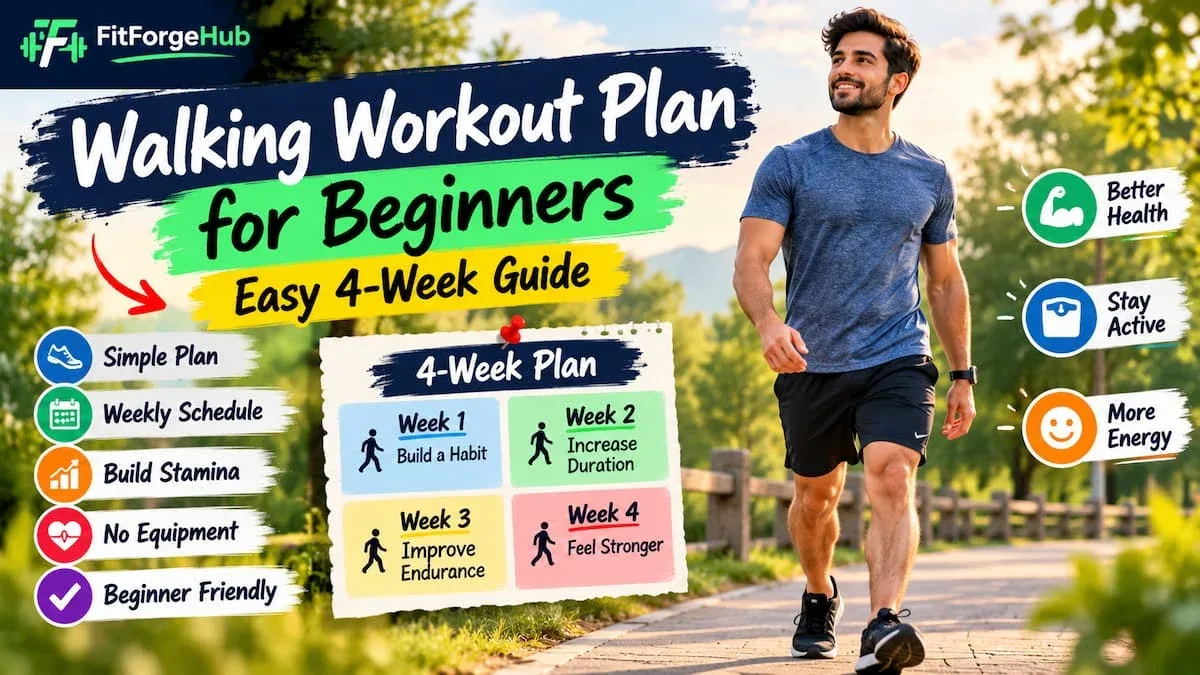
This four-week schedule is designed to help you build a routine without expecting too much too soon. Strength sessions include a gentle warm-up, while walking or seated cardio can be completed separately. Choose the lower end of each time range when starting from very little activity.
| Week | Strength Training | Walking or Seated Cardio | Main Goal |
|---|---|---|---|
| 1 | 2 days, 10 to 15 minutes | 3 days, 5 to 10 minutes | Learn basic movements |
| 2 | 2 days, 15 to 20 minutes | 3 to 4 days, 8 to 12 minutes | Build consistency |
| 3 | 2 days, 15 to 25 minutes | 4 days, 10 to 15 minutes | Improve stamina |
| 4 | 2 to 3 days, 20 to 25 minutes | 4 to 5 days, 12 to 20 minutes | Build a repeatable routine |
You do not have to reach the highest suggested duration. If you need another week at the same level, take it. A manageable routine you can repeat is more useful than an exhausting plan you abandon after a few days.
This beginner workout plan for overweight people follows a gradual progression. The first week focuses on learning basic movements, while the following weeks introduce small increases in exercise time and repetitions. You can repeat any week before moving forward.
Week 1: Get Comfortable Moving
Begin with seated marching, chair sit to stands, wall push ups, seated knee extensions, and seated arm raises. Perform one comfortable set of each exercise, resting whenever necessary. If five movements feel like too much, start with three.
On three other days, try a short walk or seated cardio session. Focus on learning the movements and finishing with enough energy to return to the routine later in the week.
Week 2: Build Consistency
Continue with two strength sessions. If the first week felt manageable, add standing side steps or calf raises. You may also perform a second set of one or two exercises. Avoid increasing every movement at the same time.
Try walking or seated cardio on three or four days. Keep the pace comfortable rather than focusing on speed.
Week 3: Improve Strength and Stamina
By the third week, familiar movements may begin to feel easier. Continue two strength workouts and consider two sets of your main exercises if you are recovering well. Increase your walking time slightly when comfortable.
Pay attention to fatigue and joint comfort. Mild muscle soreness can occur when starting exercise, but sharp pain or worsening joint discomfort should not be ignored.
Week 4: Make Exercise a Habit
During the fourth week, aim for a routine you can continue beyond this plan. Two strength sessions remain a useful foundation. A third lighter session is optional if you feel recovered and have enough time.
Notice practical improvements. Perhaps you can walk longer, stand up from a chair more comfortably, or complete your exercises with fewer breaks. These are meaningful signs of progress even when your body weight has not changed.
Simple Weekly Workout Example
| Day | Activity |
|---|---|
| Monday | Beginner strength workout |
| Tuesday | Easy walking or seated cardio |
| Wednesday | Rest or gentle mobility |
| Thursday | Beginner strength workout |
| Friday | Easy walking or seated cardio |
| Saturday | Optional comfortable activity |
| Sunday | Rest and recovery |
Adjust these days around your schedule. Allow enough recovery between strength sessions, particularly when your muscles are still adapting. If you want more workout ideas, explore our best home workout plan for beginners for another approach to building a home fitness routine.
How to Warm Up Before Your Workout
Before strength training, spend three to five minutes preparing your body for movement. Start with easy seated marching or slow walking. Add gentle shoulder circles and comfortable ankle movements.
Keep your warm-up relaxed. It should help you feel ready to exercise rather than make you tired before the main workout begins.
What to Do When an Exercise Feels Too Difficult
Every beginner has different abilities. Body size, mobility, previous injuries, and fitness experience can affect which exercises feel comfortable. Modifying a movement is a practical way to continue training without forcing an unsuitable version.
| Exercise | Easier Alternative |
|---|---|
| Chair sit to stand | Use a higher chair and armrest support |
| Standing marching | Seated marching |
| Wall push ups | Stand closer to the wall |
| Standing calf raises | Seated heel raises |
| Long walks | Shorter walks with rest breaks |
| Standing side steps | Smaller supported steps |
For more alternatives, read our 10 beginner exercise modifications at home guide. It explains how to adjust common movements while focusing on control and comfort.
When Should You Increase Your Workout Difficulty?
Increase your activity when your current routine feels comfortable and you are recovering well. Progress does not have to mean heavier weights or much longer sessions. Small changes are often easier to maintain.
- Add one or two controlled repetitions to an exercise.
- Walk for one additional minute.
- Add a second set to one strength exercise.
- Improve your technique before increasing difficulty.
- Increase activity gradually instead of changing everything at once.
As your fitness improves, you can work toward the CDC physical activity recommendations for adults. These include at least 150 minutes of moderate-intensity aerobic activity each week and muscle-strengthening activities on two days. Treat this as a longer-term health target rather than something you must achieve during your first four weeks.
Common Mistakes to Avoid During Your First Month
Trying to Do Too Much on Day One
It can be tempting to make up for months of inactivity with one demanding workout. However, doing too much too soon may cause excessive soreness and make your next session harder. Begin with an amount of exercise you can repeat comfortably.
Ignoring Joint Discomfort
Some physical effort is normal during exercise, but sharp or worsening joint pain is not something to push through. Stop the movement, try a more comfortable alternative, and seek professional advice for persistent pain.
Comparing Your Progress With Others
A workout that feels easy to someone else may be challenging for you. Compare your current abilities with your own starting point rather than measuring yourself against fitness videos or someone else’s progress.
Expecting Fast Weight Loss
Physical activity supports health and can contribute to weight management, but changes in body weight depend on several factors, including eating habits, sleep, medications, and health conditions. Improving stamina and strength is worthwhile even when weight loss is slow or does not occur.
Skipping Recovery
Your body needs time to adapt to unfamiliar exercise. Rest days, adequate sleep, and manageable activity between sessions can help you maintain your routine. Exercising harder every day is not necessary for beginners.
How to Track Progress Without Relying Only on Weight
Body weight is only one possible measurement, and it may not reflect improvements in strength, endurance, or movement confidence. Consider keeping a simple weekly record of changes you notice in everyday life.
- How many minutes you can walk comfortably.
- How many controlled chair sit to stands you can perform.
- Whether you need fewer rest breaks.
- How comfortable everyday movements feel.
- How consistently you complete your planned sessions.
- Whether your energy and sleep improve over time.
Review your progress once a week rather than testing yourself to exhaustion after every workout. Small, repeatable improvements can help you stay motivated.
Nutrition and Recovery Tips for Beginners
You do not need an extreme diet to begin exercising. Focus on regular, balanced meals that include vegetables or fruit, protein-rich foods, and satisfying sources of carbohydrates. Drink water throughout the day and adjust your intake for heat and activity.
Foods such as eggs, beans, yogurt, fish, poultry, and tofu provide protein that supports muscle maintenance and recovery. Individual nutrition needs vary, particularly for people managing medical conditions.
Sleep and recovery are important parts of a sustainable routine. If you feel unusually exhausted after every workout, consider reducing the exercise volume rather than pushing harder.
Once basic movements feel comfortable, you may want to explore more resistance training. Our full body dumbbell workout for beginners explains how to choose exercises, manage sets and repetitions, and gradually progress with weights.
Frequently Asked Questions
Can I exercise at home if I am very overweight?
Yes, many people can begin with short, low-impact activities at home. Seated marching, gentle walking, and supported strength movements can be adapted to different abilities. If you have significant mobility limitations or medical concerns, seek individual guidance before starting.
Is walking enough for an overweight beginner?
Walking can be an excellent starting activity if it feels comfortable. It helps you build stamina and establish regular movement. Suitable strength exercises on two days a week provide additional benefits.
How long should my first workout be?
Five to fifteen minutes may be a reasonable starting range, depending on your fitness and health. Some people need shorter sessions. Begin at a manageable level and increase gradually.
Do I need to exercise every day?
No. You can start with two strength sessions per week and comfortable activity on other days. Rest and recovery are especially important when you are new to exercise.
Will I lose weight in four weeks?
Weight changes vary, and no specific result is guaranteed. Four weeks is a useful period for building exercise habits, improving movement confidence, and noticing early fitness improvements.
What if I cannot do squats or floor exercises?
You can use seated movements, wall exercises, and supported standing activities instead. Choose exercises that match your abilities without forcing uncomfortable positions.
Final Thoughts
The best beginner workout is not necessarily the hardest one. It is a routine you can perform comfortably, recover from, and return to consistently. If your first week includes a few seated exercises and short walks, that is a meaningful starting point.
Use this beginner workout plan for overweight people as a flexible starting point rather than a strict fitness challenge. Adjust exercises when necessary, increase activity gradually, and pay attention to improvements in strength, stamina, and everyday movement. Consistency matters more than completing every exercise perfectly.
About the Author
Riaz Ahmed writes beginner-friendly fitness content for FitForgeHub, focusing on practical home workouts, strength training, and realistic exercise habits. FitForgeHub aims to make fitness information easier to understand and apply in everyday life.