
Building stronger legs doesn’t require a crowded gym or a large collection of weights. A resistance band can provide a practical way to train your quads, glutes, hamstrings, and calves at home.
In this guide, you’ll learn the best resistance band exercises for legs, including how to perform each movement, recommended sets and reps, common mistakes, and simple ways to make your workouts harder over time.
The best resistance band exercises for legs can be especially useful for beginners because bands are portable, require little storage space, and can be used for many lower-body movements.
If you’re building a home workout routine, this guide will give you a complete starting point.
Quick Tip: Start with a resistance level that allows you to control every repetition with good form. Increase the challenge gradually instead of using a band that is too difficult.
What Are Resistance Band Leg Exercises?
Resistance band leg exercises use elastic resistance to make your lower-body muscles work against tension.
Unlike traditional free weights, resistance bands become more challenging as they stretch. This makes them useful for exercises such as squats, lunges, hip bridges, lateral walks, and leg curls.
The best resistance band exercises for legs should cover several movement patterns, including:
- Squatting
- Hip hinging
- Lunging
- Hip extension
- Hip abduction
- Knee flexion
- Calf raises
A balanced routine can help you train multiple lower-body muscle groups instead of repeatedly performing only one exercise.
Can Resistance Bands Build Stronger Legs?
Yes. Resistance bands can be used for muscle-strengthening exercises and can provide a practical home-training option.
The CDC lists resistance bands among examples of muscle-strengthening activities and recommends adults perform muscle-strengthening activities on at least two days per week.[CDC]
ACSM’s 2026 resistance-training guidance also notes that elastic bands and home-based training can be effective options, and that complicated equipment is not required for the average healthy adult.[ACSM]
The key is not simply owning a band. You need to use appropriate resistance, perform controlled repetitions, train consistently, and gradually increase the challenge.
Benefits of Resistance Band Leg Workouts
The best resistance band exercises for legs can offer several practical benefits.
1. Easy to Use at Home
You can perform most band exercises in a small space.
2. Portable
Resistance bands are lightweight and easy to carry when traveling.
3. Minimal Equipment
You don’t need a squat rack, barbell, or large home gym.
4. Multiple Lower-Body Exercises
One band can be used for squats, lunges, bridges, lateral movements, and more.
5. Beginner-Friendly
You can start with lighter resistance and gradually progress.
6. Convenient for Home Workouts
A short resistance-band session can be easier to fit into a busy schedule.
Best Resistance Band Exercises for Legs
Here are 9 of the best resistance band exercises for legs to include in a beginner-friendly lower-body routine.
| Exercise | Sets | Reps | Main Muscles |
|---|---|---|---|
| Resistance Band Squat | 3 | 10–15 | Quads, Glutes |
| Resistance Band Romanian Deadlift | 3 | 8–12 | Hamstrings, Glutes |
| Resistance Band Glute Bridge | 3 | 12–20 | Glutes |
| Resistance Band Reverse Lunge | 2–3 | 8–12/leg | Quads, Glutes |
| Resistance Band Lateral Walk | 2–3 | 8–15/side | Glutes |
| Band Bulgarian Split Squat | 2 | 8–12/leg | Quads, Glutes |
| Resistance Band Leg Curl | 2–3 | 10–15 | Hamstrings |
| Resistance Band Calf Raise | 3 | 12–20 | Calves |
| Resistance Band Hip Abduction | 2–3 | 12–20/side | Glute Medius |
1. Resistance Band Squat
The resistance band squat is one of the best resistance band exercises for legs because it trains the quads and glutes while allowing beginners to practice a fundamental lower-body movement.

How to Do It
- Stand on the middle of the resistance band.
- Hold the handles or band ends near shoulder height.
- Position your feet around shoulder-width apart.
- Brace your core.
- Push your hips back and bend your knees.
- Lower under control.
- Push through your feet to return to standing.
Sets & Reps
3 sets × 10–15 reps
Rest: 60–90 seconds
Form Tip
Keep your chest controlled and avoid allowing your knees to collapse inward.
2. Resistance Band Romanian Deadlift
The resistance band Romanian deadlift is one of the best resistance band exercises for legs for training the hamstrings and glutes.

How to Do It
- Stand on the middle of the band.
- Hold the band handles or ends.
- Keep your feet about hip-width apart.
- Slightly bend your knees.
- Push your hips backward.
- Lower your torso while keeping your back neutral.
- Drive your hips forward to return to standing.
Sets & Reps
3 sets × 8–12 reps
Rest: 60–120 seconds
Target Muscles
- Hamstrings
- Glutes
- Lower back as a stabilizer
Focus on moving through your hips rather than turning the movement into a squat.
3. Resistance Band Glute Bridge
The resistance band glute bridge is another useful option among the best resistance band exercises for legs, particularly when your goal is to emphasize the glutes.

How to Do It
- Lie on your back.
- Bend your knees.
- Place the band above your knees.
- Keep your feet flat on the floor.
- Brace your core.
- Drive through your feet.
- Raise your hips.
- Squeeze your glutes at the top.
- Lower slowly.
Sets & Reps
3 sets × 12–20 reps
Rest: 60–90 seconds
4. Resistance Band Reverse Lunge
Reverse lunges are one of the best resistance band exercises for legs for developing unilateral lower-body strength.
How to Do It
- Stand tall with the band positioned securely.
- Step one foot backward.
- Lower your body toward the floor.
- Keep your front foot planted.
- Push through the front foot.
- Return to the starting position.
- Repeat on the other side.
Sets & Reps
2–3 sets × 8–12 reps per leg
Rest: 60–90 seconds
Beginner Tip
Start with bodyweight reverse lunges if adding band resistance makes your balance difficult.
5. Resistance Band Lateral Walk
The lateral band walk is one of the best resistance band exercises for legs for targeting the muscles on the outside of your hips and glutes.
How to Do It
- Place the band around your thighs or ankles.
- Bend your knees slightly.
- Keep your hips back.
- Step sideways.
- Maintain tension on the band.
- Take controlled steps in both directions.
Sets & Reps
2–3 sets × 8–15 steps per side
Rest: 45–60 seconds
Target Muscles
- Glute medius
- Gluteus maximus
- Hip stabilizers
6. Resistance Band Bulgarian Split Squat
The Bulgarian split squat is a challenging unilateral exercise and can be included among the best resistance band exercises for legs once you’re comfortable with basic squats and lunges.
How to Do It
- Place your rear foot on a stable elevated surface.
- Position the resistance band securely.
- Keep your front foot planted.
- Lower your body under control.
- Keep your torso stable.
- Drive through your front foot.
- Return to the starting position.
Sets & Reps
2 sets × 8–12 reps per leg
Rest: 90 seconds
Beginner Modification
Perform a regular split squat instead of a Bulgarian split squat if balance is a problem.
7. Resistance Band Leg Curl
The resistance band leg curl directly trains knee flexion and can help you target the hamstrings.
It is one of the best resistance band exercises for legs when you want to add more direct hamstring work.
How to Do It
- Secure the band safely.
- Lie face down.
- Attach or position the band around your ankle.
- Bend your knee.
- Pull your heel toward your glutes.
- Pause briefly.
- Slowly return your leg.
Sets & Reps
2–3 sets × 10–15 reps per leg
Rest: 60–90 seconds
Safety: Only use an anchor that is specifically designed and rated for resistance-band training.
8. Resistance Band Calf Raise
Calf raises are an important part of the best resistance band exercises for legs because the calves can be trained directly with relatively simple movements.
How to Do It
- Stand upright.
- Position the resistance band securely.
- Keep your feet about hip-width apart.
- Rise onto the balls of your feet.
- Pause at the top.
- Lower slowly.
Sets & Reps
3 sets × 12–20 reps
Rest: 45–60 seconds
Form Tip
Avoid bouncing. Use a controlled range of motion.
9. Resistance Band Hip Abduction
Hip abduction is another useful movement to finish your lower-body workout.
It belongs in a complete list of the best resistance band exercises for legs because it focuses on the muscles responsible for moving your leg away from your body’s midline.
How to Do It
- Place the band around your thighs or ankles.
- Stand tall while holding a stable surface if needed.
- Move one leg outward.
- Keep your torso still.
- Pause briefly.
- Return slowly.
- Repeat on the opposite side.
Sets & Reps
2–3 sets × 12–20 reps per side
Beginner Resistance Band Leg Workout
If you don’t want to perform all nine exercises in one session, use this simple routine.

Beginner Lower-Body Workout
1. Resistance Band Squat
3 × 10–15
2. Resistance Band Romanian Deadlift
3 × 8–12
3. Resistance Band Reverse Lunge
2 × 8–12 per leg
4. Resistance Band Glute Bridge
3 × 12–20
5. Resistance Band Lateral Walk
2 × 10–15 steps per side
6. Resistance Band Calf Raise
3 × 12–20
Rest approximately 60–120 seconds between challenging sets.
This routine combines several of the best resistance band exercises for legs without making the workout unnecessarily complicated.
Sets, Reps, and Rest
For beginners, a practical starting range is:
- Compound exercises: 8–15 reps
- Isolation exercises: 10–20 reps
- Rest: 60–120 seconds
- Training frequency: 2–3 lower-body sessions per week
The CDC notes that resistance-band work counts as muscle-strengthening activity and gives 8–12 repetitions as an example range, with one to three sets; your exact programming can vary based on training experience and goals.
You don’t need to take every set to absolute failure. Focus on controlled reps and gradually make the exercise more challenging.
How to Progress With Resistance Bands
The best resistance band exercises for legs will eventually become easier as your strength improves.
That’s when you need progressive overload.

Try one of these methods:
1. Use a Stronger Band
Move to the next resistance level when your current band becomes too easy.
2. Add Reps
For example:
10 reps → 12 reps → 15 reps
3. Add Sets
You can move from 2 sets to 3 sets when appropriate.
4. Improve Your Technique
Slower, controlled repetitions can make an exercise more challenging.
5. Use Harder Variations
For example:
Squat → split squat → Bulgarian split squat.
ACSM’s 2026 guidance emphasizes consistency and gradual progression rather than relying on complicated training methods.
How Often Should You Train Your Legs?
For most beginners, 2 lower-body sessions per week can be a practical starting point.
For example:
Monday: Lower Body
Tuesday: Upper Body
Wednesday: Rest
Thursday: Lower Body
Friday: Upper Body
Saturday: Optional light activity
Sunday: Rest
The CDC recommends adults perform muscle-strengthening activities on at least two days each week and work all major muscle groups.
For more beginner workout ideas, see our Beginner Push Pull Legs Workout at Home.
Common Mistakes
Even the best resistance band exercises for legs won’t be very effective if your technique is poor.
Mistake 1: Using Too Much Resistance
A band that is too heavy can make you lose control.
Mistake 2: Rushing Repetitions
Slow down and control both the lifting and lowering phases.
Mistake 3: Poor Knee Position
During squats and lunges, keep your knees tracking in line with your feet.
Mistake 4: Ignoring Range of Motion
Use a comfortable range of motion that you can control.
Mistake 5: Never Increasing the Challenge
If every workout feels exactly the same, you may eventually stop making progress.
Resistance Band Leg Workout Without an Anchor
One advantage of the best resistance band exercises for legs is that many can be performed without attaching the band to a door or wall.
Try:
- Band squats
- Romanian deadlifts
- Glute bridges
- Reverse lunges
- Lateral walks
- Calf raises
- Hip abductions
For exercises requiring an anchor, always follow the manufacturer’s instructions and make sure the anchor is secure.
Can Resistance Bands Build Muscle?
Resistance bands can be part of a muscle-building program when the training provides enough challenge and progresses over time.
ACSM’s 2026 position-stand materials specifically identify elastic bands and home-based training as viable resistance-training options.
However, equipment alone does not determine results.
Your progress also depends on:
- Consistent resistance training
- Appropriate training volume
- Sufficient protein and overall nutrition
- Recovery
- Sleep
- Progressive overload
- Individual training experience
If your goal is broader muscle development, read our How Long Does It Take to Build Muscle? guide.
You can also combine resistance bands with dumbbells. Our Resistance Bands vs Dumbbells for Muscle Building guide explains the differences.
How to Combine This With Your Home Workout
You don’t have to train legs in isolation.
For example:
Monday — Lower Body
- Band Squat
- Band Romanian Deadlift
- Glute Bridge
- Calf Raise
Wednesday — Upper Body
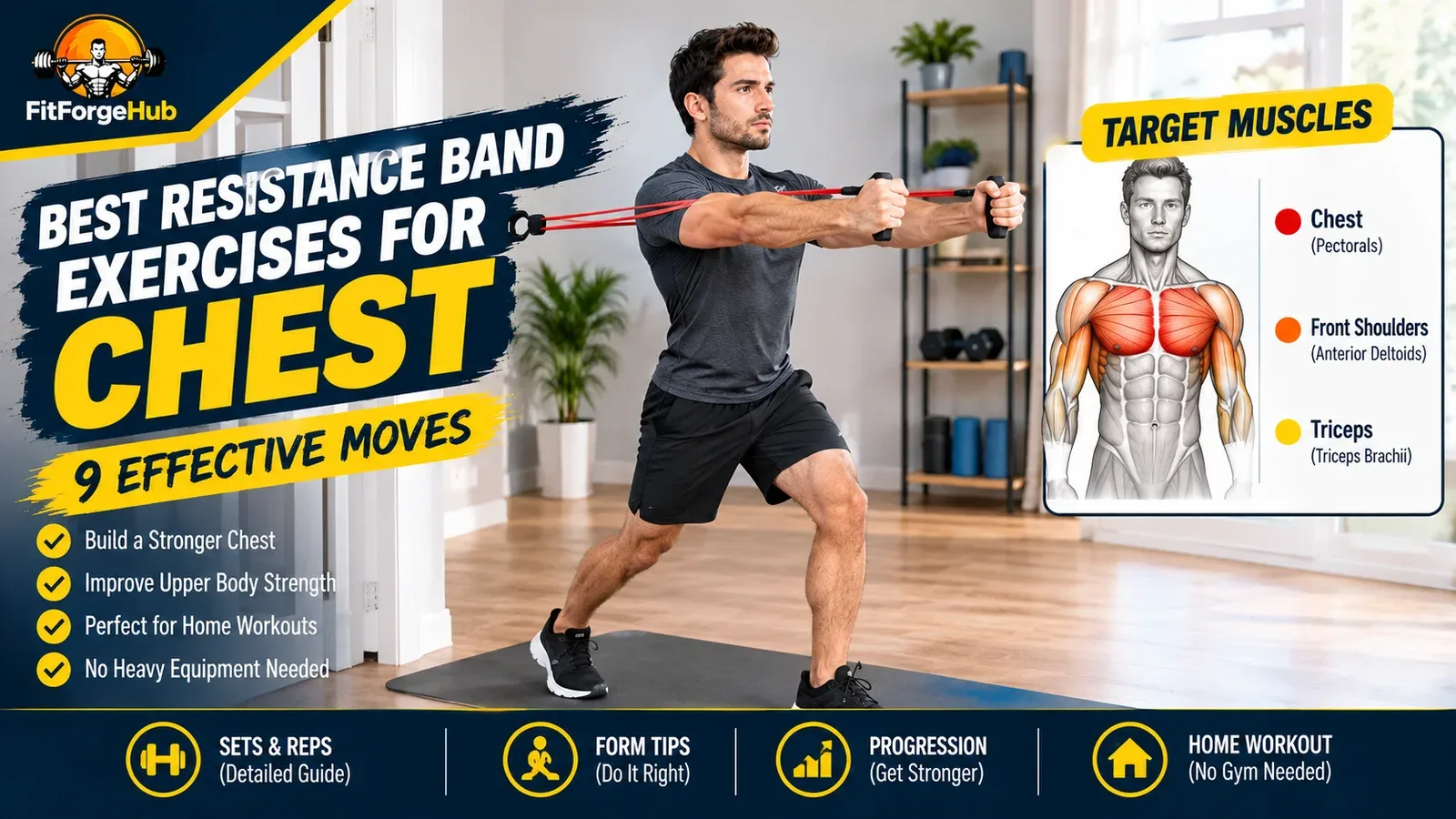
Use our Best Resistance Band Exercises for Chest.
Friday — Full Body
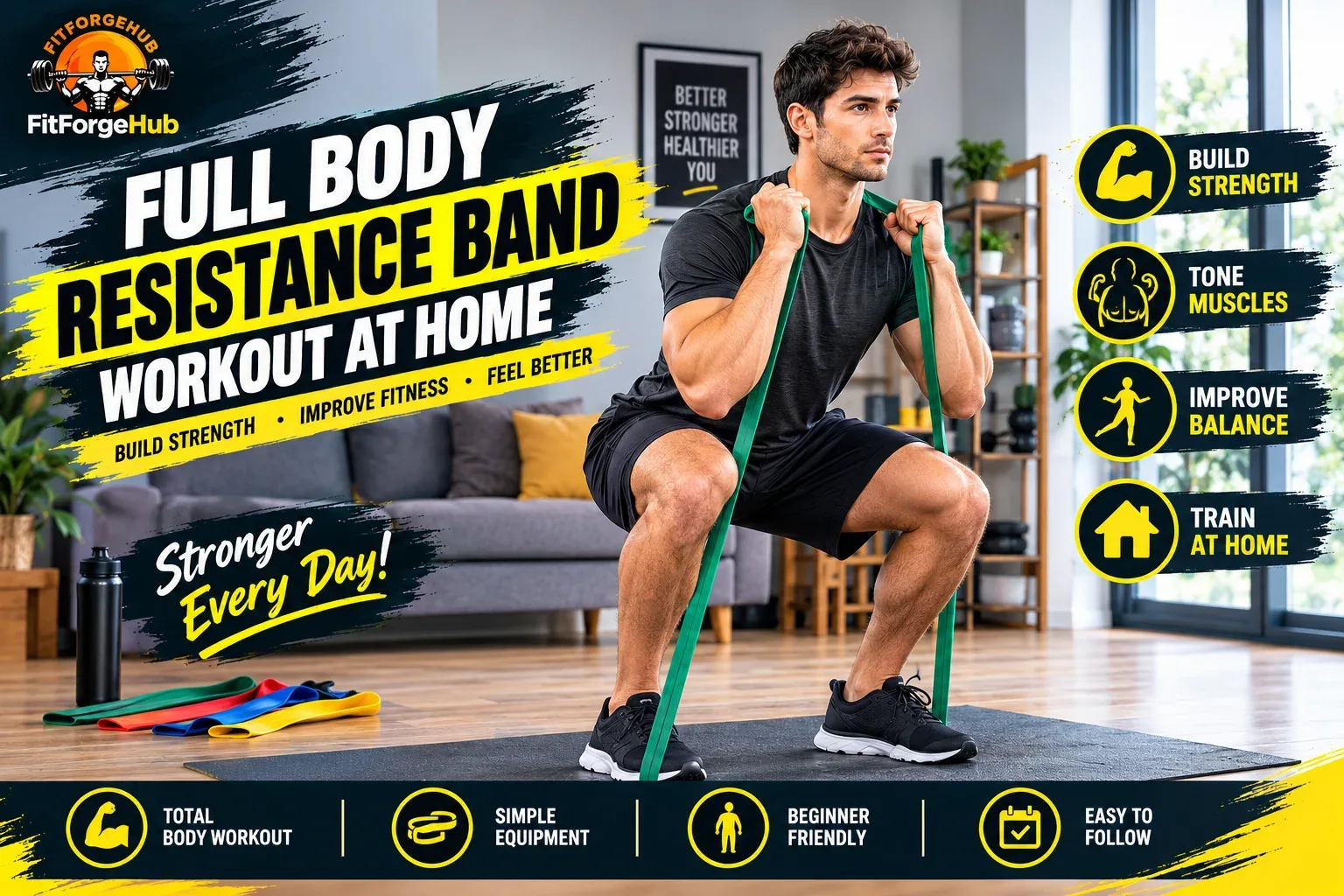
Use our Full Body Resistance Band Workout at Home.
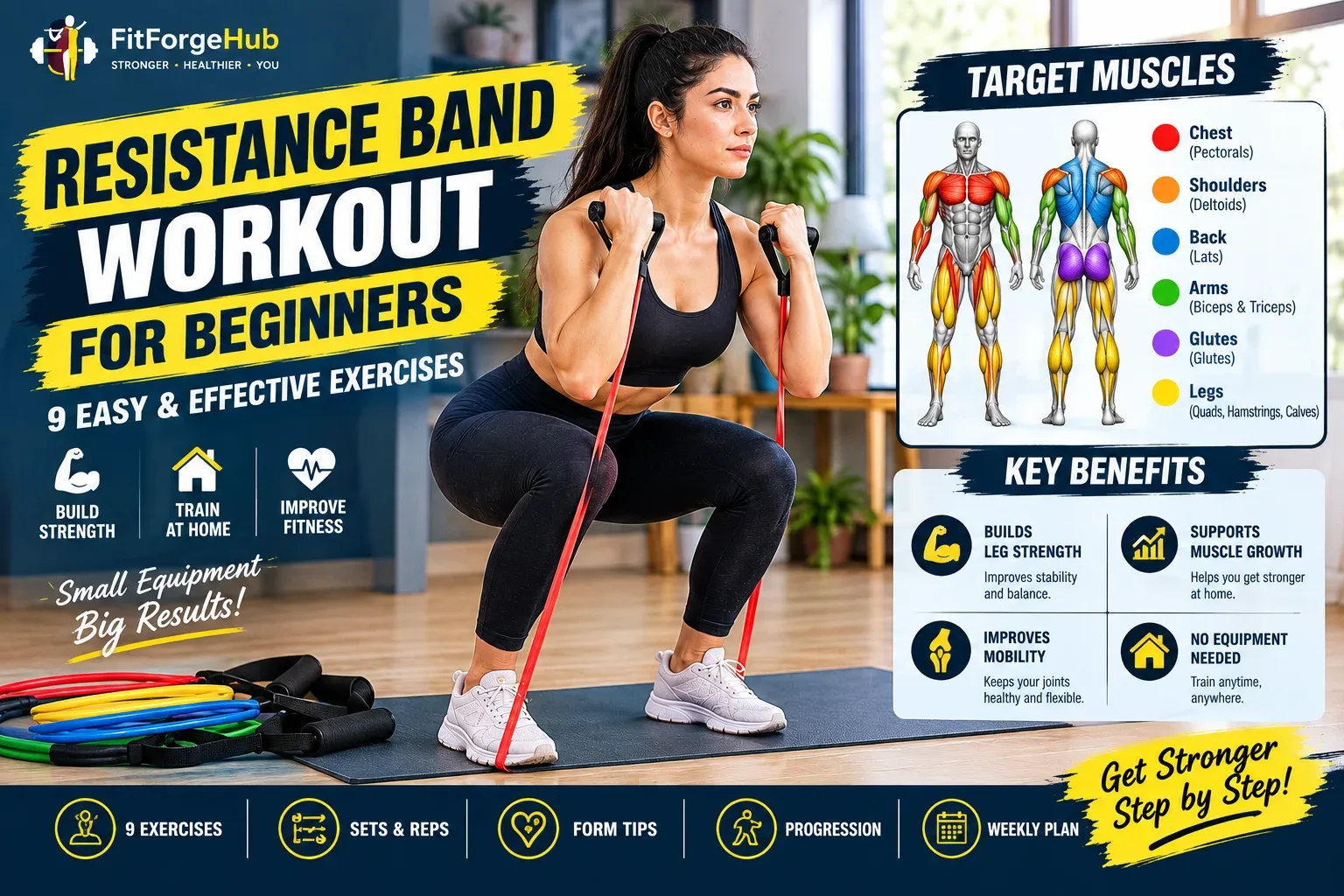
You can also use the Resistance Band Workout for Beginners as your starting point.
Nutrition and Recovery
Training is only one part of improving strength and muscle development.
Pay attention to:
Protein
Include protein-rich foods such as:
- Eggs
- Chicken
- Fish
- Greek yogurt
- Milk
- Beans
- Lentils
- Lean meat
- Tofu
Carbohydrates
Carbohydrates can provide energy for training.
Examples include:
- Rice
- Oats
- Potatoes
- Whole-grain bread
- Fruit
Recovery
Allow your muscles time to recover between challenging workouts.
Sleep, hydration, nutrition, and consistent training all contribute to your overall fitness routine.
For more nutrition guidance, see our What to Eat Before and After Workout for Muscle Gain.
Safety Tips
Before starting the best resistance band exercises for legs, inspect your band for cracks, tears, or other damage.
Also:
- Use the correct resistance level.
- Keep your movements controlled.
- Don’t allow the band to snap back toward you.
- Use secure anchors when required.
- Stop if you experience sharp or unusual pain.
- Progress gradually.
If you have a chronic health condition or are unsure what type or amount of activity is appropriate for you, talk with a qualified healthcare professional. The CDC also recommends discussing vigorous activity with a healthcare professional in certain situations.
Frequently Asked Questions
What are the best resistance band exercises for legs?
Some of the best resistance band exercises for legs include squats, Romanian deadlifts, glute bridges, reverse lunges, lateral walks, Bulgarian split squats, leg curls, calf raises, and hip abductions.
Can I build leg muscle with resistance bands?
Yes. Resistance bands can provide resistance for muscle-strengthening exercises and can be used as part of a progressive training program.
How many times a week should I do resistance band leg workouts?
Beginners can start with two lower-body sessions per week and adjust based on recovery and training goals.
Are resistance bands good for beginners?
Yes. They are portable, require little space, and allow you to start with lighter resistance.
Can I do these exercises without an anchor?
Yes. Many of the best resistance band exercises for legs don’t require an anchor, including squats, deadlifts, glute bridges, lunges, lateral walks, and calf raises.
How many reps should I do with resistance bands?
A practical beginner range is around 8–15 reps for many exercises, while some movements such as lateral walks and calf raises can work well with higher repetitions.
Can resistance bands replace dumbbells?
Resistance bands can be a useful alternative to dumbbells for many exercises, although the resistance feel and progression options are different.
For a detailed comparison, read Resistance Bands vs Dumbbells for Muscle Building.
How do I make resistance band leg exercises harder?
You can use a stronger band, add repetitions, add sets, slow down the movement, improve range of motion, or choose a harder exercise variation.
Final Thoughts
The best resistance band exercises for legs don’t need to be complicated.
A simple routine built around squats, hip hinges, lunges, glute-focused movements, lateral work, and calf exercises can give beginners a practical way to train their lower body at home.
Start with manageable resistance, learn the movements, and gradually increase the challenge.
Most importantly, stay consistent.
The best resistance band exercises for legs are the ones you can perform safely, recover from, and continue progressing with over time.
About the Author
Riaz Ahmed
Riaz Ahmed holds a Master’s degree in Health and Physical Education and is the founder of FitForgeHub, where he shares practical fitness and workout information.
His content focuses on beginner-friendly workouts, resistance training, muscle-building fundamentals, home fitness, and practical exercise guidance.
Website: FitForgeHub.com
Disclaimer:
This article is provided for general educational and informational purposes only. It is not medical advice or a substitute for evaluation or treatment from a qualified healthcare professional. Exercise according to your individual abilities and circumstances.