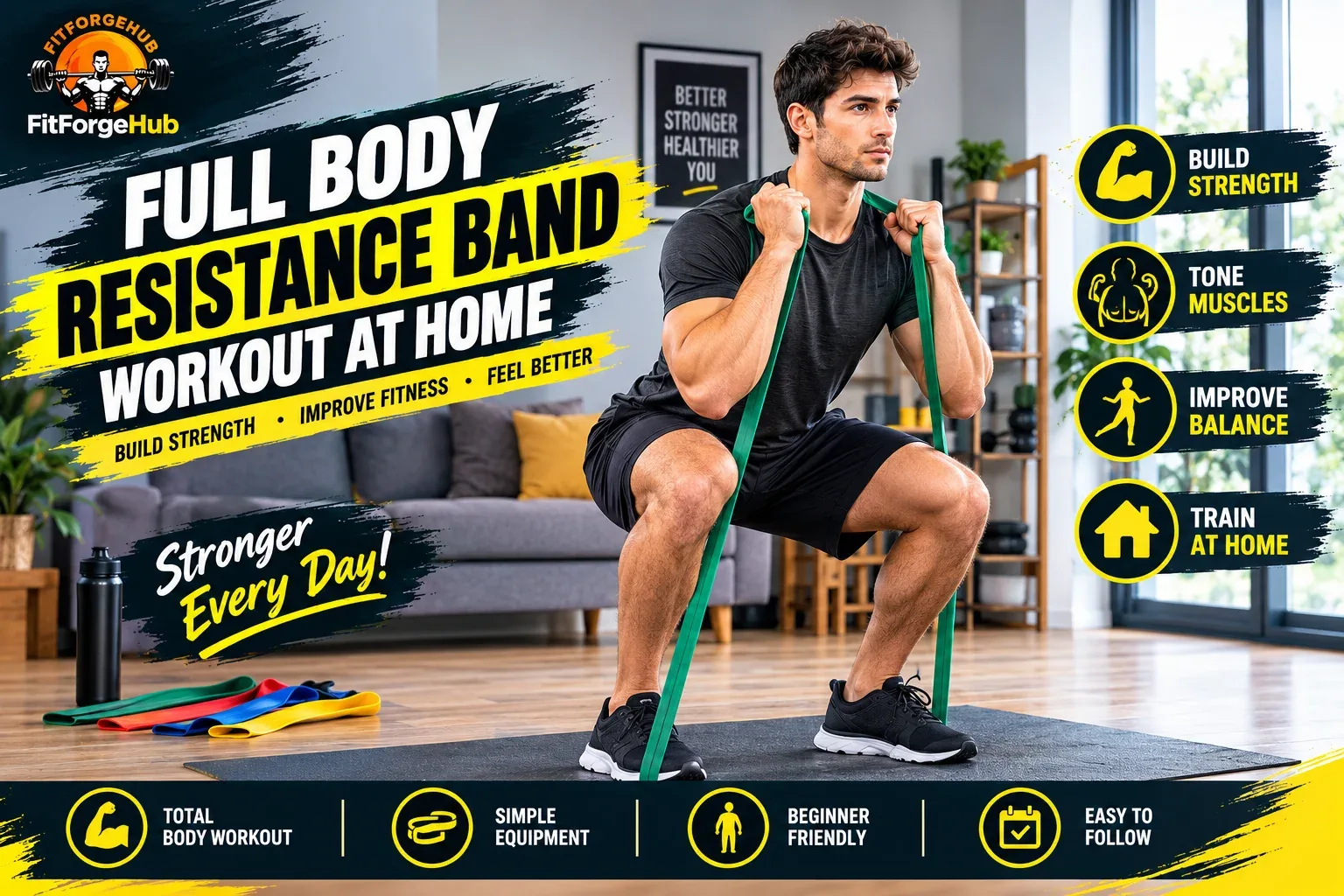
If you want to build strength at home without a full home gym, resistance bands can be a practical training option. This full body resistance band workout at home targets your major muscle groups with simple exercises that can be adjusted to your current fitness level.
You don’t need a barbell, weight machine, or expensive equipment to get started. A few resistance bands, enough space to move safely, and a consistent workout routine can give beginners a simple way to train at home.
In this guide, you’ll learn 9 beginner-friendly resistance band exercises, recommended sets and reps, rest periods, progression strategies, common mistakes, and a simple weekly schedule.
Quick note: This guide is for general fitness education. If you have an injury, medical condition, or concerns about starting exercise, consider speaking with a qualified healthcare professional before beginning a new training program.
Table of Contents
- Can You Get a Full Body Workout With Resistance Bands?
- Benefits of Full Body Resistance Band Training
- 9 Full Body Resistance Band Exercises
- Beginner Full Body Resistance Band Workout
- Sets, Reps, and Rest
- How to Progress With Resistance Bands
- How Often Should You Do This Workout?
- Common Resistance Band Workout Mistakes
- Sample Weekly Schedule
- Resistance Band Workout Without an Anchor
- Nutrition and Recovery
- Frequently Asked Questions
- Final Thoughts
Can You Get a Full-Body Workout With Resistance Bands?
Yes. Resistance bands can be used to train many of the major muscle groups, including your legs, hips, back, chest, shoulders, and arms.
The CDC lists resistance bands as one example of muscle-strengthening activity and recommends that adults perform muscle-strengthening activities on at least 2 days per week, working all major muscle groups. (CDC)
A well-designed full body resistance band workout at home can include:
- Squatting movements
- Hip and glute exercises
- Rows for the back
- Chest presses
- Shoulder exercises
- Biceps exercises
- Triceps exercises
- Core stability exercises
The biggest advantage for beginners is simplicity. You can start with lighter resistance, learn proper technique, and gradually make the workout more challenging.
Benefits of Full Body Resistance Band Training
Resistance bands are popular for home workouts because they are portable, relatively inexpensive, and can provide resistance without requiring a traditional weight room.
1. Train at Home
You can perform most band exercises in a small workout area.
2. Train Multiple Muscle Groups
A single workout can target your upper body, lower body, and core.
3. Easy to Adjust
Many bands come in different resistance levels, allowing you to increase or decrease the challenge.
4. Beginner Friendly
Bands can be useful when you’re learning basic movement patterns and building consistency.
5. Easy to Store
Bands take up much less space than many traditional pieces of gym equipment.
The 2026 ACSM resistance-training position stand highlights consistency, gradual progression, and practical options such as elastic bands and home-based training. (ACSM)
9 Full Body Resistance Band Exercises
Here are nine exercises you can combine into a beginner-friendly full body resistance band workout at home.
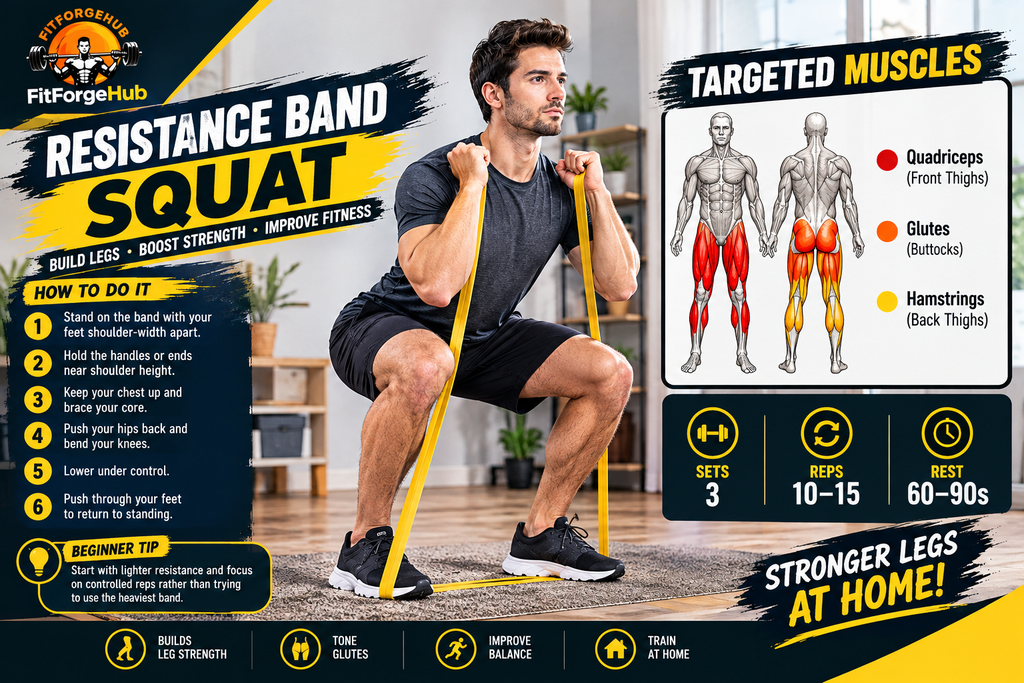
1. Resistance Band Squat
Targets: Quads, glutes, hamstrings
Sets: 3
Reps: 10–15
Rest: 60–90 seconds
How to Do It
- Stand on the resistance band with your feet about shoulder-width apart.
- Hold the handles or ends of the band near shoulder height.
- Keep your chest up and brace your core.
- Push your hips back and bend your knees.
- Lower under control.
- Push through your feet to return to standing.
Beginner Tip
Start with lighter resistance and focus on controlled reps rather than trying to use the heaviest band.
2. Resistance Band Row
Targets: Upper back, lats, rear shoulders, biceps
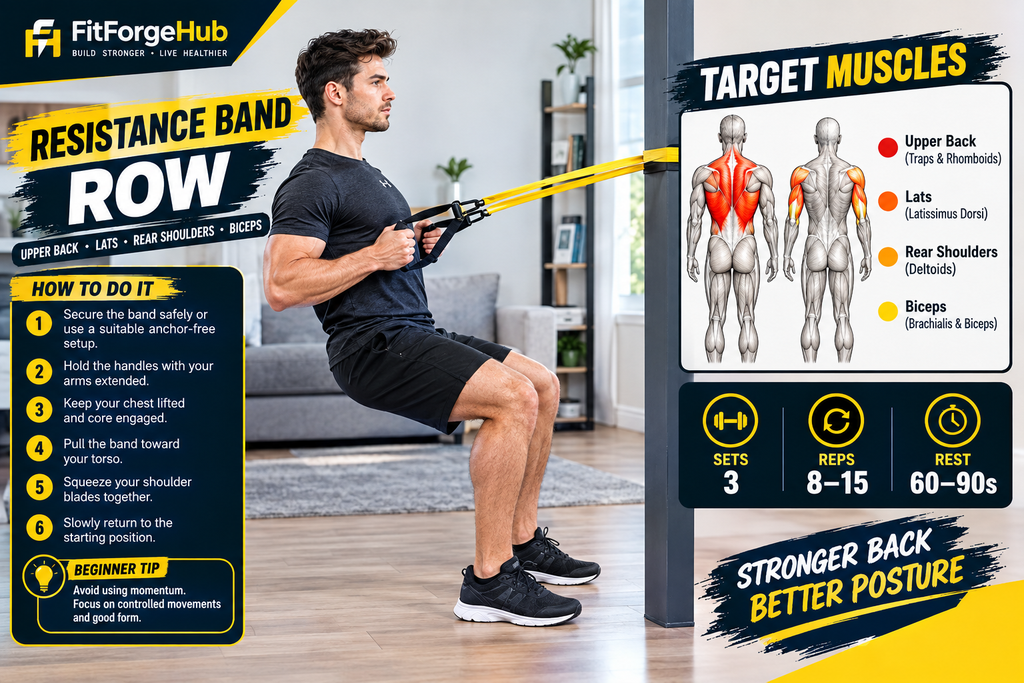
Sets: 3
Reps: 8–15
Rest: 60–90 seconds
How to Do It
- Secure the band safely or use a suitable anchor-free setup.
- Hold the handles with your arms extended.
- Keep your chest lifted.
- Pull the band toward your torso.
- Squeeze your shoulder blades together.
- Slowly return to the starting position.
Avoid using momentum to pull the band.
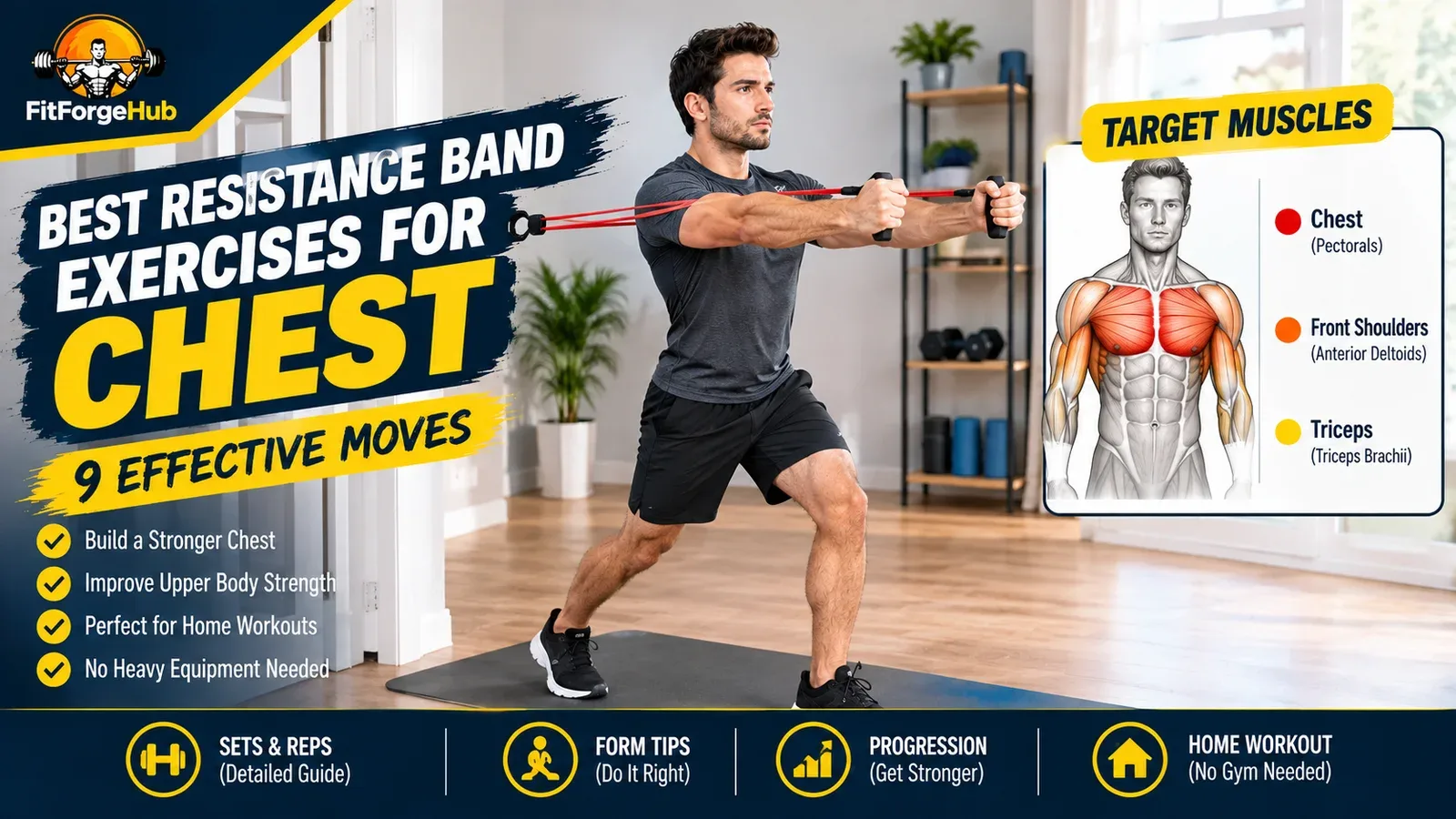
3. Resistance Band Chest Press
Targets: Chest, shoulders, triceps
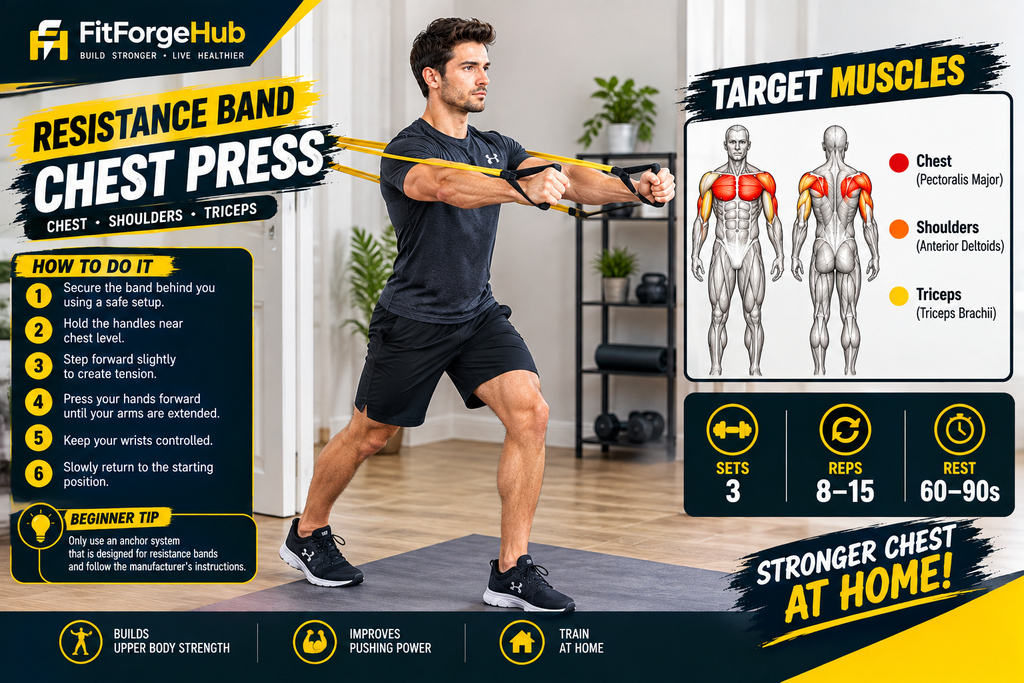
Sets: 3
Reps: 8–15
Rest: 60–90 seconds
How to Do It
- Secure the band behind you using a safe setup.
- Hold the handles near chest level.
- Step forward slightly to create tension.
- Press your hands forward.
- Keep your wrists controlled.
- Slowly return your hands toward your chest.
Safety tip: Only use an anchor system that is designed for resistance bands and follow the manufacturer’s instructions.
4. Resistance Band Shoulder Press
Targets: Shoulders, triceps
Sets: 2–3
Reps: 8–12
Rest: 60–90 seconds
How to Do It
- Stand on the middle of the band.
- Bring the handles to shoulder level.
- Keep your core tight.
- Press your hands overhead.
- Stop before forcing your elbows into an uncomfortable position.
- Lower slowly.
Keep the movement controlled throughout each repetition.
5. Resistance Band Biceps Curl
Targets: Biceps
Sets: 2–3
Reps: 10–15
Rest: 60 seconds
How to Do It
- Stand on the center of the band.
- Hold the handles with your palms facing forward.
- Keep your elbows close to your sides.
- Curl your hands toward your shoulders.
- Squeeze your biceps.
- Lower the handles slowly.
Don’t swing your body to create momentum.
6. Resistance Band Triceps Extension
Targets: Triceps
Sets: 2–3
Reps: 10–15
Rest: 60 seconds
How to Do It
- Hold the band securely.
- Position your elbows close to your body.
- Extend your arms against the resistance.
- Squeeze your triceps at the end of the movement.
- Return slowly.
Choose a resistance level that allows you to maintain good form.
7. Resistance Band Glute Bridge
Targets: Glutes, hamstrings
Sets: 3
Reps: 12–20
Rest: 60–90 seconds
How to Do It
- Lie on your back with your knees bent.
- Place the band above your knees if appropriate for the band type.
- Keep your feet flat.
- Brace your core.
- Drive through your feet and lift your hips.
- Squeeze your glutes at the top.
- Lower your hips slowly.
Avoid overextending your lower back.
8. Resistance Band Lateral Walk
Targets: Glutes, hip muscles, outer thighs
Sets: 2–3
Reps: 8–15 steps per side
Rest: 60 seconds
How to Do It
- Place a loop band above your knees or around your lower legs, depending on your experience and band.
- Bend your knees slightly.
- Keep your hips back.
- Step sideways while maintaining band tension.
- Follow with your other foot.
- Continue for the desired number of steps.
Try not to let your knees collapse inward.
9. Resistance Band Pallof Press
Targets: Core
Sets: 2–3
Reps: 8–12 per side
Rest: 60 seconds
How to Do It
- Attach the band securely at about chest height.
- Stand sideways to the anchor.
- Hold the band close to your chest.
- Brace your core.
- Press your hands straight forward.
- Resist the band pulling you toward the anchor.
- Bring your hands back slowly.
This exercise focuses on controlling rotation rather than moving quickly.
Beginner Full Body Resistance Band Workout
If you’re new to resistance bands, you don’t need to perform every possible exercise in one session.
Use this simple routine:
| Exercise | Sets | Reps |
|---|---|---|
| Resistance Band Squat | 3 | 10–15 |
| Resistance Band Row | 3 | 8–15 |
| Resistance Band Chest Press | 3 | 8–15 |
| Shoulder Press | 2 | 8–12 |
| Biceps Curl | 2 | 10–15 |
| Triceps Extension | 2 | 10–15 |
| Glute Bridge | 3 | 12–20 |
| Lateral Walk | 2 | 8–15/side |
| Pallof Press | 2 | 8–12/side |
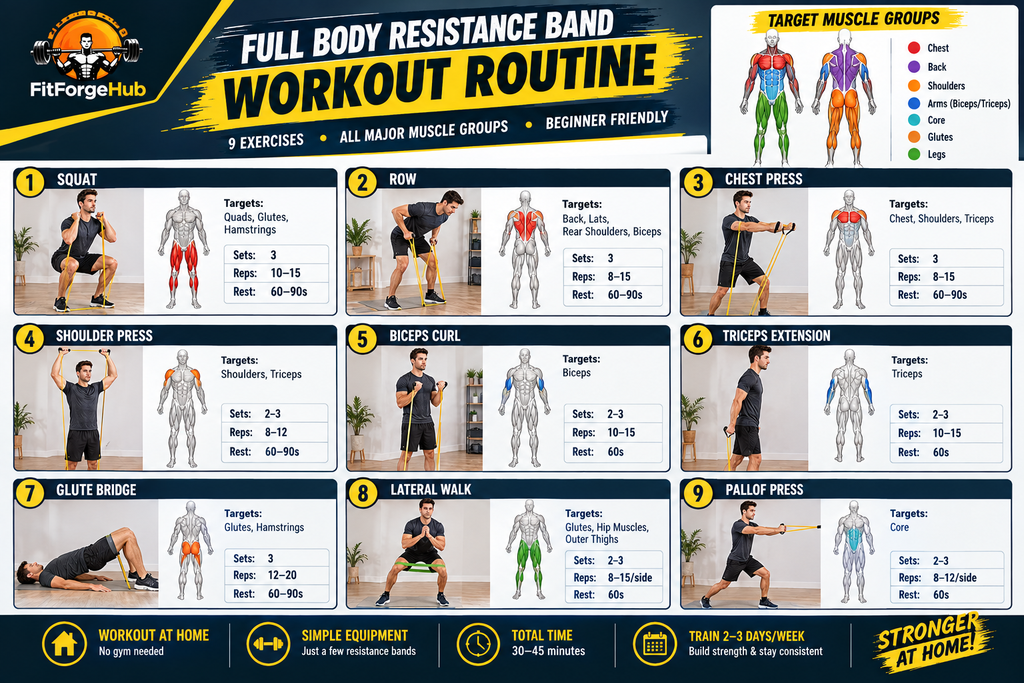
Workout duration: Approximately 30–45 minutes.
You can reduce the number of exercises when you’re starting and gradually build up as you become more comfortable.
Sets, Reps, and Rest
For beginners, a practical starting point is:
Compound exercises
2–3 sets × 8–15 reps
Examples:
- Squats
- Rows
- Chest press
- Shoulder press
Isolation exercises
2–3 sets × 10–15 reps
Examples:
- Biceps curls
- Triceps extensions
Core and glute exercises
2–3 sets × 8–20 reps
Examples:
- Glute bridges
- Lateral walks
- Pallof presses
The CDC notes that 8–12 repetitions can be used as a set for muscle-strengthening activities, with one or more sets depending on the goal and individual circumstances. (CDC)
How to Progress With Resistance Bands
Doing the same workout forever won’t provide the same challenge as your strength improves.
The goal is to gradually increase the training challenge.
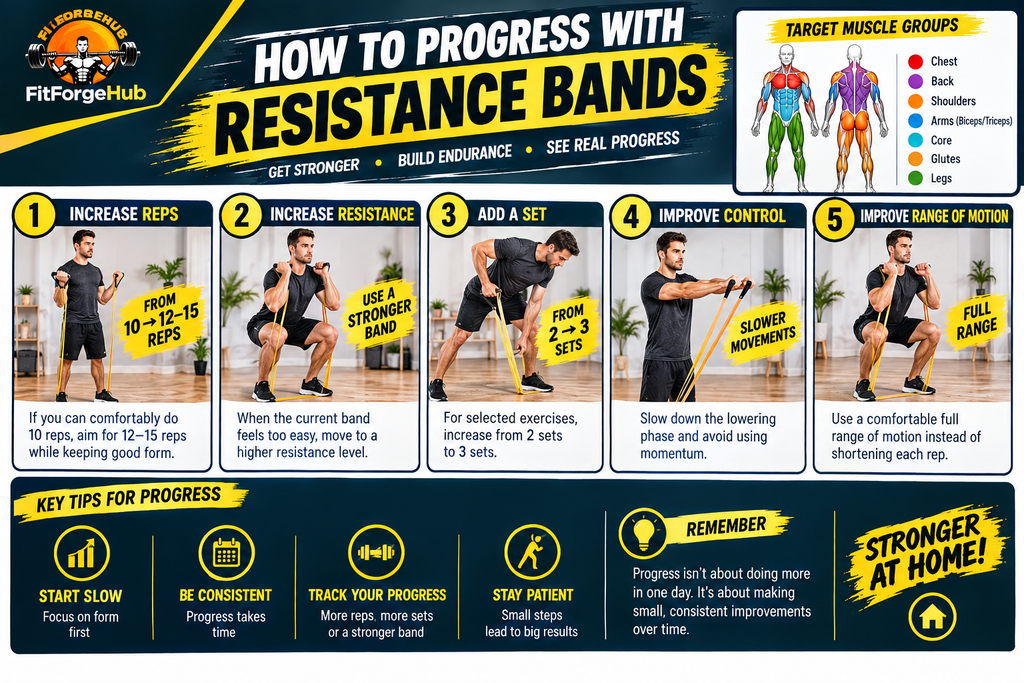
Method 1: Increase Reps
If you’re comfortably completing 10 reps, work toward 12–15 reps while maintaining good form.
Method 2: Increase Resistance
Move to a stronger band when the current band becomes too easy.
Method 3: Add a Set
For selected exercises, you can increase from 2 sets to 3 sets.
Method 4: Improve Control
Slow down the lowering portion and avoid using momentum.
Method 5: Improve Range of Motion
When appropriate, use a comfortable full range of motion rather than shortening every repetition.
ACSM’s 2026 guidance emphasizes consistency and gradual progression rather than relying on complicated training techniques. (ACSM)
How Often Should You Do This Workout?
For most beginners, 2–3 full-body resistance-training sessions per week can be a practical schedule.
For example:
Monday: Full Body Resistance Band Workout
Tuesday: Walking or light activity
Wednesday: Rest
Thursday: Full Body Resistance Band Workout
Friday: Walking or light activity
Saturday: Optional resistance-band session
Sunday: Rest
The CDC recommends muscle-strengthening activity on at least 2 days per week for adults and advises working all major muscle groups. (CDC)
If you’re completely new to exercise, start conservatively and focus on learning the movements.
Common Resistance Band Workout Mistakes
1. Using Too Much Resistance
A heavier band isn’t automatically better.
If you can’t control the movement, reduce the resistance.
2. Moving Too Quickly
Fast repetitions can make it harder to maintain good technique.
Use controlled movements.
3. Ignoring Warm-Up
Spend a few minutes doing light movement before your workout.
4. Training Hard Every Day
Your muscles also need time to recover.
5. Poor Band Setup
Never use a damaged band or an unsafe anchor.
Inspect your equipment regularly.
6. Only Training One Body Part
A full-body routine should include movements for the major muscle groups rather than focusing only on arms or chest.
Resistance Band Workout Without an Anchor
You can perform many exercises without an anchor, including:
- Squats
- Glute bridges
- Lateral walks
- Biceps curls
- Shoulder presses
- Triceps extensions
- Some rows
- Some core exercises
For exercises that require an anchor, follow the band’s manufacturer instructions and make sure the attachment point is secure.
If you don’t have an anchor, you can simply choose anchor-free exercises.
Nutrition and Recovery
Training is only one part of improving your fitness.
Your recovery habits matter too.
Focus on:
- Adequate protein
- Fruits and vegetables
- Whole grains
- Healthy fats
- Enough fluids
- Consistent sleep
- Rest between challenging workouts
If your goal is muscle growth, your overall calorie and protein intake should support that goal.
For more nutrition guidance, you can read:
What to Eat Before and After Workout for Muscle Gain
Related Articles
For those who want to continue their training journey, also read our related articles.
- Resistance band basics:
Resistance Band Workout for Beginners - Muscle-building foundation:
How to Build Muscle at Home Without Weights - Dumbbell alternative:
Complete Dumbbell Workout Guide for Beginners - Training frequency:
How Often Should You Train Each Muscle Group? - Muscle-building timeline:
How Long Does It Take to Build Muscle? - Beginner home training:
How to Start Working Out at Home for Beginners - Push-pull-legs option:
Beginner Push Pull Legs Workout at Home - Leg training:
Best Home Leg Workout Without Equipment - Chest training:
Best Home Chest Workout Without a Bench
Frequently Asked Questions
Can beginners use resistance bands?
Yes. Resistance bands can be used by beginners to perform a wide range of strength exercises. Start with manageable resistance and prioritize technique.
Is a resistance band workout enough for a full-body workout?
It can be. A properly structured routine can include exercises for the legs, glutes, back, chest, shoulders, arms, and core.
How many days a week should I do resistance band workouts?
Two to three sessions per week can be a practical starting point for a beginner. Adults are generally advised to perform muscle-strengthening activity on at least 2 days each week. (CDC)
Can resistance bands build muscle?
Resistance training can support muscle growth when the training provides an appropriate challenge and is performed consistently. ACSM’s 2026 resistance-training guidance includes elastic bands among effective resistance-training options. (ACSM)
Can I do resistance band workouts at home?
Yes. Many resistance band exercises can be performed at home with limited space and equipment.
How long should a resistance band workout last?
A beginner full-body session can take approximately 30–45 minutes, depending on the number of exercises, sets, rest periods, and warm-up.
Should I use resistance bands or dumbbells?
Both can be useful. Choose the option that fits your goals, available space, budget, and training preferences.
You can compare your options with:
Complete Dumbbell Workout Guide for Beginners
Final Thoughts
A full body resistance band workout at home can be a simple way for beginners to start resistance training without building an expensive home gym.
Focus on the basics:
Good form → consistent training → gradual progression → recovery.
You don’t need a complicated routine to get started. Choose manageable resistance, train the major muscle groups, track your progress, and increase the challenge gradually as your fitness improves.
If you want to build a complete home workout routine, continue with the other beginner guides on FitForgeHub.
👤 About the Author
Riaz Ahmed
Riaz Ahmed holds a Master’s degree in Health and Physical Education and is the founder of FitForgeHub, where he shares practical fitness and workout information.
His content focuses on beginner-friendly workout routines, resistance training, muscle building, home workouts, weight management, and practical fitness education.
Website: FitForgeHub.com
Disclaimer: The information provided on FitForgeHub is for general educational and informational purposes only and is not a substitute for professional medical advice, diagnosis, or treatment.