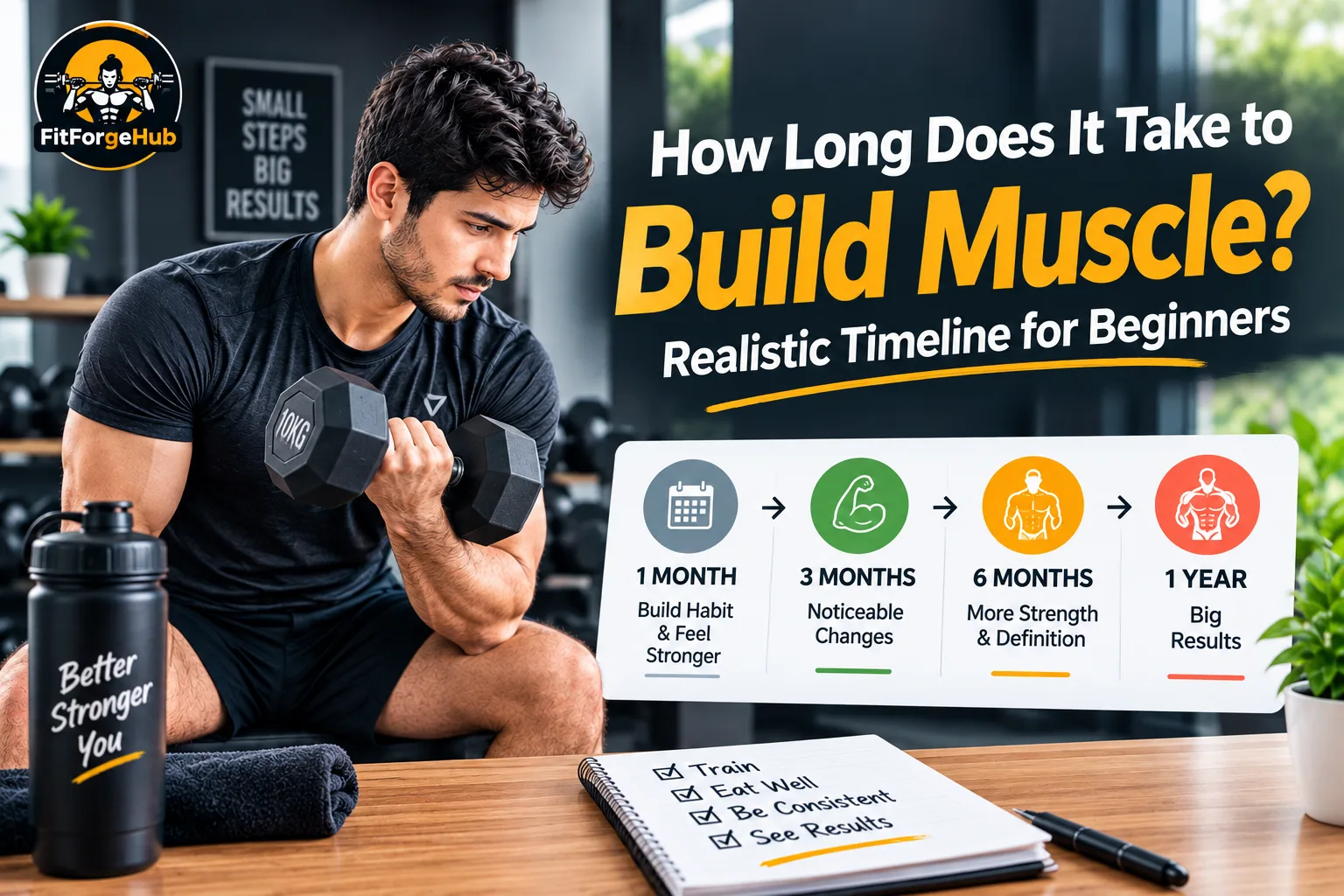
A practical guide to muscle growth, realistic timelines, training, nutrition, recovery, and what beginners can expect
If you’re starting a muscle-building workout, one of the first questions you’ll probably ask is:
How long does it take to build muscle?
The honest answer is that there is no single timeline that applies to everyone.
Some beginners notice improvements in strength and workout performance within the first few weeks. Visible changes in muscle size can take longer and are influenced by training consistency, nutrition, sleep, genetics, age, starting fitness level, and how effectively your workouts become more challenging over time.
Research has found that measurable changes in muscle size can occur relatively early in resistance-training programs, but the amount and timing of change varies between people and study designs. (PubMed)
So instead of promising that you’ll “build muscle in 30 days,” this guide explains what a realistic muscle-building timeline looks like and what you can actually control.
Quick Answer: Beginners may notice strength and performance improvements within several weeks, while noticeable changes in muscle size usually require consistent training over a longer period. Think in terms of months of consistent work, not overnight transformations.
Table of Contents
- How Long Does It Take to Build Muscle?
- What Happens When You Start Strength Training?
- A Realistic Muscle-Building Timeline
- What Can You Expect After 1 Month?
- What Can You Expect After 2–3 Months?
- What Can You Expect After 6 Months?
- What Can You Expect After 1 Year?
- Why Do Beginners Sometimes Progress Faster?
- What Factors Affect How Fast You Build Muscle?
- Does Training Frequency Affect Muscle Growth?
- How Many Days a Week Should You Train?
- How Many Sets and Reps Should You Do?
- Why Progressive Overload Matters
- How Nutrition Affects Muscle Growth
- Do You Need a Calorie Surplus?
- How Much Protein Do You Need?
- Why Sleep and Recovery Matter
- Can You Build Muscle at Home?
- Can Skinny Beginners Build Muscle?
- Why You May Not See Results Yet
- Common Muscle-Building Mistakes
- How to Track Your Muscle-Building Progress
- A Simple Beginner Muscle-Building Plan
- Frequently Asked Questions
- Final Thoughts
- About the Author
How Long Does It Take to Build Muscle?
For a beginner, muscle building is a gradual process rather than something that happens within a few workouts.
You may notice several different types of progress at different times.
Early Progress
During the first few weeks, you may notice:
- Better exercise technique
- Improved coordination
- Increased strength
- More confidence during workouts
- Better ability to complete your planned sets
Later Progress
With continued training, you may begin noticing:
- Changes in muscle size
- Changes in body shape
- Better muscle definition
- Increased training capacity
- Gradual increases in the amount of resistance you can use
The exact timeline varies.
Research has found that measurable changes related to muscle hypertrophy can occur relatively early after beginning resistance training, although the rate of progress varies between individuals.
PubMed — Time Course of Short-Term Hypertrophy
What Happens When You Start Strength Training?
When you begin resistance training, your body has to adapt to a new physical demand.
At first, some of your progress comes from becoming better at performing the movements.
For example, your first few dumbbell workouts may feel awkward.
During the first few weeks, many beginners notice that exercises start to feel easier and their strength improves
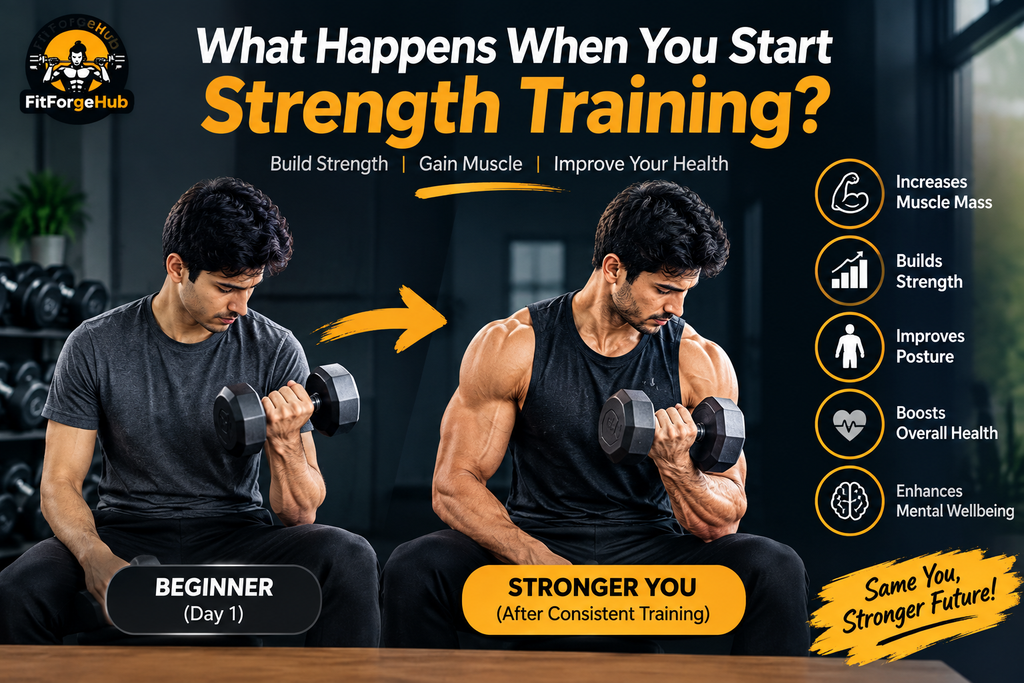
After several sessions, you may notice that:
- Your technique is better.
- You feel more stable.
- You can perform more repetitions.
- The same dumbbells feel easier.
- You understand how to control each movement.
That’s real progress.
Muscle growth is only one part of your adaptation to resistance training.
This is why you shouldn’t judge your entire fitness journey by how your muscles look in the mirror during the first few weeks.
A Realistic Muscle-Building Timeline
Everyone responds differently, but this general framework can help you understand what to expect.
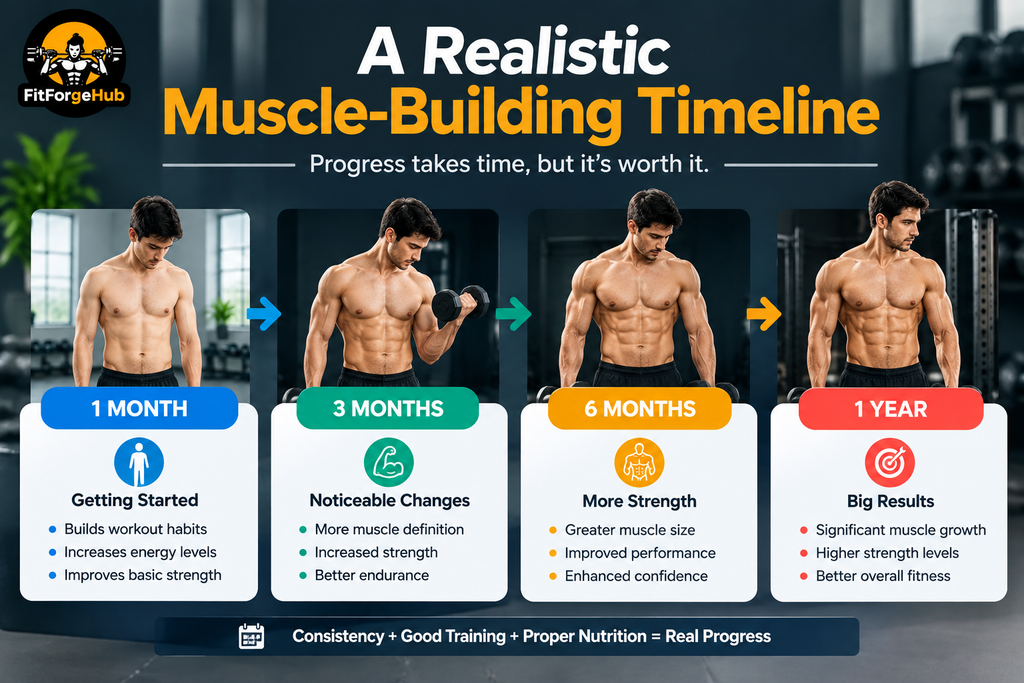
A realistic muscle-building timeline showing what beginners may experience after 1 month, 3 months, 6 months, and 1 year of consistent training.| Training Period | What You May Notice |
|---|---|
| First 2–4 weeks | Better technique, coordination and strength |
| 1–3 months | Increasing strength and potentially noticeable physical changes |
| 3–6 months | More noticeable changes with consistent training |
| 6–12 months | Meaningful progress for many consistent beginners |
| 1+ year | Continued development with appropriate training and nutrition |
These are not guaranteed milestones.
Your results can be faster or slower.
The most useful way to think about this table is as a framework rather than a promise.
What Can You Expect After 1 Month?
How long does it take to build muscle? In the first month, beginners may notice improvements in strength and workout performance before major visual changes become obvious
Your first month should primarily be about building good habits.
Instead of asking:
“Why don’t I look completely different yet?”
ask:
- Am I training consistently?
- Is my technique improving?
- Am I completing more repetitions?
- Am I gradually increasing resistance?
- Am I eating enough nutritious food?
- Am I getting enough sleep?
- Am I recovering between workouts?
If the answer to these questions is mostly yes, you’re building the foundation for future progress.
For beginners, strength improvements can occur before obvious visual changes.
What Can You Expect After 2–3 Months?
After several months of consistent resistance training, some beginners may begin noticing more obvious changes.
These could include:
- Stronger arms
- Better-developed shoulders
- Increased leg strength
- Improved posture and control
- Changes in how clothes fit
- More noticeable muscle development
However, the amount of visible change depends heavily on your starting point and how consistently you’ve trained.
Don’t compare your three-month progress to someone else’s three-year transformation.
By this stage, how long does it take to build muscle becomes easier to understand because consistent training can lead to more noticeable changes in strength and muscle development.
What Can You Expect After 6 Months?
Six months gives you a much larger training window.
If you’ve consistently trained, progressed your exercises, eaten appropriately, and recovered well, you may have made meaningful improvements in:
- Strength
- Muscle size
- Workout performance
- Exercise technique
- Overall fitness
Some people will see dramatic changes.
Others may see more subtle changes.
Both can be normal.
Your genetics, body composition, training history, nutrition, and starting condition all influence the result.
What Can You Expect After 1 Year?
A full year of consistent training can make a major difference.
You have enough time to:
- Build a strong training habit
- Learn proper exercise technique
- Progress through different resistance levels
- Improve multiple muscle groups
- Experiment with different workout structures
- Understand how your body responds to training
The important word is consistent.
A year of occasional workouts is not the same as a year of structured resistance training.
Why Do Beginners Sometimes Progress Faster?
Beginners often have plenty of room for improvement.
If you’ve never followed a structured resistance-training program, your body is being exposed to a new stimulus.
You may therefore experience noticeable improvements in strength and performance relatively quickly.
This is sometimes called beginner gains.
But it doesn’t mean beginners have unlimited progress.
As you become more experienced, continuing to improve generally requires better programming, appropriate resistance, adequate recovery, and patience.
What Factors Affect How Fast You Build Muscle?
Several factors can influence muscle growth.
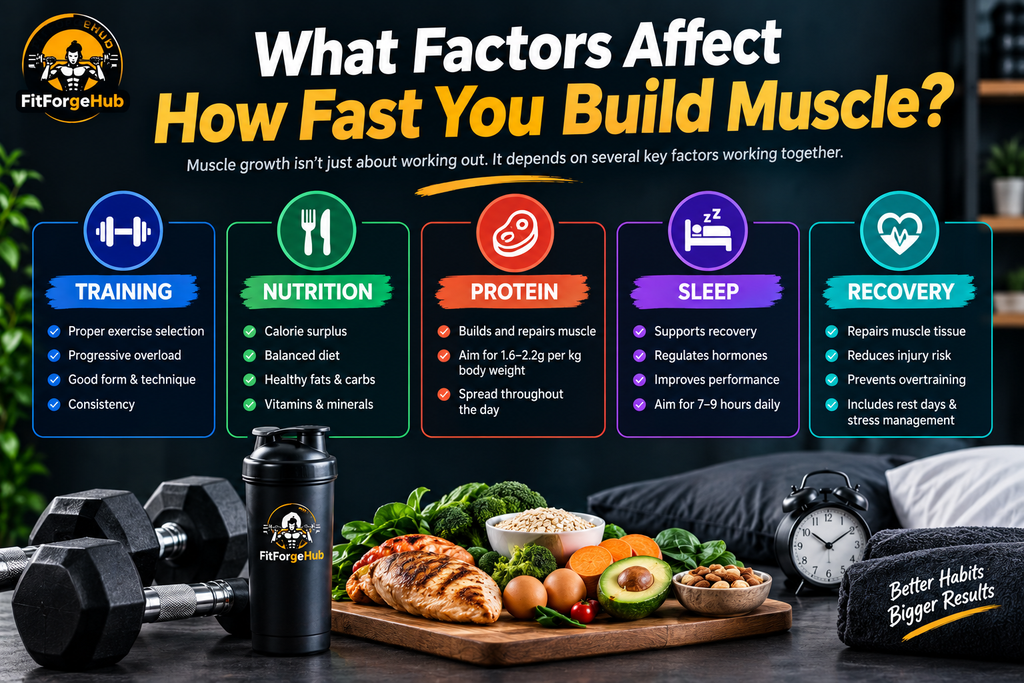
1. Training Consistency
Missing workouts regularly makes progress harder.
You don’t need to train every day.
You do need a routine you can actually follow.
2. Progressive Overload
Your muscles need a reason to adapt.
That can involve gradually increasing:
- Resistance
- Repetitions
- Sets
- Exercise difficulty
- Range of motion
- Training quality
You don’t have to increase everything at once.
3. Nutrition
Your body needs adequate energy and nutrients to support training and recovery.
A balanced diet matters.
4. Protein Intake
Protein provides amino acids needed for tissue repair and muscle protein synthesis.
Your individual protein needs depend on factors such as body size, training, age, and overall diet.
5. Sleep
Poor sleep can make training and recovery more difficult.
Treat sleep as part of your training plan rather than an optional extra.
6. Genetics
People naturally respond differently to resistance training.
Two people can follow similar programs and still experience different results.
7. Starting Point
Someone who has never trained may have a different rate of progress from someone who has already spent several years lifting weights.
Does Training Frequency Affect Muscle Growth?
Yes, training frequency can be part of an effective muscle-building program.
However, more training days do not automatically mean more muscle.
For beginners, training the major muscle groups regularly while allowing enough recovery is often more practical than training every day.
Your previous FitForgeHub guide covers this in detail:
[How Often Should You Train Each Muscle Group?]
For general health, the CDC recommends adults perform muscle-strengthening activities on at least 2 days per week, involving all major muscle groups.
CDC — Adding Physical Activity as an Adult
How Many Days a Week Should You Train?
For a beginner, 2–3 resistance-training sessions per week can be a practical starting point.
One simple schedule is:
| Day | Activity |
|---|---|
| Monday | Full-body workout |
| Tuesday | Rest/light activity |
| Wednesday | Full-body workout |
| Thursday | Rest |
| Friday | Full-body workout |
| Saturday | Walking/mobility |
| Sunday | Rest |
This isn’t the only effective schedule.
The best schedule is one that fits your lifestyle and allows you to train consistently.
How Many Sets and Reps Should You Do?
You don’t need hundreds of repetitions to build muscle.
For many beginner resistance exercises, a practical starting point is:
2–3 sets per exercise
with roughly:
8–15 controlled repetitions
depending on the exercise and your ability.
The CDC also uses 8–12 repetitions as an example of a muscle-strengthening set and notes that one set is a starting point, while two or three sets can provide additional benefit. (CDC)
Your previous dumbbell workouts on FitForgeHub use this beginner-friendly approach.
For example:
[Full Body Dumbbell Workout for Beginners]
Why Progressive Overload Matters
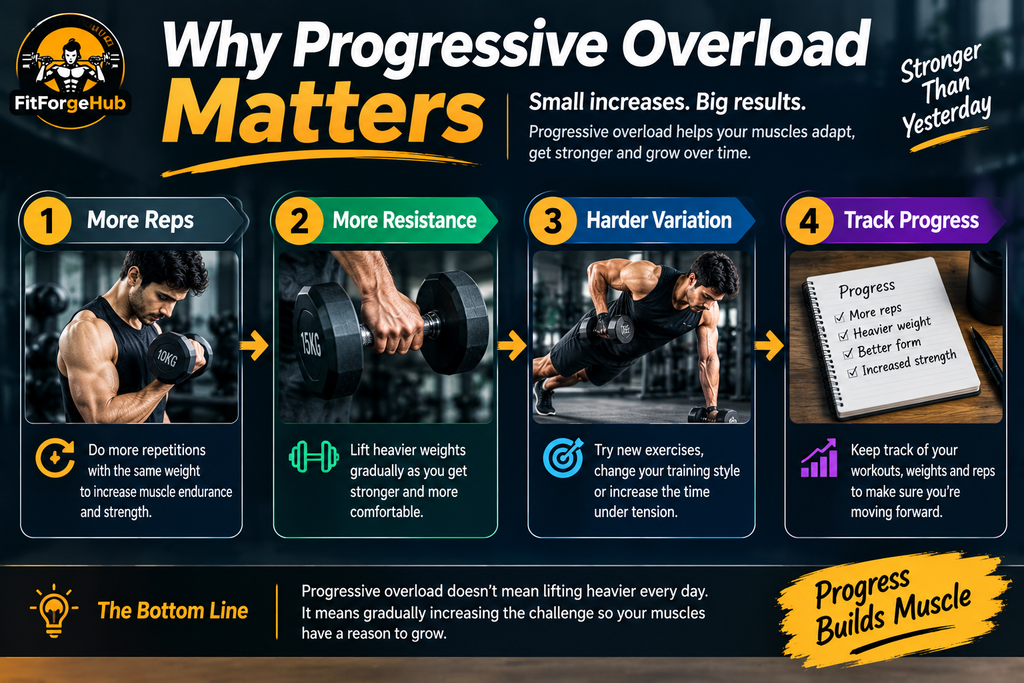
Imagine doing exactly:
10 push-ups
with exactly the same difficulty every workout for a year.
At some point, your body may no longer be challenged in the same way.
That’s where progressive overload comes in.
You might progress from:
8 push-ups → 10 push-ups → 12 push-ups
Then move to a more challenging variation.
With dumbbells, you might progress from:
10 lb → 12 lb → 15 lb
when you’re ready and can maintain proper form.
The goal isn’t to make every workout brutally difficult.
The goal is to gradually increase the challenge.
How Nutrition Affects Muscle Growth
Training provides the stimulus.
Nutrition helps support the process.
A muscle-building diet doesn’t have to be complicated.
Build meals around foods such as:
Protein Sources
- Eggs
- Chicken
- Fish
- Greek yogurt
- Milk
- Beans
- Lentils
- Lean meat
- Tofu
- Cottage cheese
Carbohydrate Sources
- Rice
- Oats
- Potatoes
- Whole grains
- Fruits
- Beans
Healthy Fat Sources
- Nuts
- Seeds
- Avocado
- Olive oil
- Nut butters
And don’t forget vegetables and adequate fluids.
For a related guide:
[What to Eat Before and After Workout for Muscle Gain]
Do You Need a Calorie Surplus?
Not necessarily in every situation.
If your primary goal is maximizing muscle gain, consuming enough energy to support training is important.
A modest calorie surplus can support muscle gain for some people, particularly when combined with resistance training.
However, calorie needs are individual.
Your goal, body composition, activity level, training history, and current diet all matter.
Avoid assuming that “eat as much as possible” is a muscle-building strategy.
Large amounts of unnecessary weight gain can make body-composition goals harder.
How Much Protein Do You Need?
Protein needs vary from person to person.
You don’t automatically need protein supplements to build muscle.
Many people can get plenty of protein from normal foods.
If you’re unsure about your personal nutrition needs, especially if you have a medical condition or specific dietary requirements, consider speaking with a registered dietitian or qualified healthcare professional.
For most beginners, improving overall diet quality is a better starting point than immediately buying expensive supplements.
Why Sleep and Recovery Matter
Your workout is only one part of the process.
Recovery matters too.
Try to maintain:
- A consistent sleep schedule
- Adequate food intake
- Rest days
- Manageable training volume
- Reasonable stress levels
If you’re constantly exhausted, your workouts may suffer.
A sustainable program should challenge you without making every day feel like a recovery battle.
Can You Build Muscle at Home?
Yes.
You don’t need a commercial gym to begin resistance training.
Depending on your training level, you can use:
- Bodyweight exercises
- Dumbbells
- Resistance bands
- Adjustable dumbbells
- A stable bench or floor
- Other appropriate resistance equipment
FitForgeHub already has a beginner guide covering bodyweight muscle building:
[How to Build Muscle at Home Without Weights]
That article explains exercises such as push-ups, squats, lunges, glute bridges, chair dips and planks, along with a simple beginner routine. (fitforgehub.com)
Can Skinny Beginners Build Muscle?
Yes.
Being naturally thin doesn’t mean you cannot build muscle.
However, you need to focus on the same fundamentals:
- Resistance training
- Progressive overload
- Adequate calories
- Enough protein
- Recovery
- Consistency
If you’re starting from a lower body weight, consistently eating enough food may be particularly important.
Avoid trying to gain weight as quickly as possible.
A gradual approach is usually easier to manage.
For a related FitForgeHub guide:
[Dumbbell Workout for Skinny Beginners]
Why You May Not See Results Yet
If you’ve been training for a few weeks and don’t see a dramatic difference, don’t automatically assume your program isn’t working.
Check these areas.
Are You Training Consistently?
If you train once and then skip a week, your progress will be harder to measure.
Are You Progressing?
Write down your:
- Exercises
- Sets
- Repetitions
- Resistance
If your performance never changes, your program may need adjustment.
Are You Eating Enough?
If you’re trying to gain muscle but consistently undereating, gaining size may be more difficult.
Are You Sleeping?
Poor recovery can affect your ability to train effectively.
Are You Comparing Yourself Too Often?
Daily mirror checks can make gradual progress difficult to notice.
Take photos under similar conditions every few weeks if you want a visual record.
Common Muscle-Building Mistakes
1. Expecting Results in 7 Days
Muscle growth is a gradual process.
2. Changing Programs Every Week
Give your routine enough time to evaluate progress.
3. Training Every Day
More isn’t automatically better.
4. Using Too Much Weight
Heavy weights with poor technique can make exercises unnecessarily difficult.
5. Ignoring Legs
A balanced program should train the major muscle groups.
6. Focusing Only on Supplements
Supplements cannot replace consistent training and a balanced diet.
7. Not Tracking Progress
If you don’t record your workouts, it becomes harder to see gradual improvements.
8. Comparing Yourself to Advanced Lifters
Your starting point matters.
How to Track Your Muscle-Building Progress
Don’t rely only on body weight.
Track several things.
1. Strength
Can you lift more resistance?
2. Repetitions
Can you perform more controlled reps?
3. Measurements
You can occasionally measure areas such as:
- Arms
- Chest
- Waist
- Thighs
4. Progress Photos
Take photos under similar:
- Lighting
- Clothing
- Camera angle
- Distance
5. Body Weight
Track it consistently if gaining or losing weight is part of your goal.
6. Workout Performance
Keep a simple workout log.
For example:
Dumbbell Shoulder Press
Week 1: 10 lb × 8 reps
Week 2: 10 lb × 10 reps
Week 3: 10 lb × 12 reps
Week 4: 12 lb × 8 reps
That’s measurable progress.
A Simple Beginner Muscle-Building Plan
If you’re just starting, you don’t need a complicated bodybuilding split.
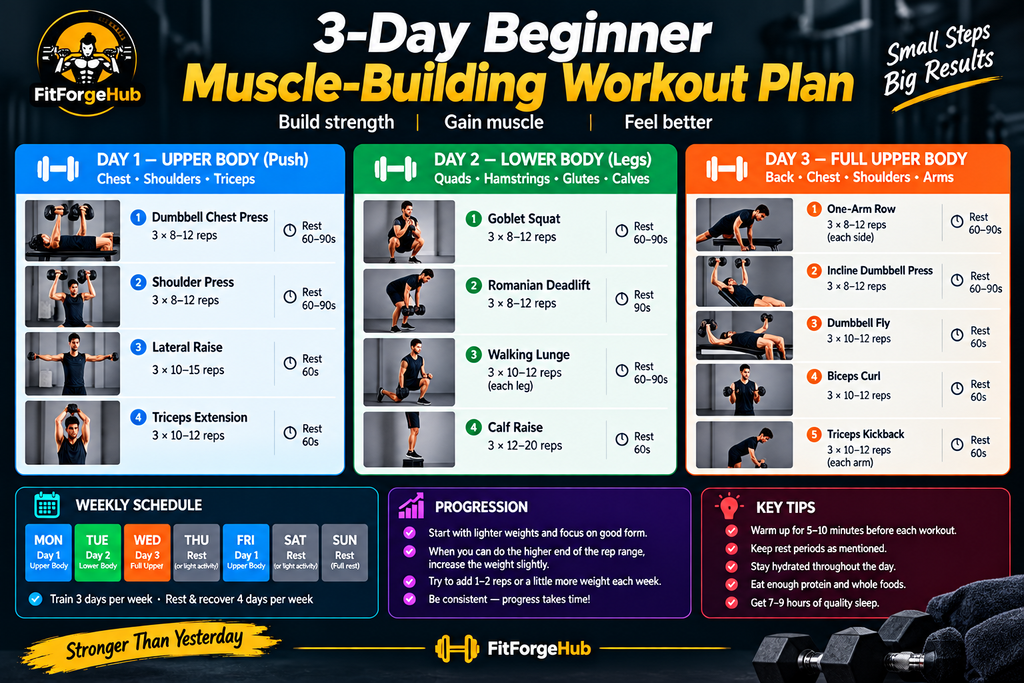
Try this structure:
Monday — Full Body
- Squats
- Dumbbell chest press
- Dumbbell row
- Shoulder press
- Biceps curl
- Plank
Wednesday — Full Body
- Romanian deadlift
- Push-ups
- One-arm dumbbell row
- Lateral raises
- Triceps extension
- Reverse crunch
Friday — Full Body
Repeat Monday while trying to improve technique or repetitions.
Start with manageable resistance.
As you become stronger, gradually increase the challenge.
For a more complete beginner routine, use:
[Best Beginner Muscle Building Workout at Home]
FitForgeHub’s existing article already provides a beginner-friendly full-body structure and discusses progressive overload, recovery, and nutrition. (fitforgehub.com)
Frequently Asked Questions
How long does it take to see muscle growth?
There is no universal timeline. Beginners may notice strength and performance improvements within several weeks, while visible muscle-size changes generally require consistent training over a longer period.
Can I build noticeable muscle in 30 days?
You may improve strength and training performance in 30 days, but significant visual muscle growth should not be guaranteed. Muscle development is a gradual process.
How long does it take to build muscle?
There is no single timeline for everyone. Beginners may notice strength improvements within several weeks, while visible muscle growth generally requires consistent training over a longer period.
Can beginners build muscle faster?
Beginners can sometimes experience relatively quick improvements because they are adapting to a new training stimulus. That doesn’t mean everyone will experience the same rate of muscle growth.
How many days a week should I work out to build muscle?
For many beginners, 2–3 resistance-training sessions per week can be a practical starting point. The major muscle groups should be trained regularly while allowing appropriate recovery.
Can I build muscle at home?
Yes. Bodyweight exercises, dumbbells and resistance bands can all be used for resistance training at home.
Do I need to lift heavy weights to build muscle?
Not necessarily. You need sufficient resistance and progressive challenge. The appropriate load depends on the exercise, your experience and your ability to maintain good form.
Does protein make muscles grow faster?
Protein supports muscle repair and growth, but protein alone doesn’t build muscle without an appropriate training stimulus.
Is it possible to build muscle after age 30?
Yes. Adults can improve strength and build muscle through resistance training. The rate of progress can vary with age and other individual factors.
Should I work out every day to build muscle?
No. You don’t need hard resistance workouts every day. Rest and recovery are important components of a sustainable training plan.
Why am I not gaining muscle even though I work out?
Possible reasons include inconsistent training, insufficient progression, inadequate food intake, insufficient protein, poor recovery, unrealistic expectations, or a program that doesn’t match your goal.
Final Thoughts
So, how long does it take to build muscle?
The most honest answer is:
It takes time, consistency and progressive training.
You may notice strength improvements within the first several weeks. More visible muscle development generally requires continued training over a longer period.
Instead of looking for a magic 30-day transformation, focus on what you can control:
Train consistently.
Progress gradually.
Eat appropriately.
Get enough protein.
Sleep and recover.
Track your progress.
If you follow those basics for months rather than days, you’ll have a much better foundation for long-term muscle development.
And remember: your first goal isn’t to become an advanced lifter.
Your first goal is to become someone who trains consistently.
About the Author
Riaz Ahmed
Riaz Ahmed holds a Master’s degree in Health and Physical Education and is the founder of FitForgeHub, where he shares practical fitness and workout information for beginners and fitness enthusiasts.
His goal through FitForgeHub is to make exercise, strength training, workout planning and healthy fitness habits easier to understand and apply in everyday life.
Learn more about FitForgeHub and its mission on the [About Us] page.
Disclaimer
The information published on FitForgeHub is intended for general educational purposes and is not medical advice. Fitness and nutrition needs vary between individuals. If you have an injury, medical condition, or concerns about starting a new exercise program, consult an appropriately qualified healthcare professional.