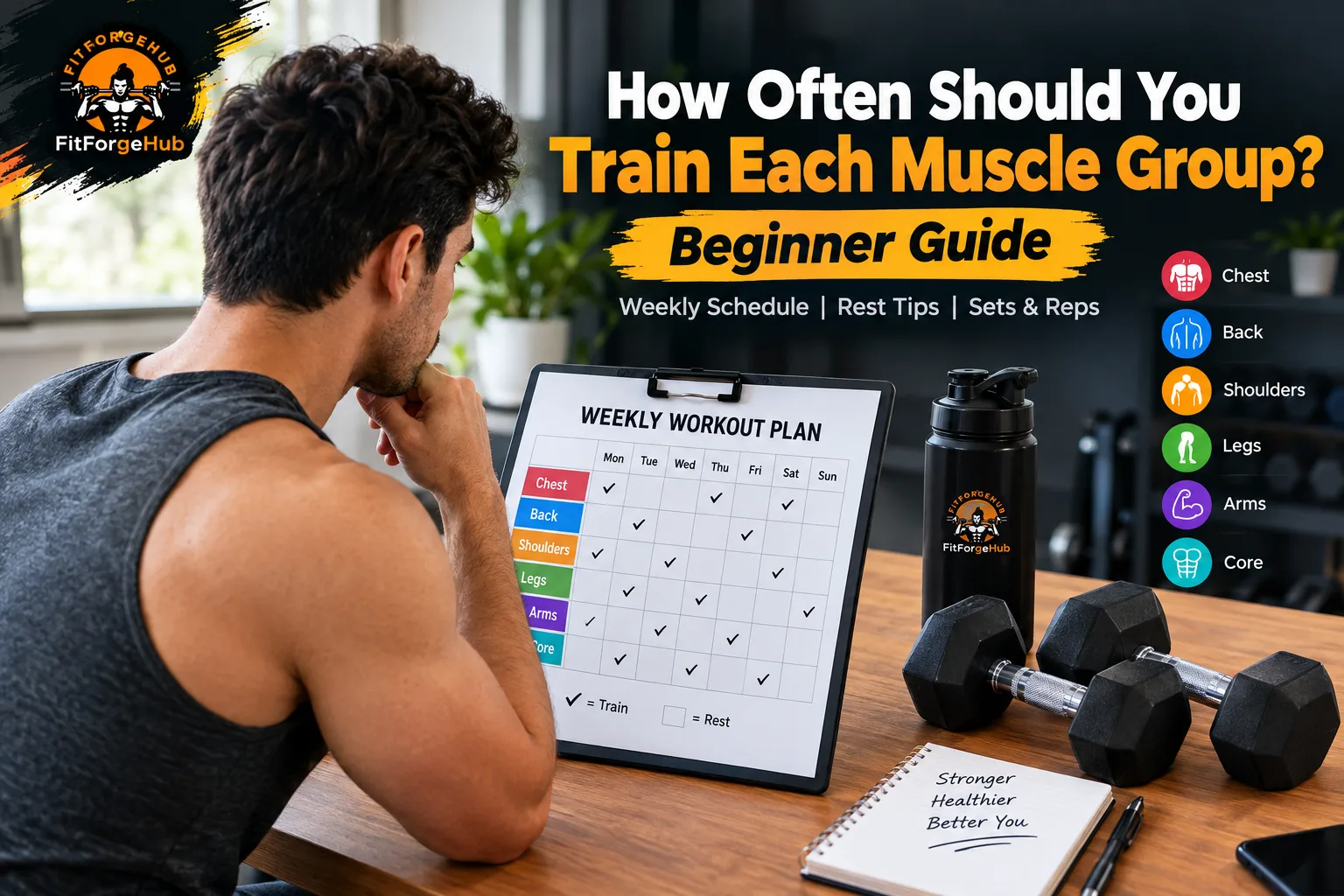
Training Frequency Guide for Beginners and Home Workouts
If you’re trying to build muscle or get stronger, one question eventually comes up:
One of the most common questions beginners ask is: how often should you train each muscle group to build muscle and strength?
How often should you train each muscle group?
Understanding how often should you train each muscle group can help you organize your workouts and recovery more effectively.
Should you train your chest once a week? Twice a week? Can you train your shoulders every day? And how much rest does a muscle actually need?
For beginners, these questions can make fitness seem much more complicated than it needs to be.
The good news is that you don’t need a complicated bodybuilding split to make progress. A simple, consistent resistance-training routine that trains the major muscle groups regularly can work very well.
For most beginners, training each major muscle group around two times per week is a practical starting point. However, the best frequency depends on your training experience, total weekly workload, recovery, schedule, and goals.
This guide explains how often to train each muscle group, how to organize your weekly workouts, when to take rest days, and how to adjust your routine as you become stronger.
Quick Answer: Most beginners can start by training each major muscle group about 2 times per week, while allowing enough recovery between challenging sessions. A full-body workout 2–3 times per week is one simple way to achieve this.
Table of Contents
- What Does Training Frequency Mean?
- How Often Should Beginners Train Each Muscle Group?
- How Often Should You Train Chest?
- How Often Should You Train Back?
- How Often Should You Train Shoulders?
- How Often Should You Train Legs?
- How Often Should You Train Biceps?
- How Often Should You Train Triceps?
- How Often Should You Train Abs and Core?
- Can You Train the Same Muscle Two Days in a Row?
- How Much Rest Does a Muscle Need?
- Full-Body vs Split Training
- Best Weekly Workout Schedule for Beginners
- Example 3-Day Full-Body Workout
- Example 4-Day Upper/Lower Split
- How Many Sets Per Muscle Group?
- How to Know If You’re Training Too Much
- How to Know If You’re Recovering Well
- How to Increase Training Frequency Safely
- Common Muscle Training Frequency Mistakes
- Training Frequency for Muscle Gain
- Training Frequency for Strength
- Frequently Asked Questions
- Final Thoughts
- About the Author
What Does Training Frequency Mean?
Training frequency simply means how often you train a particular muscle group during a specific period, usually one week.
For example:
If you train your chest on:
- Monday
- Thursday
your chest training frequency is 2 times per week.
Frequency is different from training volume.
Training Frequency
How often you train.
Training Volume
How much total training you perform.
For example, you might train your chest twice per week and perform three sets each session.
That gives you:
2 sessions × 3 sets = 6 sets per week
Understanding this difference makes it much easier to build a sensible workout program.
How Often Should Beginners Train Each Muscle Group?
For most beginners, two training sessions per week per major muscle group is a useful target.
That doesn’t mean you must follow exactly two sessions forever.
Your ideal frequency can change as you gain experience.
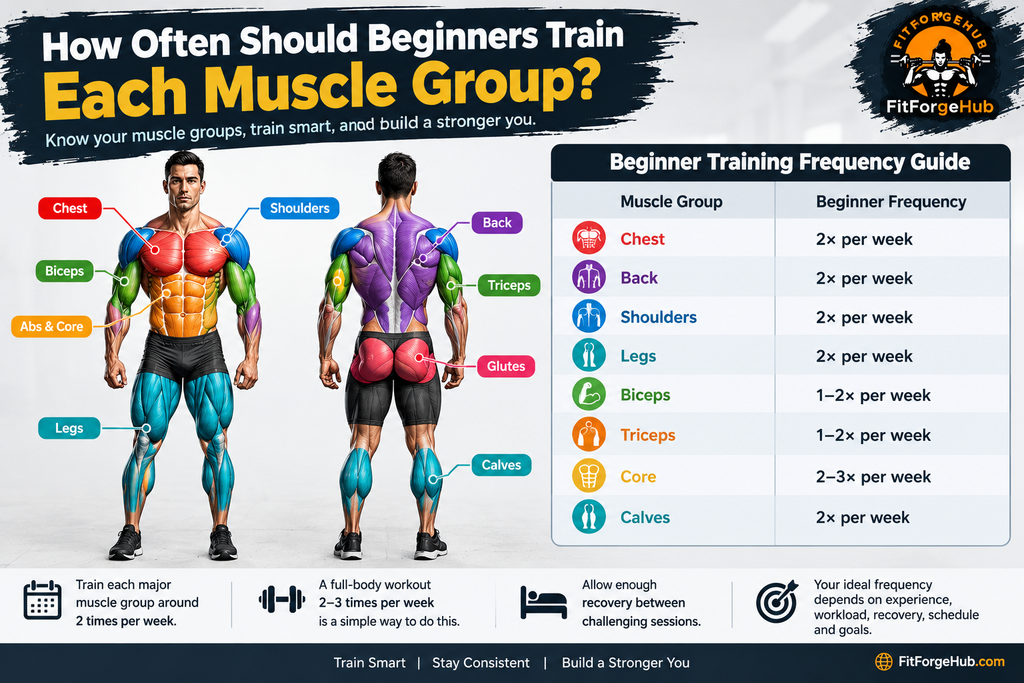
A beginner-friendly guide to training each major muscle group and planning weekly workout frequency.The American College of Sports Medicine’s current resistance-training guidance emphasizes consistency and recommends training all major muscle groups at least twice per week, while gradually building your routine around your goals and schedule.
For someone new to resistance training, a simple full-body routine can therefore be an excellent option.
Beginner Frequency Guide
| Muscle Group | Beginner Frequency |
| Chest | 2× per week |
| Back | 2× per week |
| Shoulders | 2× per week |
| Legs | 2× per week |
| Biceps | 1–2× per week |
| Triceps | 1–2× per week |
| Core | 2–3× per week |
| Calves | 2× per week |
These are practical starting points, not strict rules.
Your indirect training also matters.
For example, pressing exercises train the triceps and shoulders in addition to the chest.
How Often Should You Train Chest?
If you’re wondering how often should you train each muscle group, chest training twice per week is a practical starting point for many beginners.
You don’t need to perform a huge chest workout every session.
For example:
Monday
Dumbbell Chest Press — 3 sets
Thursday
Dumbbell Floor Press — 3 sets
This gives you regular exposure to the movement while leaving recovery time between sessions.
If you’re training at home, check out:
Best Dumbbell Chest Workout at Home
The goal isn’t to destroy your chest every workout.
The goal is to train it consistently and gradually improve.
How Often Should You Train Back?
A beginner can generally train the back around two times per week.
Useful exercises include:
- One-arm dumbbell rows
- Dumbbell rows
- Resistance-band rows
- Reverse flyes
For example:
Monday: Dumbbell Row
Thursday: One-Arm Dumbbell Row
As you become stronger, you can gradually increase your weekly training volume.
For a complete routine:
Best Dumbbell Back Workout at Home
How Often Should You Train Shoulders?
Beginners can generally train their shoulders about two times per week.
But there’s an important detail.
Your shoulders are already involved in several upper-body exercises.
For example:
- Chest presses involve the front shoulders.
- Shoulder presses directly train the shoulders.
- Rows involve the rear shoulder muscles.
Because of this overlap, you don’t necessarily need a huge amount of direct shoulder work.
A simple combination might include:
- Dumbbell shoulder press
- Lateral raises
- Rear-delt/reverse-fly movement
For a dedicated routine:
Best Dumbbell Shoulder Workout at Home
How Often Should You Train Legs?
Don’t treat leg training as an optional part of your routine.
For beginners, training the lower body twice per week is a practical target.
Your sessions can include:
- Goblet squats
- Romanian deadlifts
- Lunges
- Split squats
- Calf raises
You don’t need dozens of exercises.
Knowing how often should you train each muscle group also helps you avoid doing too much leg training without enough recovery.
A few well-performed movements can provide a solid foundation.
Read:
Best Dumbbell Leg Workout for Beginners
How Often Should You Train Biceps?
Your biceps don’t necessarily need a separate workout several times per week.
They already work during pulling exercises such as rows.
For many beginners, 1–2 direct biceps sessions per week is enough to start.
For example:
Monday: Dumbbell curls
Friday: Dumbbell curls
Start with a modest amount of work and increase gradually.
Doing curls every day isn’t automatically going to produce faster results.
How Often Should You Train Triceps?
The triceps work during pressing movements such as:
- Chest presses
- Push-ups
- Shoulder presses
Therefore, they already receive indirect training.
You can add direct exercises such as:
- Dumbbell overhead triceps extension
- Dumbbell kickbacks
For beginners, 1–2 direct sessions per week can be sufficient.
How Often Should You Train Abs and Core?
Your core is involved in many exercises, including:
- Squats
- Romanian deadlifts
- Rows
- Lunges
- Overhead presses
You can also train the core directly 2–3 times per week.
Simple exercises include:
- Planks
- Dead bugs
- Reverse crunches
- Leg raises
You don’t need to perform hundreds of repetitions every day.
Quality and consistency matter more.
Can You Train the Same Muscle Two Days in a Row?
Sometimes, but beginners generally don’t need to.
If you perform a challenging workout for a muscle group, giving it recovery time before another hard session can make your training easier to manage.
For example:
Monday: Full body
Tuesday: Rest
Wednesday: Full body
Thursday: Rest
Friday: Full body
This is one reason full-body training three times per week works well for many beginners.
The current ACSM guidance also emphasizes consistency over complicated programming and recommends gradually building your training around your goals and ability.
How Much Rest Does a Muscle Need?
There isn’t one exact number of hours that every muscle requires.
Recovery depends on:
- Training volume
- Training intensity
- Exercise selection
- Sleep
- Nutrition
- Training experience
- Stress
- Overall activity
Instead of obsessing over a specific number of hours, pay attention to how you perform in your next session.
If you’re consistently exhausted, unusually sore, losing strength, or struggling to complete your normal workouts, your program may need adjustment.
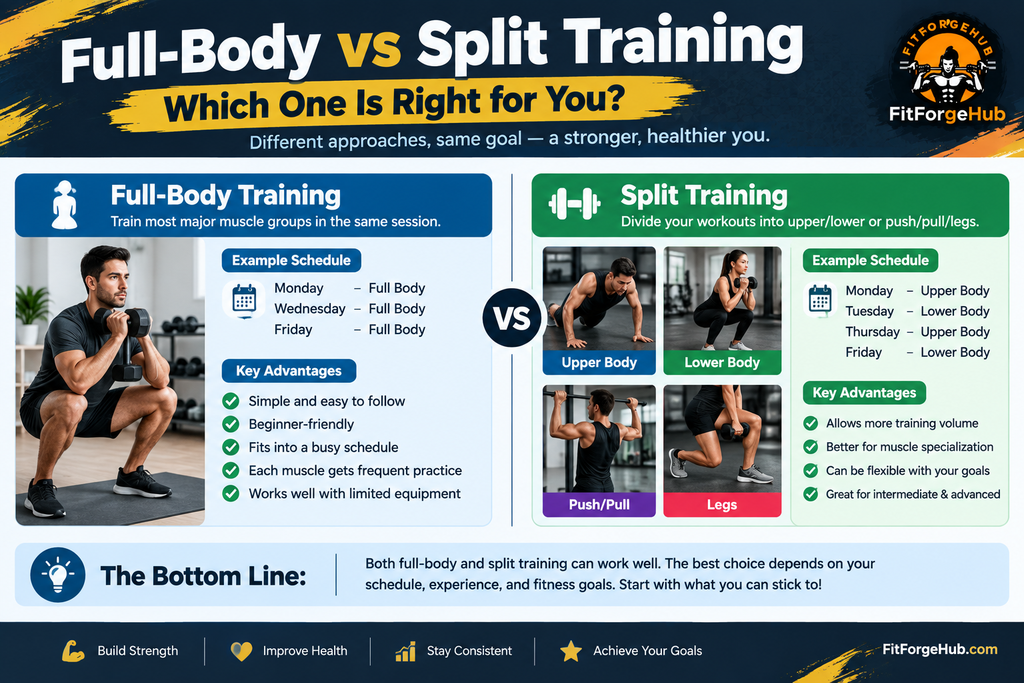
Full-Body vs Split Training
There are several ways to organize your workouts.
Choosing between full-body and split training depends partly on how often should you train each muscle group and how many days you can consistently work out.
Full-Body Training
You train most major muscle groups during the same session.
Example:
Monday: Full Body
Wednesday: Full Body
Friday: Full Body
Advantages
- Simple
- Beginner-friendly
- Easy to schedule
- Each muscle gets frequent practice
- Works well with limited equipment
Upper/Lower Split
You divide your body into upper and lower sessions.
Example:
Monday: Upper Body
Tuesday: Lower Body
Thursday: Upper Body
Friday: Lower Body
This can work well when you want more training volume without making every session a full-body workout.
Push/Pull/Legs
The traditional PPL structure divides training into:
Push: Chest, shoulders, triceps
Pull: Back, biceps
Legs: Quads, hamstrings, glutes, calves
It can be effective, but beginners don’t necessarily need to start here.
If your schedule only allows three workouts per week, a full-body routine may be easier.
Best Weekly Workout Schedule for Beginners
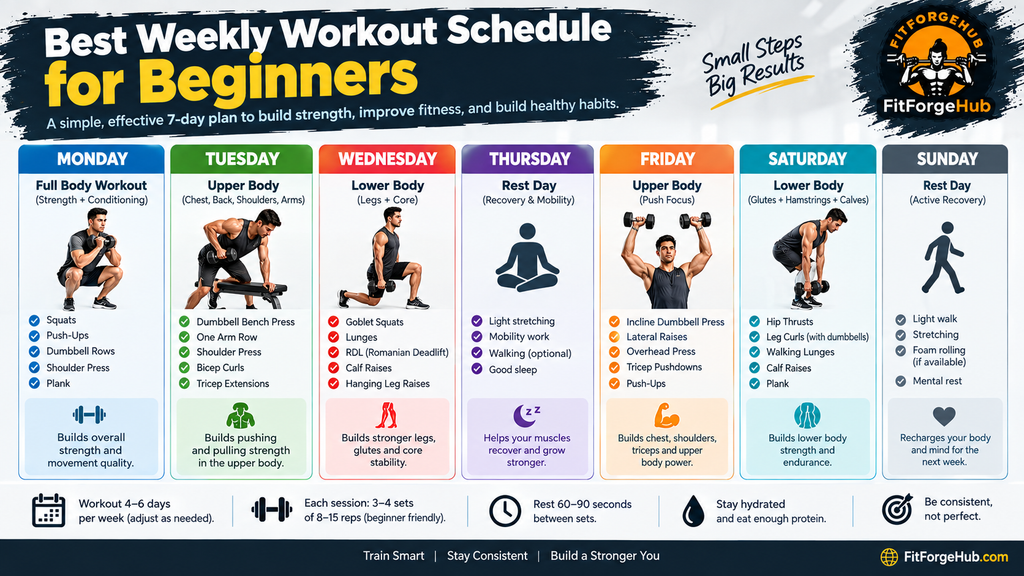
Here’s a simple three-day plan.
| Day | Workout |
| Monday | Full Body |
| Tuesday | Rest |
| Wednesday | Full Body |
| Thursday | Rest |
| Friday | Full Body |
| Saturday | Light activity |
| Sunday | Rest |
This allows regular resistance training while keeping rest days between the main sessions.
The broader physical-activity guidance also recommends muscle-strengthening activities involving the major muscle groups on at least two days per week.
Example 3-Day Full-Body Workout
Workout A
| Exercise | Sets | Reps |
| Goblet Squat | 3 | 8–12 |
| Dumbbell Chest Press | 3 | 8–12 |
| One-Arm Row | 3 | 8–12 |
| Shoulder Press | 2 | 8–12 |
| Biceps Curl | 2 | 10–15 |
| Plank | 2 | 20–45 sec |
Workout B
| Exercise | Sets | Reps |
| Romanian Deadlift | 3 | 8–12 |
| Dumbbell Floor Press | 3 | 8–12 |
| Dumbbell Row | 3 | 8–12 |
| Lateral Raise | 2 | 10–15 |
| Triceps Extension | 2 | 10–15 |
| Reverse Crunch | 2 | 10–15 |
You can alternate:
Week 1: A / B / A
Week 2: B / A / B
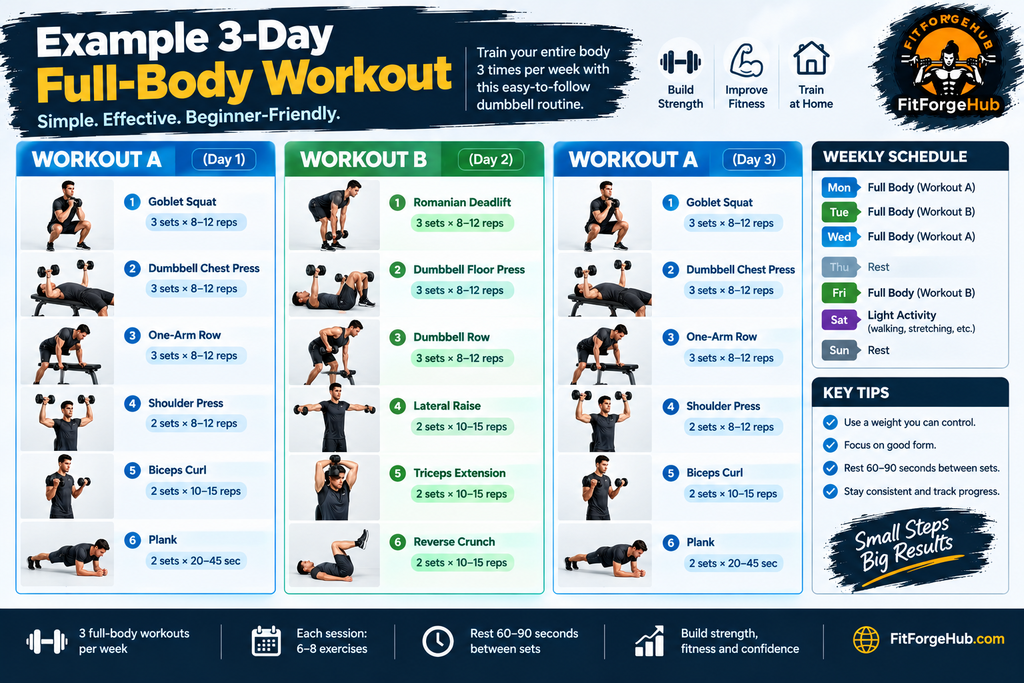
This gives you variety without constantly changing your program.
For your complete dumbbell reference guide:
Complete Dumbbell Workout Guide for Beginners
Example 4-Day Upper/Lower Split
If you eventually want a four-day routine, try:
| Day | Workout |
| Monday | Upper Body |
| Tuesday | Lower Body |
| Wednesday | Rest |
| Thursday | Upper Body |
| Friday | Lower Body |
| Saturday | Rest |
| Sunday | Rest |
This setup trains the major muscle groups approximately twice per week.
However, don’t move to four days simply because you think more workouts automatically mean faster results.
Your schedule should fit your lifestyle.
How Many Sets Per Muscle Group?
Training frequency and weekly volume should be considered together.
For example:
Training chest twice a week with:
3 sets Monday + 3 sets Thursday
gives you:
6 weekly sets.
Another person might use:
4 sets Monday + 4 sets Thursday = 8 weekly sets.
The amount of volume you need depends on your training status and goal.
The 2026 ACSM resistance-training guidance highlights approximately 10 weekly sets per muscle group as a useful hypertrophy-oriented reference point, but it also emphasizes individualization and consistency rather than treating one number as mandatory for everyone.
If you’re a beginner, there’s no need to immediately chase a high-volume program.
Start manageable.
Then build gradually.
How to Know If You’re Training Too Much
More training isn’t always better.
Possible warning signs include:
- Your performance keeps declining
- You feel unusually exhausted
- Muscle soreness remains severe for long periods
- Your normal weights suddenly feel much harder
- You’re losing motivation
- Your sleep is becoming worse
- Minor aches keep appearing
One bad workout doesn’t necessarily mean you’re overtraining.
Look for a consistent pattern.
If something feels wrong or you experience significant pain, stop the exercise and seek appropriate professional advice.
How to Know If You’re Recovering Well
Good recovery doesn’t mean you must feel completely fresh every day.
Useful signs include:
- Your strength is stable or improving
- Your technique is improving
- You can complete your planned workouts
- Normal muscle soreness resolves
- You’re sleeping reasonably well
- You’re motivated to train
- Your overall energy is manageable
Your workout log can be extremely useful here.
Record:
Exercise → Weight → Sets → Reps
Over time, you’ll be able to see whether you’re actually progressing.
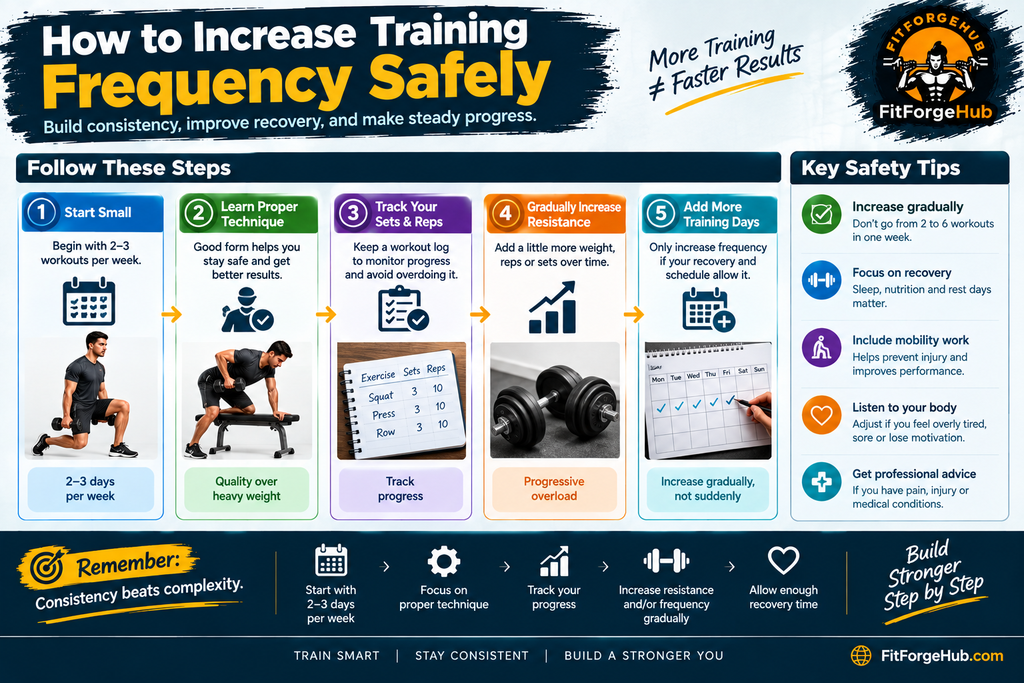
How to Increase Training Frequency Safely
Don’t suddenly go from two workouts per week to six.
Increase gradually.
Step 1
Start with 2–3 weekly workouts.
Step 2
Learn proper technique.
Step 3
Track your sets and repetitions.
Step 4
Gradually increase resistance or repetitions.
Step 5
Only add training days if your recovery and schedule support them.
Remember:
Consistency beats complexity.
The 2026 ACSM position stand specifically emphasizes that consistency is more important than creating a complicated program.
Common Muscle Training Frequency Mistakes
Mistake 1: Training Every Muscle Every Day
You don’t need to train every muscle daily.
Mistake 2: Copying an Advanced Bodybuilding Routine
A routine designed for an experienced lifter may not be appropriate for a beginner.
Mistake 3: Ignoring Recovery
Training is only one part of progress.
Mistake 4: Doing Too Many Sets
More volume isn’t automatically better.
Mistake 5: Changing Your Program Constantly
Give your program enough time to evaluate your progress.
Mistake 6: Forgetting Indirect Training
Chest pressing also involves the triceps and front shoulders.
Rows also involve the biceps and rear shoulders.
Take this overlap into account.
Mistake 7: Training Through Pain
Normal training discomfort isn’t the same as significant pain.
If an exercise causes unusual or significant pain, stop and get appropriate advice.
Training Frequency for Muscle Gain
If your main goal is muscle growth, your priorities should be:
- Consistent resistance training
- Appropriate weekly volume
- Progressive overload
- Adequate nutrition
- Enough protein
- Quality sleep
- Recovery
Frequency helps you distribute your weekly workload.
It isn’t magic by itself.
For example, six weekly chest sets can be performed as:
6 sets once per week
or:
3 sets twice per week
For many beginners, spreading the work over two sessions can make individual workouts more manageable.
When deciding how often should you train each muscle group for muscle growth, consider your weekly volume, recovery, and training experience.
Training Frequency for Strength
Strength training has additional considerations.
You need regular practice of the movements you’re trying to improve.
For beginners, full-body training can be particularly useful because you repeatedly practice fundamental movements such as:
- Squatting
- Pressing
- Pulling
- Hinges
As you become more experienced, your training can become more specialized.
Frequently Asked Questions
How often should you train each muscle group as a beginner?
For most beginners, how often should you train each muscle group comes down to recovery, schedule, and total weekly workload. Training major muscle groups around twice per week is a practical starting point.
Can I train the same muscle every day?
You generally don’t need to. Frequent hard training can make recovery and performance harder to manage.
Is once-a-week training enough to build muscle?
It can contribute to progress, but beginners may find it easier to distribute their weekly work across multiple sessions.
Should beginners train 3 or 5 days a week?
Either can work. For many beginners, 2–3 resistance-training sessions per week are easier to recover from and maintain consistently.
How many rest days should I take?
There isn’t one universal number. Your rest needs depend on training volume, intensity, experience, sleep, nutrition, and your overall activity.
Can I train chest and triceps on the same day?
Yes. They both contribute to pushing movements, so training them together can be convenient.
Can I train legs twice a week?
Yes. Two lower-body sessions per week can be a practical approach for beginners and intermediate trainees.
Should I train abs every day?
No. Daily abdominal training isn’t necessary for most people.
How often should I train biceps?
One or two direct sessions per week can be enough for many beginners, especially because pulling exercises already train the biceps.
What if I’m still sore when my next workout arrives?
Consider reducing the workout volume or intensity and allowing additional recovery if necessary. Persistent or severe pain should be evaluated by an appropriate healthcare professional.
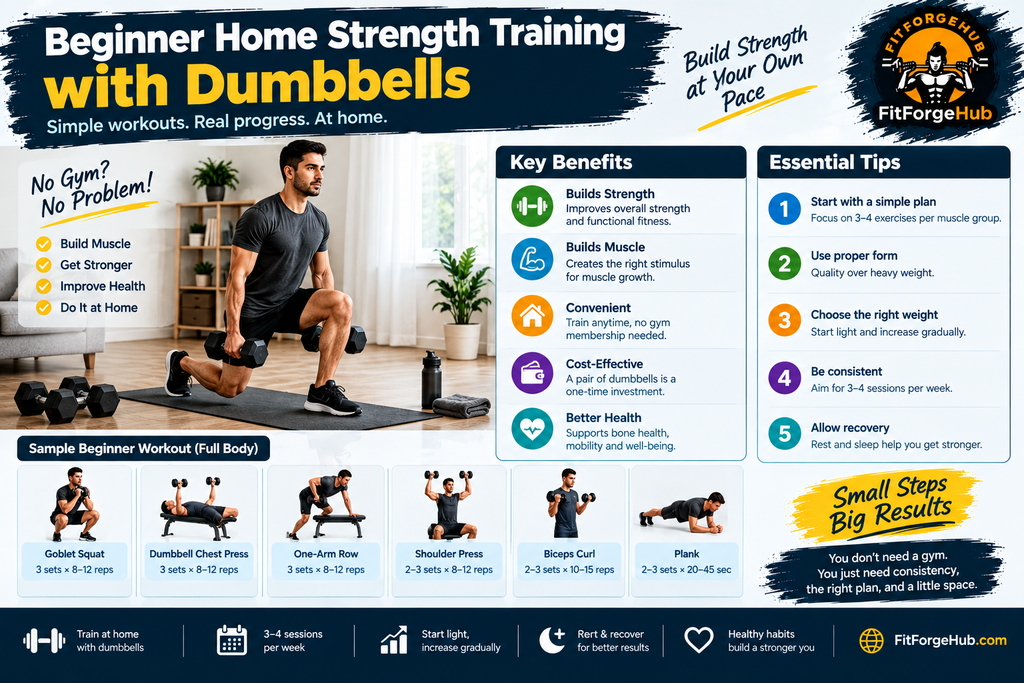
Beginners can build strength at home with simple resistance training, consistent workouts, gradual progression, and adequate recovery.Final Thoughts
You don’t need to train every muscle every day to build strength or muscle.
For most beginners, a simple plan that trains the major muscle groups around two times per week is a strong starting point.
You could accomplish this with:
2–3 full-body workouts per week
or eventually move to:
a 4-day upper/lower split.
The important thing is not finding a magical training frequency.
It’s finding a schedule you can consistently follow while recovering well.
Start with manageable workouts.
Track your progress.
Increase the challenge gradually.
And give your body enough time to recover.
About the Author
Riaz Ahmed holds a Master’s degree in Health and Physical Education and is the founder of FitForgeHub, where he shares practical fitness and workout information.
Website: FitForgeHub.com
Disclaimer
The information provided in this article is for general educational purposes and is not medical advice. Exercise needs vary from person to person. If you have an injury, medical condition, or concerns about starting a new exercise program, speak with an appropriately qualified healthcare professional before beginning.