
Starting a workout routine at home can be one of the easiest ways to become more active, build strength, and improve your overall fitness. You don’t need an expensive gym membership or a home gym filled with equipment. With a little space, consistency, and the right exercises, beginners can build an effective workout routine at home.
If you’re wondering how to start working out at home as a beginner, this guide will show you exactly where to start, which exercises to choose, how often to train, and how to progress safely.
Table of Contents
- How Should a Beginner Start Working Out at Home?
- What Do You Need for a Home Workout?
- How Often Should Beginners Work Out at Home?
- 7 Best Beginner Exercises to Do at Home
- Beginner Full-Body Home Workout
- How Long Should a Beginner Workout at Home?
- How to Progress Your Home Workouts
- Should Beginners Work Out Every Day?
- Common Beginner Home Workout Mistakes
- Tips for Staying Consistent With Home Workouts
- Frequently Asked Questions
- Final Thoughts
- About the Author
Quick Answer: How Should a Beginner Start Working Out at Home?
Beginners should start with 3 full-body workouts per week, with at least one rest day between workouts. Focus on basic movement patterns such as squats, push-ups, lunges, glute bridges, and planks.
Start with 20–30 minute workouts and gradually increase the difficulty as your strength and fitness improve.
You don’t need to train every day. Consistency is more important than doing extremely difficult workouts.
What Do You Need for a Home Workout?
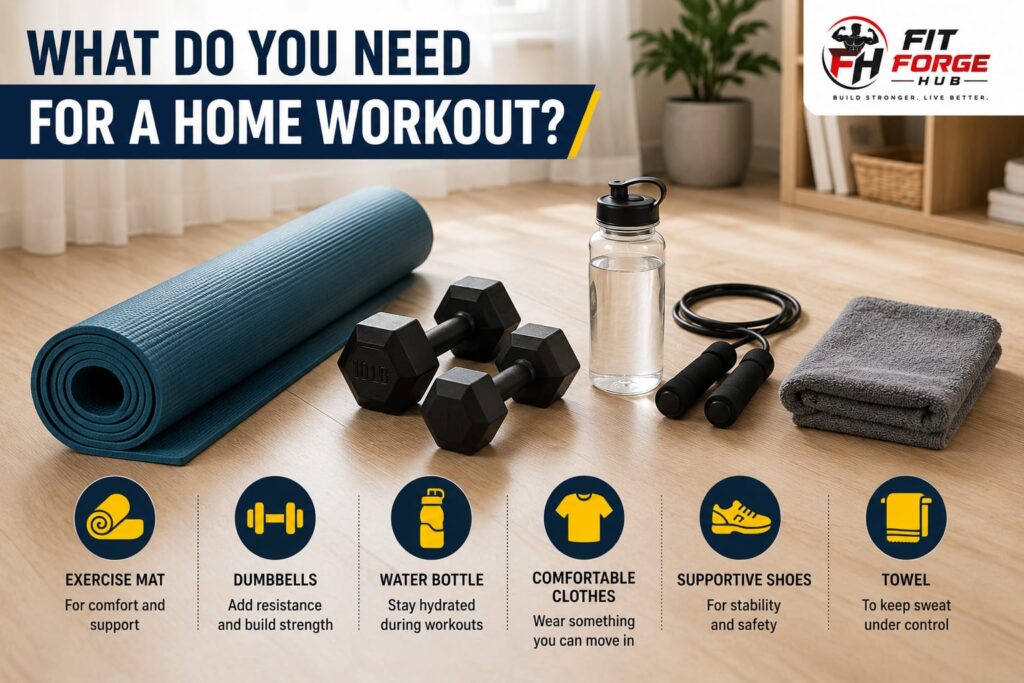
One of the biggest advantages of home workouts is that you can start with very little equipment.
For a beginner workout, you may only need:
- A small amount of open floor space
- A comfortable workout mat
- A water bottle
- Comfortable workout clothes
- A pair of dumbbells, if available
However, equipment is optional when you’re just getting started. Many effective beginner exercises use your body weight as resistance.
How Often Should Beginners Work Out at Home?
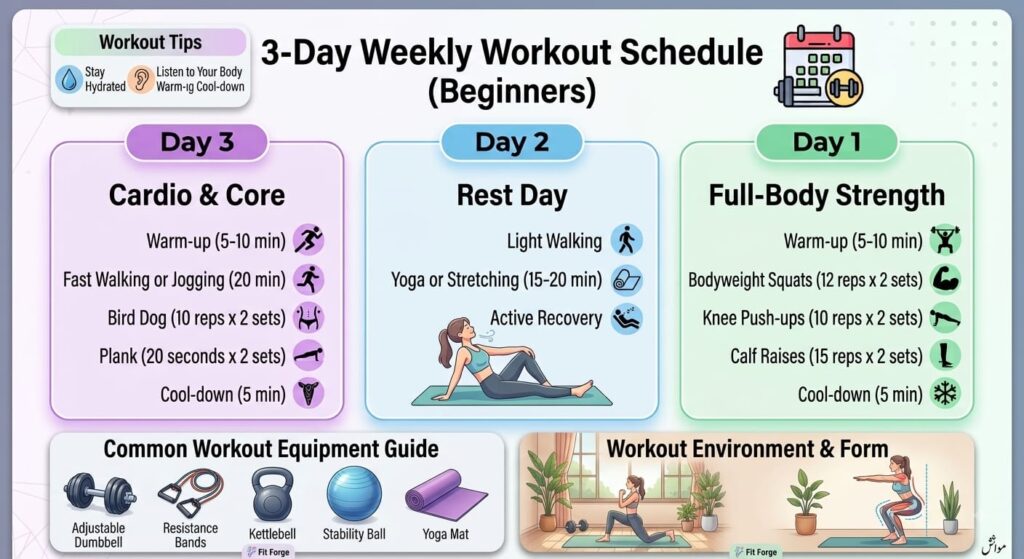
A good starting point for most beginners is 3 workout days per week.
For example:
| Day | Activity |
| Monday | Full-body workout |
| Tuesday | Rest or light activity |
| Wednesday | Full-body workout |
| Thursday | Rest |
| Friday | Full-body workout |
| Saturday | Light activity or optional cardio |
| Sunday | Rest |
This schedule gives your body time to recover between strength-training sessions.
If you’re completely new to exercise, start slowly and give yourself additional recovery time if you feel unusually tired or sore.
7 Best Beginner Exercises to Do at Home
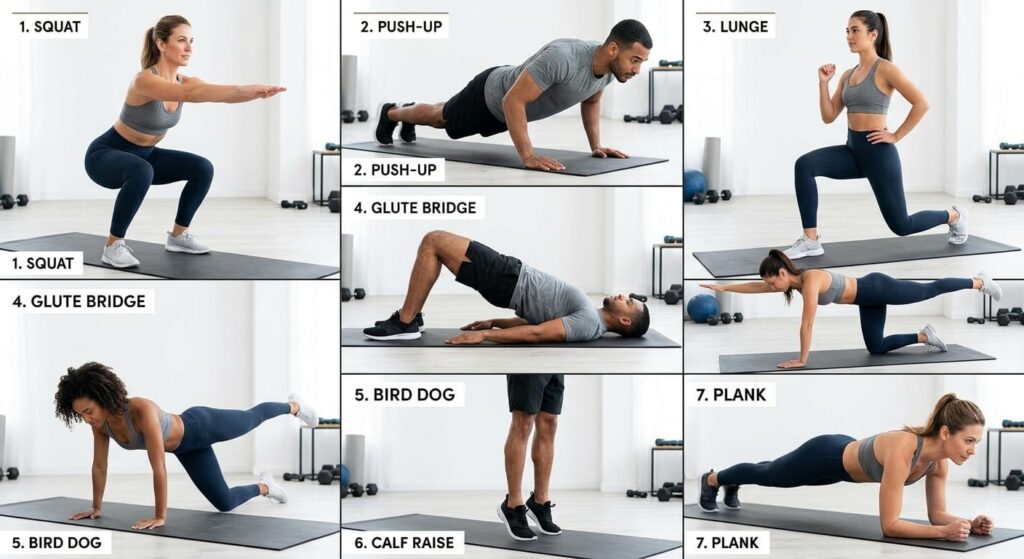
You don’t need complicated exercises when you’re starting. Focus on movements that train major muscle groups and help you develop basic strength.
1. Bodyweight Squats
Bodyweight squats are a simple lower-body exercise that primarily works the quadriceps, glutes, and hamstrings.
How to do them:
- Stand with your feet approximately shoulder-width apart.
- Keep your chest up and your core engaged.
- Bend your knees and push your hips back.
- Lower yourself as far as you can comfortably control.
- Push through your feet to return to the starting position.
Beginner target: 2–3 sets of 8–15 repetitions.
Focus on controlled movement rather than trying to perform as many repetitions as possible.
2. Incline Push-Ups
Traditional push-ups can be challenging for beginners. Incline push-ups are an easier variation because your hands are placed on an elevated, stable surface.
They work the chest, shoulders, triceps, and core.
How to do them:
- Place your hands on a stable elevated surface.
- Walk your feet back until your body forms a straight line.
- Bend your elbows and lower your chest toward the surface.
- Push yourself back to the starting position.
Beginner target: 2–3 sets of 6–12 repetitions.
As you become stronger, you can gradually progress to lower surfaces and eventually regular push-ups.
3. Reverse Lunges
Reverse lunges are a useful beginner-friendly exercise for developing lower-body strength and balance.
How to do them:
- Stand upright with your feet about hip-width apart.
- Step one foot backward.
- Lower your body under control.
- Push through the front foot to return to standing.
- Repeat on the opposite side.
Beginner target: 2–3 sets of 6–10 repetitions per leg.
Use a wall or sturdy support if you need help with balance.
4. Glute Bridges
Glute bridges primarily target the glutes while also involving the muscles around your hips and core.
How to do them:
- Lie on your back with your knees bent.
- Keep your feet flat on the floor.
- Tighten your core.
- Lift your hips toward the ceiling.
- Pause briefly at the top.
- Lower your hips slowly.
Beginner target: 2–3 sets of 10–15 repetitions.
Avoid using excessive momentum. Controlled repetitions are more useful than simply moving quickly.
5. Bird Dogs
Bird dogs are a beginner-friendly movement that challenges your core while requiring coordination and balance.
How to do them:
- Start on your hands and knees.
- Keep your back in a comfortable neutral position.
- Extend one arm and the opposite leg.
- Pause briefly.
- Return to the starting position.
- Repeat on the opposite side.
Beginner target: 2–3 sets of 6–10 repetitions per side.
Move slowly and avoid rotating your hips or shoulders.
6. Standing Calf Raises
Calf raises are easy to perform at home and require little or no equipment.
How to do them:
- Stand upright with your feet about hip-width apart.
- Hold onto a stable surface if necessary.
- Raise your heels off the floor.
- Pause briefly at the top.
- Lower your heels slowly.
Beginner target: 2–3 sets of 12–20 repetitions.
7. Plank
The plank is a simple exercise for developing core endurance.
How to do it:
- Place your forearms on the floor.
- Extend your legs behind you.
- Keep your body in a straight, comfortable line.
- Brace your core.
- Hold the position while maintaining good form.
Beginner target: 15–30 seconds for 2–3 sets.
If a full plank is too difficult, perform it with your knees on the floor.
Beginner Full-Body Home Workout
You can combine the exercises above into a simple beginner workout.
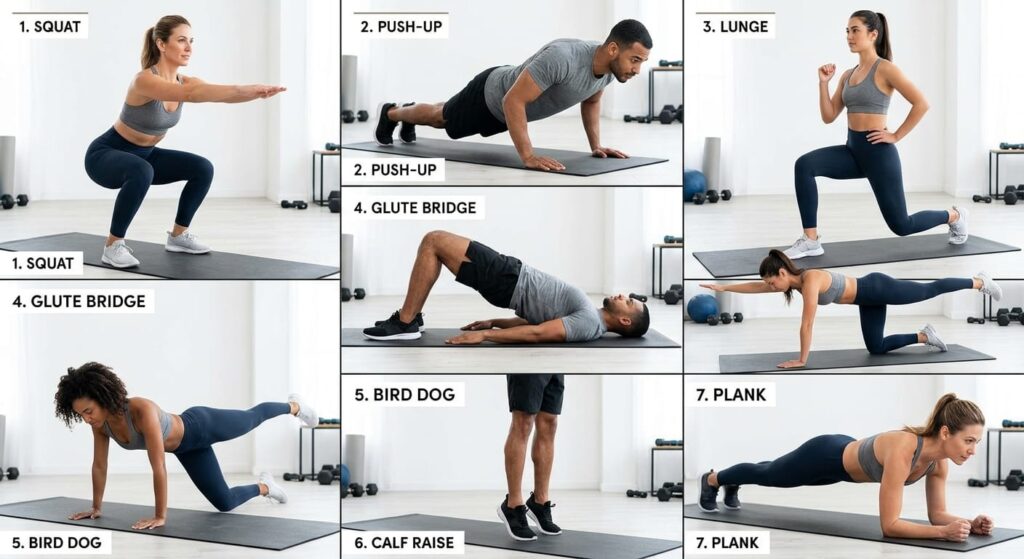
| Exercise | Sets | Reps/Time | Rest |
| Bodyweight Squats | 3 | 8–15 | 60–90 sec |
| Incline Push-Ups | 3 | 6–12 | 60–90 sec |
| Reverse Lunges | 2 | 6–10/leg | 60–90 sec |
| Glute Bridges | 3 | 10–15 | 60 sec |
| Bird Dogs | 2 | 6–10/side | 45–60 sec |
| Calf Raises | 2 | 12–20 | 45–60 sec |
| Plank | 2 | 15–30 sec | 45–60 sec |
You don’t have to complete every exercise on your first workout. If you’re new to exercise, start with fewer sets and gradually build up.
How Long Should a Beginner Workout at Home?
A beginner home workout can take approximately 20–30 minutes, including a short warm-up.
You don’t need to spend an hour exercising to make progress. The most important factors are consistency, appropriate exercise selection, recovery, and gradually increasing the challenge.
As your fitness improves, you can increase workout duration or difficulty.
How to Progress Your Home Workouts
One of the biggest mistakes beginners make is doing the same workout at the same difficulty level for months.
Your body needs an appropriate increase in challenge over time.
You can progress by:
- Adding a few repetitions
- Adding another set
- Using a more challenging exercise variation
- Slowing down the movement
- Reducing rest periods when appropriate
- Adding resistance with dumbbells or resistance bands
- Improving your exercise technique
For example, you might start with incline push-ups and later progress to knee push-ups and then regular push-ups.
The goal isn’t to make every workout extremely difficult. The goal is to gradually become stronger and more capable.
Should Beginners Work Out Every Day?
You don’t need to perform hard strength workouts every day.
For most beginners, three full-body strength sessions per week provide a practical starting point. On rest days, you can choose light activities such as walking, mobility work, or other comfortable movement.
Recovery is an important part of a training program because your body needs time to adapt to exercise.
If you’re new to exercise, starting with smaller amounts of activity and gradually increasing the duration, frequency, and intensity is recommended by the World Health Organization
The CDC’s Physical Activity Guidelines recommend regular aerobic activity along with muscle-strengthening activities during the week.
Common Beginner Home Workout Mistakes
1. Doing Too Much Too Soon
Starting with extremely long or intense workouts can make it harder to stay consistent.
Start at a manageable level and increase the challenge gradually.
2. Ignoring Exercise Form
More repetitions aren’t necessarily better if your technique breaks down.
Learn the basic movement pattern first, then increase repetitions or resistance.
3. Training the Same Muscles Every Day
Your muscles need recovery after challenging strength workouts. Avoid turning every day into an intense full-body session.
4. Changing Your Workout Every Few Days
Constantly changing exercises makes it harder to track progress.
Stick with a basic routine long enough to improve your technique and performance.
5. Expecting Results Overnight
Fitness takes time. Your results will depend on factors such as your starting point, training consistency, nutrition, sleep, recovery, and genetics.
Focus on gradual improvement instead of looking for instant results.
Tips for Staying Consistent With Home Workouts
The best workout routine is one you can actually follow.
Try these simple strategies:
- Schedule your workouts at a specific time.
- Start with realistic goals.
- Keep your workout clothes and equipment ready.
- Track your exercises and repetitions.
- Focus on improving gradually.
- Don’t worry about having a perfect workout every time.
- Take rest days when needed.
- Celebrate improvements in strength and consistency.
Even a short workout can be useful when it helps you maintain a consistent exercise habit.
Frequently Asked Questions
Can I start working out at home with no equipment?
How many days a week should a beginner work out?
Three full-body strength workouts per week can be a practical starting point for many beginners. Your ideal schedule may vary depending on your fitness level, recovery, and other activities.
Can I build muscle by working out at home?
Yes. You can develop strength and muscle with bodyweight exercises and home equipment. As you become stronger, adding resistance through dumbbells, resistance bands, or more challenging exercise variations can make workouts progressively harder.
Is 20 minutes enough for a beginner workout?
Yes. A focused 20-minute workout can be a useful starting point. Workout quality and consistency are more important than simply spending a long time exercising.
What should I do on rest days?
You can rest completely or perform light activities such as walking and gentle mobility work. If you are very sore or unusually fatigued, additional recovery may be appropriate.
Should I do cardio or strength training first?
It depends on your goals and the type of workout you’re doing. If improving strength is your main goal, performing strength exercises while you’re relatively fresh can be useful. You can include cardio separately or after strength training depending on your overall plan.
Final Thoughts
Starting a workout routine at home doesn’t need to be complicated. Begin with basic exercises, train consistently, focus on good technique, and gradually increase the challenge as your fitness improves.
A simple three-day full-body routine can provide a strong foundation for beginners. Once you’ve built consistency, you can progress to dumbbells, resistance bands, more challenging exercises, and more structured workout programs.
If you’re ready to take the next step, check out our [Full Body Home Workout for Beginners] and [3-Day Workout Plan for Beginners] for more structured routines.
Important: If you have an injury, medical condition, or are unsure whether exercise is appropriate for you, speak with a qualified healthcare professional before starting a new exercise program. Stop exercising if you experience significant pain, dizziness, chest pain, or other concerning symptoms.
About the Author
FitForgeHub Fitness Team
The FitForgeHub Fitness Team creates practical, beginner-friendly fitness content focused on home workouts, strength training, muscle building, and healthy lifestyle habits.
Our goal is to make fitness easier to understand and more accessible by providing simple workout guides, exercise tips, and practical training information for people at different fitness levels.
At FitForgeHub, we focus on creating helpful, easy-to-follow content that readers can use to build consistent and sustainable fitness habits.
Learn more about FitForgeHub: About Us
Disclaimer: The information provided on FitForgeHub is for general educational purposes only and should not be considered medical advice. Consult a qualified healthcare professional before starting a new exercise or fitness program, especially if you have an injury, medical condition, or other health concerns.
One thought on “How to Start Working Out at Home for Beginners: A Simple Step-by-Step Guide”