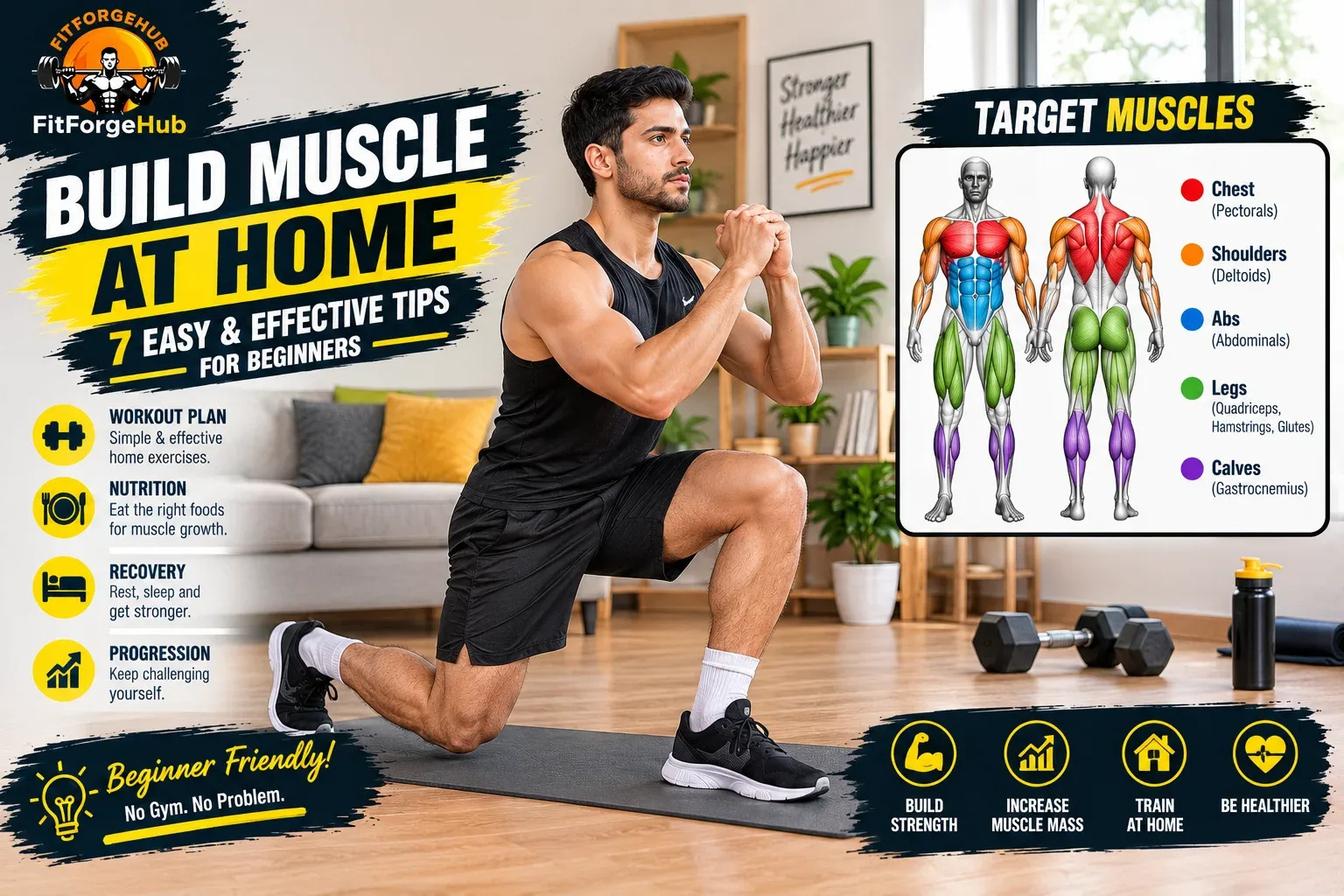
Building muscle does not always require a commercial gym or a large collection of equipment. With consistent resistance training, progressive overload, adequate nutrition, and enough recovery, beginners can create an effective muscle-building routine at home.
If you’re wondering how to build muscle at home, the most important thing is not finding a complicated workout. It’s creating a routine you can perform consistently and gradually making it more challenging.
This complete guide explains how beginners can build muscle at home, with or without dumbbells, while keeping their workouts simple and practical.
Important: This article provides general fitness and educational information. It is not medical advice. If you have an injury, chronic health condition, or concerns about starting exercise, speak with an appropriate healthcare professional before beginning a new training program.
Table of Contents
- What Does It Take to Build Muscle at Home?
- Can You Really Build Muscle Without a Gym?
- The 5 Principles of Muscle Growth
- Best Exercises to Build Muscle at Home
- Beginner 3-Day Home Muscle Building Workout
- How Many Sets and Reps Should You Do?
- Progressive Overload: How to Keep Growing
- How to Build Muscle at Home Without Weights
- How to Build Muscle at Home With Dumbbells
- How Often Should You Train?
- Nutrition for Building Muscle
- Protein and Muscle Growth
- Recovery and Sleep
- Common Mistakes Beginners Should Avoid
- How Long Does It Take to Build Muscle?
- Simple Weekly Schedule
- Frequently Asked Questions
- Final Thoughts
What Does It Take to Build Muscle at Home?
To build muscle at home, you need to give your muscles a reason to adapt.
Resistance training creates the training stimulus. Nutrition provides the energy and nutrients needed to support the process, while recovery gives your body time to adapt.
A simple home muscle-building approach includes:
- Resistance exercises
- Consistent weekly training
- Gradually increasing difficulty
- Enough protein and overall nutrition
- Adequate recovery
- Good exercise technique
- Patience and consistency
The American College of Sports Medicine’s 2026 resistance-training position stand emphasizes consistency and individualizing training according to goals. Its guidance also notes that complicated programming and specific equipment are not always necessary for healthy adults.
For beginners, building muscle at home can therefore be much simpler than it first appears.
Can You Really Build Muscle Without a Gym?
Yes, beginners can use home-based resistance training to improve strength and build muscle.
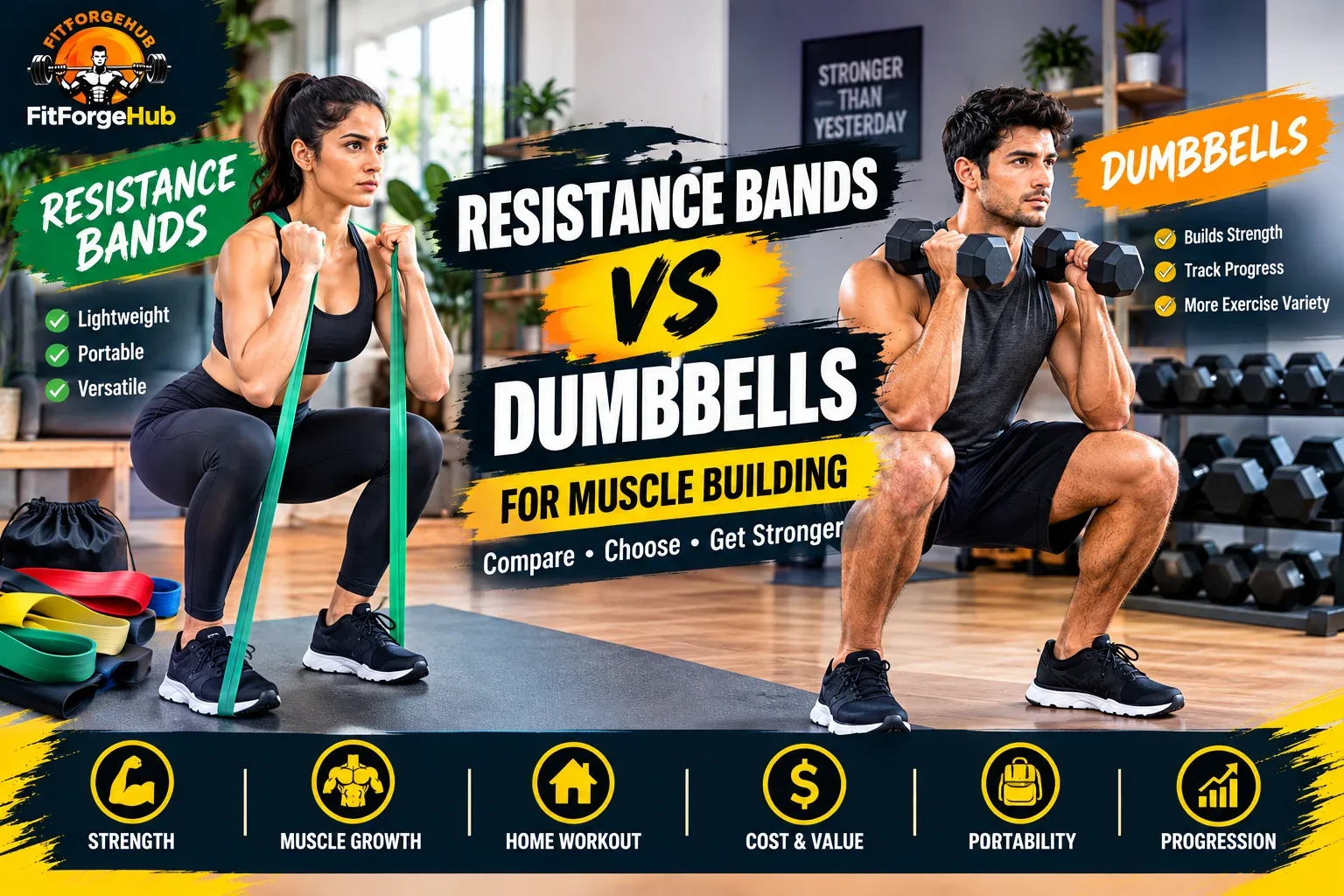
A gym can provide more equipment and easier access to progressively heavier loads, but a home routine can still provide resistance through:
- Bodyweight exercises
- Dumbbells
- Resistance bands
- Backpacks loaded appropriately
- Household objects when used safely
- Different exercise variations
- Increased repetitions
- Increased range of motion
- Slower, controlled repetitions
The key is creating enough challenge and gradually increasing it.
For example, if regular push-ups become easy, you could increase repetitions, use a more difficult variation, improve your range of motion, or add another appropriate form of resistance.
The goal is not simply to exercise. The goal is to progressively challenge your muscles.
The 5 Principles of Muscle Growth
Building muscle at home depends on more than just doing exercises. Your results come from combining effective training with proper nutrition, recovery, progressive overload, and consistency.
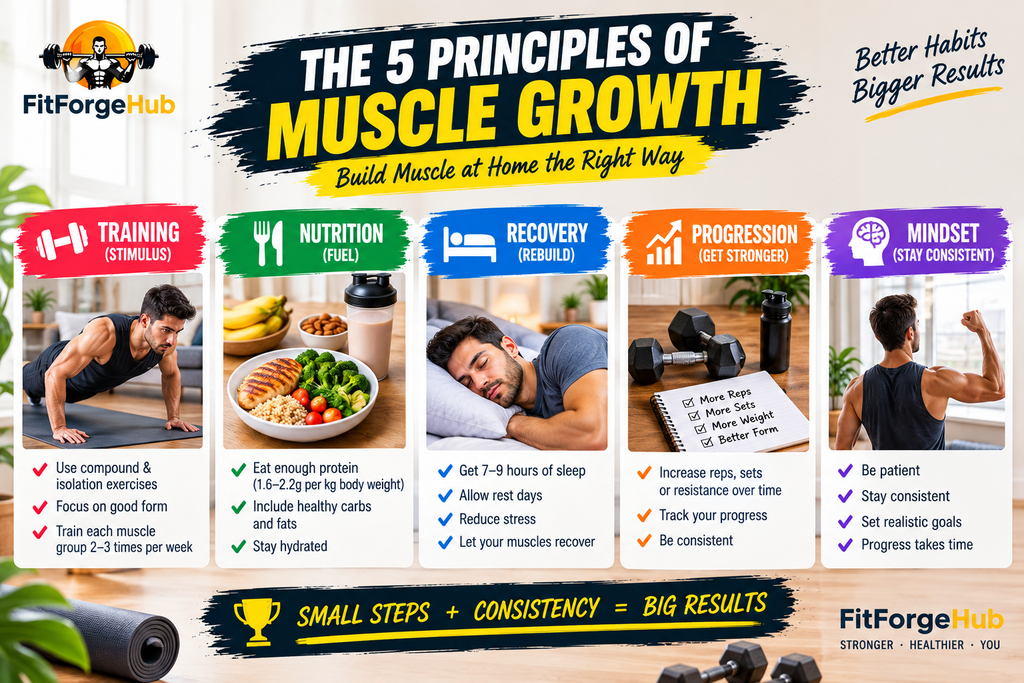
If your goal is to build muscle at home, focus on these five principles.
1. Consistency
A simple workout performed consistently is more useful than an advanced program that you rarely complete.
Try to establish a realistic weekly routine that fits your schedule.
2. Progressive Overload
Your muscles need an increasing challenge over time.
You can progress by:
- Adding repetitions
- Adding sets
- Increasing resistance
- Using a harder exercise variation
- Improving range of motion
- Improving control
- Reducing unnecessary rest when appropriate
Progress does not always mean lifting heavier weights.
3. Sufficient Training Volume
Muscle growth requires enough productive training.
You don’t need to perform dozens of exercises in every session.
A beginner can start with a manageable number of exercises and gradually increase training demands as their experience improves.
The 2026 ACSM position stand notes that muscle-growth goals can involve higher weekly training volume, while also emphasizing that consistency matters.
4. Nutrition
Training is only one part of the process.
Your diet should provide enough:
- Protein
- Carbohydrates
- Healthy fats
- Calories
- Vitamins and minerals
- Fluids
If you’re trying to gain muscle, consistently eating too little can make progress more difficult.
5. Recovery
Your workout provides the stimulus, but recovery is an important part of adaptation.
Give muscle groups appropriate recovery between challenging sessions and prioritize adequate sleep.
Best Exercises to Build Muscle at Home
You do not need a full gym to build muscle. A combination of bodyweight exercises and basic dumbbell movements can effectively train the major muscle groups at home.
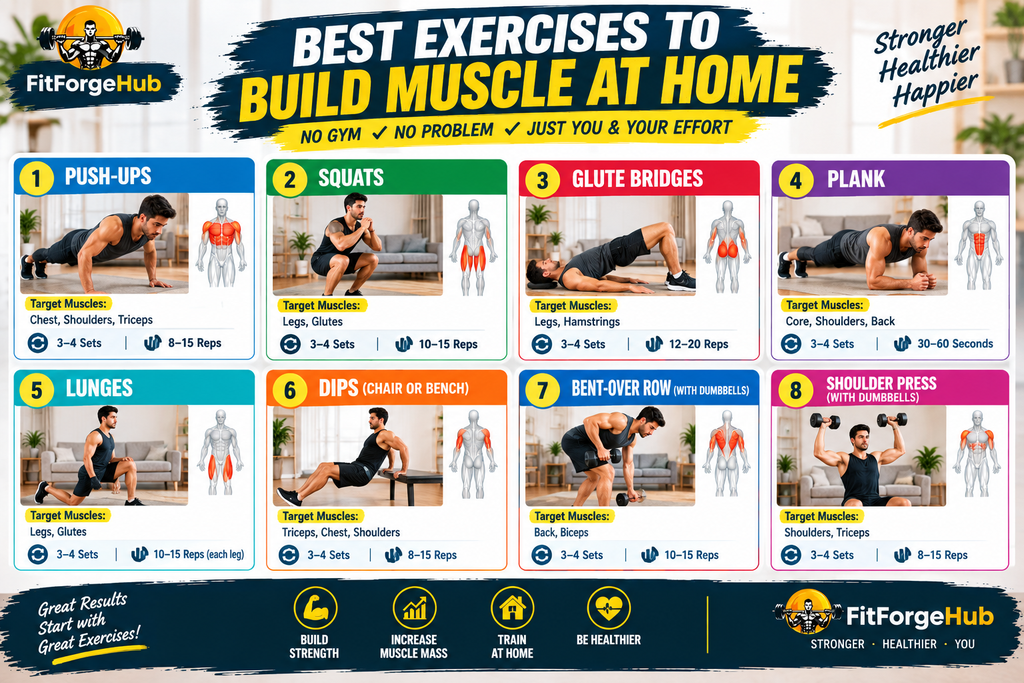
Here are some useful exercises for a beginner home muscle building workout.
Chest
- Push-ups
- Wide push-ups
- Dumbbell floor press
- Dumbbell squeeze press
Back
- One-arm dumbbell row
- Bent-over dumbbell row
- Resistance-band row
- Backpack row
Shoulders
- Dumbbell shoulder press
- Lateral raises
- Pike push-ups
Legs
- Bodyweight squats
- Reverse lunges
- Bulgarian split squats
- Glute bridges
- Calf raises
Arms
- Dumbbell curls
- Hammer curls
- Overhead triceps extensions
- Close-grip push-ups
Core
- Plank
- Dead bug
- Reverse crunch
- Side plank
Beginner 3-Day Home Muscle Building Workout
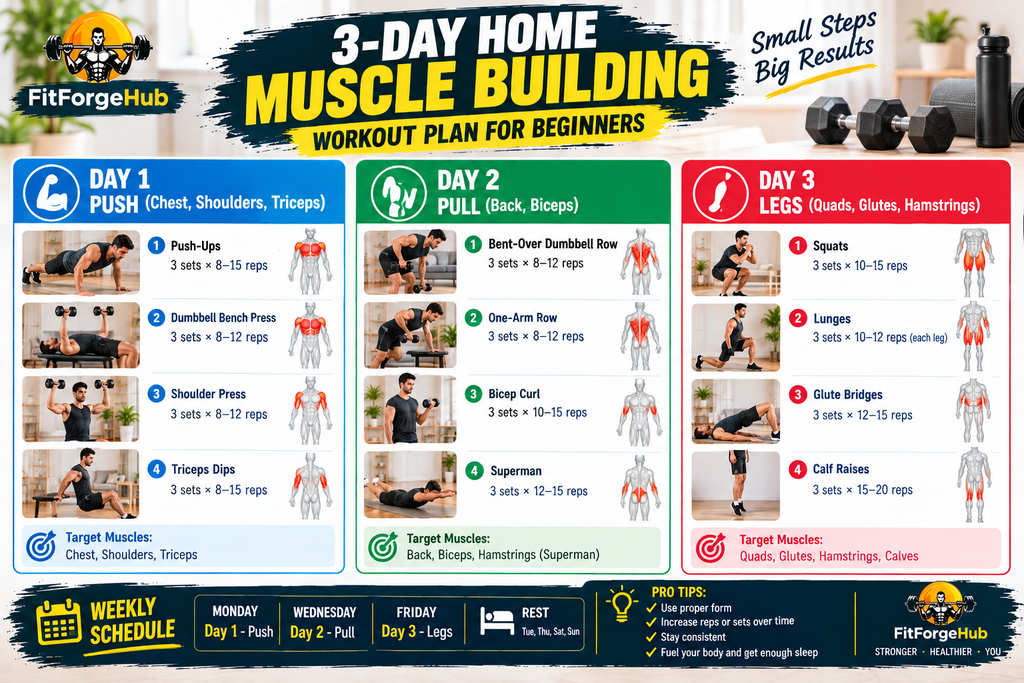
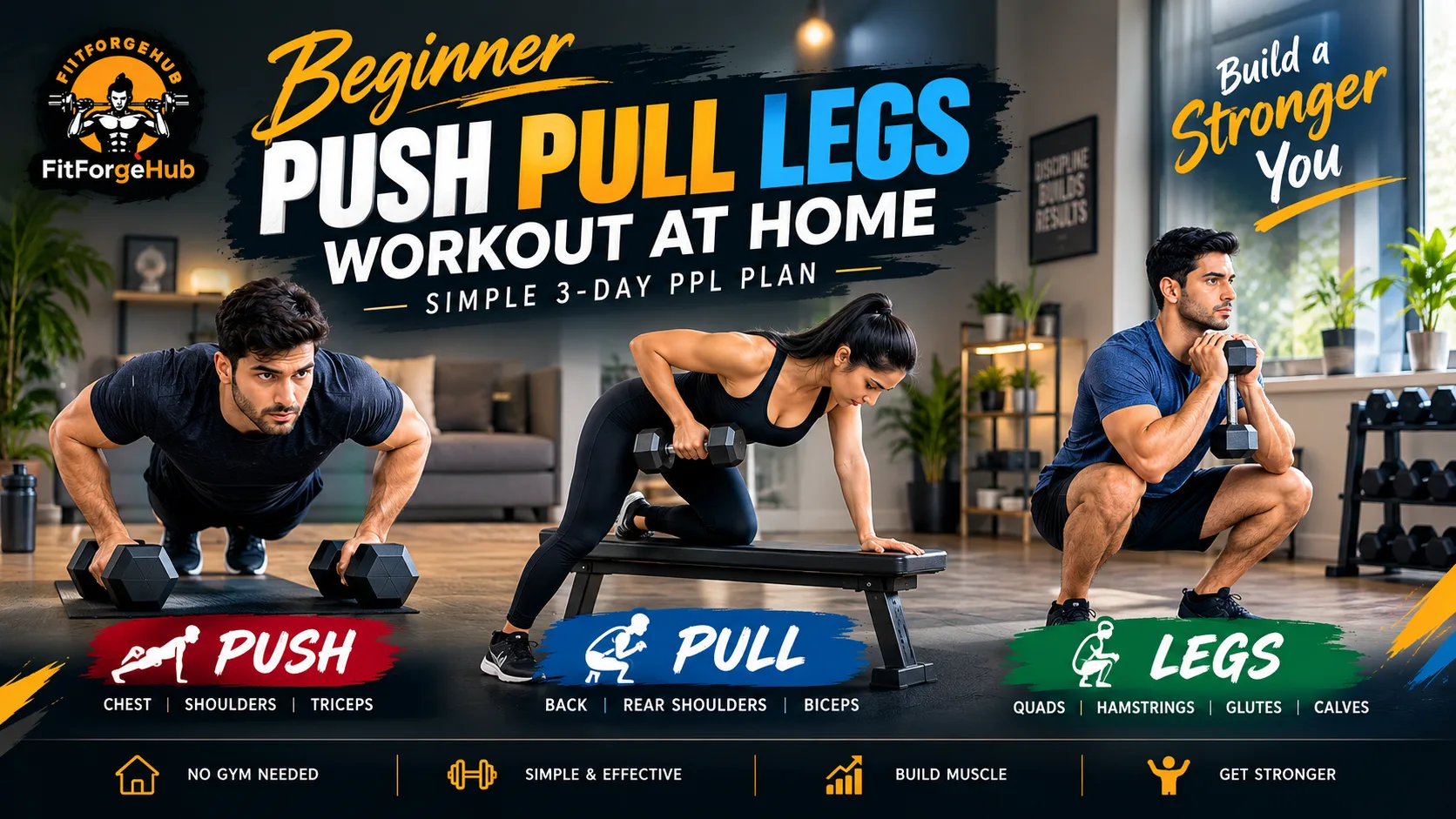
If you’re new to resistance training, a 3-day routine can be a practical starting point.
Day 1 — Full Body
| Exercise | Sets | Reps |
|---|---|---|
| Bodyweight Squat | 3 | 10–15 |
| Push-Ups | 3 | 6–15 |
| One-Arm Dumbbell Row | 3 | 8–12 |
| Glute Bridge | 2 | 10–15 |
| Dumbbell Shoulder Press | 2 | 8–12 |
| Plank | 2 | 20–45 sec |
Rest approximately 60–120 seconds between most sets.
Day 2 — Rest or Light Activity
You can take a complete rest day or perform light activity such as walking or mobility work.
Don’t turn every recovery day into another hard workout.
Day 3 — Full Body
| Exercise | Sets | Reps |
|---|---|---|
| Reverse Lunges | 3 | 8–12/leg |
| Dumbbell Floor Press | 3 | 8–12 |
| Bent-Over Dumbbell Row | 3 | 8–12 |
| Romanian Deadlift | 2 | 8–12 |
| Lateral Raise | 2 | 10–15 |
| Calf Raises | 3 | 12–20 |
Day 4 — Rest
Take a recovery day.
Day 5 — Full Body
| Exercise | Sets | Reps |
|---|---|---|
| Bulgarian Split Squat | 2 | 8–12/leg |
| Push-Ups | 3 | 6–15 |
| One-Arm Dumbbell Row | 3 | 8–12 |
| Glute Bridge | 3 | 10–15 |
| Dumbbell Curl | 2 | 10–15 |
| Overhead Triceps Extension | 2 | 10–15 |
Days 6–7 — Recovery
Use these days for recovery, walking, mobility work, or other activities appropriate for your fitness level.
The CDC recommends that adults include muscle-strengthening activity on at least two days per week and work all major muscle groups.
CDC: Adult Activity Guidelines
How Many Sets and Reps Should You Do?
There isn’t one magic repetition range for every exercise.
For beginners, a practical starting range is:
Strength-focused exercises:
6–12 repetitions
Isolation exercises:
10–15 repetitions
Bodyweight exercises:
6–20 repetitions depending on the movement
Calf exercises:
12–20 repetitions
The important point is to perform controlled repetitions with good technique and make the exercise progressively more challenging over time.
Progressive Overload: How to Keep Growing
Progressive overload is one of the most important concepts when you want to build muscle at home.
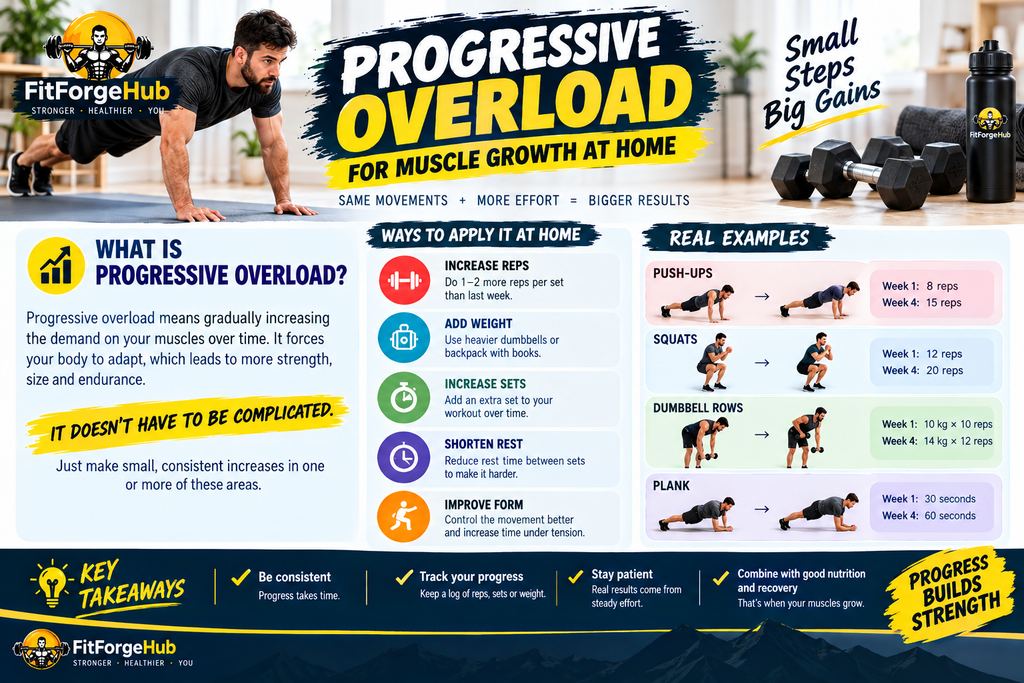
Suppose you perform:
Push-ups — 3 × 8
After several weeks, you can comfortably perform:
Push-ups — 3 × 15
Instead of continuing indefinitely without changing the challenge, you can consider a harder variation or another appropriate progression.
For dumbbell exercises, progression can be simpler:
Week 1: 8 kg × 8 reps
Week 2: 8 kg × 10 reps
Week 3: 8 kg × 12 reps
Week 4: Increase resistance and return toward the lower end of the rep range.
You don’t need to increase everything every workout.
Your goal is gradual progress while maintaining good technique.
How to Build Muscle at Home Without Weights
You can perform a useful beginner routine even without dumbbells.
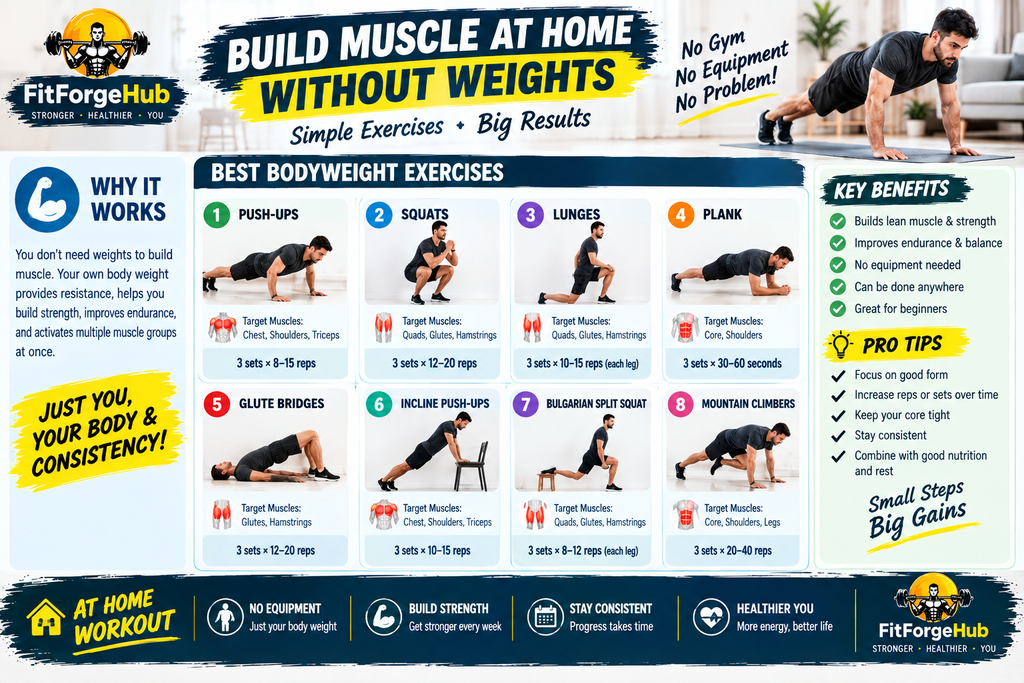
Try:
Chest
- Push-ups
- Close-grip push-ups
- Wide push-ups
Legs
- Squats
- Reverse lunges
- Split squats
- Bulgarian split squats
Glutes
- Glute bridges
- Single-leg glute bridges
Shoulders
- Pike push-ups
- Plank shoulder taps
Core
- Planks
- Side planks
- Reverse crunches
For a dedicated no-equipment routine, see our guide:
How to Build Muscle at Home Without Weights
/how-to-build-muscle-at-home-without-weights/
How to Build Muscle at Home With Dumbbells
Dumbbells make progression easier because you can increase external resistance.
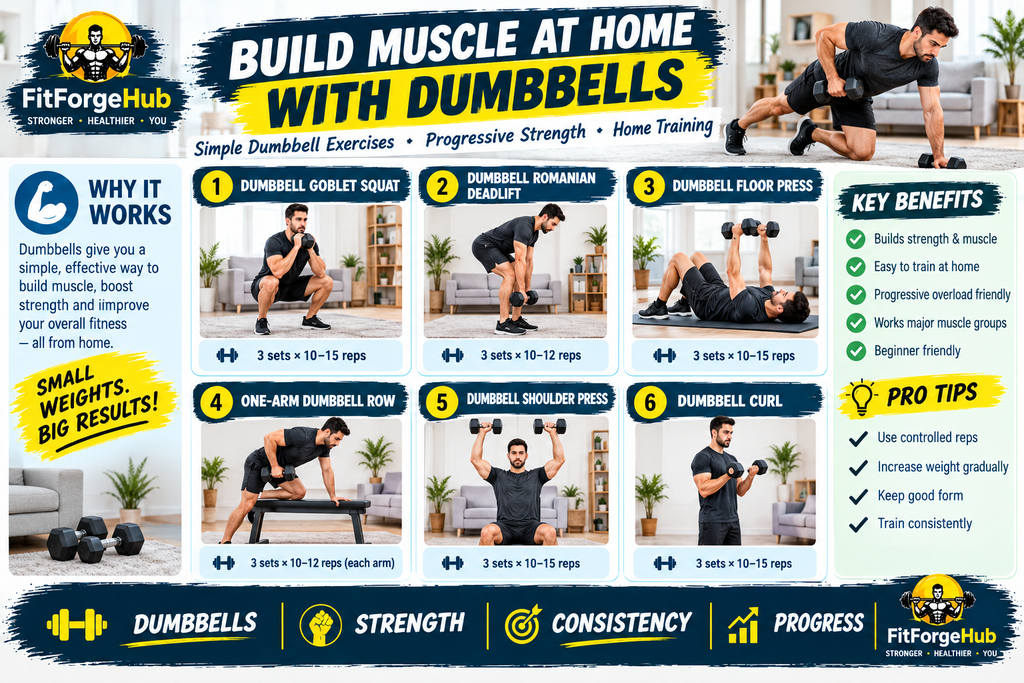
A basic pair of adjustable dumbbells can be useful for exercises such as:
- Floor press
- Rows
- Shoulder press
- Goblet squats
- Romanian deadlifts
- Lunges
- Lateral raises
- Biceps curls
- Hammer curls
- Triceps extensions
If you are new to dumbbell training, start with our:
Complete Dumbbell Workout Guide for Beginners
/complete-dumbbell-workout-guide-for-beginners/
You can also use our full-body routine:
Full Body Dumbbell Workout for Beginners
/full-body-dumbbell-workout-for-beginners/
How Often Should You Train?
For beginners, three resistance-training days per week can provide a simple structure.
For example:
Monday: Full Body
Tuesday: Rest
Wednesday: Full Body
Thursday: Rest
Friday: Full Body
Saturday: Light activity
Sunday: Rest
The exact schedule can be adjusted around your work, school, recovery, and experience.
The CDC recommends muscle-strengthening activity on at least two days each week for adults.
CDC: What Counts as Physical Activity
For more detail, read:
How Often Should You Train Each Muscle Group?
/how-often-should-you-train-each-muscle-group/
Nutrition for Building Muscle
If your goal is to build muscle at home, don’t focus only on workouts.
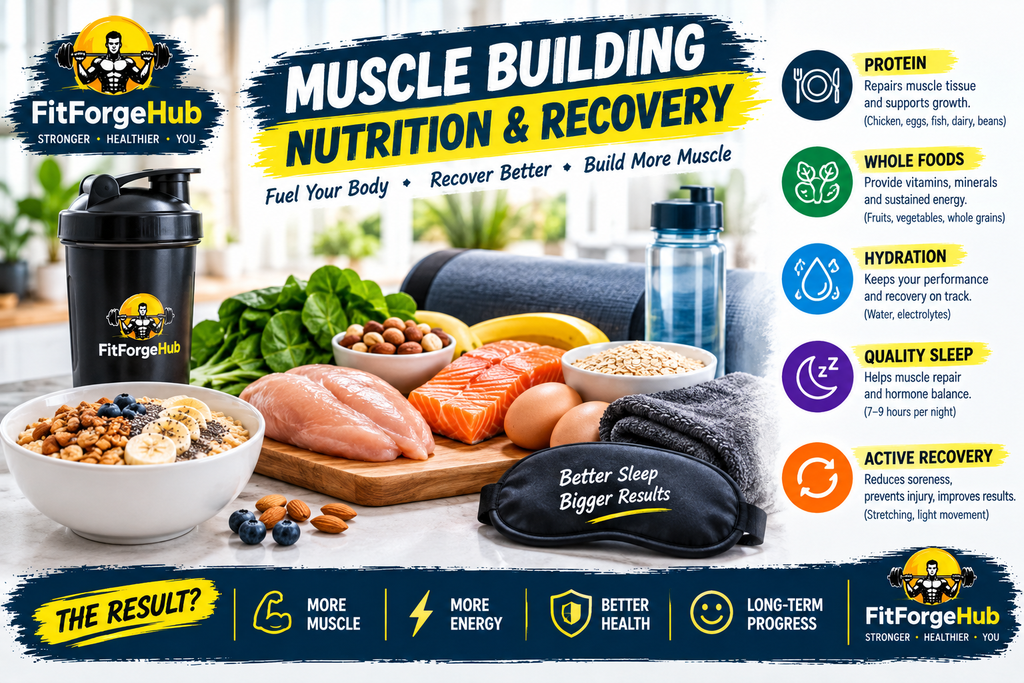
Your daily diet should contain a variety of nutritious foods.
Useful food groups include:
Protein Sources
- Eggs
- Chicken
- Fish
- Lean meat
- Milk
- Greek yogurt
- Cottage cheese
- Beans
- Lentils
- Soy foods
Carbohydrate Sources
- Rice
- Potatoes
- Oats
- Whole-grain bread
- Pasta
- Fruits
- Beans
Healthy Fat Sources
- Nuts
- Seeds
- Peanut butter
- Avocado
- Olive oil
A balanced diet can make it easier to support training and recovery.
How Much Protein Do You Need?
Protein provides amino acids used by the body for many functions, including maintaining and building muscle tissue.
Rather than relying on one meal, spread protein-containing foods throughout your day.
For people with specific medical conditions, kidney disease, dietary restrictions, or other health concerns, protein intake should be discussed with an appropriate healthcare professional or registered dietitian.
Recovery and Sleep
A good workout plan also needs recovery.
Try to:
- Maintain a consistent sleep schedule
- Take rest days
- Avoid training the same muscles hard every day
- Eat enough nutritious food
- Stay hydrated
- Manage overall training stress
If performance continues to decline and you’re constantly exhausted, reducing training demands and reviewing recovery may be appropriate.
Common Mistakes Beginners Should Avoid
1. Changing Workouts Every Few Days
Constantly changing exercises makes it harder to track progress.
Give a program enough time to evaluate whether you’re improving.
2. Doing Too Much Too Soon
More training isn’t automatically better.
Start with a manageable amount and increase gradually.
3. Ignoring Technique
Don’t sacrifice form simply to complete more repetitions.
Controlled movement and appropriate exercise technique should come first.
4. Not Tracking Progress
Write down:
- Exercise
- Sets
- Reps
- Resistance
- Date
This makes progressive overload much easier to manage.
5. Expecting Fast Results
Muscle growth takes time.
Your strength may improve before visible muscle changes become obvious.
For a detailed timeline, read:
How Long Does It Take to Build Muscle?
/how-long-does-it-take-to-build-muscle/
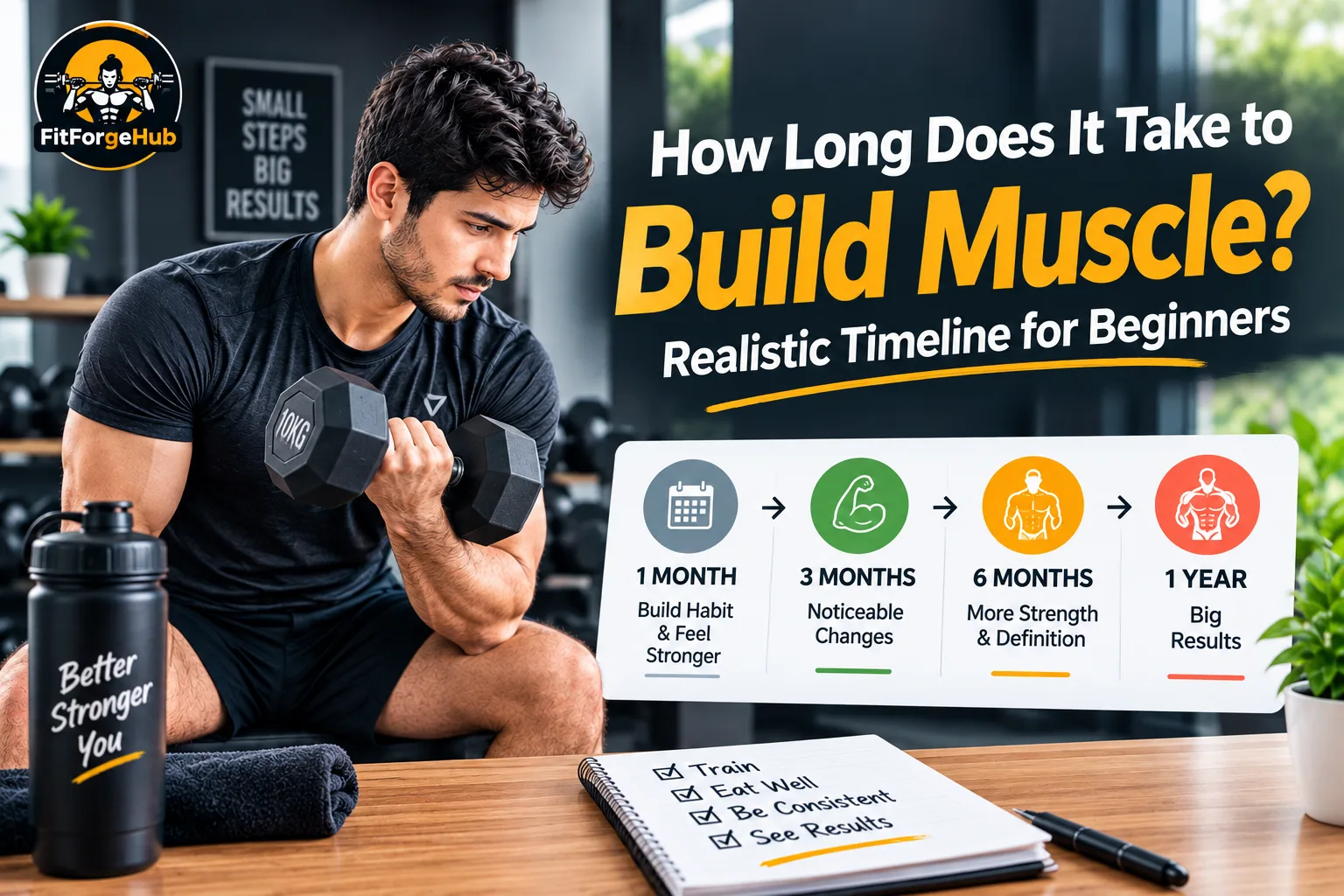
How Long Does It Take to Build Muscle?
There is no single timeline that applies to everyone.
Results depend on factors such as:
- Training experience
- Genetics
- Nutrition
- Protein intake
- Training consistency
- Recovery
- Sleep
- Starting body composition
- Exercise quality
- Progressive overload
Beginners may notice improvements in exercise performance relatively early, while visible changes in muscle size can take longer.
The important thing is to measure progress over months rather than expecting dramatic changes after a few workouts.
Simple Weekly Schedule
Here’s a beginner-friendly structure:
| Day | Activity |
|---|---|
| Monday | Full-body strength |
| Tuesday | Rest / walking |
| Wednesday | Full-body strength |
| Thursday | Rest / mobility |
| Friday | Full-body strength |
| Saturday | Light activity |
| Sunday | Rest |
You can adjust this schedule according to your availability and recovery.
How to Make Your Home Workouts More Effective
If your current workout becomes too easy, don’t immediately add a huge amount of training.
Instead, try one change at a time:
- Add a few repetitions.
- Improve your exercise range of motion.
- Add resistance.
- Use a harder variation.
- Add a set when appropriate.
- Improve your technique and control.
This gives you a clear progression path.
The 2026 ACSM guidance specifically emphasizes consistency and notes that complicated equipment or advanced programming is not required for many healthy adults to benefit from resistance training.
Frequently Asked Questions
Can I build muscle at home without a gym?
Yes. Beginners can perform resistance exercises at home using bodyweight, dumbbells, resistance bands, or other appropriate forms of resistance.
Can I build muscle at home without weights?
Yes, especially as a beginner. Push-ups, squats, lunges, split squats and other bodyweight movements can provide resistance.
As you become stronger, you may need harder exercise variations or additional resistance to continue progressing.
Is 3 days a week enough to build muscle?
Three resistance-training sessions can provide a practical structure for beginners. The appropriate frequency depends on the individual’s training experience, exercise selection, recovery, and goals.
How long should a home muscle-building workout last?
A beginner session may take approximately 30–60 minutes, depending on the number of exercises, sets, warm-up, and rest periods.
The quality and consistency of training matter more than trying to make every workout extremely long.
Do I need dumbbells to build muscle at home?
No. Dumbbells are useful, but they aren’t mandatory for beginners.
Bodyweight exercises can provide a meaningful training stimulus, while dumbbells and resistance bands can make progressive overload easier.
Should I train every day to build muscle?
No. More frequent training isn’t automatically better. Your muscles also need recovery.
A structured schedule with rest days can be easier for beginners to maintain.
What should I eat to build muscle?
Focus on a balanced diet containing adequate protein, carbohydrates, healthy fats, fruits, vegetables, and enough total energy to support your goals.
Final Thoughts
If you want to build muscle at home, you don’t need to make your routine unnecessarily complicated.
Start with a manageable resistance-training program, learn the basic movements, eat a balanced diet, recover properly, and gradually increase the challenge.
Whether you train with bodyweight exercises, dumbbells, resistance bands, or a combination of them, consistency and progression are the foundation of a sustainable home muscle-building routine.
Start where you are, track your workouts, and give your body enough time to adapt.
About the Author
Riaz Ahmed
Riaz Ahmed holds a Master’s degree in Health and Physical Education and is the founder of FitForgeHub, where he shares practical fitness and workout information.
His content focuses on beginner-friendly workout routines, strength training, muscle-building guidance, home workouts, nutrition basics, and practical fitness education.
Website: FitForgeHub.com
Disclaimer: The information provided on FitForgeHub is for general educational and informational purposes only. It is not intended to replace professional medical, nutritional, or fitness advice. Consult a qualified healthcare professional before starting a new exercise or nutrition program, particularly if you have an existing health condition or injury.